WCRC Intelligence
Korea's $115bn October: AI chips double exports, but who gains?
South Korea sold $115.28bn of goods abroad in October, almost twice as much as a year earlier, and half of it was semiconductors. The surge confirms Asia's AI hardware boom and exposes a two-speed factory economy that every board buying chips, servers or memory now has to plan around.
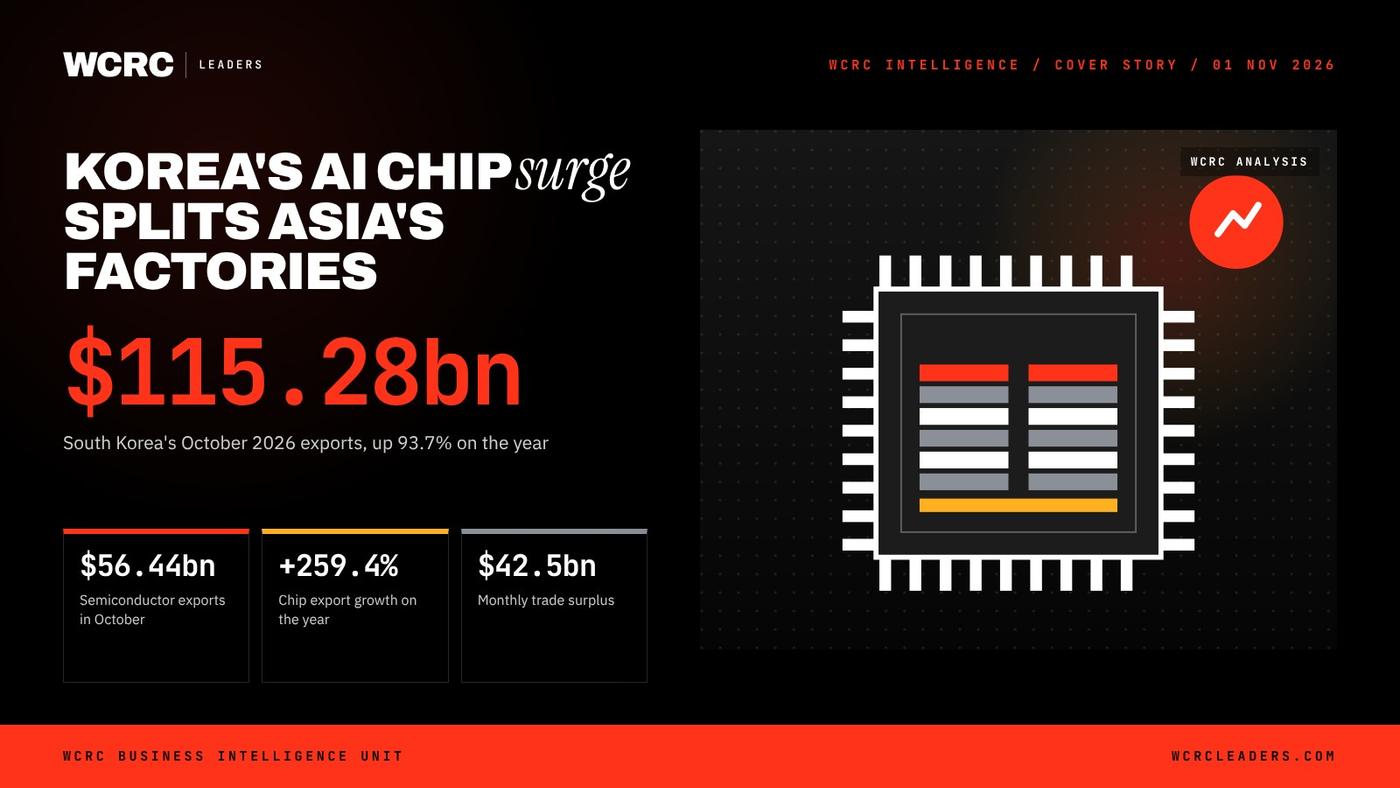
At a glance: WCRC Leaders' assessment: Korea's October numbers show the AI build-out has turned a handful of memory and server suppliers into the price-setters of Asian trade, and buyers in India and the Gulf should treat chip supply as a board-level risk, not a procurement line. The trade ministry reported on 1 November 2026 that exports rose 93.7% to $115.28bn, the second-highest month on record after September. Semiconductors reached $56.44bn, up 259.4%. Exports for January to October total about $930bn, and the ministry expects a $1 trillion year in November.
What did Korea report for October?
Korea's Ministry of Trade, Industry and Energy said exports in October reached $115.28bn, up 93.7% on October 2025, and above $110bn for the second month running. Only September, when exports passed $120bn for the first time, has been higher. Average daily exports were $5.24bn, up 76.0%, which strips out part of the boost from a holiday that fell in October last year.
Imports rose 36.0% to $72.78bn, leaving a surplus of $42.5bn, the second straight month above $40bn. Energy imports climbed 63.1% to $16.49bn. Crude oil imports cost $10.7bn, up 51.9%, even though volumes fell 6.3%: the ministry put the rise in unit prices at 62.0%.
Cumulative exports for January to October reached about $930bn, up 60.6%, the first time Korea has passed $900bn in ten months. The full-year record, set in 2025, was $709.3bn. The cumulative surplus stands at $294.9bn. With roughly $70bn needed to reach $1 trillion, Minister Kim Jeong-kwan said the milestone was virtually certain in November.
Where did the money come from?
Semiconductors did most of the work. Chip exports were $56.44bn, up 259.4%, the second month above $50bn and the second-highest month on record, behind September. Computers, which in Korea's trade data now mostly means enterprise solid-state drives for servers, rose 496.6% to $5.85bn. Together the two lines made up about 54% of all exports, on WCRC's calculation from the ministry's figures.
The rest of the economy grew too, but differently. Eighteen of 20 major product lines rose. Cars reached $6.55bn, up 18.1%, a record for any October, helped by hybrids. Cosmetics rose 57.5% to $1.44bn and bio-health 30.2% to $1.53bn. Electrical equipment, much of it grid gear, hit a monthly record of $1.99bn, up 74.0%.
Some gains were price, not volume. Petroleum products rose 80.0% in value to $6.92bn while shipped volumes fell 7.5%. Petrochemicals rose 27.5% while volumes fell 6.8%. Ships fell 43.6% against a year-ago base swollen by an offshore plant delivery.
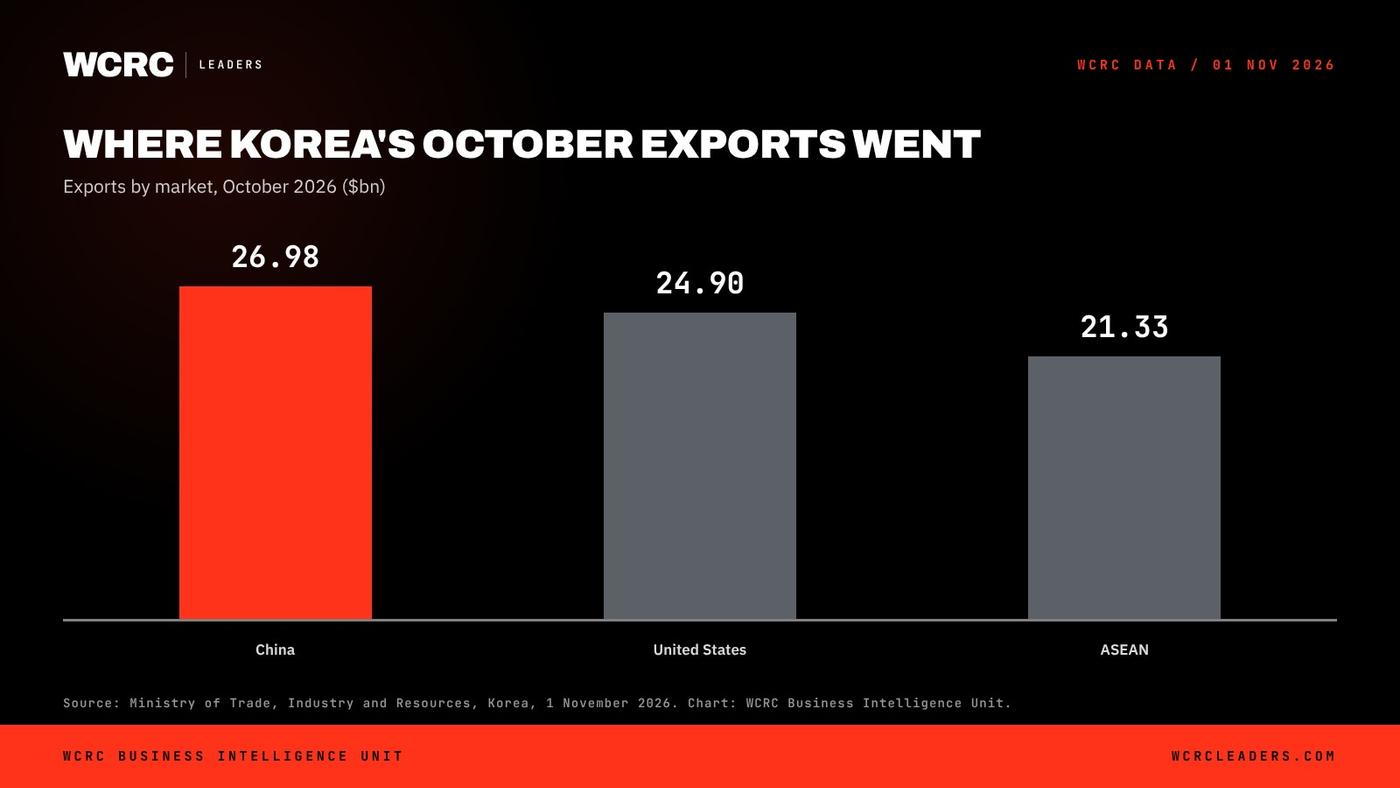
By market, seven of nine regions grew. Exports to China rose 133.6% to $26.98bn, the fifth month above $20bn. The United States took $24.9bn, up 185.8%, and ASEAN $21.33bn, up 128.0%. The EU rose 56.4%, an eleventh consecutive monthly gain.
Why is this a two-speed factory?
The headline hides a split. On WCRC's calculation from the ministry's figures, exports excluding chips and computers grew by roughly a quarter, a healthy figure, but one flattered by oil prices. Chips and server storage grew roughly ten times as fast. A single product family now moves Korea's trade balance, its currency and, as WCRC noted last week, its growth: Korea's chips lifted GDP by 1.0% in the third quarter even as household consumption fell.
The same split runs through company results. SK hynix posted an 80% operating margin for the quarter and has already sold more than half of its 2027 and 2028 output. Samsung, named among India's Most Powerful Brands 2026 by WCRC, earned almost its entire record quarterly profit from chips while its phone business lost money. In other words, the same company sits on both sides of the divide: it sells scarce memory at high prices and buys it for its own devices.
China shows the other speed. Its official manufacturing PMI, released by the National Bureau of Statistics on 31 October, fell back to 49.3 from 50.1, signalling contraction. Yet China was Korea's largest market in October, because Chinese assemblers and data-centre builders keep buying Korean memory even as broader factory demand cools. Korea and Japan are riding the AI order book; general manufacturing across the region is not. Japan's September exports were also lifted by AI chips while oil widened its deficit.
Who captures the value?
Analysis: the value is pooling where supply is scarcest. Memory makers with high-bandwidth and server storage capacity have pricing power that buyers cannot easily escape. Read through WCRC's Price Power Model, part of the Brand & Marketing Codex, the test is how much premium a supplier can charge before buyers switch. In memory today the honest answer is: a great deal, because there are few places to switch to. That premium is being paid by hyperscalers, server builders, phone assemblers and, at the end of the chain, enterprises buying AI capacity.
The demand behind it is contracted, not speculative. Microsoft's $677bn commercial backlog and doubled capital spending show where the orders start, and TSMC and ASML have said supply falls short to 2028. Korea's October data is the shipping manifest for that spending.
Those squeezed in the middle are assemblers with thin margins. India's electronics contract manufacturers, such as Dixon Technologies, one of WCRC 1000, India's Most Valuable Enterprises 2026, and domestic server makers such as Netweb Technologies, also one of WCRC 1000, depend on imported memory whose price they do not set. India's own chip ambitions, including Micron India, a WCRC MegaBrand in semiconductor design and fabrication, will take years to change that balance. India's exports have grown on electronics, but much of the value inside each device still crosses the border as a component.
The Gulf sits on the buying side too. Sovereign AI and data-centre programmes in the UAE and Saudi Arabia need the same servers and memory, and their budgets are now exposed to Korean pricing. The minister himself flagged the other side of the region's exposure: he said protectionism in major economies, supply-chain restructuring and geopolitical instability in the Middle East continue to weigh on Korea's small and mid-sized exporters, and pledged to spread the gains beyond the chip giants.
What should boards in India, the Gulf and Asia do?
In the terms of SeeClear, a model in WCRC's Guru Management Codex, boards should first separate fact from projection. The fact is a contracted, multi-year shortage of memory and server storage with prices set in Korea. The projection is that the cycle will keep doubling exports indefinitely. Base-year effects alone will slow the growth rates in 2027, even if volumes stay high.
That suggests three practical moves. Buyers should lock in longer supply agreements where they can, since suppliers are already allocating 2027 and 2028 output. Capital plans for AI and data centres should carry a memory-price scenario, not a single cost line. And exporters outside the chip chain, from Korean mid-sized firms to Indian engineering companies, should expect the AI cycle to lift their costs before it lifts their orders.
The WCRC View
The WCRC Business Intelligence Unit reads October as confirmation that AI hardware is now the centre of gravity of Asian trade. Korea will almost certainly cross $1 trillion of exports in November, and semiconductors will have paid for most of the climb.
The winners are clear: memory makers with high-bandwidth and server storage capacity, and the economies that host them. Read through the Price Power Model, their premium will last as long as supply stays short, which on current contracts means at least 2027 and 2028.
The exposed are the assemblers and buyers. Indian electronics makers, Gulf data-centre programmes and Asian phone brands carry rising input costs they do not control. Viewed through Corporate Value Intelligence, WCRC's framework for interpreting enterprise value, investors will reward companies that can show secured supply and pass-through pricing, and mark down those that cannot.
Applying SeeClear, boards should plan on the contracted shortage, not the headline growth rate. Secure supply, stress-test capex budgets against memory prices, and treat dependence on a few Korean and Taiwanese suppliers as a strategic risk on the board's agenda.
WCRC will watch three things next: whether November's data confirms the $1 trillion year, how the Bank of Korea weighs a chip-led economy against weak households at its 26 November meeting, and whether memory contract prices for 2027 keep rising.
WCRC models applied: Price Power Model (Brand & Marketing Codex), SeeClear (Guru Management Codex), Corporate Value Intelligence.
Quick answers
Q: How much did South Korea export in October 2026? A: $115.28bn, up 93.7% on a year earlier, according to the Ministry of Trade, Industry and Energy. It was the second-highest month on record, after September 2026.
Q: How large were Korea's semiconductor exports in October? A: $56.44bn, up 259.4%, the second consecutive month above $50bn. Computer exports, mainly server SSDs, rose 496.6% to $5.85bn.
Q: Will Korea reach $1 trillion of exports in 2026? A: Exports for January to October total about $930bn. The trade ministry said reaching $1 trillion in November is virtually certain.
Q: Which markets drove the growth? A: China ($26.98bn, up 133.6%), the United States ($24.9bn, up 185.8%) and ASEAN ($21.33bn, up 128.0%). Seven of nine major regions grew.
ECB holds at 2.50% as 18.9% energy inflation sets the world's rates
India's fiscal deficit jumps 24.7% as the energy shock eats its room
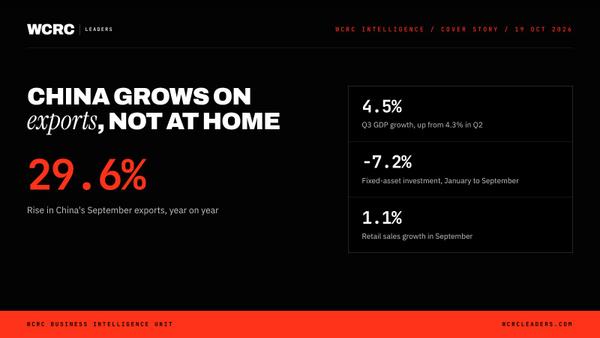
China's 4.5% growth runs on exports, and Asia's boards will feel it
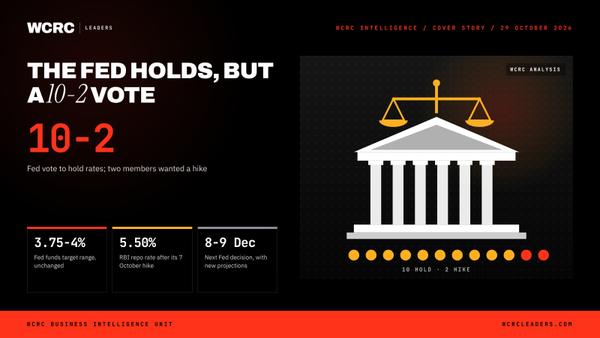
Fed holds at 3.75-4%, but a 10-2 vote keeps Gulf and Asia on alert
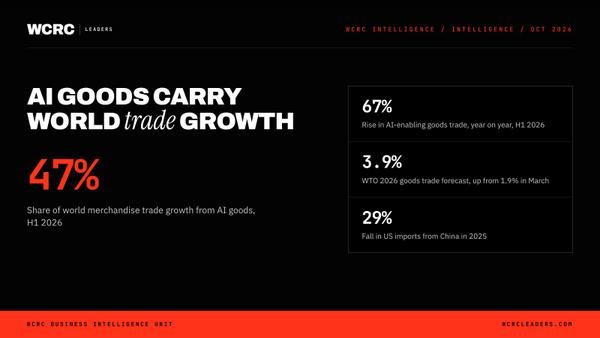
The AI trade economy: chips and servers now carry almost half of world trade growth
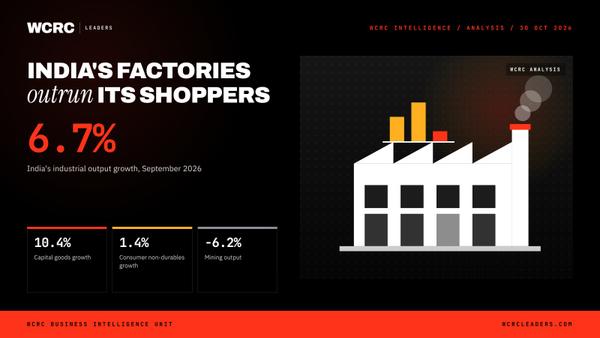
India's factory output grows 6.7% as capital goods outrun consumers
Filed under