WCRC Intelligence
India's fiscal deficit jumps 24.7% as the energy shock eats its room
India's central government ran a fiscal deficit of ₹7,14,413 crore in the first half of 2026-27, a quarter more than a year earlier. Taxes grew by 3.8%, spending by 10.7%, and the gap between the two is the clearest sign yet of how the energy shock is reaching the public purse.
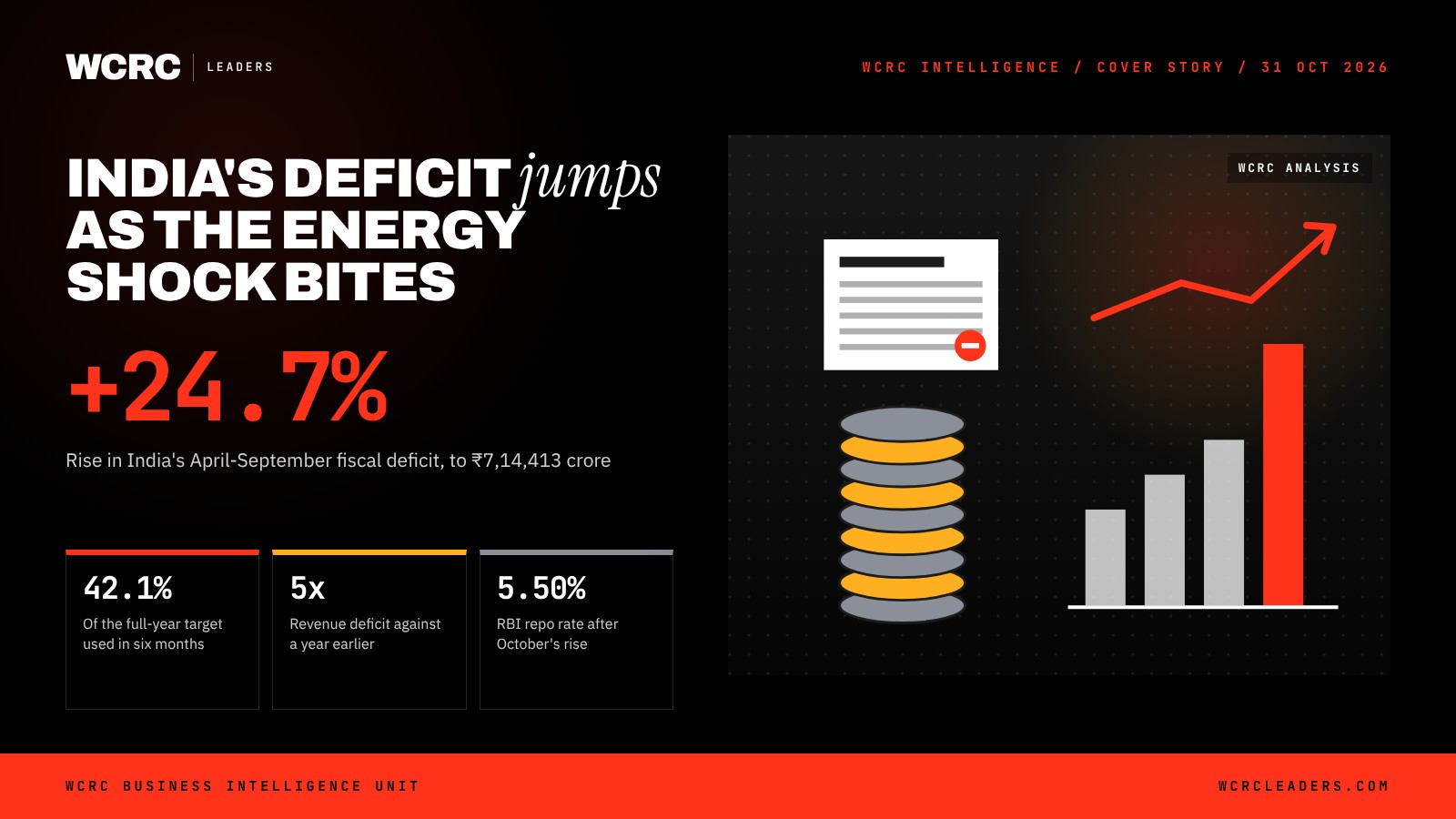
At a glance: WCRC Leaders' assessment: India's fiscal room is narrowing fastest exactly where boards need it most, in the space for public spending to cushion an energy shock while interest rates rise. Accounts released by the Controller General of Accounts show the Centre's April to September deficit at ₹7,14,413 crore, up 24.7%, with 42.1% of the full-year target used in six months. The revenue deficit is five times last year's. For companies, Gulf investors and Asian markets, this shapes borrowing costs, the rupee and government demand through 2027.
What do the half-year accounts show?
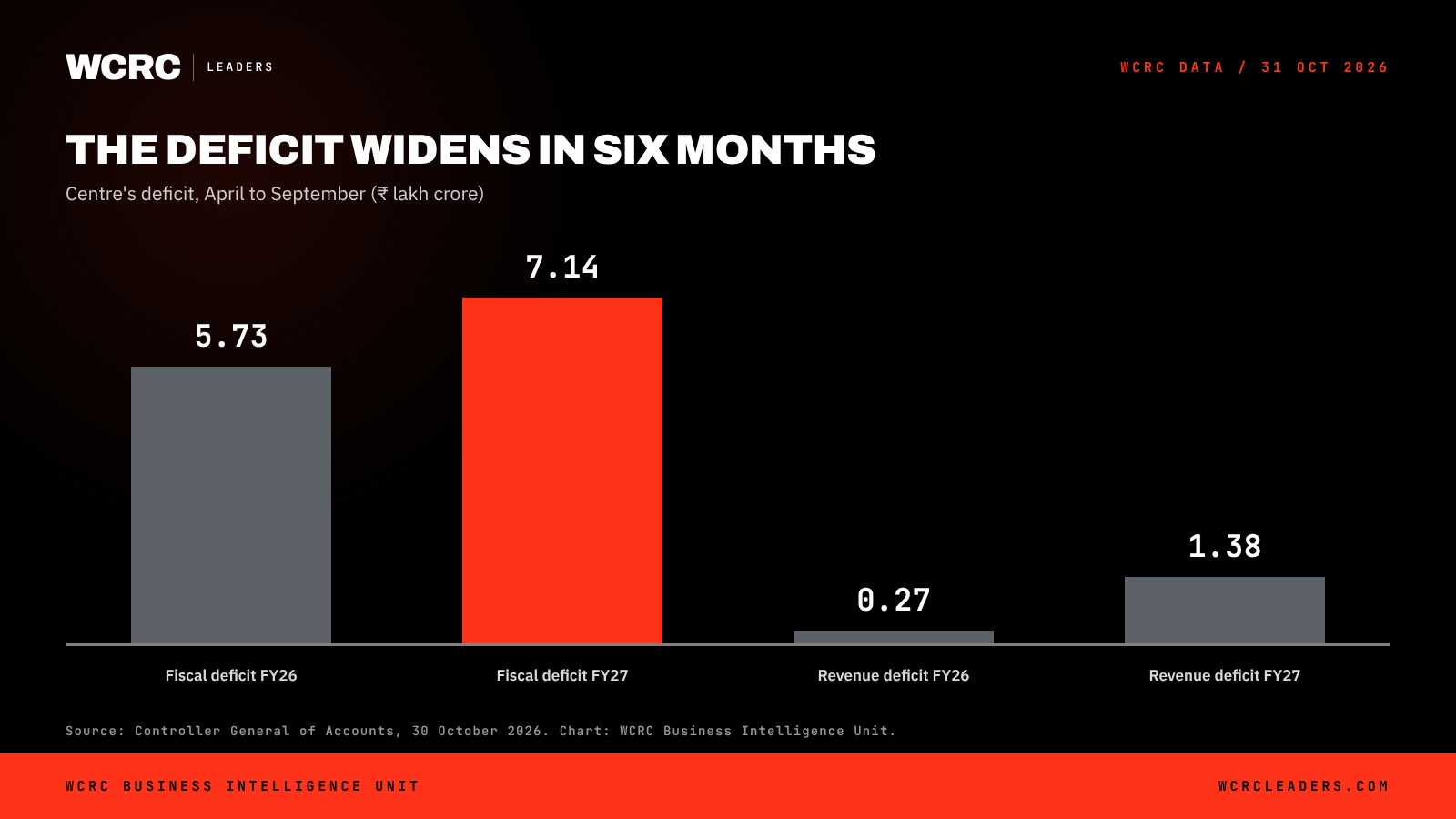
The numbers come straight from the Union Government's monthly accounts for September 2026. Between April and September, total receipts came to ₹18,35,422 crore, up 6.1% on the same period of 2025-26. Total spending reached ₹25,49,835 crore, up 10.7%. The difference, the fiscal deficit, was ₹7,14,413 crore against ₹5,73,123 crore a year earlier, an increase of ₹1,41,290 crore or 24.7%.
Three lines matter more than the headline.
First, the revenue deficit, the gap between day-to-day income and day-to-day spending, rose from ₹27,147 crore to ₹1,38,468 crore. Revenue spending grew 10.0% to ₹18,95,288 crore while revenue receipts grew only 3.6% to ₹17,56,820 crore. That is borrowing to pay running costs, not to build assets.
Second, the primary account, which strips out interest, swung from a surplus of ₹5,059 crore to a deficit of ₹68,403 crore. A year ago the government covered everything except its interest bill from its own income. This year it did not.
Third, interest payments rose 11.7% to ₹6,46,010 crore. On our calculation from the same accounts, interest now absorbs 50.6% of the Centre's net tax revenue, against 47.0% a year earlier.
How far into the budget is the government?
The Union Budget for 2026-27 set a full-year fiscal deficit of ₹16,95,768 crore, or 4.3% of GDP, with a revenue deficit of ₹5,92,344 crore. Using those Budget Estimates, our calculation shows the government had used 42.1% of its annual deficit allowance by the end of September, and 23.4% of the revenue deficit allowance.
The budget assumed net tax revenue of ₹28,66,922 crore for the year. Half way through, collections stood at ₹12,76,088 crore, or 44.5%. Non-debt receipts as a whole were at 50.3% of the year's estimate, helped by a jump in "other receipts", the line that carries asset sales, from ₹23,417 crore to ₹62,159 crore. Strip that out and the revenue picture is weaker still.
The second half of the year usually brings heavier tax receipts, so 42.1% is not yet a breach. But net tax growth of 3.8% is well short of what the full-year estimate needs, and that leaves less margin for any further shock.
Where does the energy shock come in?
The accounts do not break out the cause of every rupee, so what follows is WCRC analysis built on the official record.
The Reserve Bank of India's Monetary Policy Committee, raising the repo rate by 25 basis points to 5.50% on 7 October, cited "sharp volatility in crude oil prices" and warned of "high energy and other commodity prices". That was India's first rate hike since 2023. In Europe, the ECB held its deposit rate at 2.50% on 29 October as euro-area energy inflation reached 18.9%, as WCRC reported on the decision. The shock is global, and India imports most of the crude it refines.
An energy shock hits a government budget in three ways. It raises the cost of anything the state pays for or protects, from fuel used by its own departments to fertiliser and cooking gas support. It pushes the state to hold back pump and power prices, which shifts cost onto public balance sheets. And it slows the corporate profits and consumer demand that feed tax receipts. A 10.0% rise in revenue spending set against 3.8% growth in net tax is the shape that pattern leaves in the accounts.
Oil marketers sit in the middle. Hindustan Petroleum Corporation, one of WCRC 1000, India's Most Valuable Enterprises 2026, set out how the oil bill is testing India in its September-quarter results.
Is capital spending being cut to make room?
Not yet, and that is the good news. Capital expenditure rose 12.7% to ₹6,54,547 crore, which on our calculation is 53.6% of the ₹12,21,821 crore budgeted for the year. The government has front-loaded its building programme rather than trimmed it.
That spending is showing up in industry. Factory output grew 6.7% in September with capital goods up 10.4%, as WCRC set out in its analysis of the IIP. Consumer non-durables grew just 1.4%. Public capex is carrying the industrial cycle while households hold back.
The risk is the second half. If revenue keeps lagging and the deficit target holds, capital spending is the easiest line to slow. Contractors, cement, steel and capital goods makers have the most to lose from a quiet trim between January and March.
What else did the RBI's data show on 30 October?
Two releases from the RBI help frame the picture. Services exports reached $39.3 billion in September 2026, up 7.2% on a year earlier, after growth of 13.4% in July and 13.7% in August. Services remain India's steadiest source of foreign exchange, but the pace slowed in September.
On credit, the weighted average lending rate on fresh rupee loans fell to 8.51% in September from 8.61% in August, and the one-year median MCLR eased to 8.55% in October. These figures largely predate the October rate rise working through. With the government's borrowing need rising, the direction for corporate borrowing costs from here is more likely up than down.
What does this mean for boards in India, the Gulf and Asia?
India. A wider deficit, a rate rise and slower tax growth together raise the cost of capital. Boards planning debt-funded expansion should test their plans against higher yields, as WCRC noted when India's 10-year yield hit 7.46%. Companies that sell to government should watch payment cycles and order timing closely in the final quarter.
Gulf investors. Gulf sovereign and private capital is heavily exposed to India through listed equity, infrastructure and private deals. A rising deficit tends to pressure the rupee and bond yields, which affects dollar returns. At the same time, the energy shock that strains India's budget is lifting Gulf oil revenues, even as shipping risk around Hormuz, which WCRC tracked in its board risk briefing, complicates the picture. The Gulf is both a beneficiary of the shock and a funder of the economy it squeezes.
Asian markets. India is not alone. Oil importers across Asia, from Japan to Korea, face the same squeeze on trade balances and public finances. Investors comparing Asian sovereigns will weigh India's growth and capex record against a fiscal path that has just turned the wrong way.
The WCRC View
India's fiscal story in 2026-27 has changed from steady consolidation to managed strain. The deficit is up a quarter, the revenue deficit is five times larger and the primary account has slipped from surplus to deficit. None of this is a crisis yet. All of it narrows the government's room to absorb a longer energy shock without either borrowing more or cutting capital spending.
In the terms of SeeClear, a model in WCRC's Guru Management Codex, boards should separate fact from projection. The fact is a 3.8% rise in net tax against a 10.7% rise in spending. The projection, that a strong second half will fix it, is a hope, not a plan. Budget for the fact.
Read through WCRC's Corporate Value Intelligence framework, enterprise value in India now rests more heavily on the cost of capital. Firms that carry high debt, rely on government orders or depend on imported energy face the biggest pressure on value. Firms with pricing power, export earnings in dollars and clean balance sheets gain relative ground.
The Fortress Model of Crisis Leadership, also in the Guru Management Codex, fits the moment: secure the base before the storm deepens. That means locking in funding while rates are still moving, stress-testing energy costs, and agreeing contingency plans for public-sector receivables.
WCRC will watch three things next: October tax collections and the November accounts for any change in the revenue trend, whether capex growth holds in the third quarter, and the government's borrowing calendar for the second half.
WCRC models applied: SeeClear (Guru Management Codex), Fortress Model of Crisis Leadership (Guru Management Codex), Corporate Value Intelligence.
Quick answers
Q: What was India's fiscal deficit for April to September 2026? A: ₹7,14,413 crore, up 24.7% from ₹5,73,123 crore in the same period of 2025-26, according to the Controller General of Accounts.
Q: How much of the full-year target has been used? A: About 42.1% of the ₹16,95,768 crore fiscal deficit set in the Union Budget 2026-27, on WCRC's calculation from official figures.
Q: Is the government cutting capital spending? A: No. Capital expenditure rose 12.7% to ₹6,54,547 crore in the first half, about 53.6% of the year's budget.
Q: What did the RBI report on 30 October? A: Services exports of $39.3 billion in September, up 7.2%, and a weighted average lending rate on fresh rupee loans of 8.51%, down from 8.61% in August.
ECB holds at 2.50% as 18.9% energy inflation sets the world's rates
China's 4.5% growth runs on exports, and Asia's boards will feel it
Fed holds at 3.75-4%, but a 10-2 vote keeps Gulf and Asia on alert

The AI trade economy: chips and servers now carry almost half of world trade growth

India's factory output grows 6.7% as capital goods outrun consumers
China's profits jump 14.4%: chips and metals boom, steel and cars bleed
Filed under