Technology
SK hynix's 80% margin quarter: who pays for the AI memory squeeze
SK hynix earned ₩83.3trn of operating profit on ₩104.6trn of revenue in the third quarter, and has already sold more than half of its 2027 and 2028 capacity. For every company that buys memory, from Abu Dhabi data-centre builders to Indian phone assemblers, the bill is now being set in Korea.
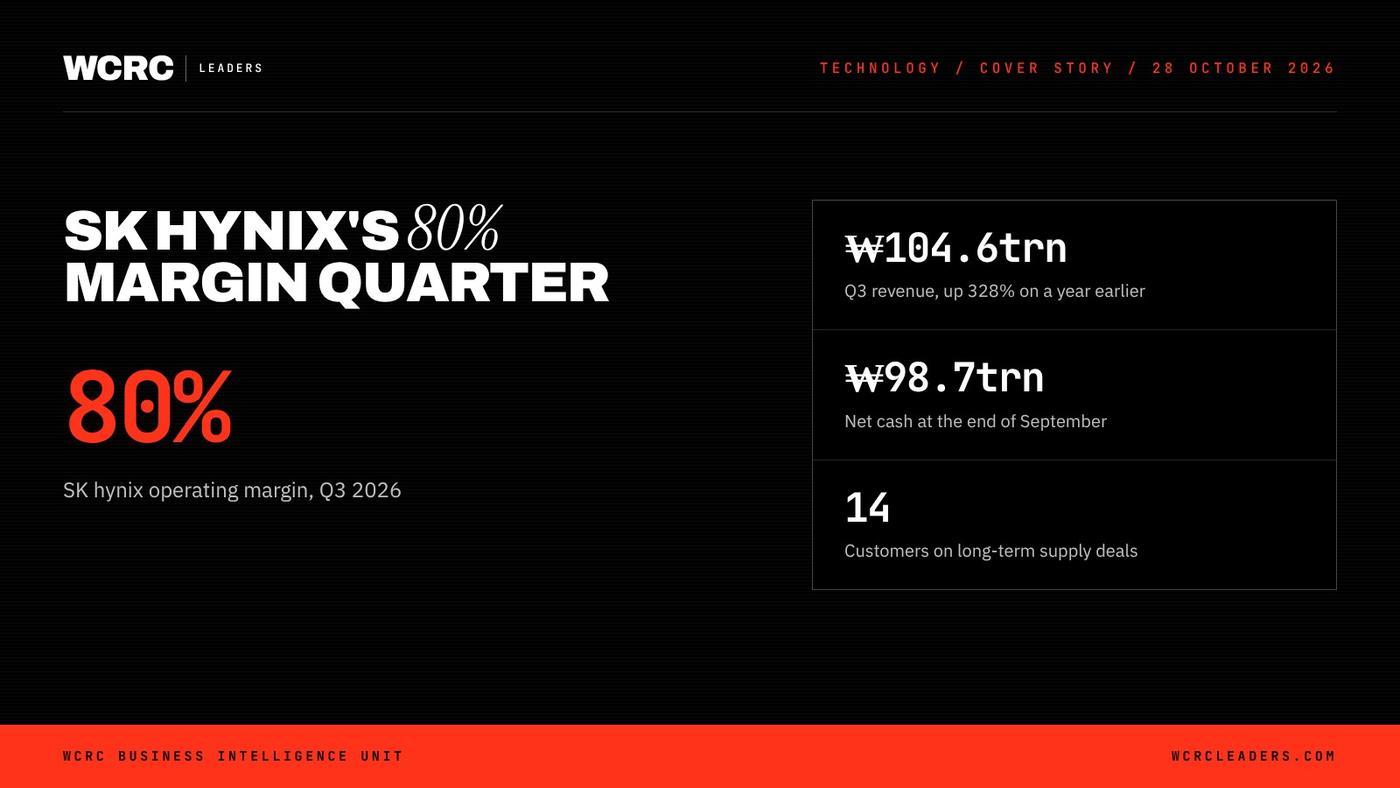
At a glance: WCRC Leaders' assessment: memory has become the scarcest and most profitable input in the AI build-out, and buyers without long-term contracts will pay for that scarcity until at least 2030. On 28 October 2026 SK hynix reported its first quarter above ₩100trn of revenue, up 328% on a year earlier, with an 80% operating margin, ₩98.7trn of net cash and long-term supply deals with 14 customers. It plans about ₩100trn of shareholder returns for 2026 and has stopped reviewing a Solidigm listing.
What did SK hynix report?
Revenue for the July to September quarter reached ₩104.6trn, up 32% on the second quarter and 328% on the same quarter of 2025. It is the first time the company has passed ₩100trn in a single quarter. Operating profit was ₩83.3trn, up 38% quarter on quarter and 632% year on year, giving an operating margin of 80%, against 76% in the second quarter.
Net profit was ₩39.8trn, a net margin of 38%. That is down 58% from the second quarter's ₩93.9trn but up 216% on a year earlier. The balance sheet has turned into a war chest: cash and equivalents rose by ₩26.5trn to ₩114.5trn, borrowings fell by ₩2.8trn to ₩15.8trn, and net cash stood at ₩98.7trn.
The company said DRAM sales grew on server DDR5 and on HBM4, its newest high-bandwidth memory, which began shipping in earnest. NAND sales rose on 321-layer enterprise SSDs for data centres. It expects HBM4 to overtake the previous generation, HBM3E, in both shipments and revenue in the fourth quarter, and its M15X fab to reach full capacity by the end of the year.
For scale, Samsung, a WCRC MegaBrand in televisions, guided on 8 October to third-quarter operating profit of about ₩107.4trn on sales of about ₩195trn across all its businesses. SK hynix, a far narrower company, earned roughly three-quarters of that profit on just over half the revenue.
Why does an 80% margin matter beyond Korea?
A margin of that size in manufacturing is a price signal: buyers of AI servers have little choice. The accelerators made by NVIDIA, a WCRC MegaBrand in AI platforms and enterprise AI infrastructure, and by others depend on stacks of high-bandwidth memory, and only a handful of companies can make it at volume.
SK hynix said it has signed long-term agreements with 14 major customers, including global cloud providers. Together they cover more than 50% of its total production capacity for 2027 and 2028. Terms typically run five years, and prices move with the market within an agreed range. The company expects demand to exceed supply through 2030, citing the difficulty of leading-edge processes and long fab lead times.
"The customer trust built through our technological competitiveness is leading to long-term contracts," said Chief Executive Kwak Noh-Jung, "and our business structure is transforming into one with earnings stability and mid-to-long term demand visibility."
WCRC analysis: the largest cloud buyers have secured their memory. Second-tier clouds, sovereign AI programmes and device makers are bidding for what remains, and marginal buyers pay the marginal price.
What does it mean for India's chip and electronics ambitions?
India sits on both sides: exposed to higher prices as a user, rewarded as a would-be producer.
Micron India, a WCRC MegaBrand in semiconductor design and fabrication, opened India's first semiconductor assembly and test facility at Sanand in Gujarat on 28 February 2026. The $2.75bn site, funded by Micron and its government partners, turns DRAM and NAND wafers into finished memory products. Micron has said it expects to assemble and test tens of millions of chips there in 2026, rising to hundreds of millions in 2027.
Tata Electronics has announced up to ₹91,000 crore for a fab at Dholera with Taiwan's Powerchip Semiconductor Manufacturing Corporation, for up to 50,000 wafers a month, focused on logic, power and display chips rather than memory. The Union Cabinet approved Semicon 2.0 on 15 July 2026 with an outlay of ₹1,27,500 crore. The government says 12 manufacturing projects worth over ₹1.64 lakh crore are approved, that Micron, Kaynes Technology, one of WCRC 1000, India's Most Valuable Enterprises 2026, and CG Semi have started commercial production, and that the first fab is due to be commissioned in 2028.
The pressure falls on assemblers. Dixon Technologies, one of WCRC 1000, India's Most Valuable Enterprises 2026, and its peers build phones, laptops and televisions in which memory is a large and rising share of cost. Dixon is also among India's Most Loved 250 Workplaces 2026, selected by the Business Intelligence Unit of WCRC. WCRC analysis: in a seller's market for memory, an assembler's margin depends on how well its brand customers can pass on cost, and on whether it secures supply before its rivals. A memory cycle this strong argues for revisiting a component policy built around logic, packaging and displays.
What should Gulf AI data-centre buyers take from it?
The Gulf is now a significant memory customer. OpenAI has said the first 200MW of the 1GW Stargate UAE cluster in Abu Dhabi, built with G42, Oracle, NVIDIA, Cisco and SoftBank, is expected to go live in 2026.
WCRC analysis: a sovereign buyer can finance a data centre in months, but it cannot conjure memory supply that is already contracted. Contracted customers have priority, so a new campus in Abu Dhabi or Riyadh buys through its accelerator vendors or at market terms. Memory, not chips alone, will set the pace and cost of deployment. Long-dated supply commitments, negotiated alongside accelerator orders, are now a board-level procurement question. We covered the capital side of this in UAE-Greece $15bn: G42 and Gulf capital in Europe.
Why is SK hynix handing ₩10trn of shares to employees?
The board approved a ₩14trn cash dividend and a ₩20trn share buyback for the third quarter. About ₩10trn of the repurchased shares will be cancelled. The remaining approximately ₩10trn, the company said, "will be used for employee compensation and is not included in the shareholder return total."
The quarterly dividend is ₩20,000 a share: ₩10,000 regular and ₩10,000 special, funded from gains on SK hynix's investment in Kioxia. For 2026 the company targets about ₩100trn of total returns, including at least ₩30trn of cash dividends and at least ₩60trn of buybacks and cancellations, which includes the ₩40trn programme announced in August and completed last week. It aims to return at least 50% of free cash flow.
"Our principle has been to share the majority of the gains from successful strategic investments with our shareholders," Mr Kwak said.
WCRC analysis: a ₩10trn equity pool for staff is a statement about the talent market. Engineers who can run leading-edge DRAM and HBM processes are scarce, and new fabs in India and elsewhere are hiring from the same pool. For Indian and Gulf companies recruiting experienced fab and packaging staff, the benchmark has moved: cash salaries will not match an employer whose shares pay out on this scale.
Why did the Solidigm listing stop?
SK hynix confirmed that it has discontinued its review of an initial public offering for Solidigm, its US NAND subsidiary. Mr Kwak said the listing "was intended to raise external capital for the expansion of Solidigm's production facilities," but that given recent financial market conditions "we concluded that proceeding at this time would not be the best way to achieve the originally anticipated outcome. We have therefore discontinued our review." WCRC examined that decision when it was first signalled in SK hynix shelves the Solidigm IPO: what it says about the AI capex cycle.
With ₩98.7trn of net cash, SK hynix does not need outside equity. It expects investment to rise significantly next year as Yongin Phase 1 enters full operation. For the wider supply chain, see TSMC and ASML's record quarters and Korea's Q3 GDP and chips.
The WCRC View
The call. The AI build-out has a new bottleneck and a new tollkeeper. An 80% operating margin, half of 2027-28 output pre-sold and demand forecast to beat supply until 2030 mean memory will stay expensive. This is a structural shift in bargaining power, not a quarterly spike.
Who gains. Memory makers and their shareholders first; the cloud giants that signed early second. Indian assembly and test operators, starting with Micron at Sanand, gain from full order books. Late buyers, device assemblers and second-wave sovereign AI projects lose.
What boards in India should do now. Ask management how much of the company's 2027 memory need is contracted, at what price range, and with what pass-through to customers. Electronics manufacturers should treat memory supply as a strategic risk, not a purchasing line.
What Gulf boards should do now. Negotiate memory and accelerator supply together, over multiple years, before committing to campus timelines. Capacity built without contracted memory will sit idle.
On talent. Expect fab and packaging pay to rise across Asia. Indian and Gulf employers should design equity or long-term retention schemes for semiconductor staff now.
What WCRC will watch. Samsung's full third-quarter results, HBM4's share of SK hynix sales in the fourth quarter, the pace of investment at Yongin in 2027, Micron's Sanand ramp, and whether Indian policy moves towards memory under Semicon 2.0.
Quick answers
Q: What were SK hynix's Q3 2026 results? A: Revenue of ₩104.6trn, up 328% year on year and 32% on the previous quarter; operating profit of ₩83.3trn, an 80% margin; net profit of ₩39.8trn; net cash of ₩98.7trn.
Q: How much will SK hynix return to shareholders in 2026? A: About ₩100trn, including at least ₩30trn of dividends and at least ₩60trn of buybacks and cancellations. The Q3 dividend is ₩20,000 a share, half of it a special payout from Kioxia gains.
Q: How long does SK hynix expect the memory shortage to last? A: It expects demand to exceed supply through 2030, and long-term agreements with 14 customers cover more than half of its 2027 and 2028 capacity.
Q: Is Solidigm going public? A: No. SK hynix has discontinued its review of a Solidigm IPO, citing recent financial market conditions.

Your customers will send their agents: what the Personal Agent Protocol means for the board
Infosys cuts FY27 guidance to 1-2% as AI reaches 10.5% of revenue
Anthropic files for ANT listing: $16.3bn in sales, $80.7bn net loss
SK hynix shelves the Solidigm IPO: what it says about the AI capex cycle
Junior hires fall to 9% at Anthropic: a warning for India's IT pyramid
Supplier-funded compute: what CFOs should read into the AI financing loop
Filed under