WCRC Intelligence
China's 4.5% growth runs on exports, and Asia's boards will feel it
China's economy picked up speed in the third quarter, but almost all of the lift came from goods leaving the country. At home, investment is shrinking and shoppers are barely spending, which means more Chinese output is heading for markets in India, the Gulf and the rest of Asia.
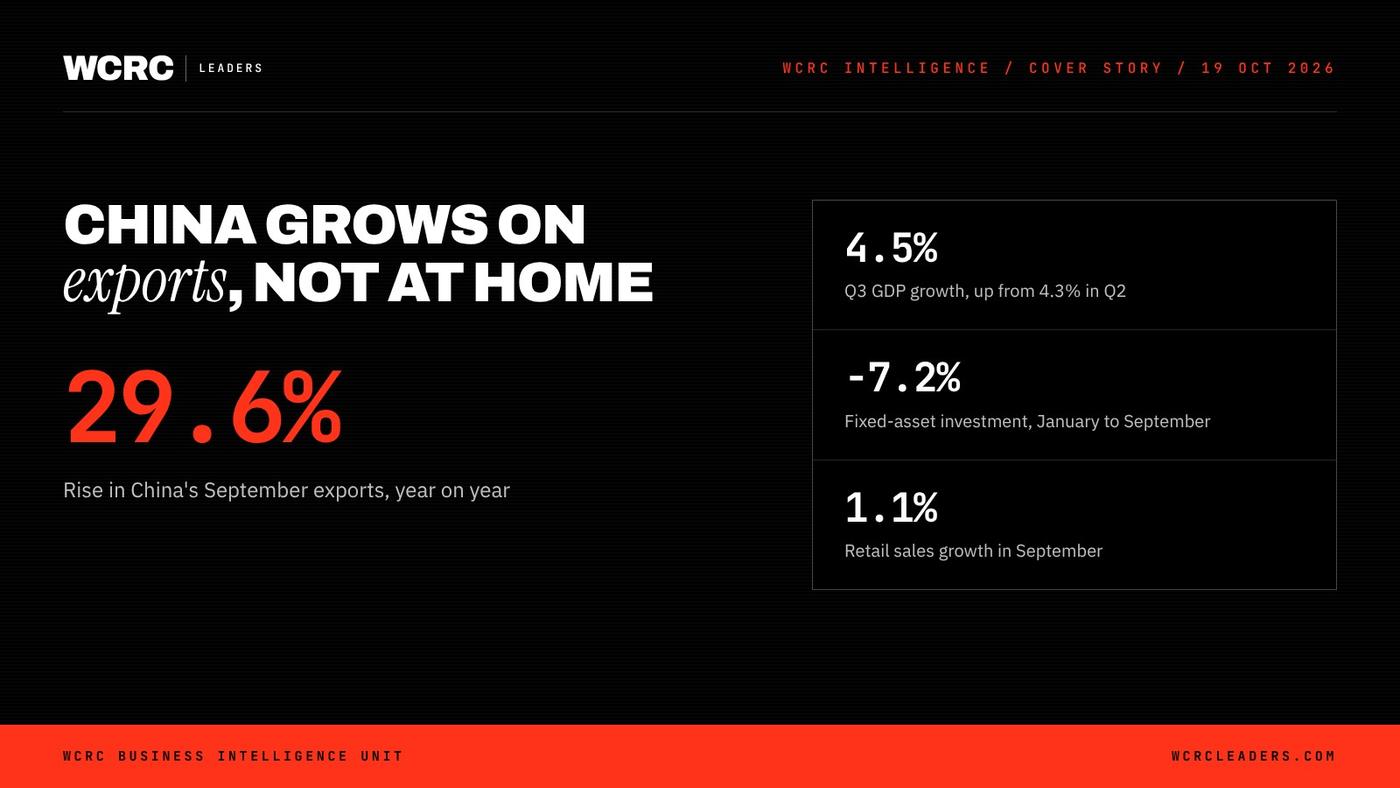
At a glance: WCRC Leaders' assessment: China is exporting its way past a domestic slump, and the bill lands on competing manufacturers in India and Asia before it lands anywhere else. On 19 October 2026 the National Bureau of Statistics reported third-quarter growth of 4.5% year on year, up from 4.3% in the second quarter. Exports rose 16.4% in the first nine months and 29.6% in September alone, while fixed-asset investment fell 7.2% and retail sales grew just 1.1%. For boards, the question is no longer whether China's surplus capacity reaches their markets, but how fast.
What did China report on Monday?
The National Bureau of Statistics (NBS) said gross domestic product for January to September reached 107,107.1 billion yuan, up 4.6% on a year earlier at constant prices. Growth by quarter ran at 5.0% in the first quarter, 4.3% in the second and 4.5% in the third. On a quarter-on-quarter basis, the economy grew 1.2% in the July to September period.
Services did most of the work on the output side. Tertiary industry value added rose 5.2% in the nine months, against 3.8% for the secondary sector. Industrial output at larger enterprises grew 5.5% in September and 5.3% for the year to date, with high-tech manufacturing up 14.3% and equipment manufacturing up 10.2%. Output of industrial robots rose 29.1%, lithium-ion batteries 39.5%.
The bureau's verdict was mixed. It said the economy "continued to demonstrate strong resilience and vitality", but also that "the issue of insufficient domestic demand remains prominent."
Where is the growth actually coming from?
Trade. China's goods exports reached 23,197.9 billion yuan in the first nine months, up 16.4%. In September they hit 3,034.4 billion yuan, up 29.6% on a year earlier. Mechanical and electrical products, the category that covers machinery, electronics, vehicles and batteries, rose 23.7% and made up 64.3% of all exports. Trade with Belt and Road partner countries grew 17.1%.
Imports rose too, by 22.3% for the nine months and 24.6% in September. WCRC analysis: part of that import growth is likely to reflect higher energy prices rather than stronger demand. The US Energy Information Administration (EIA) says Brent crude averaged $114 a barrel in September, $23 above August, after attacks on oil infrastructure around the Middle East. A rise in the value of fuel imports is not the same as a rise in Chinese consumption.
The other half of the picture is weak. Fixed-asset investment fell 7.2% to 33,411.5 billion yuan in the nine months. Real-estate development investment dropped 20.6%, infrastructure 4.2% and manufacturing 2.1%. Private investment fell 10.4%. Sales of new commercial buildings by floor area fell 13.2%. Retail sales of consumer goods reached 4,243.3 billion yuan in September, up only 1.1%, the same pace as the year to date.
Prices tell the same story. Consumer prices rose 0.9% in September and 0.9% across the nine months, with core inflation at 1.0% in September. Urban surveyed unemployment stood at 5.2%. Producer prices, by contrast, rose 5.0% in September as input costs climbed, with industrial purchasing prices up 6.9%.
Why does an export-led recovery matter to India?
Because India is where much of that output is going. India's Ministry of Commerce and Industry reported on 15 October that imports from China rose 31.52% year on year in September and 27.82% in April to September. India's total merchandise imports reached $74.61bn in September against exports of $44.40bn.
WCRC analysis: the timing is awkward for Indian manufacturers. India's wholesale inflation reached 11.39% in September, with basic metals at 16.96% and chemicals at 16.74%, as WCRC reported on India's margin squeeze. The Reserve Bank of India raised its policy rate on 7 October for the first time since 2023, a move WCRC examined for its effect on capex. Indian producers are therefore facing higher input and borrowing costs at the moment Chinese competitors, with idle capacity in property-linked sectors such as steel, glass and building chemicals, are pushing harder into export markets.
There is a nuance boards should not miss. China's factory-gate prices are rising, not falling, so the pressure is less about collapsing Chinese prices and more about volume. When a 20.6% fall in property investment removes domestic buyers, the same plants keep running and sell abroad. Expect India's Directorate General of Trade Remedies, which already runs a busy docket of anti-dumping cases on Chinese chemicals and steel products, to see more applications.
What does it mean for the Gulf?
For Gulf producers, whose crude has long flowed east to China, the read is mixed. The EIA's October outlook expects Chinese liquid fuels consumption to average 16.02 million barrels a day in 2026, below 16.58 million in 2025. Higher import values reflect a price shock, not a demand boom.
The EIA also says Middle East production shut-ins averaged 4.8 million barrels a day in September, down from a peak of 10.9 million in May, and it expects 4.5 million in the fourth quarter. It forecasts Brent at $105 a barrel in the fourth quarter and $84 in 2027. As flows recover, Gulf exporters will be selling into a Chinese market where construction, the biggest user of many fuels and materials, is still contracting.
WCRC analysis: petrochemicals carry the sharper risk. Gulf polymer and chemical makers compete with Chinese plants for buyers in India, South-East Asia and Africa. A Chinese property sector that has cut development investment by a fifth needs less PVC, pipe and insulation at home, and that surplus competes directly with Gulf product abroad. The UAE-Saudi rail and grid pact points to where the Gulf is building its own demand; the China numbers argue for speed.
How exposed are Asian supply chains?
For Asian manufacturers who buy Chinese components, the surge is useful: more supply, steadier delivery and, in many categories, competitive prices. For those who compete with Chinese finished goods, it is a threat. The categories growing fastest in China's output, from batteries to robots, are the same ones South-East Asian and Indian industrial policies are trying to build at home.
Trade politics adds a second layer. The United States and China extended their tariff truce by two months to 10 January 2027, as WCRC set out after the Washington summit. In Beijing on 9 October, the European Union reached a "shared understanding" with China to moderate hybrid car exports, which WCRC described as negotiated export restraint. WCRC analysis: every barrier raised in Washington or Brussels makes Asian, Indian and Gulf markets more attractive outlets for Chinese goods.
What comes next, and when?
China hosts the APEC leaders' meeting in November, and the EIA publishes its next oil outlook on 10 November. On its usual calendar, the NBS releases October activity data in mid-November and fourth-quarter GDP in January. The US-China truce expires on 10 January 2027. Watch for new domestic-demand measures: the bureau pledged to "step up efforts to boost domestic demand."
The WCRC View
The WCRC Business Intelligence Unit reads the third-quarter data as a warning, not a recovery. Growth of 4.5% looks steady, but it rests on exports rising almost 30% in a single month while investment, property and household spending all weaken. That is a surplus looking for a home.
India's manufacturers are first in line. Imports from China rose by almost a third in September, at a time of double-digit wholesale inflation and a rate hike. Boards in steel, chemicals, electronics assembly and capital goods should model a scenario in which Chinese import volumes stay at current levels for at least two more quarters, and price their contracts and capex plans on that basis.
Gulf energy and petrochemical boards should separate price from volume. China's import bill is up because oil is dear, not because China is consuming more. Strategy built on Chinese demand growth needs a harder test.
What leaders should do now: map which product lines face Chinese competition in their home and export markets, prepare trade-remedy evidence early rather than after margins fall, and look for the opposite trade, where cheaper Chinese inputs can lower their own costs.
WCRC will watch three things: China's October export and retail figures in November, any stimulus aimed at households, and new anti-dumping filings in India and South-East Asia.
Quick answers
Q: How fast did China's economy grow in the third quarter of 2026? A: GDP grew 4.5% year on year in July to September, up from 4.3% in the second quarter and down from 5.0% in the first, according to the National Bureau of Statistics. Nine-month growth was 4.6%.
Q: How much did China's exports grow? A: Goods exports rose 16.4% to 23,197.9 billion yuan in January to September, and 29.6% to 3,034.4 billion yuan in September.
Q: Is Chinese domestic demand weakening? A: Yes. Fixed-asset investment fell 7.2% in the nine months, real-estate development investment fell 20.6%, and September retail sales of consumer goods grew 1.1%. Consumer prices rose 0.9%.
Q: How much have India's imports from China grown? A: India's Ministry of Commerce and Industry reported that imports from China rose 31.52% year on year in September 2026 and 27.82% in April to September.
Filed under