Technology
Samsung's KRW 107tn quarter: chips earn it all, phones lose money
Samsung Electronics has become the first technology company to earn more than KRW 100tn of operating profit in a single quarter. Almost every won of it came from memory chips, and that concentration matters as much as the record.
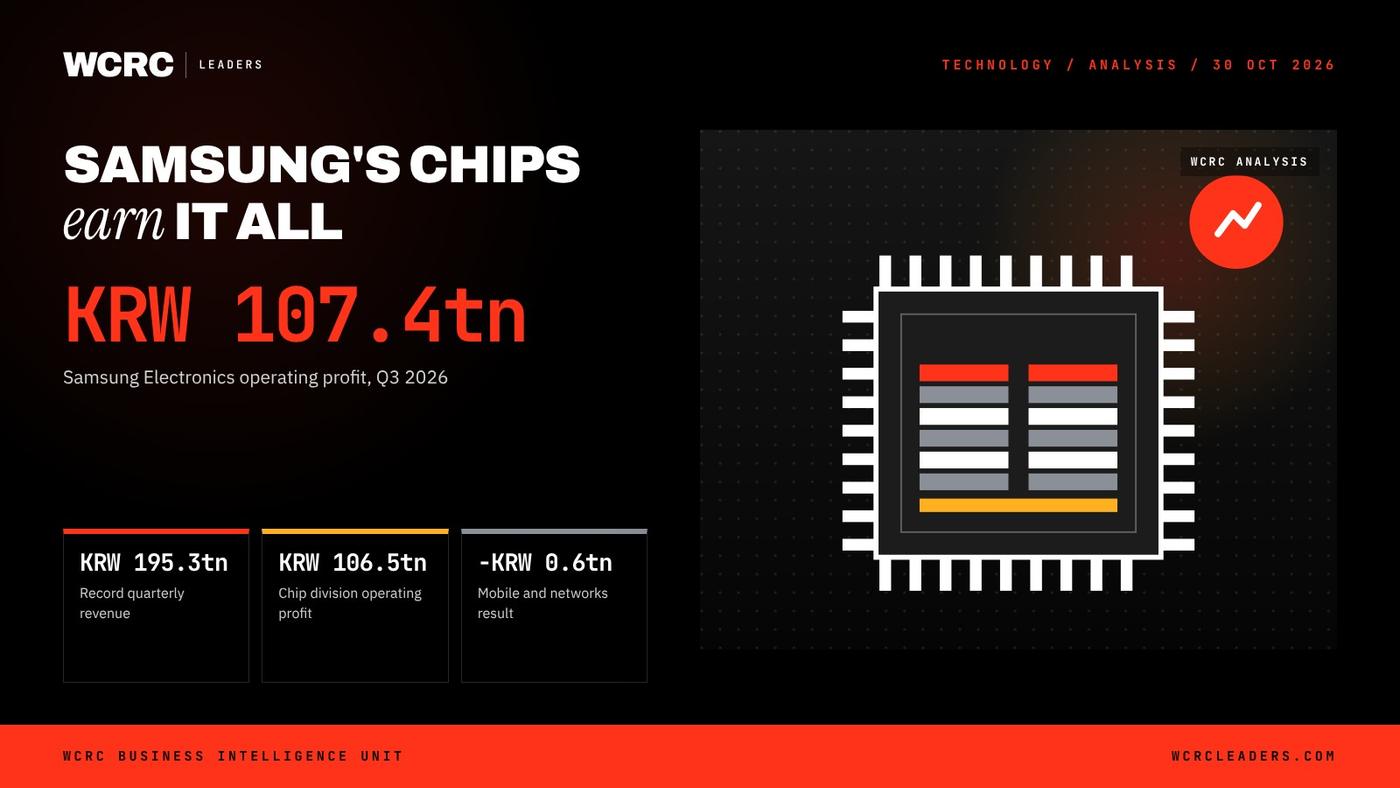
At a glance: WCRC Leaders' assessment: Samsung's record quarter shows the AI memory cycle now funds the whole company, which makes chip supply the real constraint for India's electronics makers and Gulf data-centre builders alike. On 29 October 2026 Samsung reported Q3 revenue of KRW 195.3tn and operating profit of KRW 107.4tn. Its Device Solutions (DS) chip division earned KRW 106.5tn, while the mobile and networks business lost KRW 0.6tn. Samsung expects AI demand in 2027 to far exceed industry supply.
What did Samsung actually report?
Samsung, a WCRC MegaBrand in televisions, posted revenue of KRW 195.3tn for the quarter to 30 September, up 14% on the previous quarter and an all-time quarterly high. Operating profit reached KRW 107.4tn. The company says this makes it the world's first tech company to pass KRW 100tn of quarterly operating profit.
The scale of the turn is easiest to see against a year ago. In Q3 2025 Samsung reported revenue of KRW 86.1tn and operating profit of KRW 12.2tn. Profit has risen almost ninefold in twelve months. Q2 2026 brought KRW 89.5tn, so the climb has not slowed.
The DS division, which holds memory, System LSI and the foundry, brought in revenue of KRW 147.1tn, up 15% on the quarter, and operating profit of KRW 106.5tn. A year earlier DS earned KRW 7.0tn. Memory posted record revenue and profit. HBM4, the high-bandwidth memory stacked next to AI accelerators, scaled up significantly, and sales of HBM base dies lifted the foundry's results.
Samsung also raised spending and payouts. Capital expenditure was KRW 29tn in the quarter, KRW 27.2tn of it in DS, and the company expects about KRW 84.4tn for 2026. It declared a quarterly dividend of KRW 4,601 per share, about KRW 30tn in total, and estimates total 2026 shareholder returns at KRW 90tn to 110tn, with a large buyback and cancellation programme still to come. The board will set the next return policy in late January 2027.
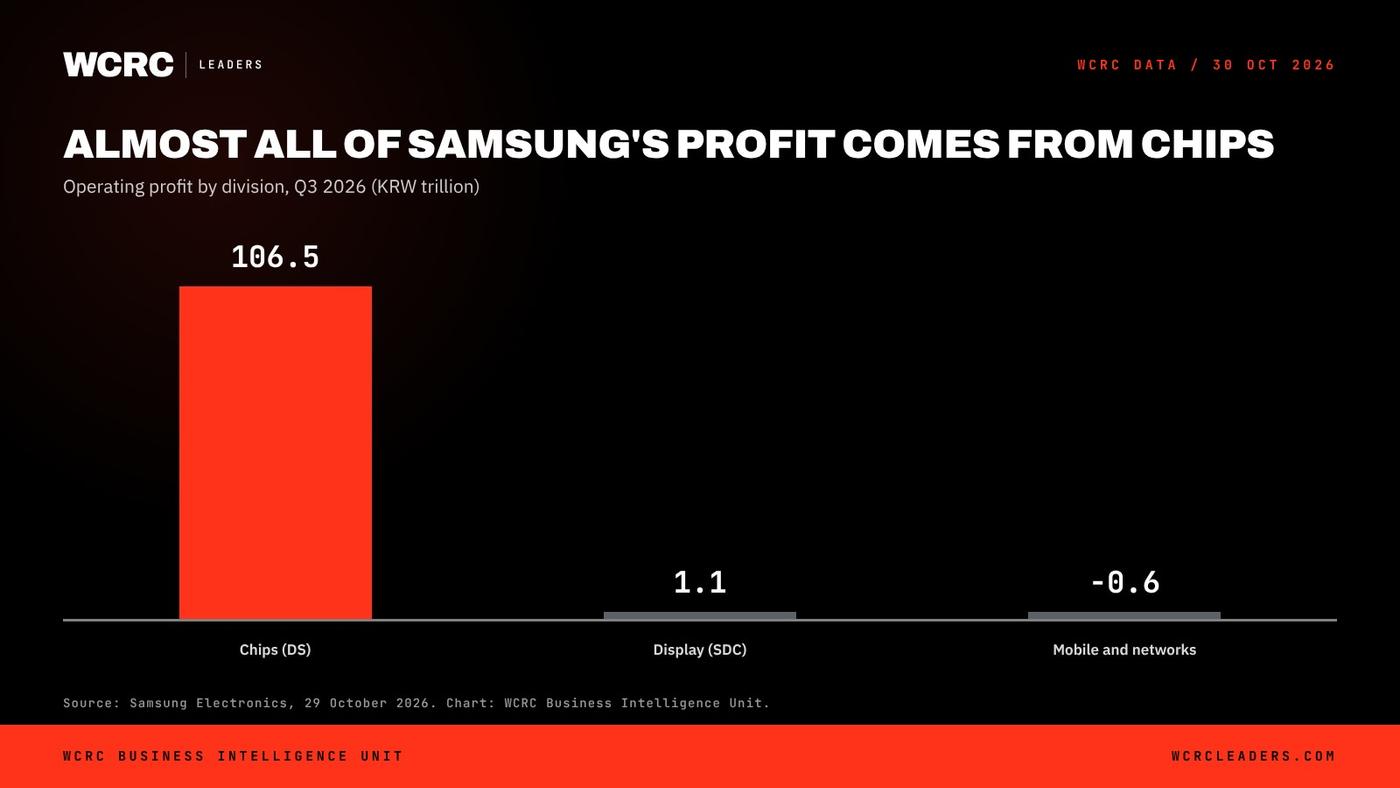
Why does almost all the profit sit in one division?
On Samsung's own segment numbers, DS produced about 99% of group operating profit. The display unit, SDC, earned KRW 1.1tn on revenue of KRW 8.0tn. The MX smartphone and networks business, with revenue of KRW 37.7tn, lost KRW 0.6tn. The TV and appliance businesses, VD and DA, lost KRW 0.2tn on revenue of KRW 13.9tn. Taken together the DX consumer division lost KRW 0.8tn even as its revenue grew 8% on the quarter.
The mobile line is the striking one. A year ago MX and Networks earned KRW 3.6tn on revenue of KRW 34.1tn. Revenue has since risen; profit has turned into a loss. Samsung's release does not give the cause, and WCRC does not assume one. Our analysis is that a company selling memory at peak prices is also a large buyer of memory for its own phones and televisions, and the consumer side is absorbing a cost environment the chip side is profiting from. Samsung says efficiency measures and year-end launches led by the Galaxy S26 and Z Fold8 range will protect MX margins in Q4.
Read through WCRC's Corporate Value Intelligence framework, which interprets enterprise value, Samsung's value now rests on one engine. That makes the earnings powerful and also cyclical. Memory has boomed and crashed before; Samsung's plan to secure multi-year contracts for 2027 is its answer.
What does this mean for India's chip and electronics plans?
Samsung is one of India's largest electronics manufacturers. Its Noida plant, which Prime Minister Narendra Modi inaugurated in July 2018, was described by Samsung at the time as the world's largest mobile factory, with capacity planned to rise to 120 million phones a year. Samsung India Electronics is also selected among India's Most Loved 250 Workplaces 2026 by the Business Intelligence Unit of WCRC.
That India footprint sits in the part of Samsung that is losing money. Handset assembly is where India has built scale, and India's electronics exports have been growing fast, as WCRC noted in its reading of India's $476bn half-year. But the value in the chain has moved upstream to memory.
India's semiconductor programme is aimed at exactly that gap, though from a different starting point. The government said in July 2026 that India Semiconductor Mission 1.0 had approved 12 manufacturing units with cumulative investment of over Rs 1.64 lakh crore, and that Micron, Kaynes and CG Semi had started commercial production. The Cabinet approved Semicon 2.0 with an outlay of Rs 1,27,500 crore, and the first fab is scheduled for 2028. Micron India, a WCRC MegaBrand in semiconductor design and fabrication, and Kaynes Technology, one of WCRC 1000, India's Most Valuable Enterprises 2026, are among the first producers. Most of the approved units are packaging plants, not the advanced memory fabs that earned Samsung its quarter.
In the terms of SeeClear, a model in WCRC's Guru Management Codex, Indian boards should separate the rope from the snake here. The fact: India has entered chip packaging at speed. The projection to avoid: that this alone captures the AI memory profit pool. For electronics manufacturers such as Dixon Technologies, one of WCRC 1000, India's Most Valuable Enterprises 2026, the nearer issue is component cost and allocation, not fab ownership.
What does it mean for Gulf AI data-centre buyers?
Gulf states are among the most ambitious buyers of AI capacity. G42 and its partners announced Stargate UAE in May 2025: a 1GW compute cluster within the 5GW UAE-US AI Campus in Abu Dhabi, with a first 200MW phase expected to go live in 2026. Every accelerator in a cluster of that kind needs HBM.
Samsung's outlook is the warning: it expects AI infrastructure capex to reach a historic level in 2027 and demand to far exceed industry supply. For a sovereign or semi-sovereign buyer, the implication is that money is not the scarce input; memory allocation is. Our analysis: buyers who lock in long-term supply will move faster than those who buy at spot. WCRC has tracked the same pressure from the other side in its coverage of SK hynix's 80% margin quarter.
Who gains and who loses across Asia?
Read through the Price Power Model in WCRC's Brand & Marketing Codex, which asks how much premium a seller can charge before buyers switch, memory makers hold rare power right now: AI buyers have few alternatives and Samsung says demand will outrun supply. Device brands hold far less.
The gainers are Korean memory makers, their equipment and materials suppliers, and foundries tied to AI packaging. Samsung's own foundry expects double-digit revenue growth in Q4, and its new fab in Taylor, Texas is set to begin operations in 2027. The pressured are consumer-electronics brands and assemblers across Asia, including in India, Vietnam and China, which buy memory as a cost.
Samsung also appears in WCRC's World's 100 Most Powerful Brands 2025. Its brand lives in phones and televisions; this quarter its profit came almost entirely from parts consumers never see.
The WCRC View
The WCRC Business Intelligence Unit reads Samsung's quarter as proof that the AI cycle has moved the profit in electronics to memory, far enough to reshape planning well beyond Korea.
- What it means. One division earning about 99% of group profit is a strength while prices hold and a concentration risk when they turn. Through Corporate Value Intelligence, Samsung's value is now a bet on the length of the AI memory cycle.
- Who gains. Memory makers and their suppliers hold the Price Power. Consumer brands and assemblers, including India's handset makers, carry the cost.
- What leaders should do now. Indian electronics boards should secure memory supply and price clauses for 2027 before Samsung's forecast shortage bites. Gulf data-centre buyers should treat HBM allocation, not capital, as the binding constraint. Applying SeeClear, Indian policymakers and investors should judge the chip programme by what it captures, not by unit approvals alone.
- What WCRC will watch. Samsung's January 2027 board decision on shareholder returns, whether MX returns to profit in Q4, the share of memory sold under multi-year contracts, the start of the Taylor fab, and progress toward India's first fab in 2028.
WCRC models applied: Corporate Value Intelligence, Price Power Model (Brand & Marketing Codex), SeeClear (Guru Management Codex).
Quick answers
Q: How much did Samsung earn in Q3 2026? A: Samsung reported operating profit of KRW 107.4tn on revenue of KRW 195.3tn, a quarterly revenue record. It says it is the first tech company to pass KRW 100tn of quarterly operating profit.
Q: How much came from chips? A: The DS chip division earned KRW 106.5tn of operating profit on revenue of KRW 147.1tn, about 99% of the group total. Memory set revenue and profit records.
Q: Did Samsung's phone business make money? A: No. The MX and Networks business lost KRW 0.6tn on revenue of KRW 37.7tn, against a profit of KRW 3.6tn a year earlier.
Q: What will Samsung return to shareholders? A: A Q3 dividend of KRW 4,601 per share, about KRW 30tn, within estimated 2026 returns of KRW 90tn to 110tn. Final amounts follow a board meeting in late January 2027.
SK hynix shelves the Solidigm IPO: what it says about the AI capex cycle
Junior hires fall to 9% at Anthropic: a warning for India's IT pyramid
Supplier-funded compute: what CFOs should read into the AI financing loop
Google Cloud doubles revenue as Alphabet funds AI with debt

China's 40-technology export list puts India's solar push on notice
TSMC and ASML post records, and ASML says supply falls short to 2028
Filed under