Technology
TSMC and ASML post records, and ASML says supply falls short to 2028
The two companies at the narrowest point of the AI supply chain have just reported their best quarters. The more important message is ASML's: the machines that make advanced chips will stay scarce for at least two more years.
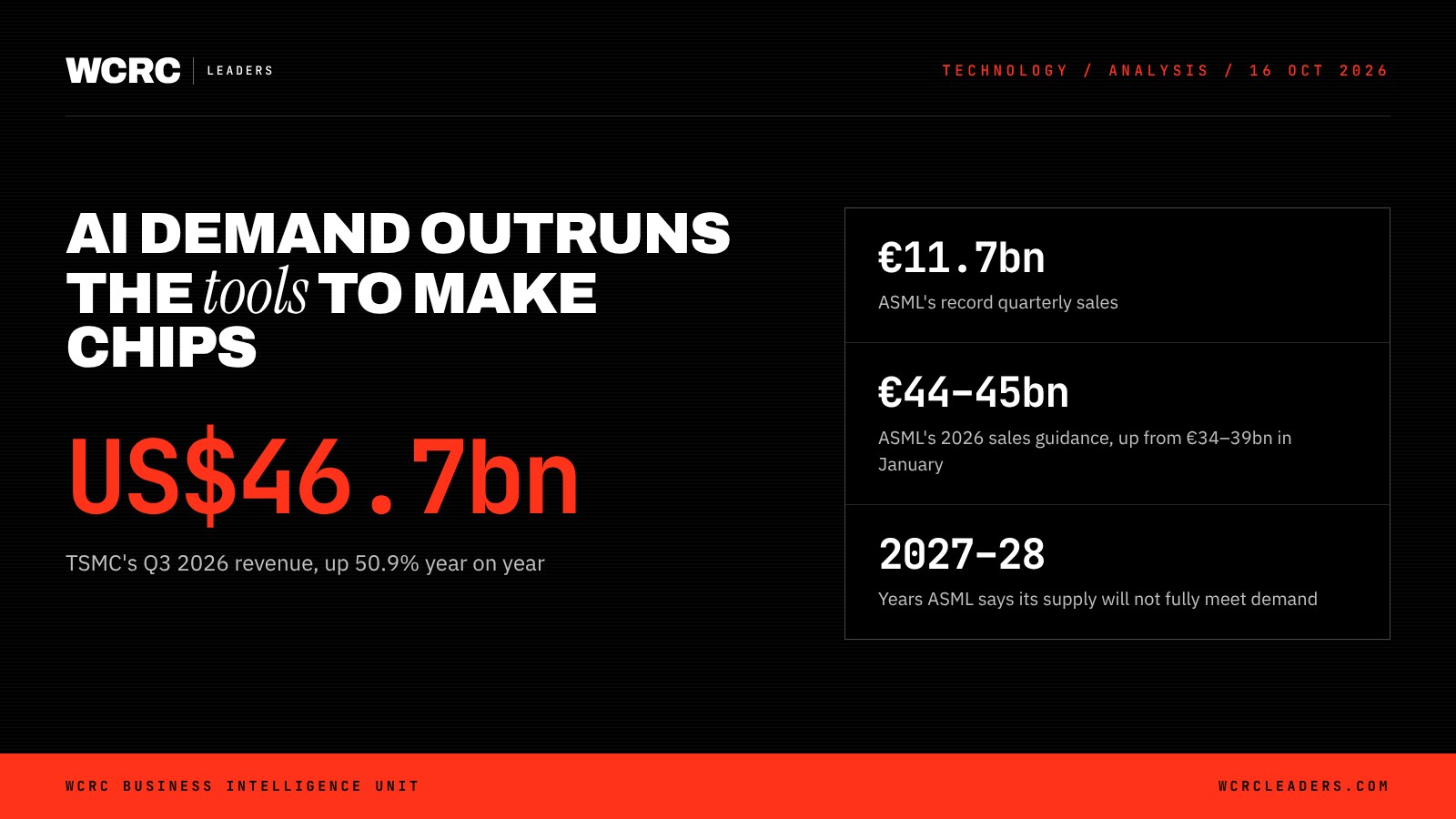
At a glance: WCRC Leaders' assessment: the AI build-out is now constrained by chip-making tools, not by demand, so boards should plan for scarce compute through 2028. On 14 October 2026 ASML reported record sales of €11.7bn and said its planned supply for 2027 and 2028 "will not fully meet the demand of our customers". A day later TSMC reported revenue of NT$1,494.2bn (US$46.7bn), up 50.9%. For companies in India, the Gulf and Asia that are buying AI capacity or building chip plants, timing and access now matter more than price.
What did TSMC and ASML actually report?
TSMC, the world's largest contract chipmaker, reported third-quarter revenue of NT$1,494.24bn (US$46.72bn) on 15 October 2026. That is 50.9% more than a year earlier in Taiwan dollars, and 41.2% more in US dollars. Net income rose 68.7% to NT$763.06bn. Gross margin was 66.4% and operating margin 58.7%. Revenue rose 17.6% on the previous quarter.
Advanced chips did the work. Processes at 7 nanometres and below made up 79% of wafer revenue: 3nm at 33%, 5nm at 28%, 7nm at 10% and the new 2nm at 8%. High-performance computing, the category that holds AI accelerators, rose to 68% of revenue from 66% in the second quarter. North American customers accounted for 79%.
TSMC guided fourth-quarter revenue of US$52.3bn to US$54.3bn, with gross margin of 65% to 67%. Chief financial officer Wendell Huang said the third quarter "was supported by strong demand for our leading-edge process technologies", and that he expects the fourth quarter to be helped by the steep ramp of 2nm.
ASML, the Dutch company that is the only maker of extreme ultraviolet (EUV) lithography machines, reported record third-quarter sales of €11.7bn and net income of €5.0bn on 14 October. A year earlier the figures were €7.5bn and €2.1bn, so net income has more than doubled. Gross margin was 57.5%. ASML guided fourth-quarter sales of €14.2bn to €15.2bn and full-year 2026 sales of €44bn to €45bn.
Why does ASML's supply warning matter more than the record numbers?
Records describe the past. ASML's outlook describes the ceiling on the future.
In January 2026 ASML guided full-year sales of €34bn to €39bn. Nine months later the range is €44bn to €45bn, about 22% higher at the midpoint and well above the €32.7bn it sold in 2025. Even so, chief executive Christophe Fouquet said customers are raising their short- and medium-term demand forecasts, mainly because of AI investment, and that "we now expect that our supply as currently planned for both 2027 and 2028 will not fully meet the demand of our customers".
The plan he refers to is already large. ASML's release says it intends to raise its low-NA EUV and DUV immersion capacity by 30% in 2027 over 2026. It is now "investigating ways to increase capacity for 2028 beyond the 30% increase we previously communicated". Some customers want to place orders for 2029 and 2030.
Analysis: a lithography tool ordered today becomes chip output only after it is built, shipped, installed and qualified in a fab. If ASML cannot meet demand for tools in 2027 and 2028, the chipmakers that depend on them cannot add leading-edge output as fast as their customers want. That pushes scarcity in AI chips well past the current cycle.
How big and how long is the AI build-out?
TSMC's figures suggest the boom is about pricing and mix as much as volume. Wafer shipments rose only 9.6% year on year, to 4.48 million 12-inch equivalent wafers, while revenue rose 50.9%. Gross margin climbed to 66.4% from roughly 59.5% a year earlier, based on TSMC's reported figures. Analysis: customers are paying more for each advanced wafer, which is what a seller's market looks like.
TSMC is spending to meet it. Capital expenditure was US$13.84bn in the third quarter and US$40.64bn in the first nine months of 2026.
Analysis: the length of the build-out is the bigger signal for boards. Customers asking ASML for 2029 and 2030 slots are planning AI capacity five years out. That does not prove AI revenue will justify the spending, a question WCRC examined in The $6 trillion question: is AI spending outrunning AI revenue?. It does show that the largest buyers are committing capital on a multi-year horizon, and that supply, not appetite, sets the pace for now. The same pattern shows up in trade data, covered in The AI trade economy: chips and servers now carry almost half of world trade growth.
What does this mean for India's chip ambitions?
India is building a chip industry into this squeeze. On 15 July 2026 the Union Cabinet approved Semicon 2.0, with an outlay of about ₹1,27,500 crore. It covers six pillars: design, machines and materials, fabs, assembly and test, research, and talent.
Under the first phase, the India Semiconductor Mission has approved 12 manufacturing units with cumulative investment of over ₹1.64 lakh crore. They include one silicon fab, one silicon carbide fab, one gallium nitride micro-LED display fab and nine packaging units. Micron, Kaynes and CG Semi have started commercial production. The government says the first fab is scheduled for commissioning in 2028.
Analysis: 2028 is the same year ASML says its planned supply falls short. India's packaging and test units, which use far less lithography, are less exposed. A new silicon fab competes for tools with TSMC, Samsung and Intel, which have deeper order books and longer relationships with ASML. Including "machines and materials" in Semicon 2.0 is the right instinct. Indian promoters should treat tool delivery slots as a critical path item, not a procurement detail.
Can the Gulf get the chips its data centres need?
The Gulf has set out some of the largest AI compute plans outside the United States and China. Stargate UAE is a 1-gigawatt cluster in Abu Dhabi that G42 is building for OpenAI with Oracle, Nvidia, Cisco and SoftBank, with a first 200-megawatt phase expected to go live in 2026. G42 says it sits within a 5-gigawatt UAE-US AI Campus, and that the US has authorised the export of advanced AI chips to it. In Saudi Arabia, stc's center3 and HUMAIN, owned by the Public Investment Fund, announced in December 2025 a joint venture for data centres to host up to 1 gigawatt of AI workloads.
Analysis: these projects have secured political approval and capital. The next constraint is physical. Every gigawatt needs accelerators made on TSMC's leading-edge lines, and those lines depend on ASML's tools. Gulf buyers with sovereign backing and early commitments are likely to be served. Later entrants in the region may find that money alone does not buy a place in the queue.
What should companies buying AI compute do now?
Most companies will never buy a wafer. They buy capacity from cloud providers, data-centre operators and model companies, who in turn compete for chips. Scarcity upstream reaches them as higher prices, longer waits for dedicated capacity and tighter contract terms.
Analysis: three practical responses follow. First, secure capacity for priority AI workloads now, with multi-year terms where the business case is clear. Second, avoid single-supplier dependence; contracts should include alternatives if a provider's allocation is cut. Third, spend on efficiency. Smaller models, better utilisation and careful workload choice stretch scarce compute further. CFOs should also check how suppliers fund the capacity they sell, a risk set out in Supplier-funded compute: what CFOs should read into the AI financing loop.
The WCRC View
From the WCRC Business Intelligence Unit.
- The call: the AI build-out has moved from a demand story to a supply story. When the sole supplier of EUV tools says it cannot meet planned demand in 2027 and 2028, leading-edge chip capacity stays scarce for at least two more years.
- Who gains: ASML and TSMC hold pricing power, shown in margins of 57.5% and 66.4%. Large buyers with early commitments, including Gulf sovereign-backed projects, gain because allocation favours those already in the queue.
- Who is exposed: latecomers to compute, mid-sized enterprises renting capacity on short contracts, and new fabs, including India's, that need tools in the same window as the industry's biggest customers.
- What leaders should do: boards in India, the Gulf and Asia should ask management three questions this quarter. How much AI capacity is contracted for 2027 and 2028? What happens if a provider cuts our allocation? Where can efficiency reduce how much compute we need?
- What WCRC will watch: ASML's fourth-quarter results in January 2027 and any confirmed 2028 capacity increase; TSMC's delivery against its US$52.3bn to US$54.3bn fourth-quarter guidance and its 2027 capital spending plan; progress on India's first fab ahead of its 2028 commissioning date; and the start-up of Stargate UAE's first 200 megawatts.
Quick answers
Q: How much revenue did TSMC report for the third quarter of 2026? A: NT$1,494.24bn (US$46.72bn), up 50.9% year on year in Taiwan dollars, with net income up 68.7% and gross margin of 66.4%.
Q: What did ASML say about supply in 2027 and 2028? A: It said its supply as currently planned for both years "will not fully meet the demand of our customers", and that it is investigating ways to add 2028 capacity beyond a previously communicated 30% increase.
Q: What is ASML's 2026 sales guidance now? A: €44bn to €45bn, up from €34bn to €39bn in January 2026. It sold €32.7bn in 2025.
Q: When will India's first semiconductor fab be commissioned? A: The government says the first fab is scheduled for commissioning in 2028, under a programme that has approved 12 units worth over ₹1.64 lakh crore.
Filed under