WCRC Intelligence
Korea's chips lift GDP 1.0% as households pull back
South Korea's economy grew 1.0% in the third quarter, powered by semiconductor investment and exports, while private consumption shrank for the first time in nearly four years. The split matters for the memory cycle, for the Bank of Korea's next move and for every Asian and Gulf buyer of AI hardware.
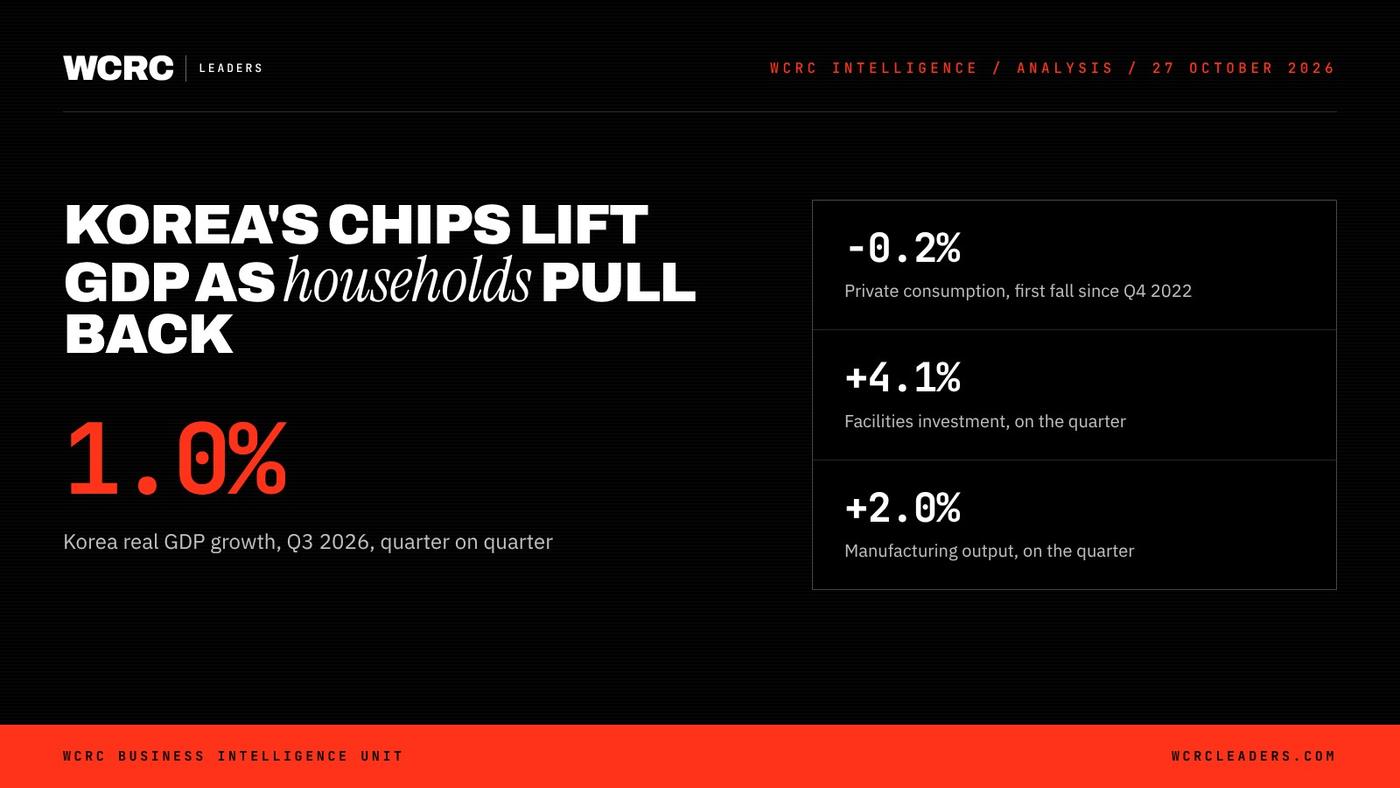
At a glance: WCRC Leaders' assessment: Korea is now running a two-speed economy in which AI memory demand, not households, sets the pace, and that ties both its growth and its rate path to the chip cycle. The Bank of Korea's advance estimate, released on 27 October 2026, shows real GDP up 1.0% on the quarter and 3.4% on the year. Facilities investment rose 4.1% and goods exports 2.4%, but private consumption fell 0.2%. With the Base Rate at 3.00% and a policy meeting on 26 November, boards from Mumbai to Riyadh should read this as a signal on memory supply and pricing.
What did the Bank of Korea report?
The Bank of Korea's advance estimate for the third quarter of 2026 puts real GDP growth at 1.0% quarter on quarter, seasonally adjusted, and 3.4% year on year. Real gross domestic income, which captures the gain from better export prices, rose 3.4% on the quarter and 18.8% on the year.
The quarter follows growth of 0.6% in the second quarter and 1.8% in the first, according to the Bank's ECOS database. Korea contracted by 0.1% as recently as the fourth quarter of 2025.
On the spending side, facilities investment rose 4.1% on the quarter and 9.4% on the year. Government consumption rose 1.9%. Construction investment edged up 0.7%. Goods exports grew 2.4% and goods imports 2.7%. Domestic demand excluding inventories rose 0.9%.
On the production side, manufacturing grew 2.0% on the quarter and 7.0% on the year. Services, the largest part of the economy, managed only 0.2%.
Why did households fall behind?
Private consumption fell 0.2% on the quarter. ECOS data show this is the first quarterly decline since the fourth quarter of 2022, and the steepest since the first quarter of 2022, when spending fell 1.0%. On a year-on-year basis consumption still rose 1.1%, a fraction of the 9.4% growth in facilities investment.
The Bank of Korea had flagged the softness before the data landed. In its opening remarks to the press conference after the 22 October policy meeting, the Bank said consumption "has temporarily slowed mainly due to a correction in stock prices and strikes at automakers". It still described consumption as on a modest recovery path, with income gains from exports and investment expected to feed through.
WCRC analysis: the gap between an 18.8% annual rise in real income and a fall in household spending shows where the chip windfall is landing. It is flowing to corporate balance sheets, capital spending and the state, not yet to consumers. The boom is narrower than the headline suggests.
What does it say about the AI memory cycle?
The national accounts confirm at the macro level what Korea's two memory makers have been reporting at company level.
Samsung Electronics, a WCRC MegaBrand in televisions, issued third-quarter guidance on 8 October of about 195 trillion won in consolidated sales and about 107.40 trillion won in operating profit. A year earlier, operating profit was 12.17 trillion won, so it is now roughly eight times higher. Samsung's full results, with divisional detail, are still to come.
SK hynix reported second-quarter revenue of 79.3187 trillion won and operating profit of 60.5426 trillion won, a 76% operating margin. The company said it began mass shipments of HBM4, the high-bandwidth memory used in AI accelerators, in that quarter and had finalised long-term agreements with around 10 customers. It said "the momentum in memory demand is expected to persist." It reports third-quarter results on 28 October.
Supply is the constraint. In August SK hynix committed about 54 trillion won to two new fabs: 35.2 trillion won for Yongin Y2, a DRAM and HBM base, and 19.1 trillion won for the Cheongju M17 NAND fab. Y2 breaks ground in July 2027 and opens its first cleanroom in June 2029. New memory capacity on that scale is years away, which helps explain why imports rose alongside exports this quarter.
ASML has said its planned supply for 2027 and 2028 will not fully meet customer demand, as WCRC set out in its analysis of TSMC and ASML's record quarters, and chips and chipmaking tools led Japan's September exports.
What does it mean for the Bank of Korea?
On 22 October the Monetary Policy Board held the Base Rate at 3.00%, after raising it by 25 basis points from 2.75% on 27 August. The Board said growth this year and next is expected to be "considerably higher than the August forecasts" of 3.3% and 2.9%, and that inflation "is expected to remain above the target level for a considerable time."
The Bank also said it "will determine the timing and pace of further Base Rate hikes while closely monitoring incoming data," adding that "it would not be too late to further assess these through incoming data, such as Q3 GDP." That data has now arrived, and it is strong. The next policy meeting is on 26 November, under Governor Shin Hyun Song, who took office in April 2026. WCRC covered the October decision in Bank of Korea holds at 3.00% and keeps more hikes on the table.
WCRC analysis: a 1.0% quarter strengthens the case for another increase, but the consumption figure cuts the other way. A hike aimed at an overheating chip sector would land hardest on households that are already cutting back. The October inflation print and the Bank's November outlook will decide which side wins.
What does it mean for India, the Gulf and Asian supply chains?
For India, the Korean data underline both the opportunity and the dependency. Micron opened India's first semiconductor assembly and test facility in Sanand, Gujarat, on 28 February 2026, an investment of about $2.75bn with government partners. It turns DRAM and NAND wafers from Micron's global network into finished memory products, and Micron expects to assemble and test tens of millions of chips in 2026 and hundreds of millions in 2027. Micron India is a WCRC MegaBrand in semiconductor design and fabrication. The government notified a special economic zone at Dholera on 9 April 2026 for Tata Semiconductor Manufacturing's ₹91,000 crore fab.
India's electronics manufacturers, such as Dixon Technologies, one of WCRC 1000, India's Most Valuable Enterprises 2026, and Kaynes Technology, one of WCRC 1000, India's Most Valuable Enterprises 2026, work in a market where memory prices are set largely by Korean suppliers. WCRC analysis: when Samsung and SK hynix earn margins of this size, memory becomes a cost line that Indian device makers cannot control. WCRC's review of India's half-year exports showed electronics leading growth, which makes that cost exposure larger, not smaller.
For the Gulf, the read-across is about procurement. WCRC analysis: sovereign-backed AI data-centre projects compete for the same high-bandwidth memory as the largest cloud companies, and long-term agreements of the kind SK hynix describes favour buyers who commit early and in volume. Late buyers face allocation, not just price.
For Asian supply chains, WCRC analysis: the risk is concentration, with China's export-led quarter, covered in WCRC's analysis of China's 4.5% growth, adding a second source of strain.
Samsung was named among the world brands in India's Most Powerful Brands 2026 by WCRC, and Samsung India Electronics and Dixon Technologies were both selected among India's Most Loved 250 Workplaces 2026 by the Business Intelligence Unit of WCRC.
The WCRC View
The call. Korea's third quarter is a memory-cycle quarter presented as a national recovery. Growth is real, but it rests on chip investment and exports while households retreat. Leaders should treat Korean growth as a proxy for AI hardware demand, not as a signal of broad Asian consumer strength.
Who gains. Samsung and SK hynix, their equipment suppliers, and buyers with long-term memory contracts. Korean consumer businesses, and exporters selling to Korean households, do not.
What CEOs should do now. Indian device makers should lock in memory supply and model a scenario in which DRAM and HBM prices stay high through 2027. Gulf data-centre sponsors should secure memory allocation alongside accelerators, not after them. Asian manufacturers should stress-test for a Bank of Korea hike that strengthens the won.
The risk. A cycle this concentrated can turn quickly. If AI capital spending slows, Korea loses its main engine just as consumption is already weak.
What WCRC will watch. SK hynix results on 28 October, Samsung's full third-quarter results, Korea's October inflation data, and the Bank of Korea's decision and new outlook on 26 November.
Quick answers
Q: How fast did South Korea's economy grow in the third quarter of 2026? A: Real GDP grew 1.0% on the quarter and 3.4% on the year, according to the Bank of Korea's advance estimate released on 27 October 2026.
Q: What drove the growth? A: Facilities investment rose 4.1% and goods exports 2.4% on the quarter, led by the semiconductor sector.
Q: What happened to consumer spending? A: Private consumption fell 0.2% on the quarter, its first decline since the fourth quarter of 2022.
Q: When does the Bank of Korea next decide on rates? A: The Monetary Policy Board meets on 26 November 2026. The Base Rate is 3.00%, held on 22 October after a hike on 27 August.
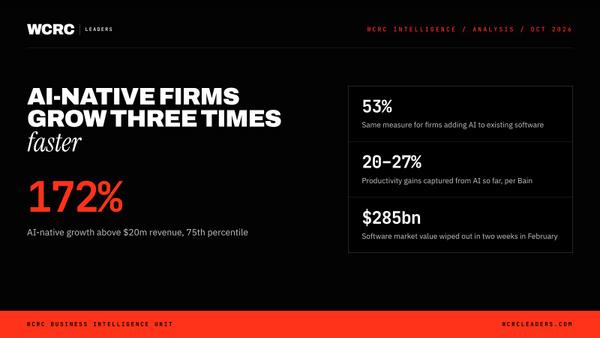
AI-native vs AI-retrofit: the growth gap incumbents should study
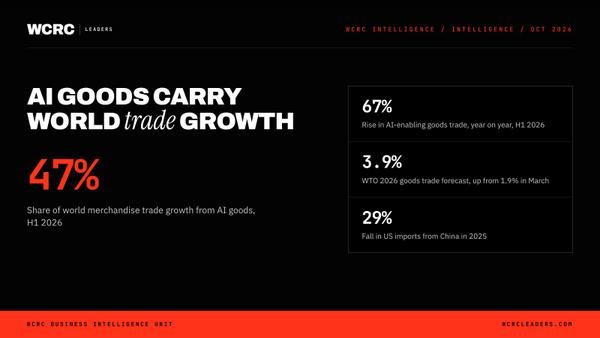
The AI trade economy: chips and servers now carry almost half of world trade growth
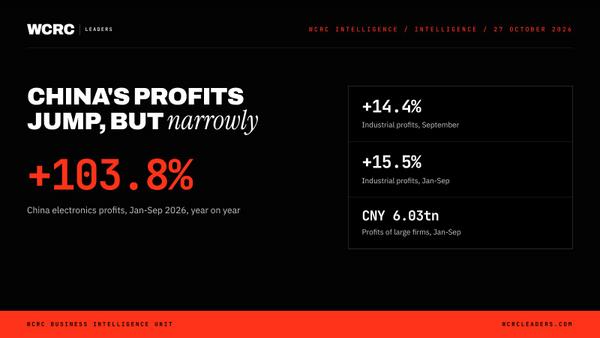
China's profits jump 14.4%: chips and metals boom, steel and cars bleed
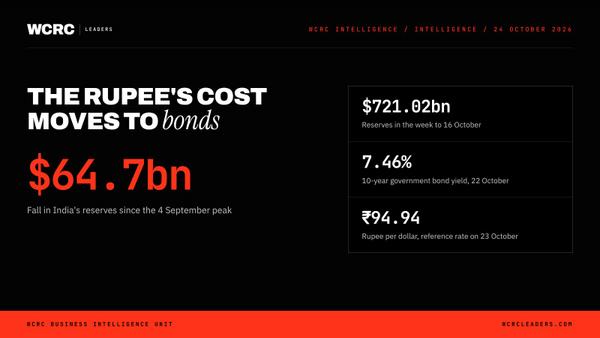
India's 10-year yield hits 7.46% as reserves fall $64.7bn from peak
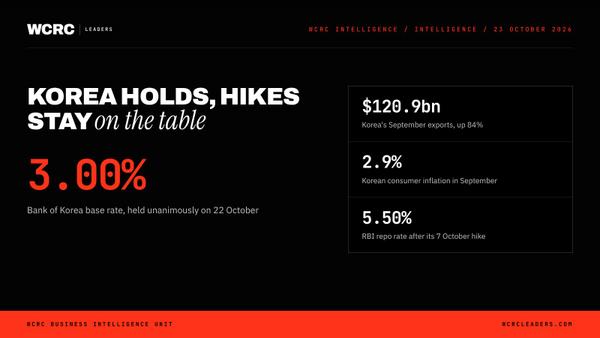
Bank of Korea holds at 3.00% and keeps more hikes on the table
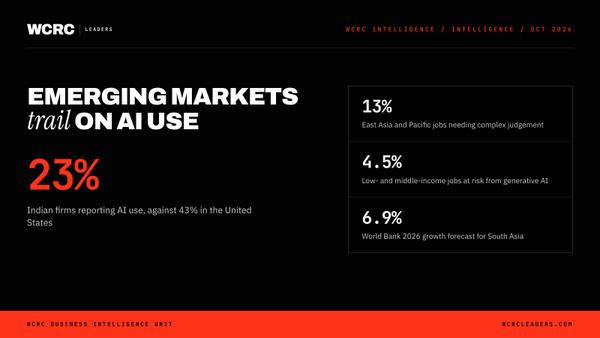
The AI adoption gap: what the World Bank's new numbers say about emerging markets
Filed under