WCRC Intelligence
Fed holds at 3.75-4%, but a 10-2 vote keeps Gulf and Asia on alert
The US Federal Reserve paused on 28 October after September's hike. Two of its twelve voters wanted another quarter point, and that split matters more to boards in Riyadh, Dubai, Mumbai and Jakarta than the pause itself.
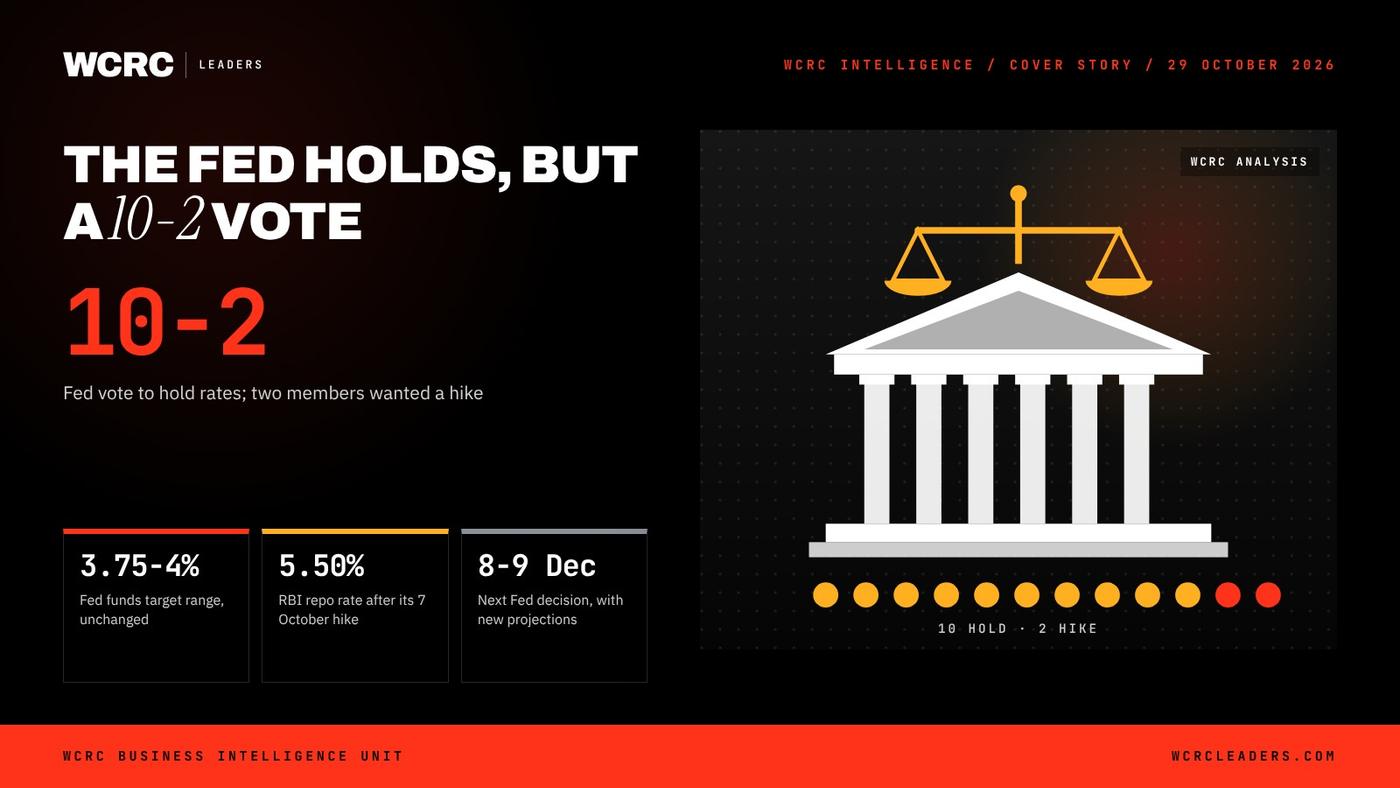
At a glance: WCRC Leaders' assessment: the Fed's pause is a hold, not a turn, and boards in India, the Gulf and Asia should budget for dollar funding costs staying high into 2027. On 28 October the Federal Open Market Committee kept its target range at 3-3/4 to 4 percent by a 10-2 vote, with Lisa D. Cook and Beth M. Hammack preferring a 1/4 point rise. Gulf central banks that track the Fed held their September hikes, India's central bank is already tightening, and Asian lenders are defending currencies.
What did the Fed decide, and why does the dissent matter?
The Federal Open Market Committee left the federal funds target range at 3-3/4 to 4 percent at the end of its 27-28 October meeting. On 16 September it had raised the range by 1/4 point, 12-0.
This time the vote was 10-2. Lisa D. Cook and Beth M. Hammack dissented, preferring to raise the range by another 1/4 point at this meeting. Dissent for tighter policy signals that the next move is more likely up than down.
The statement's language supports that reading. The committee said "Economic activity is expanding at a strong pace", an upgrade from the "solid pace" it described in September. It repeated, word for word: "Inflation remains elevated." And it added: "While uncertainty remains elevated owing, in part, to geopolitical developments, domestic spending has been resilient."
That is not a central bank about to ease. The next decision is due on 8-9 December, with fresh economic projections. Minutes of the October meeting are due three weeks after the decision, around 18 November.
Analysis: In the terms of SeeClear, a model in WCRC's Guru Management Codex, boards should separate fact from projection before setting 2027 budgets. The facts are a held range, a 10-2 vote for tighter policy and inflation called "elevated". The belief that US rates will fall next year is a projection, and nothing in this statement supports it. Mistaking the rope for the snake either way, reading the pause as easing or the dissent as a certain hike, leads to mispriced plans.
What does this mean for Gulf central banks and their pegs?
Saudi Arabia's riyal and the UAE's dirham are pegged to the US dollar, so their central banks typically move policy rates in step with the Fed.
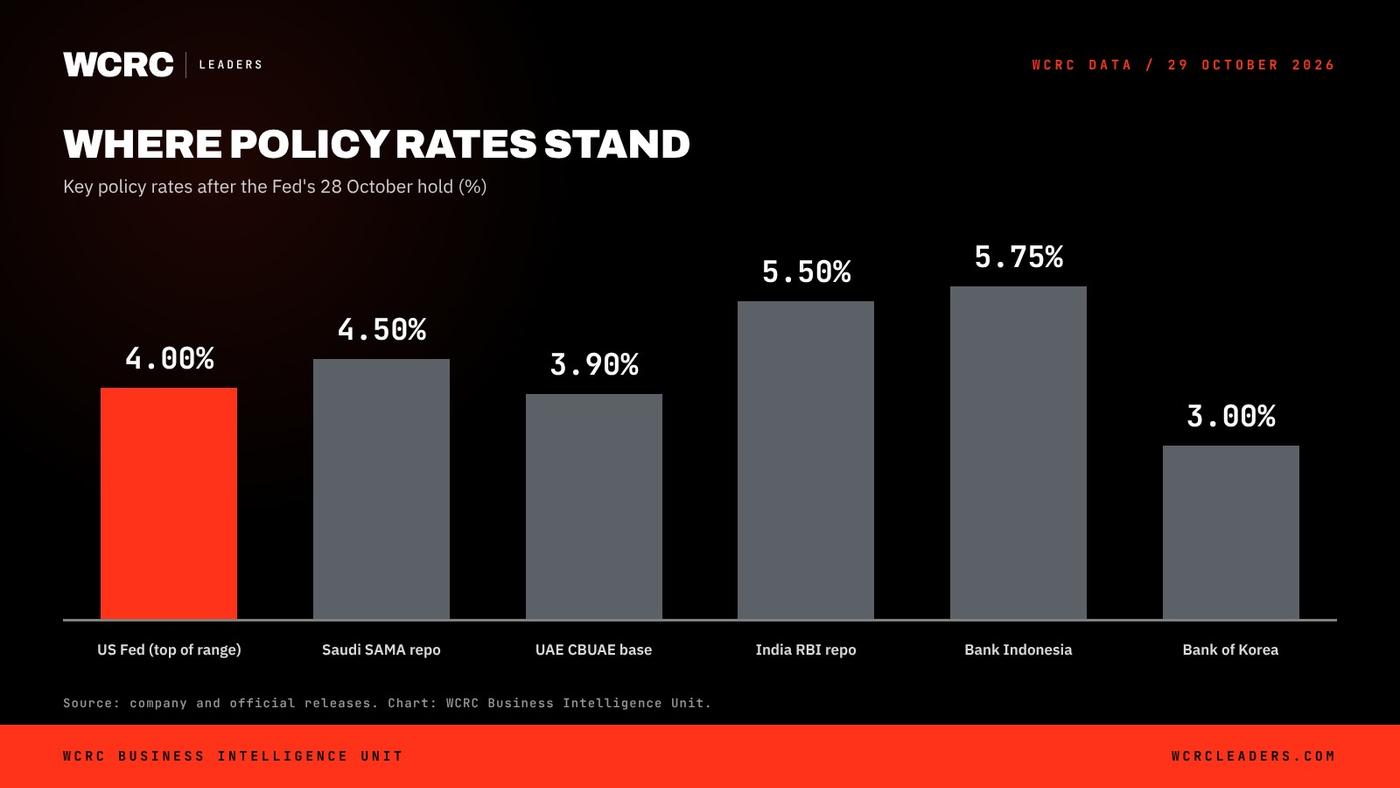
On 16 September, the same day as the Fed's hike, the Saudi Central Bank (SAMA) raised its repo rate by 25 basis points to 4.50% and its reverse repo rate by 25 basis points to 4.00%. The Central Bank of the UAE (CBUAE) raised its Base Rate by 25 basis points to 3.9% from 3.65%, effective 17 September, taking its overnight standing credit facility to 4.4%. The CBUAE says its Base Rate is "anchored to the US Federal Reserve's IORB", the interest rate the Fed pays on reserve balances.
At the time of writing, neither SAMA nor the CBUAE had published a notice responding to the 28 October decision. With the Fed unchanged, the peg gives them little reason to move. SAMA cut its repo rate to 4.50% in October 2025 and to 4.25% that December, then had to raise it back to 4.50% this September. A Fed hike in December would most likely be matched again, lifting the cost of riyal and dirham borrowing for project finance, real estate and the giga-project supply chain.
Analysis: Read through the Fortress Model of Crisis Leadership, another model in the Guru Management Codex, the peg changes where crisis preparation sits. A pegged central bank cannot cushion local borrowers against a Fed move, so the defences have to be built inside the company, in fixed-rate funding, covenant headroom and liquidity, before December rather than after.
How exposed is the rupee, and what is the Reserve Bank of India doing?
India does not peg, but feels the same pressure. The Reserve Bank of India's Monetary Policy Committee raised the repo rate by 25 basis points to 5.50% on 7 October, its first rate hike since 2023. The vote was unanimous; the stance moved to "calibrated tightening", and its resolution says rate cuts are "off the table in the near term". The standing deposit facility sits at 5.25% and the marginal standing facility at 5.75%.
The resolution names the Fed's September hike as reinforcing expectations of higher global rates. Governor Sanjay Malhotra's statement points to "rising bond yields in advanced economies and an appreciating dollar" as forces keeping global markets fragile.
Foreign portfolio investors took out a net US$10.3 billion between April and 5 October. India's crude basket averaged US$116.1 a barrel in September, up from US$82.0 in July. Foreign exchange reserves stood at US$734.6 billion on 2 October; by 16 October they were US$721.0 billion. Against that, net non-resident deposit inflows surged to US$119.2 billion, from US$5.6 billion a year earlier, after measures taken in June, a defence whose cost WCRC has traced through to bank margins.
The RBI projects CPI inflation of 5.2% for 2026-27, peaking at 6.0% in the October-December quarter, and GDP growth of 7.1%. Its next meeting runs from 2 to 4 December. WCRC reported the 10-year government bond yield at 7.46% on 22 October.
Analysis: Read through WCRC's Corporate Value Intelligence framework for interpreting enterprise value, this is a valuation story too. For the listed companies in WCRC 1000, India's Most Valuable Enterprises 2026, dearer dollar funding, a pressured rupee and portfolio outflows all reach market value: through interest and hedging costs, and through what foreign investors will pay for Indian equity. Enterprises with dollar debt and rupee revenue are the most exposed.
Are Asia's other central banks following?
Several are leaning the same way. Bank Indonesia held its BI-Rate at 5.75% on 21 October but raised its deposit facility rate to 5.00%, saying it is "firmly committed to maintaining Rupiah exchange rate stability". The rupiah stood at Rp17,985 per dollar on 20 October, and the central bank linked its weakness to Middle East tensions and US monetary tightening.
The Bank of Korea held its Base Rate at 3.00% on 22 October by a unanimous vote, after raising it in July and August. Its board said it will "determine the timing and pace of further Base Rate hikes while closely monitoring incoming data", as WCRC reported on Korea's decision. The Fed's pause has not loosened conditions in Asia.
What should boards in India, the Gulf and Asia do now?
Analysis by WCRC Leaders.
Reprice the base case. Run 2027 plans at today's rates plus one further 25 basis point Fed move, and test a second.
Look again at dollar debt. Floating-rate dollar loans and 2027 maturities are candidates for fixing or extending now.
Treat the Gulf peg as a pass-through. Developers and contractors on long-dated projects should check covenant headroom and supplier financing against a further rise.
Watch working capital, and sequence capex. Receivables, inventory and supplier terms are the fastest levers; phase projects rather than cancel them.
The WCRC View
The Fed did not hike on 28 October, but it did not soften either. A 10-2 vote with both dissenters wanting tighter policy, an economy "expanding at a strong pace" and inflation still "elevated" add up to a central bank holding the door open for December. Applying SeeClear, WCRC's Business Intelligence Unit reads the pause as a hold, not a turning point: the fact is tightness, and easing in 2027 is only a projection.
For the Gulf, the arithmetic is mechanical. The CBUAE anchors to the Fed's reserve rate, and SAMA matched the Fed's September hike on the same day. In Fortress Model terms, the peg leaves no local cushion, so preparation is a board job. Groups with long-dated fixed funding gain; leveraged developers and contractors on floating rates lose.
For India, the RBI is already tightening into rising inflation, an oil shock and portfolio outflows. It decides on 4 December, five days before the Fed, and a December Fed hike would raise the odds of a second Indian hike. Through the Corporate Value Intelligence lens, the cost lands on enterprise value, hardest for companies carrying dollar debt against rupee revenue. Rate-sensitive sectors, from housing to vehicle finance, face a harder 2027.
For Asia, policy stays tight: Indonesia is defending the rupiah and Korea is keeping hikes on the table. Exporters with dollar revenues are better placed than importers with dollar costs.
What leaders should do now: plan for higher-for-longer dollar rates, refinance early, and phase rather than cancel investment. What WCRC will watch next: the Fed minutes around 18 November, the RBI decision on 4 December, the Fed's 9 December decision and projections, and whether SAMA and the CBUAE match any move the same day.
WCRC models applied: SeeClear and the Fortress Model of Crisis Leadership (WCRC Guru Management Codex); Corporate Value Intelligence (WCRC 1000).
Quick answers
Q: What did the Fed decide on 28 October 2026? A: It kept the federal funds target range at 3-3/4 to 4 percent by a 10-2 vote. Lisa D. Cook and Beth M. Hammack dissented, preferring a 1/4 point rise.
Q: Did Gulf central banks change rates after the Fed's October decision? A: No notice from SAMA or the CBUAE had been published at the time of writing. Both raised rates by 25 basis points on 16 September, when the Fed last hiked.
Q: Where is India's policy rate? A: The RBI raised the repo rate to 5.50% on 7 October and moved to a "calibrated tightening" stance. Its next meeting is on 2 to 4 December 2026.
Q: When does the Fed meet next? A: On 8 and 9 December 2026, a meeting that includes a new Summary of Economic Projections.
China's 4.5% growth runs on exports, and Asia's boards will feel it

The AI trade economy: chips and servers now carry almost half of world trade growth
China's profits jump 14.4%: chips and metals boom, steel and cars bleed
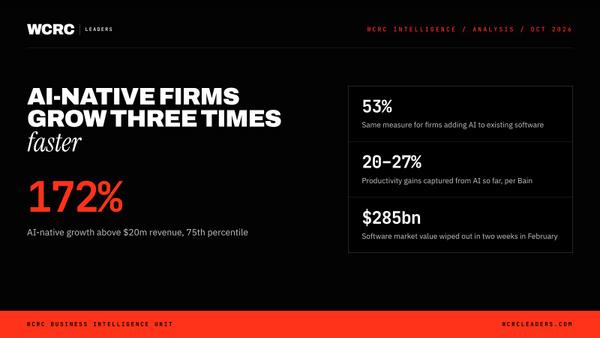
AI-native vs AI-retrofit: the growth gap incumbents should study
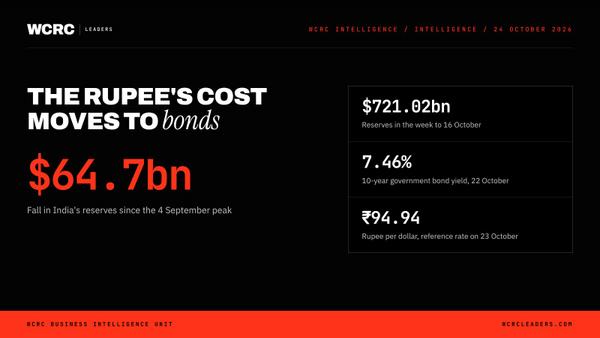
India's 10-year yield hits 7.46% as reserves fall $64.7bn from peak
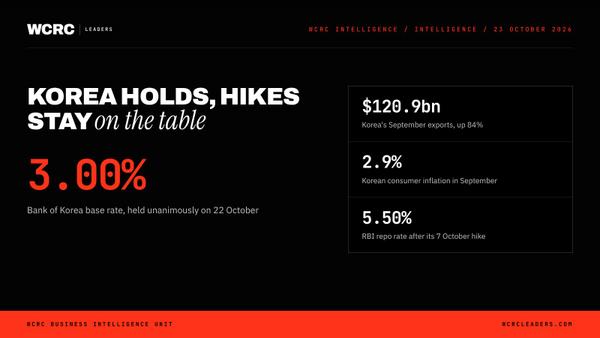
Bank of Korea holds at 3.00% and keeps more hikes on the table
Filed under