WCRC Intelligence
ECB holds at 2.50% as 18.9% energy inflation sets the world's rates
The European Central Bank kept its rates unchanged on 29 October as energy prices pushed euro-area inflation to 3.8%. A day after the Fed's own hold, the message to India, the Gulf and Asia is plain: the oil shock, not growth, is now setting the price of money.
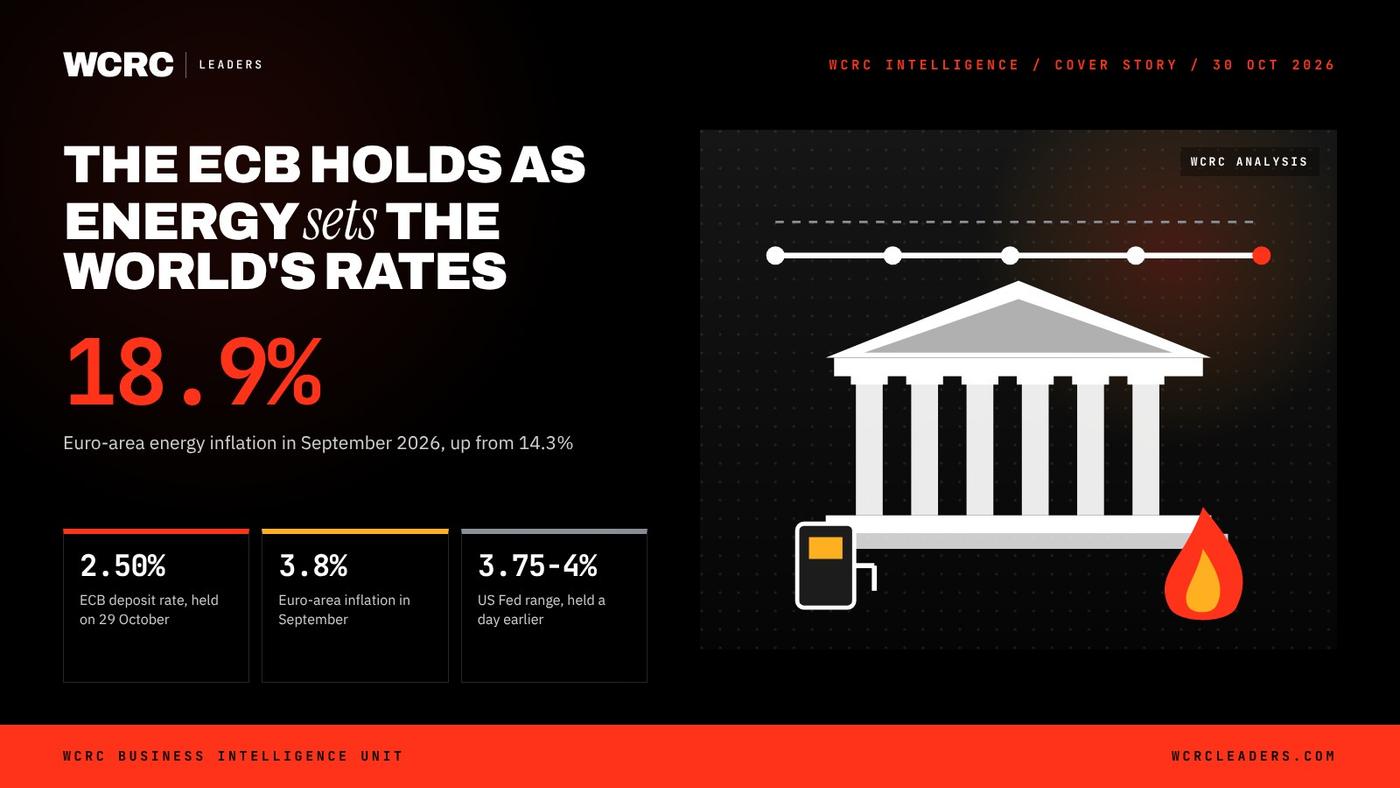
At a glance: WCRC Leaders' assessment: the world's two biggest central banks have stopped easing and are now waiting on the energy shock, so boards in India and Asia should plan for costlier money and dearer fuel well into 2027. The ECB held its deposit rate at 2.50% on 29 October 2026 after September inflation rose to 3.8% and energy inflation reached 18.9%. The US Federal Reserve held at 3.75% to 4% a day earlier. India's petroleum import bill rose by about 31% in September.
What did the ECB decide, and why does it matter outside Europe?
The ECB's Governing Council left its three key rates where they were: 2.50% on the deposit facility, 2.65% on main refinancing operations and 2.90% on the marginal lending facility. It said it is "not pre-committing to a particular rate path" and will decide meeting by meeting.
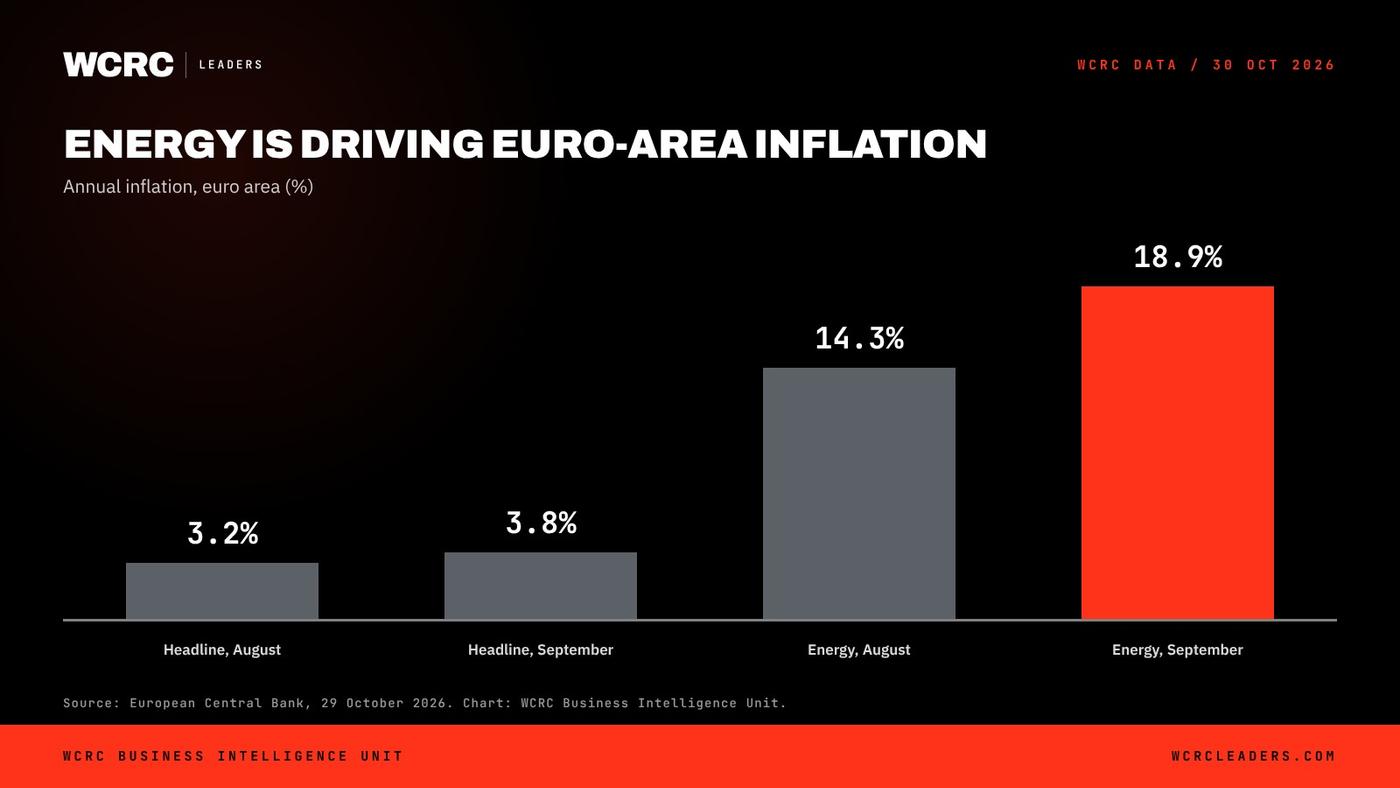
The numbers behind the hold are stark. Euro-area inflation rose to 3.8% in September from 3.2% in August. Energy inflation jumped to 18.9% from 14.3%. Inflation excluding energy edged up only to 2.3% from 2.1%, and services inflation to 3.2%. In other words, almost all of the rise is energy.
ECB President Christine Lagarde put it directly: "Energy prices have continued to rise, posing upside risks to the inflation outlook and downside risks to the growth outlook." She traced the rise to "a combination of oil prices, but more importantly, petrol, fuel, gas, and of course refining margins." The statement noted that diesel and petrol prices reached new peaks in September.
The ECB tied its risks to the Middle East conflict and to Russia's war against Ukraine, and warned that gas prices could climb if supply is disrupted further or if a cold winter meets low storage. It also said financing conditions had tightened since its last meeting, with Lagarde noting in her press conference that 10-year sovereign yields had risen by about 35 basis points since the September projections.
Europe is the cleanest test of an energy shock. Inflation excluding energy is near target and compensation per employee rose 3.3% in the second quarter, yet the ECB will not ease.
Is this now a global pattern?
Yes. The US Federal Open Market Committee held its target range at 3.75% to 4% on 28 October, by a 10 to 2 vote. Two members, Lisa D. Cook and Beth M. Hammack, wanted a further quarter-point rise. The Fed said inflation "remains elevated" and that uncertainty is high "owing, in part, to geopolitical developments". WCRC covered that decision and its Gulf and Asian read-across in Fed holds at 3.75-4%, but a 10-2 vote keeps Gulf and Asia on alert.
India moved first. On 7 October the Reserve Bank of India's Monetary Policy Committee raised the repo rate by 25 basis points to 5.50%, its first increase since February 2023, and shifted its stance to "calibrated tightening". The MPC pointed to "the re-escalation of the conflict in West Asia and the consequent sharp volatility in crude oil prices". WCRC set out what that means for company plans in India's first rate hike since 2023.
The Fed is holding with dissents for a rise, the ECB with no promise either way, and the RBI is tightening. None is cutting, and none has signalled that a cut is near.
What does the energy shock mean for India's import bill?
The RBI's 7 October statement shows the Indian crude basket at US$82.0 a barrel in July, US$90.2 in August and US$116.1 in September. That is a rise of about 42% in two months.
The trade figures show the cost. India's merchandise imports reached US$74.61bn in September 2026, up from US$69.08bn a year earlier, the Ministry of Commerce and Industry reported. Non-petroleum imports were US$56.27bn. The gap between the two, which is the petroleum import bill, comes to about US$18.34bn, against about US$14.03bn in September 2025: a rise of roughly 31%. The overall picture is softened by strong exports. Merchandise exports rose to US$44.40bn and total exports of goods and services to US$80.75bn, and the combined trade deficit narrowed to US$13.30bn. WCRC looked at that export run in India's $476bn half-year.
The RBI now projects consumer inflation at 6.0% for October to December and 5.2% for the full year 2026-27. It warned of "high volatility in international oil prices" as a near-term source of price pressure.
Refiners show both sides of the shock. Hindustan Petroleum Corporation, one of WCRC 1000, India's Most Valuable Enterprises 2026, is one of the companies at the centre of that bill, as WCRC examined in HPCL earns ₹3,625 crore as $116 crude tests India's oil bill. The open question for the economy is who carries the rest of the cost: refiners, the government, or the consumer at the pump.
Who gains and who loses in the Gulf and Asia?
This section is WCRC analysis drawn from the figures above.
Gulf producers gain on price, but not cleanly. Higher crude lifts export revenue and fiscal room. Yet the same conflict that lifts prices raises risk for shipping, insurance and investment in the region, and higher global rates make the debt that funds Gulf diversification dearer. Most Gulf currencies are pegged to the dollar, so their central banks tend to track the Fed, so a Fed that will not cut keeps borrowing costs high for Gulf companies.
Asian exporters face a squeeze from two sides. Energy importers such as Japan, Korea and India pay more for every barrel, while their buyers in Europe face 3.8% inflation and tighter credit. WCRC tracked this in AI chips lift Japan's exports 16.7% as oil nearly doubles its deficit. Exporters tied to the AI build are holding up best; makers of goods that European households buy on credit are the most exposed.
What should CEOs and boards in India, the Gulf and Asia do now?
Read through SeeClear, a model in WCRC's Guru Management Codex, the first task is to separate fact from projection. The fact is that euro-area inflation excluding energy is 2.3% and wage growth is easing. The projection, still unproven, is that energy will feed through into wages and services. Boards that budget as if the second has already happened risk cutting investment too early. Boards that ignore it risk being caught short on pricing.
The Fortress Model of Crisis Leadership, from the same codex, points to the practical response: secure the essentials first. That means fuel and freight contracts, foreign-currency borrowing and working capital, before strategic spending is reconsidered.
In the terms of WCRC's Price Power Model, the question for consumer and industrial brands is how much of a higher energy bill they can pass on before buyers switch. With European inflation at 3.8% and India's RBI projecting 6.0% for the coming quarter, that room is narrowing.
The WCRC View
The energy shock has become the main input to monetary policy on three continents. The ECB will not ease with energy inflation near 19%, the Fed is split on whether to tighten, and the RBI has already raised rates. WCRC's call: no major central bank that matters to India, the Gulf or Asia is likely to cut while the crude basket stays well above US$100.
Who gains: Gulf producers on revenue, exporters tied to AI hardware, and refiners able to manage margins. Who loses: energy-intensive manufacturers, importers paying in dollars, and consumer brands with thin pricing room.
Read through Corporate Value Intelligence, WCRC's framework for interpreting enterprise value, the risk for listed Indian companies is a double hit: higher fuel costs on the earnings line and higher rates on the discount rate applied to those earnings.
What leaders should do now: test plans at crude of US$100 and US$130; lock in energy and freight costs where the market allows; review dollar and euro debt that rolls over in the next 12 months; and be clear about pricing power before raising prices.
What WCRC will watch: the Fed's December meeting, the ECB's next decision and projections, India's October trade data in mid-November, and whether the Indian crude basket holds above US$110.
WCRC models applied: SeeClear (Guru Management Codex), Fortress Model of Crisis Leadership, Price Power Model (Brand & Marketing Codex), Corporate Value Intelligence.
Quick answers
Q: What rates did the ECB set on 29 October 2026? A: It held the deposit facility rate at 2.50%, the main refinancing rate at 2.65% and the marginal lending rate at 2.90%.
Q: How high is euro-area inflation? A: Headline inflation was 3.8% in September 2026, up from 3.2% in August. Energy inflation was 18.9%, and inflation excluding energy was 2.3%.
Q: What did the US Federal Reserve decide? A: On 28 October 2026 it held the federal funds target range at 3.75% to 4%, by a 10 to 2 vote, with two members preferring a rise.
Q: How has the oil shock hit India's import bill? A: The Indian crude basket rose from US$82.0 in July to US$116.1 a barrel in September. India's petroleum imports in September were about US$18.34bn, roughly 31% higher than a year earlier.
China's 4.5% growth runs on exports, and Asia's boards will feel it
Fed holds at 3.75-4%, but a 10-2 vote keeps Gulf and Asia on alert
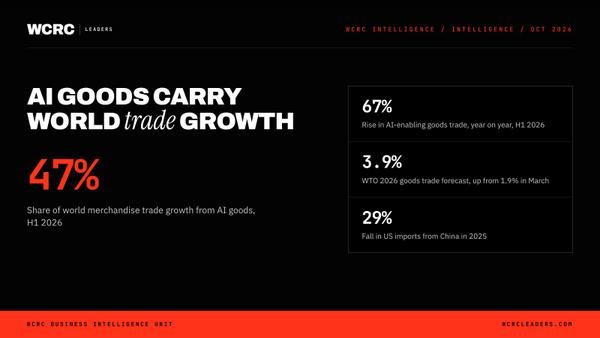
The AI trade economy: chips and servers now carry almost half of world trade growth
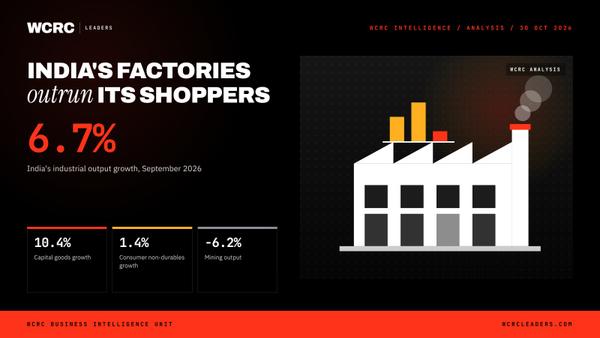
India's factory output grows 6.7% as capital goods outrun consumers
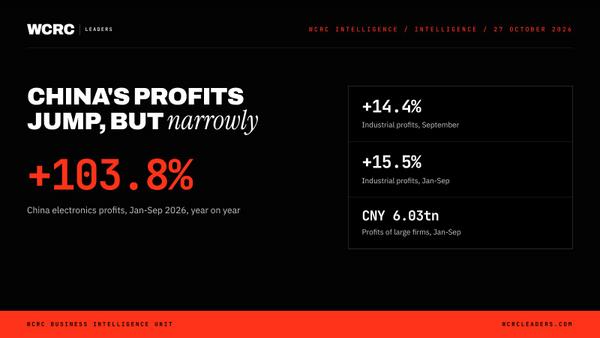
China's profits jump 14.4%: chips and metals boom, steel and cars bleed

AI-native vs AI-retrofit: the growth gap incumbents should study
Filed under