Technology
Microsoft's $677bn backlog: the AI build Asia now has to supply
Microsoft has more contracted cloud demand than it can yet deliver, and it doubled quarterly capital spending to $39.4bn to catch up. For Indian IT firms, Gulf data-centre planners and Asian chipmakers, that gap between orders and capacity is now the main commercial fact in technology.
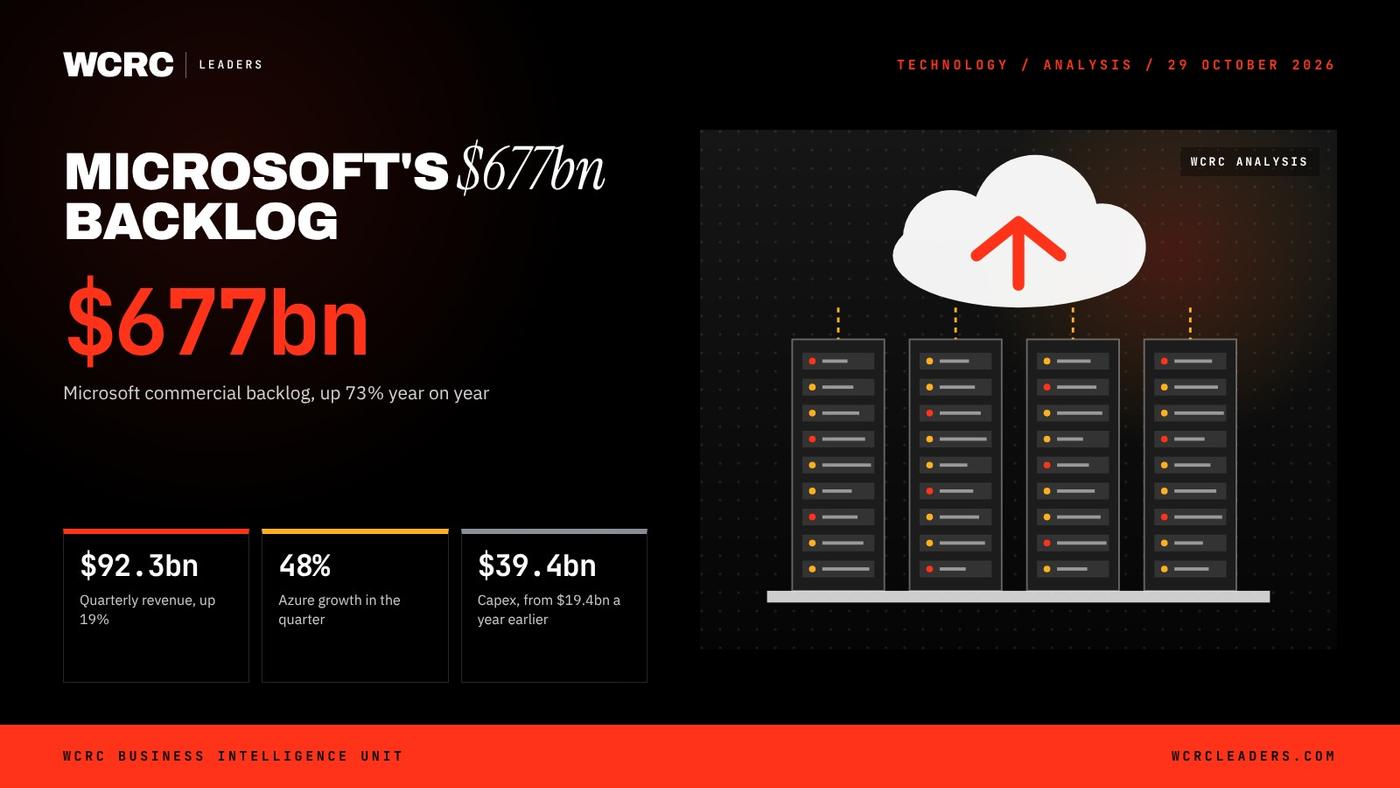
At a glance: WCRC Leaders' assessment: Microsoft's $677bn backlog shows the AI cycle is now limited by power, chips and buildings rather than by customer demand, and that shifts bargaining power towards whoever controls those inputs. Microsoft reported on 28 October 2026 for the quarter to 30 September: revenue of $92.3bn, up 19%, Azure up 48%, and additions to property and equipment of $39.4bn against $19.4bn a year earlier. For boards in India, the Gulf and Asia, the question is which side of that bottleneck they sit on.
What did Microsoft actually report?
Microsoft, a WCRC MegaBrand in enterprise cloud, productivity and AI, opened its 2027 financial year with revenue of $92.3bn, up 19%. Operating income rose 21% to $45.9bn. GAAP net income climbed 32% to $36.6bn, or $4.92 a diluted share. Excluding its OpenAI investment, which added $207m this quarter after a $3.1bn hit a year earlier, earnings per share were $4.89, up 18%.
The cloud numbers carry the story. Microsoft Cloud revenue reached $63.9bn, up 30%, about 69% of the group total. Azure grew 48% to $33.2bn, with no currency effect. Microsoft 365 commercial cloud grew a steadier 17%.
Under its new reporting structure, the Agents and Infra segment, which holds cloud and enterprise software, earned $76.8bn, up 25%. Devices and Consumer, covering Windows, Xbox and search, fell 3% to $15.5bn, with Windows OEM and devices revenue down 22%.
Chief executive Satya Nadella said in the release: "We are delivering greater capability, choice, control, and cost efficiency for customers across our entire stack." Chief financial officer Amy Hood said: "Results exceeded expectations across revenue, operating income, and earnings per share."
Why does the $677bn backlog matter more than the revenue?
Commercial remaining performance obligation, the value of signed contracts not yet recognised as revenue, rose 73% to $677bn. That implies roughly $391bn a year earlier, so close to $286bn of net new commitments arrived in twelve months. Annualise this quarter's $92.3bn and Microsoft runs at about $369bn a year: the backlog is worth roughly 1.8 years of total sales.
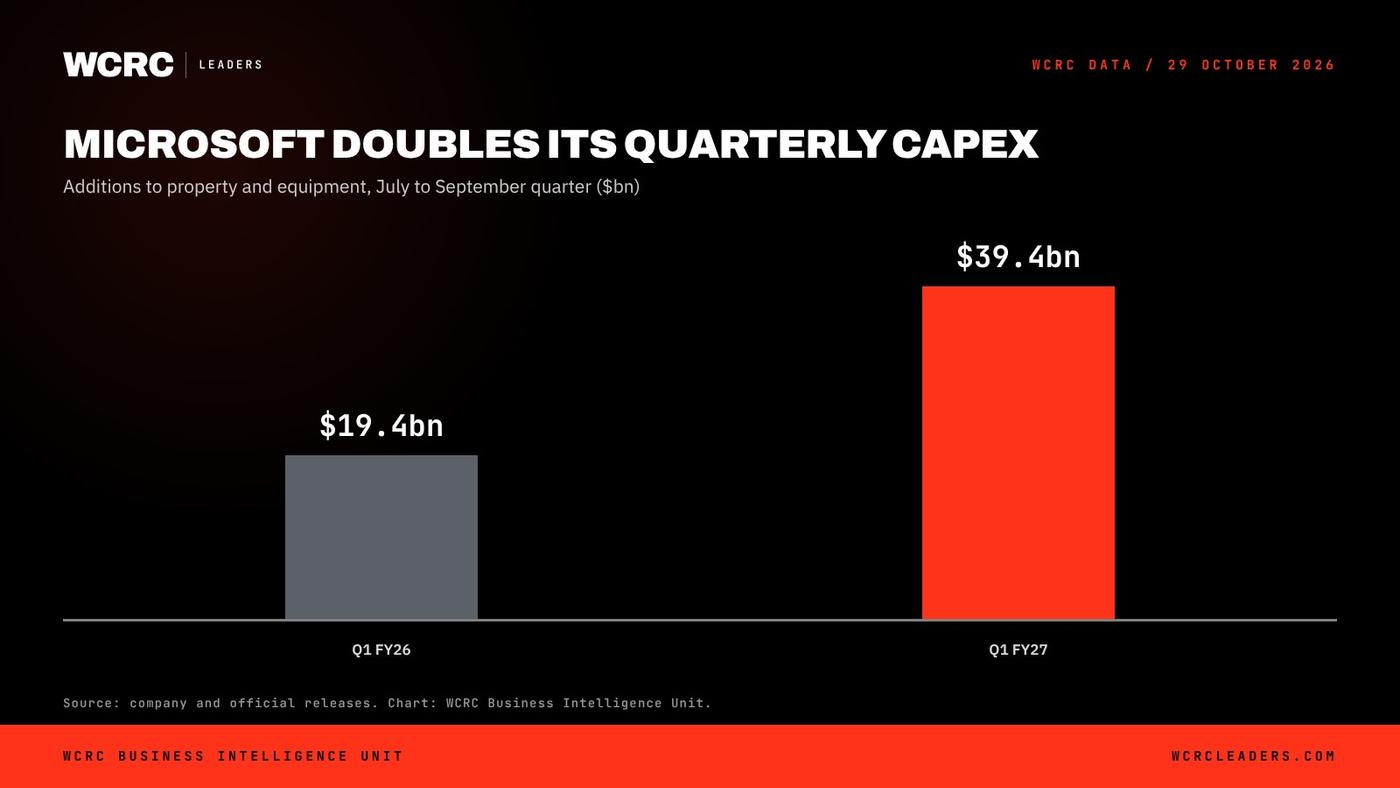
Additions to property and equipment, the cash measure of spending on data centres, servers and chips, rose from $19.4bn to $39.4bn: about 43 cents of every revenue dollar, against roughly 25 cents a year ago, and an annual rate of about $157bn.
WCRC analysis: a year ago, investors asked whether AI demand would show up. Now demand is signed and the open question is whether chips, power and construction can arrive fast enough to turn $677bn of contracts into revenue on schedule.
What does it mean for Indian IT services?
Microsoft's money is flowing into hardware and capacity, not large services teams. Infosys, one of WCRC 1000, India's Most Valuable Enterprises 2026, reported September-quarter revenue of $5,145m, up 1.5% in constant currency, and cut its full-year growth guidance to 1% to 2%. AI work reached 10.5% of revenue and large deals totalled $5.2bn, including one of over $2bn. AI demand is real for Indian firms, but it arrives in smaller, outcome-priced pieces while legacy work shrinks, as WCRC set out in Infosys cuts FY27 guidance to 1-2% as AI reaches 10.5% of revenue.
Some Indian firms are moving towards the scarce asset itself. Tata Consultancy Services, one of WCRC 1000, India's Most Valuable Enterprises 2026, announced in November 2025 a partnership with TPG for HyperVault, its AI data-centre business, planning more than a gigawatt of capacity over the next few years, with the partners committing up to Rs 18,000 crore. Read through the Future Readiness Compass in WCRC's Brand & Marketing Codex, which asks whether a brand is positioned for the next five years, a services name that adds owned capacity places itself on the side of the bottleneck that Microsoft's numbers say will hold value.
For HCLTech and Wipro, both among WCRC 1000, India's Most Valuable Enterprises 2026, the opportunity lies in migration, data engineering and running AI workloads for clients who have signed Azure commitments and now need to use them. The risk is that the same agents Microsoft sells reduce the number of people needed for that work, a pressure WCRC examined in Junior hires fall to 9% at Anthropic: a warning for India's IT pyramid.
WCRC analysis: in the terms of the Kayaka-Dasoha Value Loop, a model in WCRC's Guru Management Codex built on the dignity of honest work in an automated economy, the test for Indian IT boards is not headcount alone. It is whether engineers whose routine tasks go to agents move into the outcome-priced AI work Infosys now reports at 10.5% of revenue, or are simply released.
India is also a destination for the capex itself. Microsoft committed in December 2025 to invest $17.5bn in India over 2026 to 2029, its largest investment in Asia, including a new hyperscale cloud region in Hyderabad with three availability zones, scheduled to go live in mid-2026.
What does it mean for Gulf data-centre and power plans?
The Gulf offers what the AI build is short of: capital, land and the ability to add power quickly. Microsoft has said it will spend $15.2bn in the UAE between 2023 and 2029. Just over $7.3bn had been spent by the end of 2025, including a $1.5bn equity investment in G42 and more than $4.6bn of data-centre capex, with more than $5.5bn of further infrastructure capex planned for 2026 to 2029. Microsoft also secured US export licences in September 2025 to ship Nvidia GB300 chips to the UAE, equivalent to 60,400 additional A100 chips.
WCRC analysis: the binding cost of an AI campus is increasingly electricity and cooling, not the building. Gulf utilities, sovereign funds and developers that can guarantee firm power and US-approved chip access will find hyperscalers willing to sign long contracts; those without export approvals will find capacity hard to fill. Moves such as the UAE's €15bn Greece pledge alongside G42's AI factory plans show the Gulf intends to own this infrastructure, not only host it.
Who supplies the build in Asia?
Much of Microsoft's $39.4bn becomes orders in Asia. Accelerators from Nvidia, a WCRC MegaBrand in AI platforms and enterprise AI infrastructure, are manufactured in Taiwan. TSMC reported third-quarter revenue of $46.72bn, up 41.2% in dollar terms, with net income up 68.7% and a gross margin of 66.4%; it guided fourth-quarter revenue to $52.3bn to $54.3bn. Advanced nodes of 7nm and below made up 79% of its wafer revenue.
Memory is the other choke point, as WCRC set out in SK hynix's 80% margin quarter: who pays for the AI memory squeeze. Advanced packaging is a third, which is why equipment makers are buying into the technology, covered in Applied Materials goes to 20% of Besi.
WCRC analysis: the Price Power Model in WCRC's Brand & Marketing Codex asks how much premium a seller can charge before buyers switch. With $677bn of signed demand waiting on capacity, Microsoft's buyers of leading-edge chips and memory have almost nowhere to switch to, which is what a 66.4% gross margin at TSMC reflects. That favours Taiwan and Korea today. India's electronics and data-centre equipment makers, from power systems to cooling and cabling, can win share in the less specialised layers, where price power is thinner, but only if they deliver at hyperscale timelines.
The WCRC View
The WCRC Business Intelligence Unit reads Microsoft's quarter as confirmation that the AI build is now supply-constrained. With $677bn signed against annualised revenue of about $369bn, the next two years belong to whoever can deliver chips, power and finished halls.
- Who gains: owners of scarce inputs. Read through the Price Power Model, Taiwanese foundries and Korean memory makers hold the premium while buyers cannot switch. So do Gulf states with firm power and chip approvals, and Indian groups moving early into data-centre ownership.
- Who is squeezed: services firms that sell labour by the hour. Infosys's 1% to 2% guidance shows how little of the boom reaches traditional services revenue.
- What CEOs and boards should do now: in India, apply the Future Readiness Compass question to the portfolio: is AI revenue replacing legacy work or adding to it? Price more contracts on outcomes, and in the spirit of the Kayaka-Dasoha Value Loop, plan where displaced routine work goes before agents remove it. In the Gulf, treat grid capacity and chip licensing as strategic assets and lock in long-term offtake. Across Asia, suppliers should secure multi-year commitments while buyers are short of capacity.
- What WCRC will watch next: whether Microsoft's capex holds near $40bn a quarter, whether backlog keeps outrunning revenue, the Hyderabad cloud region, and Indian IT guidance in the December quarter.
TCS, Infosys, Wipro, HCL Technologies and Microsoft India are all named among India's Most Loved 250 Workplaces 2026 by WCRC, a reminder that the talent these firms hold remains a strategic asset as their business models shift.
WCRC models applied: Future Readiness Compass and Price Power Model (Brand & Marketing Codex); Kayaka-Dasoha Value Loop (Guru Management Codex).
Quick answers
Q: How much contracted demand does Microsoft have? A: Commercial remaining performance obligation was $677bn at 30 September 2026, up 73% year on year.
Q: How much did Microsoft spend on infrastructure in the quarter? A: Additions to property and equipment were $39.4bn, against $19.4bn a year earlier.
Q: How fast did Azure grow? A: Azure revenue grew 48% to $33.2bn, and Microsoft Cloud revenue rose 30% to $63.9bn.
Q: What has Microsoft committed to India and the UAE? A: $17.5bn in India over 2026 to 2029, and $15.2bn in the UAE over 2023 to 2029.
SK hynix shelves the Solidigm IPO: what it says about the AI capex cycle
Junior hires fall to 9% at Anthropic: a warning for India's IT pyramid
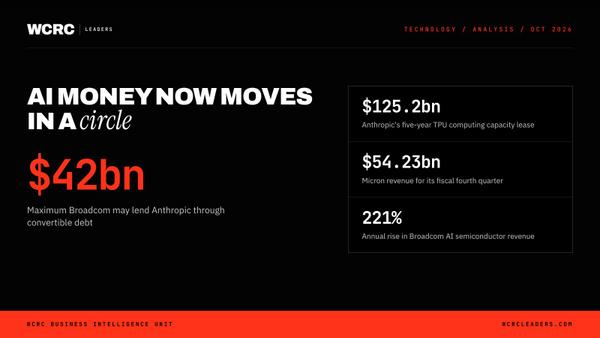
Supplier-funded compute: what CFOs should read into the AI financing loop
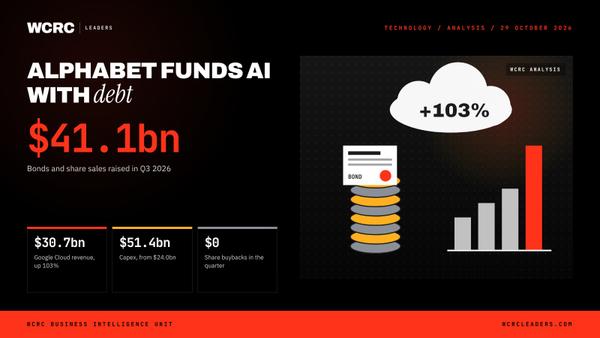
Google Cloud doubles revenue as Alphabet funds AI with debt

China's 40-technology export list puts India's solar push on notice
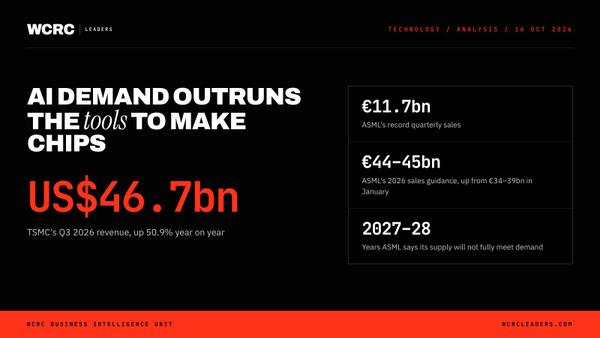
TSMC and ASML post records, and ASML says supply falls short to 2028
Filed under