Technology
Taiwan's 14.36% quarter: the AI hardware boom runs through one island
Taiwan's economy grew 14.36% year on year in the third quarter, carried by AI-driven exports and the factories built to make them. For buyers and rivals from Delhi to Abu Dhabi, the figure is a measure of how concentrated the world's AI supply has become.
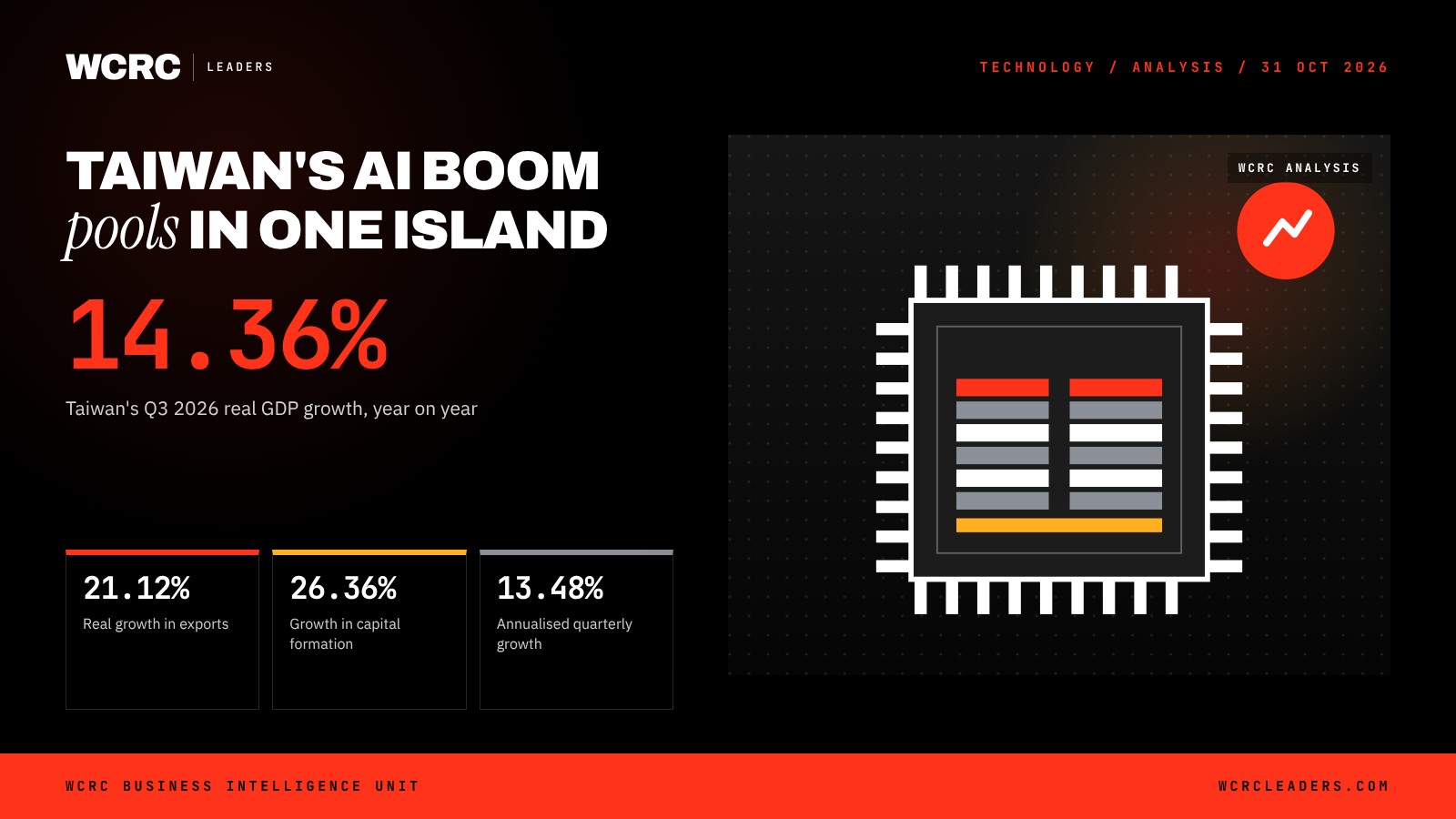
At a glance: WCRC Leaders' assessment: Taiwan's quarter shows that the AI build-out is not spreading its gains across Asia so much as pooling them in one economy, and that is a supply risk for every buyer and an opening for every challenger. Taiwan's statistics agency, DGBAS, said on 30 October that real GDP rose 14.36% on the year in Q3 2026 and 13.48% at a seasonally adjusted annualised rate. Exports of goods and services grew 21.12%. A preliminary revision is due on 27 November.
What did Taiwan actually report?
The advance estimate from the Directorate-General of Budget, Accounting and Statistics (DGBAS) puts real growth in July to September at 14.36% on a year earlier. On a quarter-on-quarter basis, seasonally adjusted and annualised, the economy expanded 13.48%.
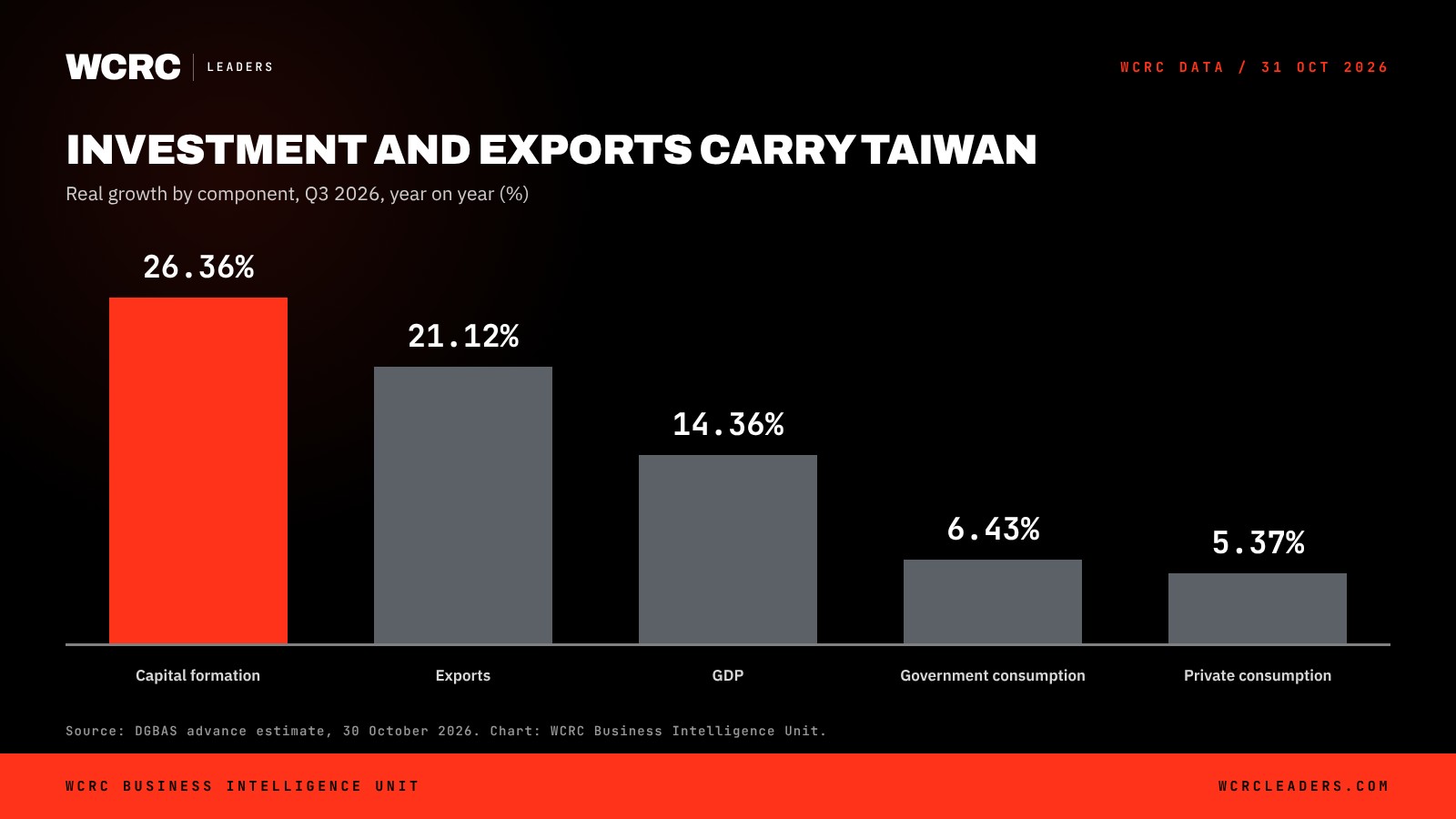
The detail matters as much as the headline. Exports of goods and services rose 21.12% in real terms and added 15.95 percentage points to growth. Imports rose 20.12% and subtracted 11.01 points, leaving net external demand with a contribution of 4.94 points. DGBAS attributes the export strength to "emerging technologies, such as artificial intelligence (AI)" and related applications.
Gross capital formation grew 26.36% and contributed 6.32 points, with DGBAS pointing to machinery and equipment, transport equipment, intellectual property products and construction. Private consumption rose 5.37% (2.30 points) and government consumption 6.43% (0.79 points).
WCRC analysis of those contributions: roughly two-thirds of the quarter's growth came from domestic demand, mainly investment. Taiwan is not only shipping AI hardware; it is spending heavily at home to make more of it. That makes the boom harder for other economies to replicate quickly.
How concentrated is the AI trade in Taiwan's exports?
Taiwan's Ministry of Finance reported on 8 October that September exports hit US$87.22bn, up 60.9% on the year, with imports up 51.7% to US$63.59bn and a trade surplus of US$23.63bn.
The commodity breakdown shows where the money is. Exports of information, communication and audio-video products, a category that includes servers, reached US$39.13bn in September, up 103.0%. Electronic components, which include chips, were US$31.13bn, up 45.3%. For January to September, total exports were US$661.55bn, up 46.2%, of which ICT and audio-video products were US$290.97bn (up 72.4%) and electronic components US$231.58bn (up 45.7%).
By WCRC's calculation from the ministry's tables, those two categories made up about 81% of Taiwan's September exports and about 79% of the nine-month total. One sector now defines the trade of an economy of 23 million people.
The destinations are just as telling. Exports to the United States more than doubled in September, up 106.2% to US$27.46bn, giving the US a 31.4% share of the year-to-date total. Shipments to ASEAN rose 93.4% to US$18.88bn, while those to mainland China and Hong Kong rose a slower 30.2%. WCRC reads the ASEAN surge as evidence that final assembly of AI servers is spreading into South-east Asia even as the core silicon stays in Taiwan.
Why does one company sit at the centre of it?
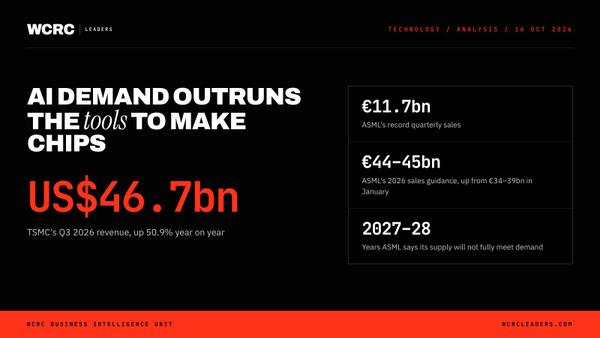
The chip at the heart of most AI servers is made by TSMC. Its third-quarter results, published on 15 October, showed revenue of NT$1,494.24bn (US$46.72bn), up 41.2% on the year in dollar terms. Net income was NT$763.06bn, up 68.7%, at a gross margin of 66.4%. Processes at 7 nanometres and below made up 79% of wafer revenue, with 3nm alone at 33% and the new 2nm node at 8%.
TSMC guided fourth-quarter revenue to US$52.3bn to US$54.3bn. Chief financial officer Wendell Huang pointed to "strong demand for our leading-edge process technologies" and a "steep ramp-up" of 2nm in the coming quarter. WCRC covered the supply side of this story in TSMC and ASML post records, and ASML says supply falls short to 2028.
Korea holds the other critical piece, memory. Samsung, selected among the World's 100 Most Powerful Brands by the Business Intelligence Unit of WCRC, earned almost all of its latest profit from chips, as WCRC reported in Samsung's KRW 107tn quarter: chips earn it all, phones lose money. SK hynix posted margins near 80%, examined in SK hynix's 80% margin quarter: who pays for the AI memory squeeze. Yet Korea's own economy grew far more slowly than Taiwan's, as WCRC noted in Korea's chips lift GDP 1.0% as households pull back. The difference is breadth: Taiwan makes the logic chips, the boards and much of the server.
What does it mean for India's electronics and chip push?
The scale gap is stark. Taiwan exported about US$70bn of ICT products and electronic components in September alone. India's electronic goods exports for the same month were US$5.31bn, up 70.44%, according to commerce ministry data covered in WCRC's India's $476bn half-year: electronics and the US outrun the Gulf shock. India is growing fast from a small base; Taiwan is growing fast from a very large one.
India's state support is now substantial. A government backgrounder dated 17 September says Semicon 1.0 approved 12 manufacturing units with cumulative investment above ₹1.64 lakh crore, including one silicon fab and nine assembly and test units, five of which have begun commercial production. The Union Cabinet approved Semicon 2.0 on 15 July 2026 with an outlay of ₹1,27,500 crore. The same document puts India's semiconductor imports at about US$150bn over FY17 to FY25.
Read through SeeClear, a model in WCRC's Guru Management Codex about separating fact from projection before a major decision, Indian boards should resist two readings at once. The projection is that Taiwan's boom shows India is too late. The fact is that most of India's approved units are assembly and test plants, which is exactly the layer where AI demand is now forcing capacity outside Taiwan, as the ASEAN numbers show. The near-term prize for India is packaging, testing and server assembly for buyers who want a second source, not leading-edge wafers.
What should Gulf AI data-centre buyers take from this?
Gulf states are among the most ambitious buyers of AI compute, with sovereign funds and national champions backing large campuses, as WCRC has tracked in stories such as UAE pledges €15bn more for Greece as G42 eyes an AI factory. Every one of those campuses depends on hardware that passes, at some stage, through Taiwan.
WCRC analysis: TSMC's margins and guidance show that pricing power sits with the supplier. A buyer joining the queue late pays more and waits longer. Gulf procurement teams should assume tight supply into 2027, lock in multi-year allocations through the hyperscalers and server makers they work with, and treat geographic concentration as a board-level risk alongside energy and cooling.
In the terms of WCRC's Future Readiness Compass, which asks whether an organisation is positioned for the next five years, a data-centre strategy built on a single supply corridor is not future-ready, however advanced the chips it secures today.
The WCRC View
Taiwan's 14.36% quarter is the clearest proof yet that the AI investment cycle has a geography, and that geography is narrow. The gains are flowing to the economy that makes the leading-edge chips and the servers built around them, and to a lesser degree to Korea's memory makers and South-east Asia's assembly lines.
Who gains: TSMC and the Taiwanese server supply chain, with pricing power that its fourth-quarter guidance suggests will hold. Who carries the risk: every buyer that has not secured allocation, and every economy whose growth plan assumes AI hardware will become cheap and plentiful soon.
For India's CEOs and boards, the call is to aim where the overflow is. Packaging, testing, components and server assembly are where buyers are already diversifying. Read through WCRC's Corporate Value Intelligence framework for interpreting enterprise value, the market will reward Indian firms that win named AI hardware customers, not those that announce capacity alone.
For Gulf boards, the priority is resilience: multi-year contracts, more than one integration partner, and an honest assessment of what a disruption in the Taiwan Strait would do to their AI timelines. Applying SeeClear means planning for supply as it is, not as forecasts hope it will be.
What WCRC will watch next: DGBAS's preliminary revision on 27 November, Taiwan's October trade data on 9 November, TSMC's 2nm ramp and whether ASEAN's share of Taiwan's exports keeps rising. A sustained shift there would be the first real sign that the AI supply chain is starting to spread out.
WCRC models applied: SeeClear (Guru Management Codex), Future Readiness Compass (Brand & Marketing Codex), Corporate Value Intelligence.
Quick answers
Q: How fast did Taiwan's economy grow in Q3 2026? A: DGBAS's advance estimate, released on 30 October 2026, shows real GDP up 14.36% year on year and 13.48% quarter on quarter at a seasonally adjusted annualised rate.
Q: What drove the growth? A: Exports of goods and services rose 21.12% and added 15.95 percentage points, which DGBAS links to AI and related technologies. Gross capital formation rose 26.36% and added 6.32 points. Net of imports, external demand contributed 4.94 points.
Q: How big were Taiwan's September exports? A: The Ministry of Finance reported US$87.22bn, up 60.9% on the year. ICT and audio-video products were US$39.13bn and electronic components US$31.13bn.
Q: When is the next update? A: Taiwan's October trade data are due on 9 November 2026, and DGBAS will publish preliminary Q3 GDP figures on 27 November 2026.
SK hynix shelves the Solidigm IPO: what it says about the AI capex cycle
Junior hires fall to 9% at Anthropic: a warning for India's IT pyramid

Supplier-funded compute: what CFOs should read into the AI financing loop
Google Cloud doubles revenue as Alphabet funds AI with debt

China's 40-technology export list puts India's solar push on notice
TSMC and ASML post records, and ASML says supply falls short to 2028
Filed under