Technology
China's 40-technology export list puts India's solar push on notice
Beijing wants to control how its most advanced AI and solar manufacturing know-how leaves the country. A registration rule is already in force, and the comment window closes on 15 November.
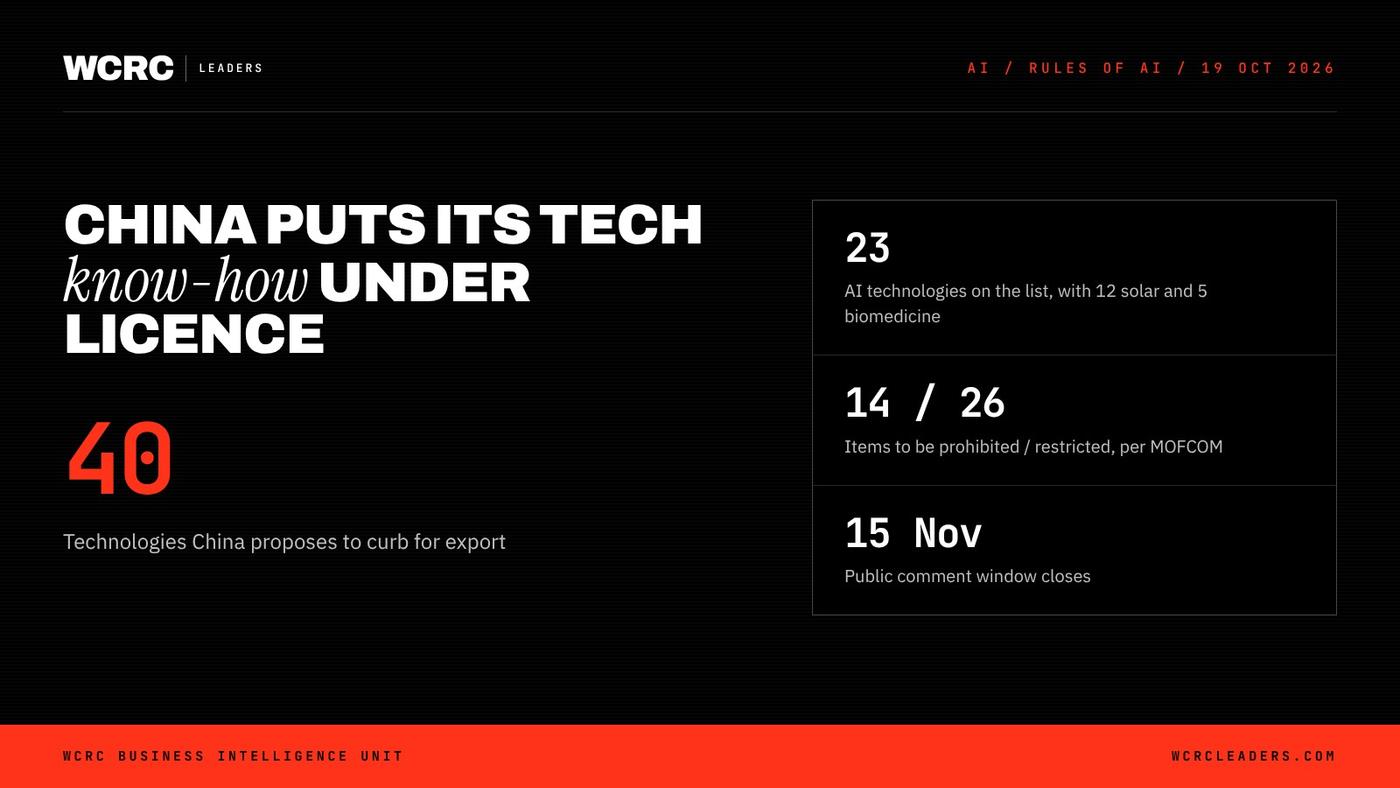
At a glance: WCRC Leaders' assessment: China has started treating its lead in solar manufacturing and frontier AI as strategic assets to be licensed, not sold, and any company planning to buy Chinese factory know-how or run Chinese models on its own servers must now plan for permits. On 16 October 2026 China's Ministry of Commerce (MOFCOM) and Ministry of Science and Technology (MOST) proposed adding 40 technologies to the country's export control catalogue: 23 in AI, 12 in solar photovoltaics and 5 in biomedicine. Exporters must already register before transferring listed technology abroad.
What exactly has China proposed?
MOFCOM and MOST Announcement No. 48 of 2026 does two things. First, it opens a draft revision of the Catalogue of Technologies Prohibited or Restricted from Export, China's main list for controlling outbound transfers of know-how, as opposed to physical goods. Second, it imposes an interim registration regime that took effect on the day of publication.
The 40 proposed additions fall into three groups. The 23 AI items cover large models, AI agents, computing clusters and information processing. The 12 solar items cover polysilicon, wafer and cell manufacturing, including the key and core equipment that carries those technologies. The 5 biomedicine items cover cell and gene therapy, small nucleic acid drugs and pathogenic microorganism technologies.
In a separate question-and-answer statement, a MOFCOM spokesperson said 14 of the 40 items would be prohibited from export and 26 restricted, meaning they could leave China only under a licence. Examples of proposed prohibitions include AI-driven malicious code generation and mutation, and production technology for perovskite and tandem solar cell modules. Examples of restricted items include AI-assisted vulnerability discovery and polysilicon engineering technology for single lines with capacity of 30,000 tonnes a year or more.
The spokesperson called the revision routine trade management "not aimed at any specific country, region or entity".
What changed on 16 October, before any final rule?
The registration requirement is already live. From 16 October until the revised catalogue formally takes effect, any exporter must register on MOFCOM's online business platform before exporting a technology listed in the annex. That includes deals already under way but not yet completed.
Registration is triggered by four situations:
- transferring ownership of a technology abroad, such as an assignment of intellectual property;
- licensing domestic technology for use abroad;
- a change of owner or actual controller of a domestic technology to a foreign party;
- any other situation MOFCOM later specifies.
The third trigger matters for dealmakers: a foreign takeover of a Chinese company holding listed technology can itself count as an export.
Public comments close on 15 November 2026. No date has been given for the final catalogue.
Which AI uses are caught, and which are not?
This is where the detail matters most for companies outside China. Technology already in the public domain through open-source release or academic publication is proposed to fall outside the controls. MOFCOM also said that offering a restricted large model through API calls, app or web interaction, software-as-a-service or lightweight on-device deployment is not treated as an export of large-model technology.
What is caught is local deployment abroad. If a restricted model is installed and run on servers outside China, that falls within export management. Deployment on a Chinese company's own overseas cloud, which the ministry described as relatively controllable, may qualify for automatic licensing. Automatic licensing is also proposed for overseas compute centres that Chinese firms build and run, overseas chip tape-out and joint research.
China's catalogue is not new. MOFCOM and MOST have revised it periodically since 2001. The last full revision, in December 2023, cut the list from 164 items to 134. In July 2025 the two ministries added battery cathode material preparation technology, covering lithium iron phosphate, and added lithium extraction and processing to an existing item. This year's proposal goes further than either: it is the first time frontier AI has entered the list on this scale.
Why does this matter for India's solar ambitions?
India has built solar module capacity at speed. The Ministry of New and Renewable Energy (MNRE) said in March 2026 that capacity on its Approved List of Models and Manufacturers (ALMM) had risen to about 172 GW, from 8.2 GW in 2021, and that cell capacity on List-II had reached 27 GW within seven months of that list's introduction.
The next step is upstream. In March MNRE extended the ALMM framework to ingots and wafers through a new List-III, mandatory for all projects from 1 June 2028. The ministry itself described ingots and wafers as "heavily import-dependent". That is the same part of the chain China now proposes to control: polysilicon lines, crystal pulling, ultra-thin wafers and advanced cell technology.
WCRC analysis: India's upstream plan depends on buying process know-how and production lines, and China is the deepest source of both. MOFCOM said solar technology below the control thresholds "remains freely exportable" and that unlisted equipment is in principle not covered. But it also said that exporting restricted technology linked to production lines, installation, commissioning or upgrades will need a licence. For an Indian manufacturer building a wafer plant to meet the 2028 deadline, the risk is less a ban than delay: a commissioning visit, a process upgrade or a technology licence could now wait on a Beijing permit.
What does it mean for AI partnerships in the Gulf and Asia?
WCRC analysis: The API and SaaS carve-out means most companies using Chinese models through a cloud service or an app see no immediate change. The exposure sits with organisations that want sovereign or on-premise deployment, which is exactly what many Gulf governments, Indian enterprises and Asian banks ask for when they license a model. A deal to install a restricted Chinese model in a local data centre, or to fine-tune and host it in-country, would fall within export management unless it qualifies for automatic licensing.
Published open-weight models are, on MOFCOM's stated approach, outside the scope. The open question is whether future versions will be released openly or held back as controlled technology.
The proposal lands amid wider tightening: Washington and Beijing are managing trade through short truces, as set out in our analysis of planning for China after the Washington summit, and chip supply is already tight, with TSMC and ASML reporting shortfalls to 2028.
What should boards do before 15 November?
Boards should ask management for five things:
- A map of exposure. Which contracts, licences, joint ventures or planned acquisitions involve Chinese AI or solar manufacturing technology that could fall within the 40 items?
- A review of live deals. Registration already applies to transfers under way. Any deal that closes after 16 October without registration carries compliance risk for the Chinese counterparty, and through it, for the buyer.
- Contract protection. New supply and licensing contracts should allocate the risk of permit delays.
- A deployment check on AI. Separate uses that rely on API or SaaS access from any plan for local hosting of a Chinese model, which could need a licence.
- A decision on comments. If the company or its Chinese partners have a view on thresholds or scope, file it before 15 November.
AI compliance now runs through several capitals at once; see our EU AI Act readiness checklist for non-EU firms.
The WCRC View
The call: China is moving from selling factories to licensing capability. The 40-item list is narrow in text but wide in effect, because it targets the know-how that turns equipment into output: process recipes, upgrades and commissioning.
Who gains: Chinese incumbents, which keep their process lead at home, and equipment and technology suppliers outside China in Europe, Japan, South Korea and the United States, which become more attractive to buyers seeking certainty. Open-source AI developers also gain, as published models are proposed to stay outside the controls.
Who loses: Manufacturers in India, Southeast Asia and the Gulf that planned to import Chinese upstream solar technology quickly, and AI buyers seeking sovereign, on-premise deployment of advanced Chinese models.
What leaders should do now: Treat Chinese technology inputs as permit-dependent. Build licensing time into project schedules, especially for Indian wafer and ingot plants aimed at the June 2028 ALMM deadline. Diversify technology sources where possible, and use the comment window.
What WCRC will watch: the final catalogue and its effective date after 15 November; whether thresholds tighten or ease after comments; how fast MOFCOM grants licences in practice; and whether India responds with support for non-Chinese upstream technology.
Quick answers
Q: How many technologies has China proposed to control? A: 40: 23 in AI, 12 in solar photovoltaics and 5 in biomedicine. MOFCOM said 14 would be prohibited and 26 restricted.
Q: Is anything already in force? A: Yes. Since 16 October 2026 exporters must register on MOFCOM's platform before exporting listed technology, including through IP assignment, licensing or a change of control to a foreign party.
Q: Are open-source AI models affected? A: Technology already public through open-source release or academic publication is proposed to be excluded. Access through API, apps or SaaS is also not treated as an export.
Q: When do public comments close? A: 15 November 2026. No date has been set for the final catalogue to take effect.
Filed under