Technology
Junior hires fall to 9% at Anthropic: a warning for India's IT pyramid
An AI developer has published hard numbers on what its own tools did to its workforce. Fewer juniors, far more machine hours and more meetings. The data come from one unusual company, but India's entry-level hiring model is built on the very layer that shrank.
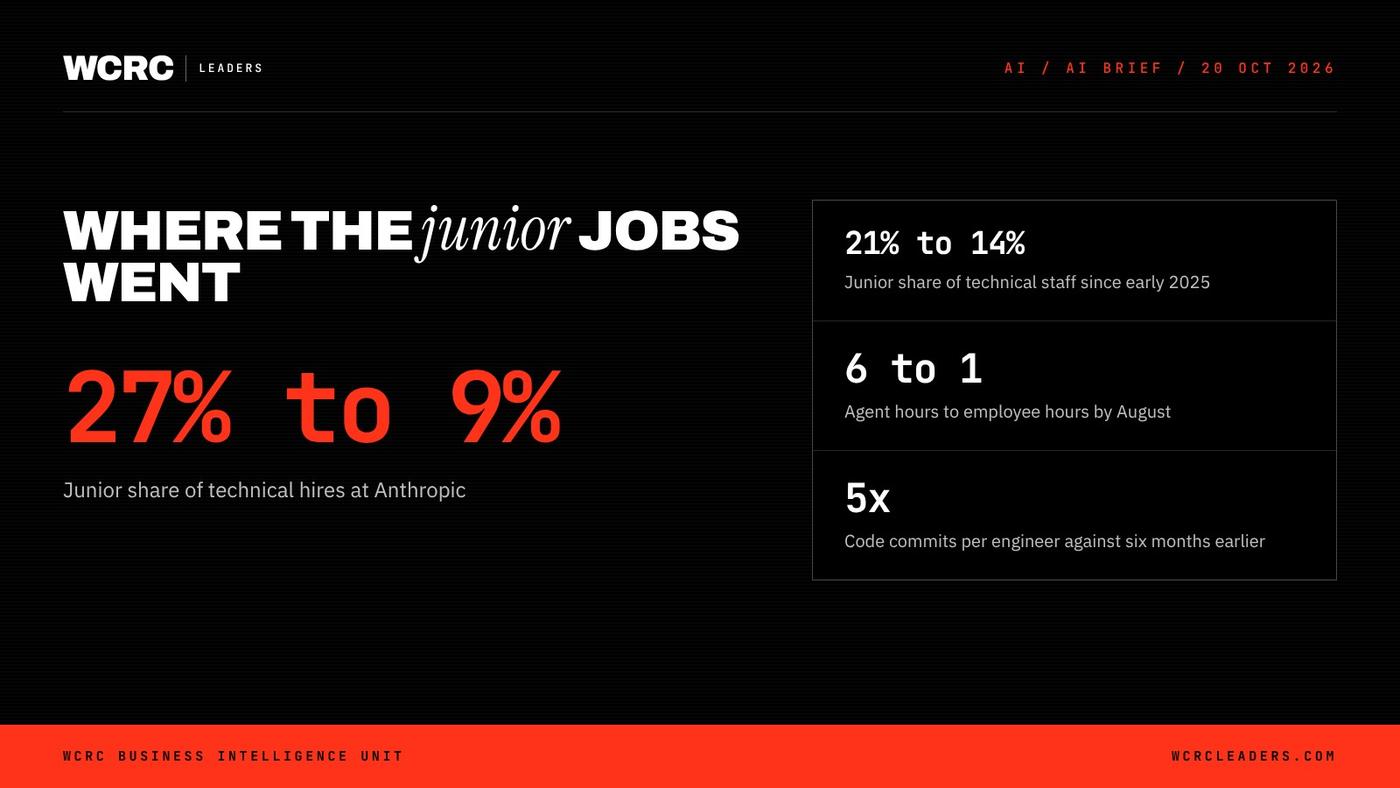
At a glance: WCRC Leaders' assessment: Anthropic's own data are the clearest early signal yet that AI agents erode demand for entry-level technical work first, and boards that run talent pyramids should plan for it now rather than wait for proof from their own payroll. On 16 October 2026 Anthropic published a technical report on its workforce, updated on 17 October. It shows the junior share of technical hires falling from 27% to 9%, agent hours outnumbering employee hours six to one, and code commits per engineer at five times the level of six months earlier. The authors stress it is one company and not a causal study.
What did Anthropic actually find?
The report, "How employment is changing at Anthropic", is written by Nathan Wilmers, Regina Catipon, Maxim Massenkoff and Peter McCrory and published under the Anthropic Institute. It draws on internal records covering headcount, AI use, output, employee surveys, Slack patterns, calendars and hiring scorecards, plus 17 employee interviews.
The headline numbers on entry-level work are stark. Since early 2025 the junior share of employment in technical departments fell from 21% to 14%. The junior share of technical hires fell faster, from 27% to 9%, with junior job postings dropping sharply after December 2025. Technical departments' share of total employment slipped from 61% to 56% over the past year, although technical headcount still grew in absolute terms. In an April 2026 survey, around a third of machine learning managers and a fifth of software engineering managers said they were hiring less because of AI.
The machine side of the ledger grew just as quickly. By August, hours worked by interactive AI agents that individual employees deploy outnumbered employee hours about six to one, with human hours counted as headcount multiplied by 40 hours a week.
Code commits per engineer ran at about five times the pace of six months earlier.
Did work get easier for the people who remain?
Not in the way many expected. The median employee now spends 20% more time in meetings than a year ago; for technical individual contributors the rise is 16%. About 80% of interactive session time is spent with the agent waiting for human input, a pattern one engineer described as people "bottlenecking the agents".
Hiring criteria are shifting. Mentions of a candidate's track record with AI tools appeared in about 5% of technical interview scorecards in 2024 and had tripled by 2026. For non-technical roles the figure was about 7% in 2024 and had quadrupled. Employees with at least a year of tenure were 50% more likely to move between departments each month in 2026 than in 2025.
Expectations are running well ahead of the wider economy. As of August, Anthropic staff expected AI to do 75% of their work by 2030. The comparable figure for other Americans was 28%.
How much weight should leaders put on this?
Less than the headlines suggest, as the authors themselves say.
First, this is a single company that builds the tools it is measuring, with unusually early and heavy adoption. The authors write that "There are many parts of Anthropic's employment practices that cannot be replicated across the economy."
Second, adopters are self-selected. The productivity comparison sets 192 engineers who took up coding agents against 74 who did not, and the authors note that "Those who adopt were already on a steeply upward trajectory compared to non-adopters." Tool uptake, they add, "is not random".
Third, volume is not value. "More code does not necessarily mean better code or business impact," the report states, and AI errors "may be harder to identify than human ones."
Fourth, and most important for this story, the junior decline is documented descriptively. The authors do not claim AI caused it. They also flag a trade-off: commitments to redeploy existing staff "could make employers hesitant to take a risk on hiring new employees."
Anthropic followed the report on 18 October with a Public Benefit Fund, committing 5% of its shares subject to stockholder approval. It says it has already committed $200 million to studying and addressing AI's disruption of workers.
Why does this matter for India's IT services firms and GCCs?
India's technology services model has long run on a pyramid: large fresher intakes at the base, trained on maintenance, testing and routine coding, then promoted into delivery and client roles. The layer that shrank fastest at Anthropic is that base.
The largest firms' latest filings show headcount already flat or falling. Tata Consultancy Services reported 598,056 employees at 30 September 2026, up 4,258 in the quarter but only about 4,700 higher than a year earlier by WCRC's calculation, with voluntary attrition at 13.3%. Wipro's closing headcount fell to 236,328 from 243,044 in the September quarter, a drop of 6,716, with attrition at 13.8%. Infosys had 328,062 employees at 30 June 2026, down from 328,594 in March; it reports September-quarter results on 23 October.
These filings do not show why headcount is flat; demand and pricing play a part. WCRC analysis: what Anthropic's data add is a mechanism. If one engineer directing agents can produce several times the commits, the work traditionally handed to a new graduate in year one is the first to be absorbed. That changes the economics of fixed-price and outcome-based contracts, where vendors keep the productivity gain, faster than time-and-materials work, where clients will press for lower bills.
Global capability centres face a different version of the same question. Hiring data covered in WCRC's report on India's two-speed job market show GCC hiring rising while IT services hiring falls, with demand tilted towards experienced and AI-skilled staff. Analysis: GCCs set up for cost-efficient scale may find parent companies asking for fewer, more senior engineers who supervise agents, rather than large junior benches.
What does it mean for Gulf and Asian employers?
Analysis: Gulf employers building national technology workforces through graduate programmes face a policy tension. Localisation targets reward headcount, while agent-heavy operating models reward fewer, more experienced people.
Across Asia, firms that import senior talent and grow juniors locally may find the training ladder breaks. If juniors no longer learn on routine work, someone has to design how they gain judgement. The US picture points the same way: the Federal Reserve's October Beige Book linked AI to slower hiring in five of 12 districts, mostly through attrition and unfilled roles, as WCRC reported last week.
How should boards plan entry-level talent?
Analysis: boards should not copy Anthropic's numbers, but they should ask for their own. Useful questions for the next people committee include: what share of hires are juniors, and how has that moved since 2025? How many agent hours does the firm run against human hours? Are interview scorecards testing AI tool use? And where will the senior engineers of 2032 come from if the base of the pyramid narrows now?
Tata Consultancy Services, Infosys and Wipro have all been selected by the Business Intelligence Unit of WCRC among India's Most Loved 250 Workplaces 2026.
The WCRC View
The WCRC Business Intelligence Unit's call: Anthropic's report is not proof that AI ends entry-level work, but it is the most detailed evidence yet of where the pressure lands first. Leaders should treat it as an early warning, not a forecast.
Who gains: experienced engineers who can direct and check agents, firms paid on outcomes, and GCCs that move up the value chain. Who loses: graduates whose first jobs were routine coding and testing, and vendors whose margins depend on billing junior hours.
What to do now: measure junior hiring share and agent use internally; redesign graduate programmes around supervising, testing and reviewing AI output; and price contracts on outcomes before clients force the issue.
The caveats matter. Meetings rose 20%, code quality is unproven and the junior decline is not shown to be caused by AI. Firms that cut graduate intake on the strength of one company's data risk a senior talent gap later.
What WCRC will watch: Infosys's September-quarter headcount and fresher commentary on 23 October; whether other AI developers or large employers publish comparable workforce data; and whether India's IT majors disclose fresher intake alongside headcount in coming quarters.
Quick answers
Q: What did Anthropic's workforce study find about junior staff? A: The junior share of technical employment fell from 21% to 14% since early 2025, and the junior share of technical hires fell from 27% to 9%.
Q: Did the authors say AI caused the fall in junior hiring? A: No. They describe the decline descriptively, note that adopters were self-selected and that Anthropic's practices cannot be replicated across the economy.
Q: How much are AI agents doing at Anthropic? A: By August, interactive agent hours deployed by individual employees outnumbered employee hours about six to one, and commits per engineer were about five times the level of six months earlier.
Q: What do the latest Indian IT filings show? A: TCS had 598,056 employees at 30 September 2026, up 4,258 in the quarter. Wipro's headcount fell by 6,716 to 236,328. Infosys reports September-quarter results on 23 October.
Filed under