Business
UAE pledges €15bn more for Greece as G42 eyes an AI factory
Abu Dhabi has added €15bn to an investment pact with Greece that began at €4bn in 2022, and its AI group G42 has signed four agreements in Athens. Gulf capital is building a position on Europe's southern edge, and Indian and Asian companies that compete for the same money should take note.
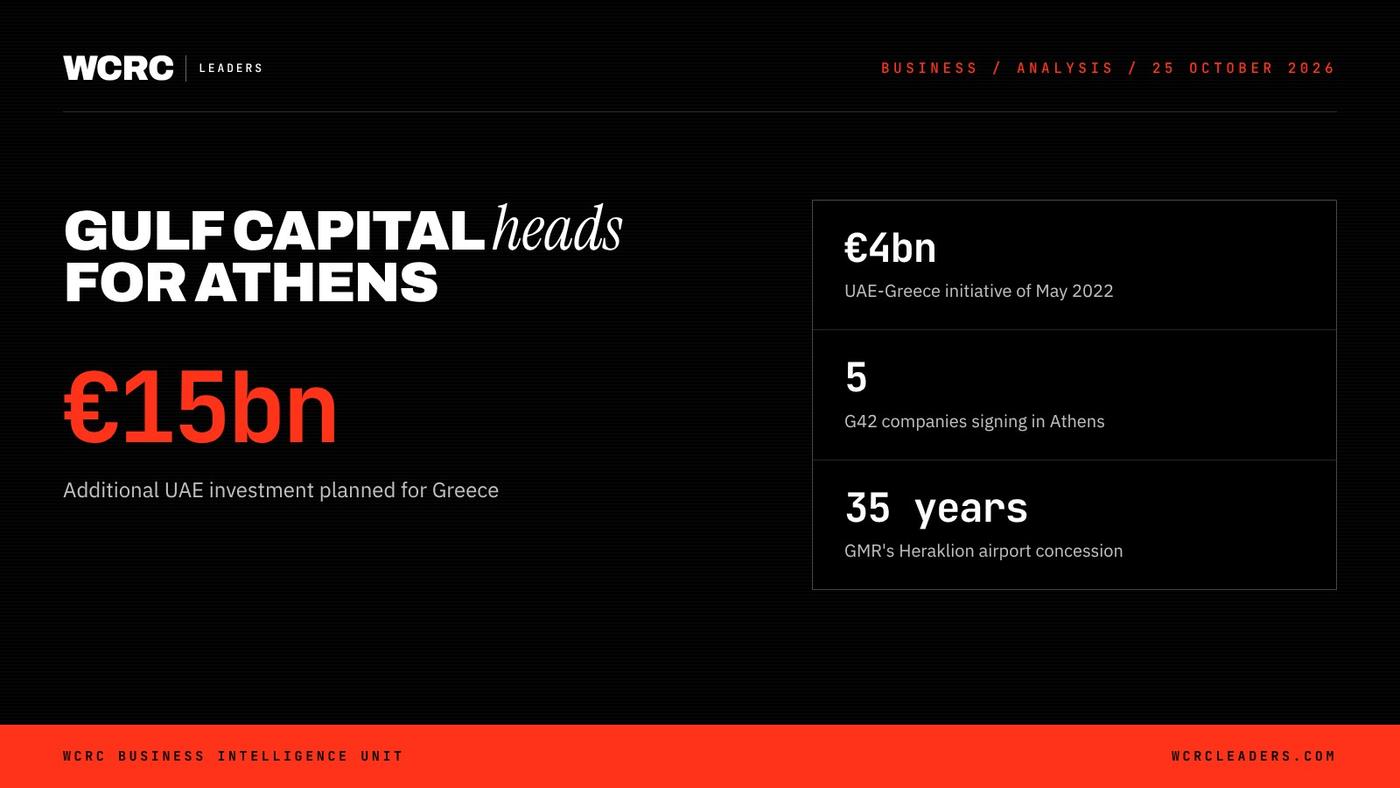
At a glance: WCRC Leaders' assessment: the UAE is treating Greece as its operating base in southern Europe, and Asian companies that want Gulf capital now face a rival that offers EU market access, energy links and a seat on the planned India-Gulf-Europe corridor. On 22 October 2026, during Sheikh Khaled bin Mohamed bin Zayed's visit to Athens, the UAE announced plans to invest a further €15bn in Greece. On the same day, five G42 companies signed agreements covering an AI factory, smart cities, government AI and genomics.
What exactly did the UAE commit to Greece?
The Abu Dhabi Media Office said on 22 October that the UAE intends to invest an additional €15bn under its joint investment initiative with the Hellenic Republic. The announcement came during the official visit of Sheikh Khaled bin Mohamed bin Zayed Al Nahyan, Crown Prince of Abu Dhabi. The initiative was launched in May 2022 at €4bn, and the media office said it has already completed significant transactions in strategic sectors, including energy and healthcare. It said the move "lays the foundation for a new phase of cooperation".
The Greek side confirmed the starting point. A briefing note from the office of Prime Minister Kyriakos Mitsotakis says the 2022 target of €4bn of direct UAE investment, set under a strategic investment cooperation agreement between the Hellenic Development Bank, the Hellenic Development Bank of Investments and Abu Dhabi's state fund ADQ, has been exceeded. The note gives no final total.
Speaking at the UAE-Greece Strategic Forum the same day, Mitsotakis said the memoranda being signed could bring additional economic benefits of 12 billion. No official list of the agreements was available, so their total count and combined value remain unconfirmed.
What did G42 sign, and how firm is it?
G42, the Abu Dhabi technology group, said its companies signed agreements in Athens on 22 October during a UAE visit led by the Ministry of Foreign Trade. There are four strands:
- AI infrastructure. Copelouzos Group will explore an AI factory in Greece with Khazna, which would lead the data centre build, and Core42, which would supply cloud and AI compute for banking, telecoms, shipping and government.
- Smart cities. Presight and Greece's Ministry of Digital Governance will explore AI-based urban analytics, starting with municipal waste management and water-network monitoring.
- Government and education. Inception42 will work with the same ministry on AI agents for cabinet business, tracking government priorities, training officials and AI tutors.
- Life sciences. M42 and Athens LifeTech Park will cooperate on genomics, population health, clinical development and biobanks, with a focus on oncology, rare diseases and neuroscience.
Boards should read these carefully. G42 calls them memoranda of understanding, with scope, structure and timelines still to be defined, and each one depends on definitive agreements and regulatory approval. No capacity in megawatts or investment value was disclosed. "Our ambition is to help countries build the infrastructure, capabilities and applications needed to unlock AI," said Mansoor Al Mansoori, chief executive of G42 International.
Why is Gulf capital moving into southern Europe now?
The money is already on the ground. Masdar bought 70% of TERNA ENERGY in November 2024 at an enterprise value of €3.2bn and took full ownership in April 2025. It inherited 1,224 MW of installed capacity and the 680 MW Amfilochia pumped-hydro project. PureHealth completed a €800m purchase of 60% of Hellenic Healthcare Group, which runs 11 hospitals and 23 diagnostic centres, in October 2025. Mitsotakis named both deals at the forum as proof of "the depth of our economic ties". The UAE foreign ministry, citing Bank of Greece data, puts net UAE direct investment into Greece at about €1.89bn in 2024.
Three forces explain the timing. WCRC analysis:
- Energy routes. Mitsotakis described Greece as an entry point for liquefied gas that supplies its northern neighbours through the Vertical Corridor, with openings in renewables and storage. Owning EU generation gives Gulf producers a hedge.
- Compute inside the EU. An AI factory in Greece would put Gulf-run compute under EU rules and close to EU customers.
- Regional risk. Mitsotakis spoke of "great regional turbulence" and cited the EU's ASPIDES naval mission protecting Red Sea shipping. Capital that is spread across both ends of a trade route is easier to defend than capital held at one end.
Is Greece really the European end of IMEC?
Not formally, and boards should be precise about this. The September 2023 memorandum on the India-Middle East-Europe Economic Corridor was signed by India, Saudi Arabia, the UAE, the European Union, France, Germany, Italy and the United States. Greece is not a signatory, and the text names no European port. It sets out a ship-to-rail network with power, data and hydrogen links.
Athens is making its case anyway. At the forum, Mitsotakis said there is "enormous potential" in IMEC and called Greece Europe's natural entry point, arguing that the corridor goes beyond port projects to logistics, energy flows and digital links. The India-Greece joint statement of February 2024 recorded that the two leaders discussed the corridor's prospects and set a target of doubling bilateral trade by 2030. WCRC analysis: the UAE's money makes Greece's claim stronger. The European landfall will go where ports, power and data capacity are already financed.
What does this mean for Indian and Asian companies?
Indian groups already hold positions along this route. GMR Airports, one of WCRC 1000, India's Most Valuable Enterprises 2026, is developing the new international airport at Heraklion in Crete with its Greek partner Terna, under a 35-year concession. Adani Ports and Special Economic Zone, one of WCRC 1000, India's Most Valuable Enterprises 2026, leads the consortium that won Israel's Haifa Port in 2022 with a 70% share, at NIS 4.1bn. Both companies were also selected among India's Most Loved 250 Workplaces 2026 by the Business Intelligence Unit of WCRC.
The competitive point is simple. Gulf sovereign and strategic investors have limited time and many offers. Earlier this month, Gulf funds that together hold 5.32% of Jio Platforms chose to stay invested through its IPO, which shows the appetite for large Indian assets is real. Greece now offers the same investors EU membership, energy assets with clear ownership, and a government that signs at head-of-state level. An Indian or Southeast Asian promoter seeking Gulf capital for data centres, renewables or logistics is now competing with Athens, not only with other Asian markets.
There is also an opening. The G42 agreements name shipping, banking and telecoms as target users of the planned compute. Indian IT, engineering and shipping firms already serve those sectors and can bid to be partners. The UAE is pursuing the same model in Asia, as its move towards a trade agreement with Singapore shows.
The WCRC View
The WCRC Business Intelligence Unit reads the €15bn as a strategic placement, not a one-off headline. Abu Dhabi already owns power and hospitals in Greece, and it now wants compute. Greece gives it a base inside the EU that sits on a corridor India helped design.
The winners are Greek infrastructure owners and the Gulf groups that are already present: Masdar, PureHealth and now G42. Asian promoters that assume Gulf money will come to them by default are the ones most likely to lose out.
Boards in India and Asia should act on three points now. First, present Gulf partners with a corridor story, not just an India story: show how an asset connects to the Gulf and to Europe. Second, target partnerships inside the Gulf groups' European projects, especially in shipping, banking technology and engineering, where Indian firms have scale. Third, price in EU rules early, because compute and data work in Greece will fall under the EU's AI regime, as WCRC's AI Act readiness checklist for non-EU firms sets out.
Memoranda are cheap. The €15bn will be judged by how many agreements become signed contracts, with disclosed megawatts and values, within 12 months.
WCRC will watch for definitive agreements on the Khazna and Core42 AI factory, any disclosure by Presight on the Abu Dhabi Securities Exchange, the first transactions under the enlarged UAE-Greece initiative, and whether Greece secures a named role in IMEC's European leg.
Quick answers
Q: How much has the UAE pledged to invest in Greece? A: An additional €15bn, announced on 22 October 2026, on top of a joint investment initiative launched in May 2022 at €4bn. Greece says the €4bn target has already been exceeded.
Q: What did G42 agree in Greece? A: Four memoranda: Khazna and Core42 with Copelouzos Group on an AI factory, Presight and Inception42 with the Ministry of Digital Governance, and M42 with Athens LifeTech Park on life sciences. All are subject to definitive agreements and approvals.
Q: Is Greece part of the IMEC corridor? A: Greece did not sign the 2023 IMEC memorandum, which names no European port. Its prime minister presents Greece as Europe's natural entry point for the corridor.
Q: Which Indian companies already operate on this route? A: GMR Airports is developing Heraklion's new airport in Crete with Terna, and Adani Ports leads the consortium that owns Israel's Haifa Port.
Vedanta doubles Gamsberg, and Ramaphosa now wants a zinc smelter
Anchor investors in Indian IPOs: why the 60% book sets the tone

Bajaj Finance lines up ₹17,500 crore as AI agents take on service

$133bn: what India's rupee defence is costing its biggest banks
Jio Platforms IPO: Gulf funds hold 5.32% and are not selling
Détente in two-month instalments: planning for China after the Washington summit
Filed under