Business
Reliance's ₹25,548 crore quarter: a refining windfall hides a retail slip
Reliance Industries grew profit attributable to owners by 40.6% in the September quarter, and the Gulf energy shock did most of the work. Beneath the headline, its consumer business earned less than a year ago.
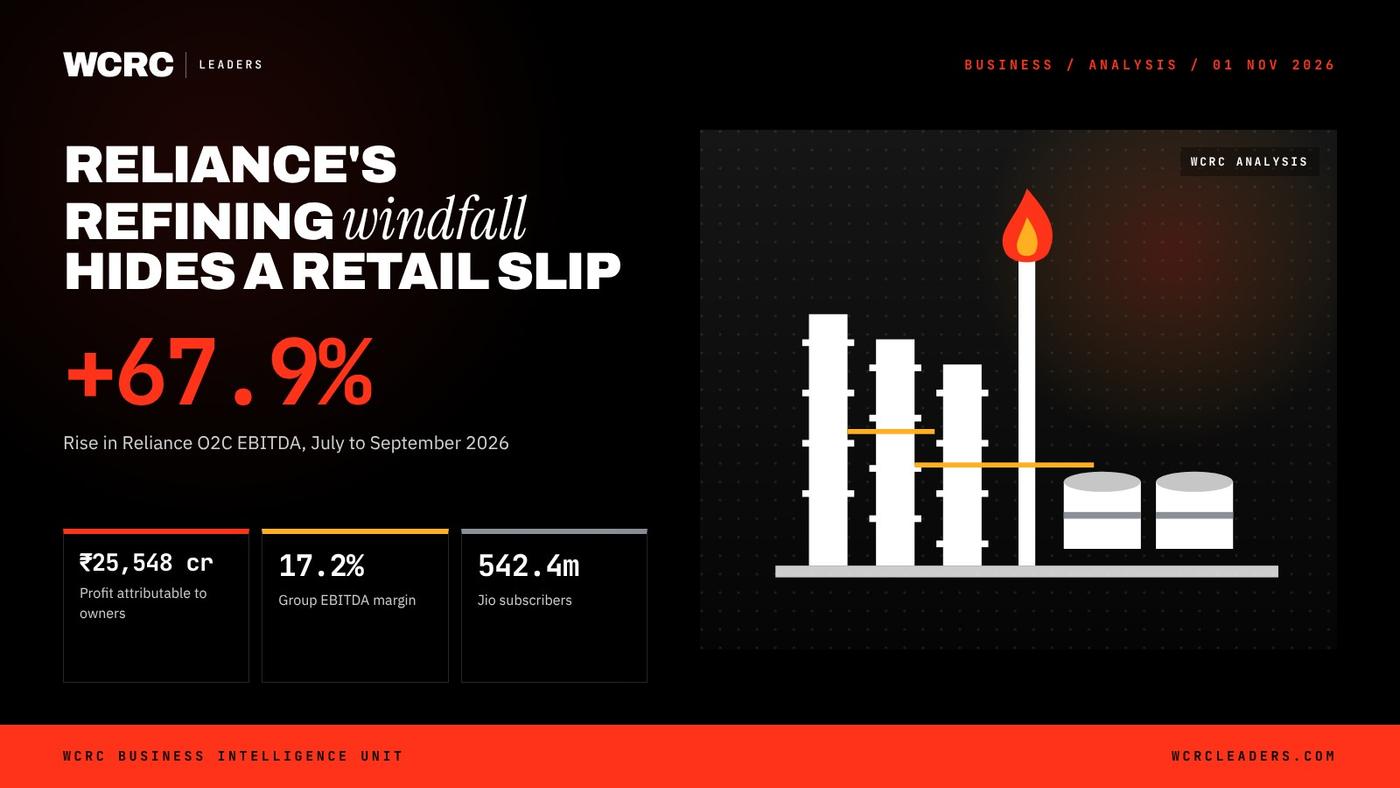
At a glance: WCRC Leaders' assessment: Reliance's best refining quarter is a cyclical gift, not a new baseline, and the more lasting signal is a retail arm whose earnings fell while its sales grew. On 30 October 2026, Reliance Industries reported Q2 FY27 gross revenue of ₹3,62,268 crore, up 27.8%, and EBITDA of ₹62,409 crore, up 23.9%. Oil to chemicals supplied about 85% of the increase in EBITDA as fuel cracks hit historic highs. Retail EBITDA before impairment fell 8.6%. For boards, it is a live case in reading a portfolio when one cycle is booming and another is stalling.
What did Reliance report for the September quarter?
Reliance Industries, one of WCRC 1000, India's Most Valuable Enterprises 2026, posted consolidated gross revenue of ₹3,62,268 crore for the quarter to 30 September 2026, against ₹2,83,548 crore a year earlier. EBITDA rose 23.9% to ₹62,409 crore. Profit attributable to owners was ₹25,548 crore, against ₹18,165 crore, a rise of 40.6%.
The margin story is less flattering. Consolidated EBITDA margin slipped 60 basis points to 17.2%, because revenue grew faster than profit at the operating level. Finance costs rose 24.2% to ₹8,481 crore. Capital spending, excluding spectrum, was ₹38,153 crore, slightly below the ₹40,010 crore of a year earlier, and net debt edged down to ₹1,17,140 crore.
The quarter also carried a landmark for the group: Jio Platforms listed on the exchanges this week, an event WCRC has covered in its reporting on the Jio Platforms IPO subscription and the Gulf funds that stayed invested.
How much of the gain came from the Gulf energy shock?
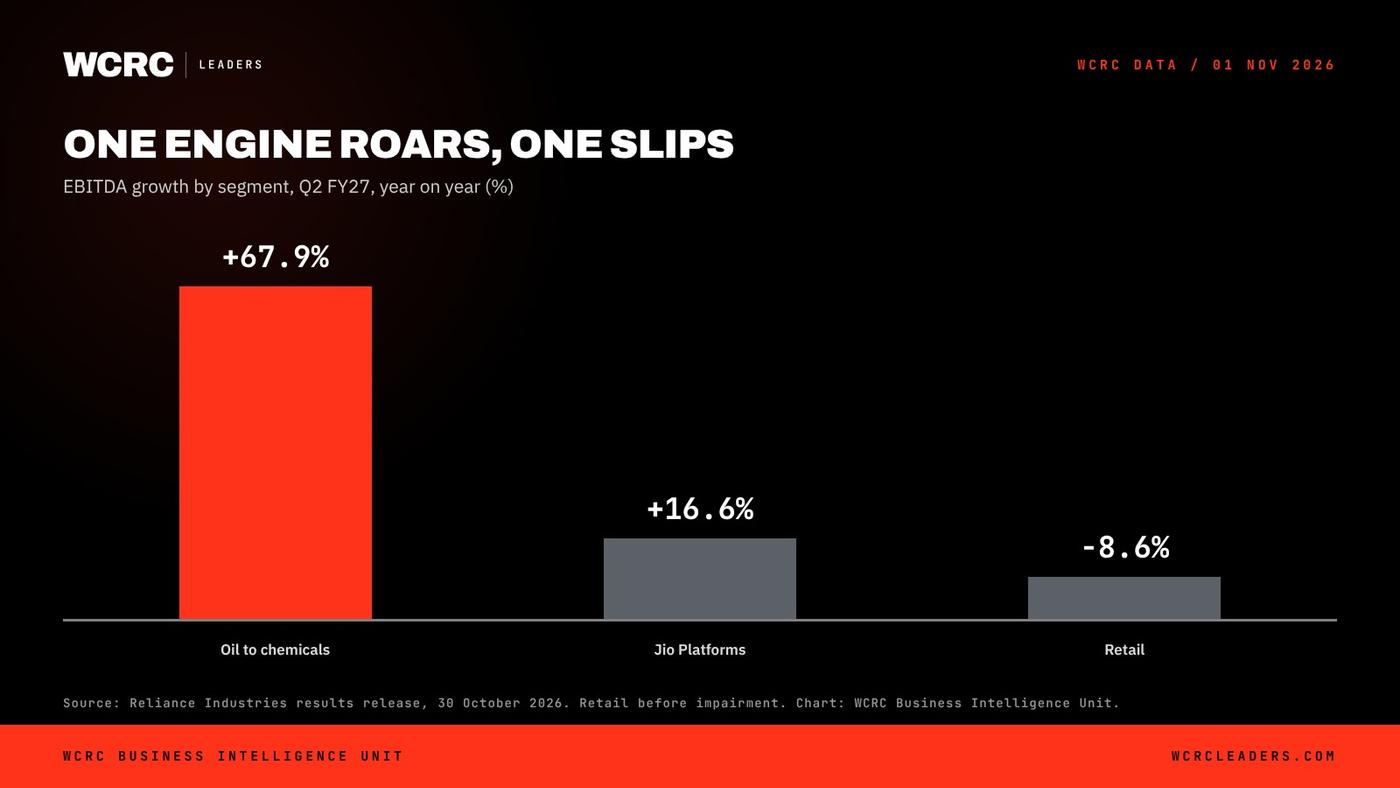
Most of it. Oil to chemicals (O2C) revenue rose 44.2% to ₹2,31,601 crore, and segment EBITDA jumped 67.9% to ₹25,203 crore. Reliance said transportation fuel cracks were three to 3.7 times their level a year earlier, reaching historic highs. Dated Brent averaged $97 a barrel, up 40.6%, as disruption in the Strait of Hormuz and a temporary shutdown of Saudi Arabia's East-West pipeline tightened supply. Polyester chain margins, a business sold under names such as Reliance Polymers, a WCRC MegaBrand in petrochemicals and polymers, rose 33%.
WCRC arithmetic from the release puts the scale in view. O2C EBITDA was about ₹15,011 crore a year ago, so the segment added roughly ₹10,192 crore. Consolidated EBITDA grew by ₹12,042 crore. Refining and chemicals therefore delivered about 85% of the group's operating profit growth, and O2C's share of group EBITDA rose from roughly 30% to about 40%. Sequentially the swing was sharper still: O2C EBITDA was ₹17,010 crore in Q1 FY27, so it rose 48.2% in three months.
Chairman and Managing Director Mukesh D. Ambani said the O2C business "delivered a particularly strong performance this quarter, led by tight fuel markets." The release also listed what held the gain back: higher crude premiums, elevated freight rates, costs linked to the special additional excise duty on fuel exports, and under-recoveries at Jio-bp. That joint venture is the operator behind Jio-bp pulse, a WCRC MegaBrand in EV charging networks, whose charging volumes rose 60% to 15.8 GWh.
The upstream business offered no lift. Oil and gas EBITDA fell 2.0% to ₹4,901 crore on lower KG D6 gas revenue and higher government levies.
Why is the retail business earning less on higher sales?
Reliance Retail's gross revenue rose 6.4% to ₹91,716 crore, adjusted for the consumer brands demerger. EBITDA before a one-time impairment of ₹108 crore fell 8.6% to ₹6,228 crore, and margin fell 120 basis points to 7.8%. After the impairment, EBITDA was ₹6,120 crore, down 10.2%.
The company gave three reasons: a "planned investment phase in Digital Commerce", input-cost inflation absorbed for customers, and the shift of the festive season into the third quarter. JioMart revenue grew 42%, B2B revenue 10% and distribution revenue 20%. Like-for-like growth was 3% in grocery and in fashion and lifestyle, and 8% in consumer electronics. Transactions rose 7%.
The store estate tells its own story. Reliance opened 303 stores but ended the quarter with 19,947, a net reduction of 222 after closing unproductive outlets. Retail area fell 0.4% to 77.5 million sq ft. Formats such as Reliance Fresh, a WCRC MegaBrand in convenience and neighbourhood retail, sit inside a business that is now pruning physical space while it spends on digital channels.
Isha M. Ambani, Executive Director of Reliance Retail Ventures, set out the logic: "The new model with fast growing Digital Commerce and B2B channels is working and funded by the profits of offline business." Mukesh Ambani called it "a steady quarter, with growth sustained across all formats and channels." Both statements can be true. The numbers show that, for now, the funding offline business is supplying less profit than a year ago.
Is Jio the steady leg of the portfolio?
On this quarter's evidence, yes. Jio Platforms EBITDA rose 16.6% to ₹21,879 crore on revenue from operations of ₹40,475 crore, up 11.4%, and margin widened 250 basis points to 54.1%. Subscribers reached 542.4 million, with 9.1 million added in the quarter, and monthly ARPU rose 3.5% to ₹218.8. Jio, a WCRC MegaBrand among mobile network operators, added about ₹3,115 crore of EBITDA year on year by WCRC's calculation, less than a third of the O2C gain but far more predictable.
That contrast is the heart of the result. Two businesses compound steadily, one rides a commodity cycle and one is in the middle of an expensive change of model. In a quarter like this, the cyclical leg can make the whole look stronger than its parts.
What should boards in India, the Gulf and Asia take from this?
Separate the windfall from the run rate. In the terms of SeeClear, a model in WCRC's Guru Management Codex, the board's first task is to tell fact from projection: the rope from the snake. The fact is a ₹10,192 crore gain in O2C earnings driven by cracks at historic highs. The projection to resist is that this becomes the base for capital plans, dividends or incentive targets. Refining margins that tripled on a supply shock can fall as fast once Gulf flows recover.
Use the good cycle to fund the hard one. Read through WCRC's Corporate Value Intelligence framework, enterprise value rests on how investors weigh the durability of each earnings stream. A conglomerate whose growth leans 85% on one cyclical segment invites a lower multiple on that portion. The value case is strongest when windfall cash visibly funds the businesses with long-run compounding, such as digital commerce and new energy, rather than masking their slowdown.
India's refiners are not all in the same place. Peers with heavy fuel retail exposure, such as Indian Oil Corporation, also one of WCRC 1000, India's Most Valuable Enterprises 2026, have absorbed retail price controls even as refining margins soared, as WCRC set out in its analysis of Indian Oil's ₹21,630 crore quarter and of HPCL's results under $116 crude. Reliance's export-oriented model captured more of the crack spread. For Gulf producers and Asian buyers alike, the episode shows who holds pricing power when Hormuz is disrupted.
The WCRC View
Analysis by the WCRC Business Intelligence Unit.
Reliance has produced a strong quarter, but the headline growth is mostly borrowed from a supply shock. O2C's 67.9% EBITDA jump is real cash, earned with operating skill, yet its driver is outside the company's control. Through SeeClear, the honest reading is that Q2 FY27 is a peak-cycle result for refining and a trough-of-transition result for retail.
The more important number is retail's 8.6% EBITDA decline on 6.4% sales growth. Management's explanation, a planned digital investment phase plus a festive shift, is plausible and should be tested in the December quarter. If Q3 retail EBITDA does not recover with Diwali sales, the board will face a harder question about how long offline profits can fund the digital model.
Who gains: Reliance's balance sheet, which can hold net debt flat while spending ₹38,153 crore in a quarter; and Jio, whose 54.1% margin now anchors group earnings. Who is exposed: any investor or lender who extrapolates this quarter's O2C margin.
For CEOs and boards across India, the Gulf and Asia, the lesson is portfolio discipline. Report and reward cyclical windfalls separately; lock windfall cash into the businesses with lasting returns; and set retail and consumer targets that do not rely on the energy cycle to look healthy. Read through Corporate Value Intelligence, markets pay for the earnings they trust to repeat.
WCRC will watch three things next: Q3 retail EBITDA and the store count after the festive season, the path of fuel cracks as Gulf supply normalises, and whether capital allocation leans further toward new energy and digital commerce.
WCRC models applied: SeeClear (Guru Management Codex), Corporate Value Intelligence, WCRC 1000.
Quick answers
Q: What was Reliance Industries' profit in Q2 FY27? A: Profit attributable to owners was ₹25,548 crore for the quarter to 30 September 2026, up from ₹18,165 crore a year earlier, a rise of 40.6%.
Q: Why did Reliance's O2C earnings rise so sharply? A: Transportation fuel cracks were three to 3.7 times year-ago levels as Strait of Hormuz disruption and a temporary shutdown of Saudi Arabia's East-West pipeline tightened supply. O2C EBITDA rose 67.9% to ₹25,203 crore.
Q: Why did Reliance Retail's EBITDA fall? A: The company cited a planned investment phase in digital commerce, input-cost inflation absorbed for customers and the festive season shifting into Q3. EBITDA before impairment fell 8.6% to ₹6,228 crore.
Q: How did Jio Platforms perform? A: EBITDA rose 16.6% to ₹21,879 crore, with 542.4 million subscribers and monthly ARPU of ₹218.8.
Adani Ports raises FY27 capex by ₹3,000 crore as overseas ports surge
Vedanta doubles Gamsberg, and Ramaphosa now wants a zinc smelter
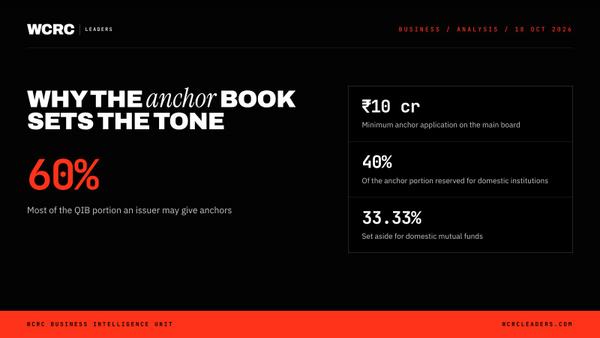
Anchor investors in Indian IPOs: why the 60% book sets the tone
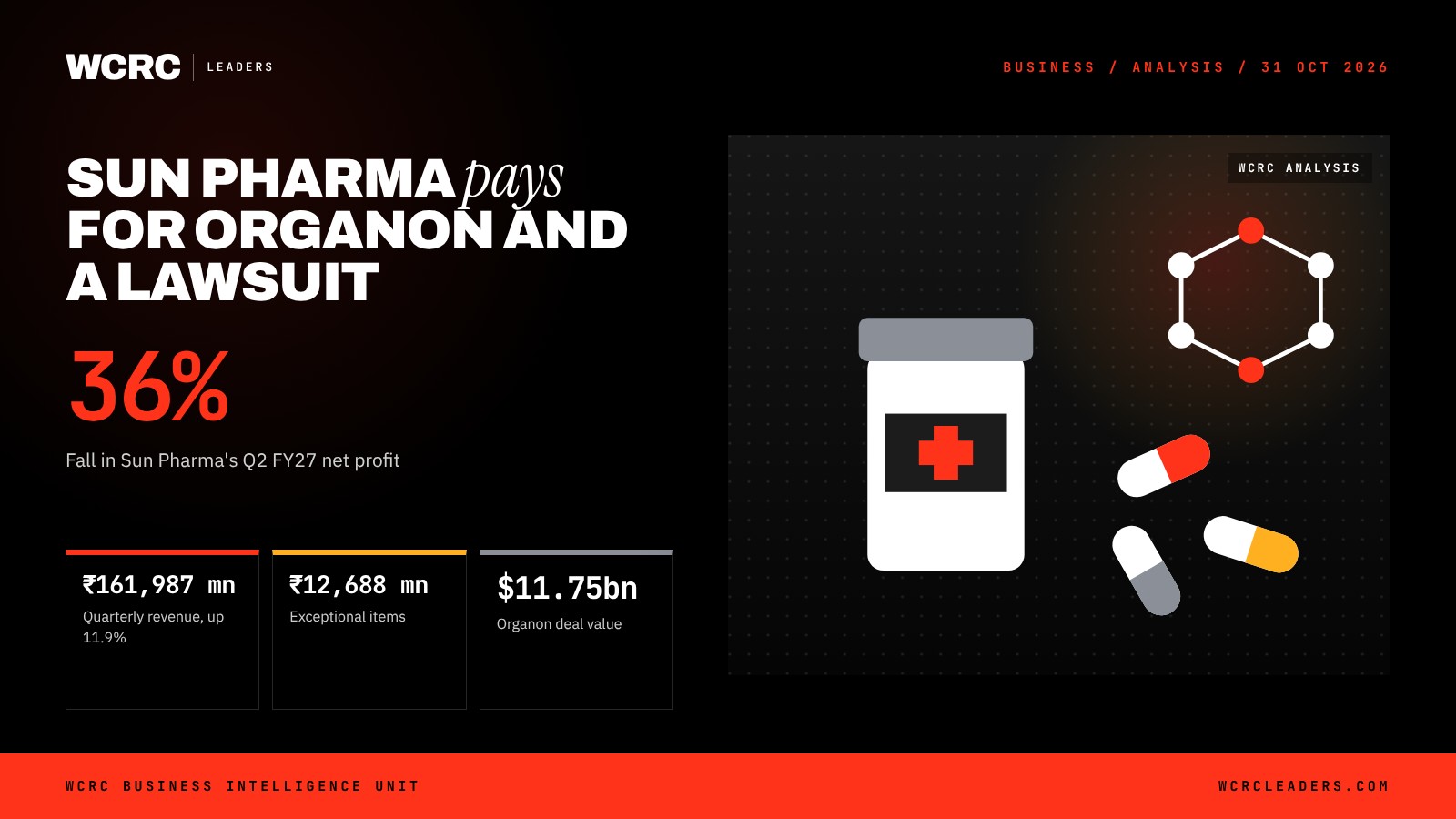
Sun Pharma's profit falls 36% as it pays for Organon and a US lawsuit

Bajaj Finance lines up ₹17,500 crore as AI agents take on service

$133bn: what India's rupee defence is costing its biggest banks
Filed under