Business
Anchor investors in Indian IPOs: why the 60% book sets the tone
Before an Indian IPO opens, a few large institutions commit first and in public. What SEBI's rules allow, what the market reads into them, and where boards go wrong.
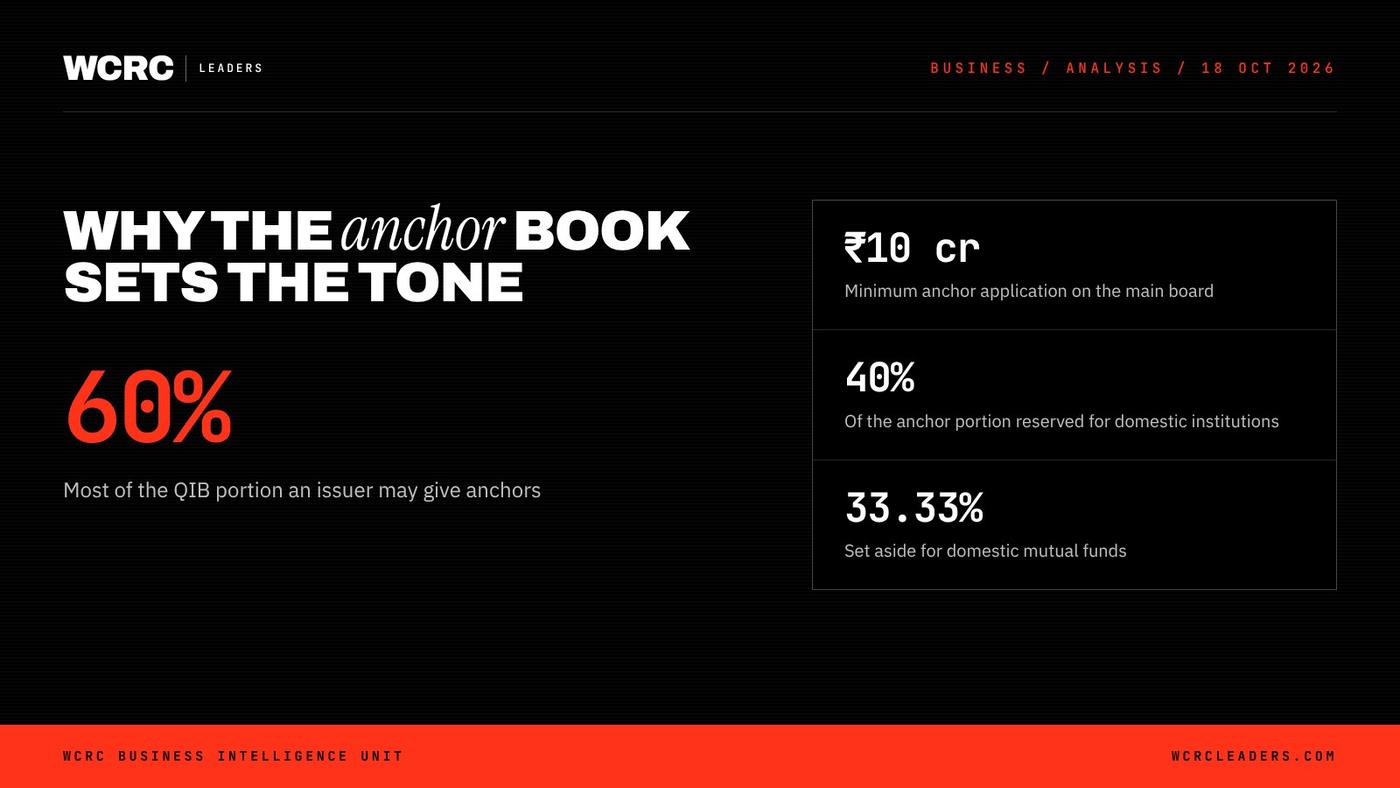
At a glance: WCRC Leaders' assessment: the anchor book is the first public verdict on an IPO's price, and boards that treat it as a box to fill rather than a signal to earn usually pay for it after listing. Under SEBI's rules, an issuer may place up to 60% of the qualified institutional buyer (QIB) portion with anchors one working day before the issue opens, and since late 2025, 40% of that is reserved for domestic mutual funds, life insurers and pension funds. Jio Platforms' anchor bidding on 19 October is the next test.
What is an anchor investor in an Indian IPO?
An anchor investor is a qualified institutional buyer that applies for at least ₹10 crore in a main board public issue run through book building. That is the definition in Regulation 2(1)(c) of the Securities and Exchange Board of India (Issue of Capital and Disclosure Requirements) Regulations 2018, the ICDR Regulations.
QIBs are the large professional investors listed in Regulation 2(1)(ss): mutual funds, scheduled commercial banks, insurers, registered pension funds and foreign portfolio investors other than individuals, corporate bodies and family offices, among others. Anchors are QIBs that bid early, at a fixed price, and accept a lock-in.
The point is to give everyone else a reference. Individual investors cannot see inside an order book while it is being built, but they can see who the anchors were and what they took before the issue opens.
How much of an IPO can anchors take?
Regulation 32(3) lets an issuer allocate up to 60% of the portion available to QIBs to anchor investors, under the conditions in Schedule XIII. The size of that QIB portion depends on how the company qualifies to list. For a Regulation 6(1) issue, Regulation 32(1) caps QIBs at 50% of the net offer, with 5% of that set aside for mutual funds. At least 35% goes to retail individual investors and at least 15% to non-institutional investors.
So in a Regulation 6(1) issue the anchor book can reach at most 60% of 50%, or 30% of the net offer. Under Regulation 6(2), QIBs must take at least 75%, so the possible anchor slice is far larger.
The SEBI (ICDR) (Third Amendment) Regulations 2025, notified on 31 October 2025 and in force from the 30th day after their gazette publication, rewrote two parts of Schedule XIII, Part A, paragraph 10:
- Reserved seats. Forty per cent of the anchor portion is now reserved: 33.33% for domestic mutual funds and 6.67% for life insurance companies and pension funds. Previously, one-third went to mutual funds alone. Any shortfall in the insurance and pension slice may be given to mutual funds.
- Who counts. Life insurers must be registered with the Insurance Regulatory and Development Authority of India, and pension funds with the Pension Fund Regulatory and Development Authority.
- How many anchors. For an anchor allocation up to ₹250 crore, between two and 15 anchors are allowed, with a minimum allotment of ₹5 crore each. Above ₹250 crore, at least five and at most 15 anchors are allowed for the first ₹250 crore, plus 15 more for every further ₹250 crore or part of it.
When do anchors bid, and how long are they locked in?
Anchor bidding takes place one working day before the issue opens to the public.
Anchors cannot sell straight away. Amendments notified on 14 January 2022, which applied to issues opening on or after 1 April 2022, split the lock-in: 50% of the shares allotted to anchors are locked in for 90 days from allotment, and the other 50% for 30 days. Before that change, all anchor shares carried a 30-day lock-in. Day 30 and day 90 are now fixed points on every new listing's calendar, the first moments large blocks of institutional stock can reach the market.
Price is bounded too. Under Regulation 29(2), the cap of the price band must be at least 105% and no more than 120% of the floor price.
What will the Jio Platforms anchor book show?
Jio Platforms is the live example. Its red herring prospectus, dated 14 October 2026 and published on SEBI's website, sets anchor bidding for Monday 19 October 2026. The issue opens on Wednesday 21 October and closes on Friday 23 October.
The offer is a fresh issue of up to 270,000,000 equity shares of ₹10 face value each, with no offer for sale by existing shareholders. It is made under Regulation 6(1), so the QIB portion is capped at half the net offer and anchors at 30% of it. There are 19 book running lead managers, and the shares are to list on BSE and the National Stock Exchange. The prospectus also refers to reservations for eligible employees and eligible Reliance Industries shareholders.
Analysis: because the issue is entirely primary, the anchor list will be read as a verdict on the company's own capital plan, not on an exit by early backers.
What does a strong or weak anchor book signal?
This section is WCRC analysis.
A strong anchor book fills at the top of the band and is spread across domestic mutual funds, insurers and patient foreign capital rather than short-term money.
For promoters in India, a strong book tells the investors who bid over the next three days that professionals have tested the price, and gives the board credible shareholders to call on after listing.
A weak book shows up in quieter ways: allotments clustered at the ₹5 crore minimum, a small number of names, a reserved slice that mutual funds had to absorb, or anchors drawn heavily from related or friendly institutions. Each tells the market the price was hard to defend.
For Gulf sovereign funds that bid as anchors, the 2025 reform changes the bargaining position. Foreign pension money does not qualify for the 6.67% reserved slice, because SEBI requires registration with India's pension regulator. Foreign funds therefore compete for the 60% of the anchor portion that is not reserved. Their value to an issuer rests on size, holding period and reputation, so they should ask for detail on use of proceeds and governance before committing.
What mistakes do boards make with the anchor book?
This section is WCRC analysis.
- Pricing for the anchor day, not day 90. A band set to fill the anchor book can leave too little on the table for the after-market. The 90-day unlock then arrives into a falling share price.
- Ignoring the unlock calendar. Results and promoter announcements near day 30 and day 90 are read alongside new supply.
- Treating names as decoration. Many famous names with small allotments signal less than a few large, long-term holders.
- Leaving the reserved slice to chance. Since late 2025, a board that has not engaged domestic insurers and pension funds early risks that 6.67% being reassigned to mutual funds.
- Over-relying on friendly money. Anchors close to promoters or bankers tell the market little.
The WCRC View
From the WCRC Business Intelligence Unit.
The anchor book is no longer a formality. SEBI's 2025 reform widened it to bring India's insurers and pension funds into new listings, and the anchor list is now the first independent check on price.
Domestic long-term institutions gain most, along with promoters whose growth plans can stand scrutiny. Issuers that price aggressively on thin anchor demand lose, usually at the 30-day and 90-day unlocks.
Boards planning a 2027 listing should start anchor conversations months before filing, court the insurance and pension reservation directly, and set the band with the 90-day share price in mind.
Gulf and Asian sovereign investors should use their scale to negotiate disclosure and access.
WCRC will watch the Jio Platforms anchor list on 19 October, the share taken by domestic mutual funds, insurers and pension funds, and the price at the 30-day and 90-day unlocks. See also Fairfax's IDBI Bank purchase and When Bad News Stops Reaching the Top.
Quick answers
Q: What is the minimum application for an anchor investor in an Indian main board IPO? A: ₹10 crore, under Regulation 2(1)(c) of the ICDR Regulations. Each anchor must also be allotted at least ₹5 crore.
Q: How much of an IPO can go to anchor investors? A: Up to 60% of the QIB portion, or at most 30% of the net offer in a Regulation 6(1) issue.
Q: How long are anchor investors locked in? A: Half their shares for 90 days and half for 30 days from allotment.
Q: When is the Jio Platforms anchor bidding? A: Monday 19 October 2026. The issue runs from 21 to 23 October.
Filed under