Business
$133bn: what India's rupee defence is costing its biggest banks
The Reserve Bank's dollar swap window pulled in $132.98bn of non-resident foreign currency deposits in under three months. The money flattered bank balance sheets in the September quarter, and the bill is now showing up in margins.
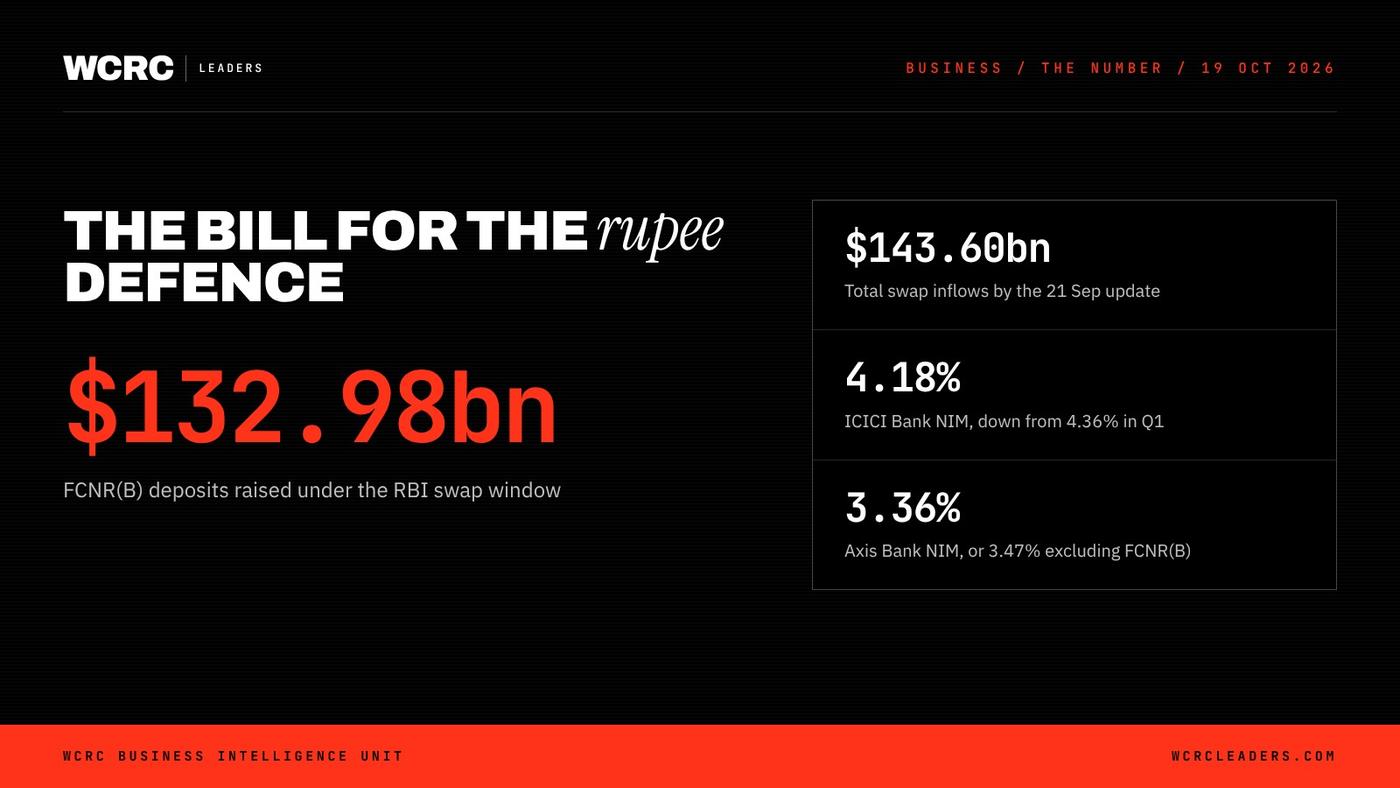
At a glance: WCRC Leaders' assessment: the FCNR(B) swap bought India time on the rupee, but the cost has moved onto bank margins and the RBI's forward book, and boards should plan now for the day these deposits come due. The RBI opened a special USD-INR swap facility on 8 June 2026 and closed its FCNR(B) leg on 31 August. Banks reported $132.98bn of deposits under it. ICICI Bank, Axis Bank and HDFC Bank all posted faster deposit growth and thinner margins for July to September.
What is the number, and where does it come from?
The figure is $132.98bn. That is the value of FCNR(B) deposits that Indian banks mobilised under the Reserve Bank of India's swap facility between 8 June and 31 August 2026, as reported by authorised dealer banks to 18 September and published by the RBI on 21 September. FCNR(B) accounts are term deposits that non-resident Indians hold in foreign currency, so the depositor carries no rupee risk.
The number grew as the reporting caught up. The RBI's first tally, released on 2 September, put FCNR(B) inflows at $127.23bn out of total swap inflows of $136.38bn, with overseas foreign currency borrowings (OFCBs) adding $5.26bn and external commercial borrowings (ECBs) $3.89bn. By the 21 September update, the total had reached $143.60bn. The FCNR(B) window shut on 31 August, a month ahead of the 30 September cut-off in the RBI's original 8 June circular. The ECB and OFCB windows stay open until 31 December 2026.
For scale, India's total foreign exchange reserves stood at $726.03bn in the week to 9 October. The FCNR(B) haul alone equals about 18% of that.
How did the swap work, and why does it matter who pays?
Under the 8 June circular, banks could swap fresh FCNR(B) deposits of three to five years with the RBI. The swap is done "at par": the bank sells dollars to the RBI at the FBIL reference rate and buys them back at maturity at the same rate. Deposits carry a one-year lock-in, and swaps cannot be cancelled.
That design is more generous than India's last rescue of this kind. In September 2013, when the rupee was also under pressure, the RBI ran an FCNR(B) swap window at a fixed rate of 3.5% a year. This time there is no charge at all.
WCRC analysis: a forward dollar normally costs more than a spot dollar against the rupee, because Indian interest rates are higher than US rates. By promising to sell the dollars back at today's rate in three to five years, the RBI has taken that forward premium onto its own books. Banks get rupee funding at roughly the dollar deposit rate, without paying to hedge. This is the real cost of defending the rupee, and it is deferred, not avoided. The RBI must hand back about $143.6bn of dollars across the swap book as the contracts mature, mostly between 2029 and 2031.
What did it do to bank results?
It inflated the deposit line and squeezed margins.
ICICI Bank reported standalone profit after tax of ₹14,843 crore for the September quarter, up 20.1% year on year, and net interest income of ₹25,339 crore, up 17.7%. Total deposits reached ₹20,49,874 crore, up 27.1%. Strip out FCNR(B) deposits and growth was 17.0%. Advances rose 30.0%, or 24.1% excluding loans made by international branches against FCNR(B) deposits. Net interest margin fell to 4.18%, from 4.36% in the June quarter and 4.30% a year earlier. ICICI's release says its CASA ratio reflects the larger term deposit base from FCNR(B) inflows.
Axis Bank gives the clearest read on the cost. Its net interest margin was 3.36% for the quarter, against 3.46% in the June quarter. Excluding the impact of FCNR(B) deposits, the bank puts it at 3.47%. That is an 11 basis point drag from one funding source in one quarter. Profit after tax was ₹7,003 crore, down 2% on the quarter and up 38% on the year. Axis disclosed $10.62bn of FCNR(B) deposits under the swap at 30 September, of which $4.57bn was lent out by its international branches as leverage loans. Total deposits grew 20.7%, or 17.0% without the leverage effect.
HDFC Bank reported a margin of 3.16% on total assets, and end-period deposits up 18.8% year on year. Its retail assets include ₹548bn of FCNR leverage loans; without them, retail asset growth was 9.1%, not 16.9%. HDFC also has a new chief executive arriving from ICICI: read our report on Anup Bagchi's appointment.
Why would cheap deposits cut margins?
WCRC analysis: there are two mechanics. First, much of the money was recycled. Banks lent to depositors or issued standby letters of credit against the deposits, which is why Axis and ICICI report large "leverage loans" from international branches. These are secured, low-spread assets. They add to the balance sheet and to interest income, but at a lower margin than the existing book. Second, liabilities grew faster than banks could put them to work. Money parked while it waits to be lent earns little. Both effects lower the margin ratio even where absolute income rises, which is exactly what ICICI's 17.7% NII growth alongside an 18 basis point quarterly margin fall shows.
Where did the money come from?
The RBI has not published a breakdown of the deposits by source country. But the remittance data points one way. In the RBI's sixth remittances survey, the six Gulf Cooperation Council states supplied 38% of India's inward remittances in 2023-24, with the UAE alone at 19.2%; the United States was the largest single source at 27.7%. The RBI's 7 October policy statement put net inflows into all non-resident deposit schemes at $119.2bn for April to August 2026.
WCRC analysis: Gulf-based Indians, many of them earning in currencies pegged to the dollar, were natural takers of a dollar deposit that paid well and could be lent against. For Gulf banks and exchange houses, that is a reminder of how quickly a policy signal in Mumbai can pull liquidity out of the region.
Did it work for the rupee?
Partly. The FBIL reference rate was ₹95.02 to the dollar on 16 October. Reserves have fallen for five straight weeks, from $785.71bn in the week to 4 September to $726.03bn in the week to 9 October, a drop of about $59.7bn. On 7 October the Monetary Policy Committee raised the repo rate by 25 basis points to 5.50%, its first increase since 2023; see our analysis of the rate hike and what it means for capex. The swap bought breathing room. It did not change the direction of travel.
The WCRC View
From the WCRC Business Intelligence Unit:
- The cost is real, but it has been moved, not removed. The RBI absorbed the hedging premium; banks absorbed a margin hit; the dollar repayment sits in the RBI's forward book. Boards should read September's deposit growth net of FCNR(B), as ICICI and Axis already do. ICICI's true deposit growth is 17%, not 27%.
- Private banks gained balance sheet, not earnings power. The winners are lenders that can put the money into higher-yielding loans quickly. Banks that simply recycled deposits into leverage loans have bought size at a lower margin.
- The 2027 lock-in is the first test. Deposits mobilised from June to August 2026 exit their one-year lock-in between June and August 2027. If US rates fall or the rupee steadies, some depositors will move. Treasurers should model early withdrawal before then.
- Corporate treasurers should not assume the window comes back. The ECB and OFCB swap closes on 31 December 2026. Companies with foreign currency borrowing plans should decide before then, and price hedges on the assumption that the RBI is not underwriting the forward premium after that date.
- What WCRC will watch next: the MPC minutes on 21 October, the December policy meeting from 2 to 4 December, weekly reserves data, and whether December-quarter margins at ICICI, Axis and HDFC recover as leverage loans reprice or are redeployed.
Quick answers
Q: How much did the RBI's FCNR(B) swap window attract? A: $132.98bn of FCNR(B) deposits mobilised to 31 August 2026, per the RBI's 21 September data. Total swap inflows including ECBs and OFCBs were $143.60bn.
Q: When did the window open and close? A: The facility opened on 8 June 2026. The FCNR(B) leg closed on 31 August 2026; the ECB and OFCB legs close on 31 December 2026.
Q: How much did FCNR(B) deposits cost Axis Bank's margin? A: Axis reported a September-quarter NIM of 3.36%, or 3.47% excluding the FCNR(B) impact, an 11 basis point drag.
Q: What tenor are the deposits? A: Three to five years, with a one-year lock-in. The RBI swap runs for the same tenor as the deposit.
Filed under