Business
Bajaj Finance lines up ₹17,500 crore as AI agents take on service
Bajaj Finance grew quarterly profit 29% and is lining up ₹17,500 crore of fresh equity just as the RBI starts tightening. Its bigger signal to boards is operational: AI bots now serve three in four of its self-service customers.
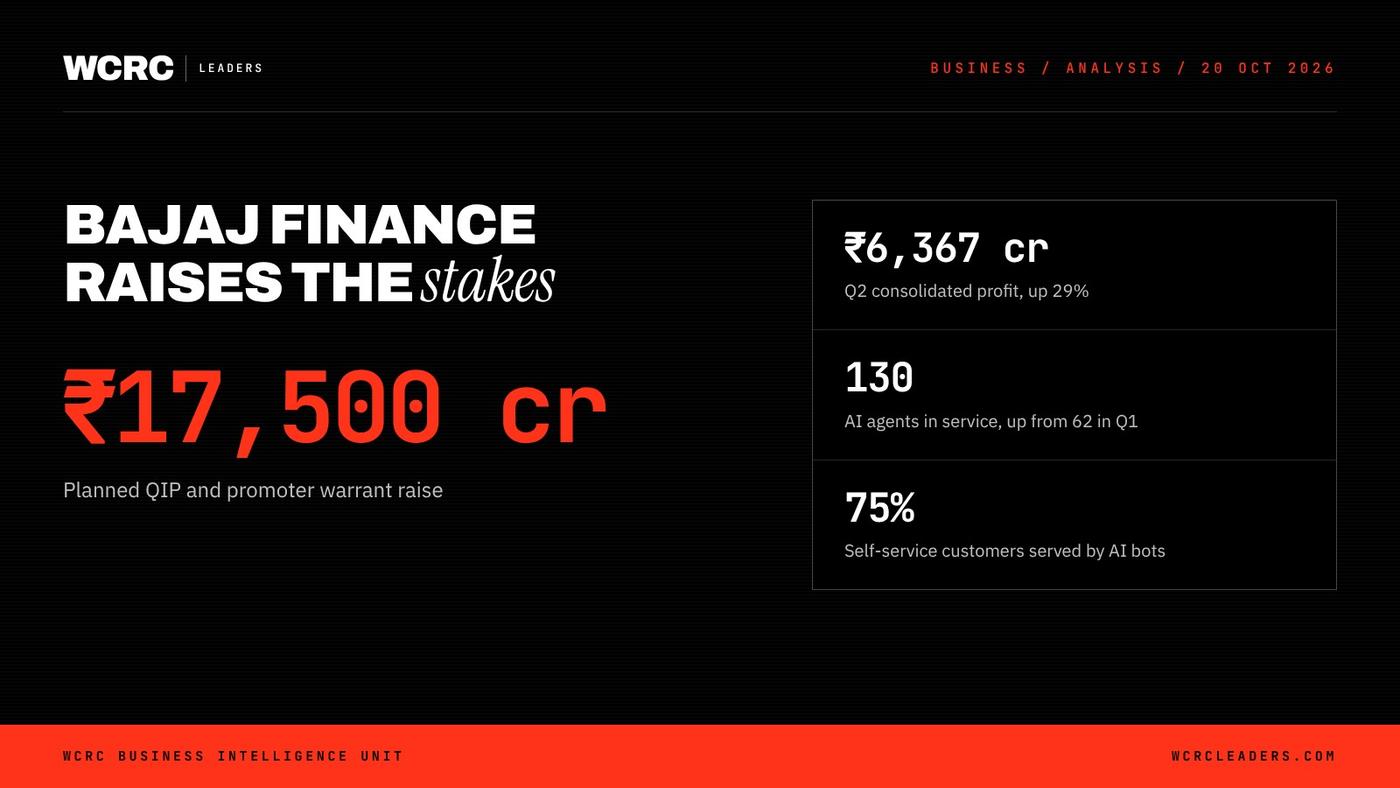
At a glance: WCRC Leaders' assessment: Bajaj Finance is raising capital from a position of strength, not need, and is using AI to hold its cost ratio steady while its loan book grows by a quarter a year. On 19 October 2026 the Pune-based lender reported consolidated profit after tax of ₹6,367 crore for the September quarter, up 29%. Its board had approved on 1 October a qualified institutions placement of up to ₹11,700 crore and warrants of up to ₹5,800 crore for promoter Bajaj Finserv. The raise comes as the Reserve Bank of India lifts its repo rate to 5.50%.
What did Bajaj Finance report for the September quarter?
The company's investor presentation for the quarter ended 30 September 2026 is strong on almost every line. Consolidated assets under management (AUM) reached ₹5,84,624 crore, up 26% from ₹4,62,261 crore a year earlier. Net interest income rose 24% to ₹13,335 crore.
Consolidated profit after tax was ₹6,367 crore, against ₹4,948 crore in the same quarter of 2025. Standalone profit, for Bajaj Finance Limited alone, was ₹5,536 crore, up from ₹4,251 crore. Annualised return on assets was 4.6% and return on equity 20.6%, compared with 4.5% and 19.1% a year earlier.
The company added 4.42 million new customers in the quarter, taking its customer base to 128.85 million. It booked 13.45 million new loans, 11% more than a year earlier (management notes that last year's earlier festival season distorts the comparison).
Credit quality improved. Gross non-performing assets fell to 1.06% from 1.24% a year earlier, and net non-performing assets to 0.42% from 0.60%. Loan losses and provisions were ₹2,166 crore, but that includes a ₹337 crore "prudent management and macro-economic provision". Excluding it, credit costs fell 12% year on year to ₹1,829 crore.
Why raise ₹17,500 crore when capital is already ample?
The consolidated capital adequacy ratio stood at 20.33% at the end of September, with Tier 1 capital of 19.43%, far above the regulatory floor. Leverage was 5.1 times, inside the 5 to 5.5 times band management considers appropriate.
The board approved the raise on 1 October, subject to shareholder approval. It has two parts: up to ₹11,700 crore of equity through a qualified institutions placement to institutional buyers, and up to ₹5,800 crore of convertible warrants for Bajaj Finserv, the promoter and holding company, which owned 51.30% of Bajaj Finance at 30 September. The presentation cites India's growth, the company's momentum and resilience.
WCRC analysis: the arithmetic explains the timing. A lender growing its book at 26% a year with leverage already at 5.1 times will drift towards the top of its own band within a few quarters unless profits alone keep pace. Raising early, and with the promoter committing a third of the money, keeps the company inside its corridor without slowing growth.
There is a precedent. In October 2023 the board approved a similar package, a placement of up to ₹8,800 crore and warrants of up to ₹1,200 crore for Bajaj Finserv, the company's exchange filing from that date shows. This round is about 75% larger.
How does the RBI's rate rise change the picture?
On 7 October the RBI's Monetary Policy Committee voted unanimously to raise the repo rate by 25 basis points to 5.50%, its first increase since 2023. It shifted its stance to "calibrated tightening" and said that "inflation and its outlook are not benign". It projects 2026-27 consumer price inflation at 5.2%, peaking at 6.0% in the third quarter.
For a non-bank lender, tightening makes borrowing dearer and lenders choosier. Bajaj Finance enters this phase well placed. Its consolidated cost of funds was 7.31% in the September quarter, 9 basis points lower than in June; the quarter closed before the hike. Deposits of ₹69,754 crore make up 14% of consolidated borrowings, a retail funding base many NBFCs lack. Its average liquidity coverage ratio was 214%, against a 100% requirement.
WCRC analysis: equity is the cheapest shock absorber a lender can buy before rates rise further. Fresh capital lowers leverage, supports the company's credit standing when it refinances debt, and gives it room to keep lending if weaker rivals pull back. The ₹337 crore overlay follows the same logic: build buffers while earnings allow.
What are the AI agents actually doing?
The presentation reports that Bajaj Finance had 130 AI agents in operation at the end of September, up from 62 in June, and 65 agentic AI deployments, up from 23. Its dedicated AI unit has grown to 328 people, from 230 a quarter earlier. The plan for the current financial year is to build more than 600 sub-agents grouped under 250 autonomous AI agents across sales, operations, human resources, technology and risk.
The number boards elsewhere should note: the company says 75% of its do-it-yourself service customers were served through AI voice and text bots in the quarter, up from 71% in June and 65% a year earlier.
The financial effect is modest so far. Operating expenses grew 23%, in step with net total income, and the cost-to-income ratio was 33.0% against 33.1% a year earlier. Management guides for a 25 to 40 basis point improvement this year. AI is not yet cutting costs outright. It is letting a lender add more than four million customers a quarter without its cost ratio rising.
What should boards in India, the Gulf and Asia take from this?
WCRC analysis: three lessons travel well beyond India.
First, scale AI where volume is high and the rules are clear. Customer service, document checks and lead handling are repetitive, measurable and easy to audit. Bajaj Finance started there and reports progress quarterly. Boards should ask management for the same discipline: a named metric, a baseline and a quarterly trend.
Second, a capital plan and an AI plan are now the same conversation. Lenders that grow fast need both more equity and lower unit costs. Retail lenders in the Gulf and Asia's consumer credit markets face the same trade-off. Raising capital buys time. Automation decides whether that time turns into profit.
Third, governance has to keep pace. Moving from 62 to 130 agents in a single quarter is fast. Each autonomous agent that can make or recommend a credit, collection or service decision adds to model risk, conduct risk and cyber exposure. Boards that cannot say who owns each agent, how it is tested and how a customer can reach a human are behind.
The WCRC View
Our call: this is a strong quarter and a well-timed raise. Bajaj Finance is using a period of high profits to strengthen its balance sheet before the rate cycle bites, and is building the AI base that will decide its costs for the rest of the decade.
Who gains: Bajaj Finserv, which deepens its commitment through warrants, and institutional investors who get access to a lender with 20.6% return on equity. Smaller NBFCs without deposits or a strong promoter lose ground, because a well-funded leader can keep lending and pricing keenly as funding tightens.
The risk: the AI build is now outpacing the evidence on cost savings. Opex is growing as fast as income. If the 600 sub-agents do not bend the cost ratio visibly by the end of FY27, investors will start treating the AI programme as spending, not savings.
What leaders should do now: finance boards should test their own capital headroom against at least two more rate rises, and set AI targets in customer and cost terms, not in agent counts. Every agent in production should have a named owner and a human escalation route.
What WCRC will watch: the shareholder vote and pricing of the placement, the RBI's next policy decision, whether cost of funds rises in the December quarter, and whether the cost-to-income ratio moves towards the promised 25 to 40 basis point improvement.
Related reading: India's first rate hike since 2023: what it means for capex and the festive season, Boards are deploying AI faster than they can secure it and Your customers will send their agents: what the Personal Agent Protocol means for the board.
Bajaj Finserv, Bajaj Finance's promoter, was selected by the Business Intelligence Unit of WCRC for India's Most Loved 250 Workplaces 2026.
Quick answers
Q: How much profit did Bajaj Finance make in Q2 FY27? A: Consolidated profit after tax was ₹6,367 crore for the quarter ended 30 September 2026, up 29% from ₹4,948 crore. Standalone profit was ₹5,536 crore.
Q: How much capital is Bajaj Finance raising? A: Up to ₹17,500 crore: a qualified institutions placement of up to ₹11,700 crore and convertible warrants of up to ₹5,800 crore for Bajaj Finserv, approved by the board on 1 October 2026 and subject to shareholder approval.
Q: How many AI agents does Bajaj Finance use? A: It reported 130 AI agents at the end of September 2026, up from 62 in June, and plans more than 600 sub-agents under 250 autonomous agents in FY27. AI bots served 75% of its self-service customers in the quarter.
Q: What did the RBI do on 7 October 2026? A: It raised the repo rate by 25 basis points to 5.50% and changed its stance to calibrated tightening.
Filed under