Business
Jio Platforms IPO: Gulf funds hold 5.32% and are not selling
Jio Platforms took anchor bids on Monday, a day before a market holiday and two days before its ₹30,213 crore public issue opens. Three Gulf sovereign funds are already on its register. Here is what the anchor book can and cannot tell boards planning their own listings.
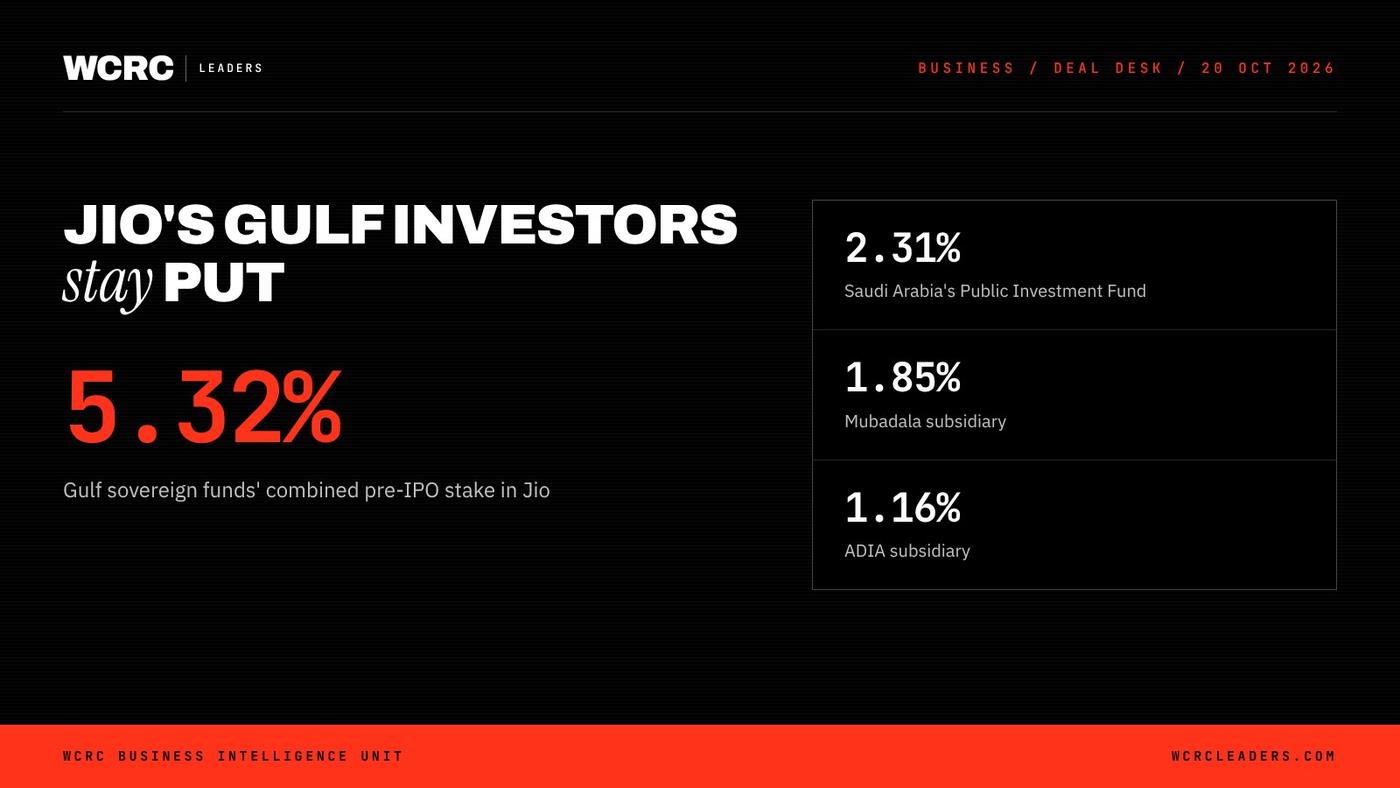
At a glance: WCRC Leaders' assessment: the most telling Gulf signal in the Jio Platforms deal is not a new anchor ticket but the sovereign money that is staying put. Saudi Arabia's Public Investment Fund, Mubadala and the Abu Dhabi Investment Authority together hold 5.32% of Jio before the issue and sell nothing in it. Anchors bid on 19 October for a book that, by WCRC's calculation, can reach about 7.3 crore shares, roughly ₹8,150 crore at the ₹1,119 cap. The public issue runs from 21 to 23 October.
What happened on Monday?
Jio Platforms Limited, the digital and telecom arm of Reliance Industries (RIL), opened its anchor investor book on Monday 19 October 2026, the date set in its red herring prospectus. Because Indian markets are shut on Tuesday 20 October for Dussehra, the anchor result has a full non-trading day to circulate before retail, high-net-worth and the remaining institutional bids open on Wednesday.
The National Stock Exchange's issue page, under the symbol JPL, sets out the mechanics: a fresh issue of up to 27 crore shares at ₹1,065 to ₹1,119, including up to ₹500 crore for eligible employees, who get a ₹54 discount, and up to ₹2,500 crore for eligible RIL shareholders. Retail investors and RIL shareholders can bid up to ₹2 lakh each, employees up to ₹5 lakh. KFin Technologies is the registrar.
WCRC has already covered the issue terms and SEBI's anchor rules. This piece looks at the anchor book itself and at the Gulf.
How big can the anchor book be?
The issue is made under Regulation 6(1) of SEBI's issue rules, which caps the qualified institutional buyer (QIB) portion at half of the net issue. Anchors may take up to 60% of that QIB portion.
WCRC has worked the numbers from the NSE issue page. If both reservations are filled in full, they absorb about 0.47 crore shares for employees (at the discounted ₹1,065) and about 2.23 crore shares for RIL shareholders (at ₹1,119). That leaves a net issue of about 24.3 crore shares, a QIB portion of about 12.1 crore shares and a maximum anchor portion of about 7.3 crore shares. At the cap, that ceiling is worth roughly ₹8,150 crore. The exact count depends on how the reservations are finally sized.
Two rules shape who gets in. Since SEBI's amendment of late 2025, 40% of the anchor portion is reserved: one-third for domestic mutual funds and 6.67% for registered Indian life insurers and pension funds. On a full book, that is about ₹3,260 crore of the anchor ceiling earmarked for domestic institutions. Foreign sovereign funds compete for the remaining 60%. And half of each anchor's allotment is locked in for 30 days, the other half for 90 days.
Why does the Gulf matter in this deal?
Gulf sovereign capital is already part of Jio's ownership. The prospectus lists three Gulf state investors among the shareholders who bought in during 2020 and remain on the register today:
| Shareholder | Pre-issue shares | Pre-issue stake |
|---|---|---|
| Public Investment Fund (Saudi Arabia) | 206,931,899 | 2.31% |
| MIC Redwood 1 RSC (Mubadala subsidiary) | 165,545,519 | 1.85% |
| Platinum Jasmine A 2018 Trust (ADIA subsidiary as trustee) | 103,465,950 | 1.16% |
| Combined | 476,343,368 | 5.32% |
ADIA's position dates from 7 June 2020, when RIL told the exchanges that a wholly owned ADIA subsidiary would invest ₹5,683.50 crore for 1.16% of Jio Platforms at an equity value of ₹4.91 lakh crore. It was the seventh such deal in under seven weeks, taking Jio's raise to ₹97,885.65 crore.
Because the IPO is a fresh issue with no offer for sale, none of these funds is cashing out. Their stakes will be diluted slightly by the 27 crore new shares, but they keep every share they hold. That decision is a quiet statement of confidence in the asset.
WCRC analysis: a sovereign fund that holds through a listing gives up the easiest exit it will ever have. Whether Gulf and Asian state investors also take fresh anchor allocations matters less than the fact that the incumbents chose not to sell. Boards should weigh the hold more heavily than any new ticket.
What should readers look for in the anchor allocation?
The anchor allocation is published through the stock exchanges once the book is allotted. WCRC will read it against four tests:
- Price. An allotment at ₹1,119, the top of the band, would show that institutions accept the company's pricing without negotiation.
- Fill. How close the book comes to the ceiling of about 7.3 crore shares. A full book leaves the main QIB portion of roughly 4.9 crore shares to be tested from Wednesday.
- Domestic share. Whether domestic mutual funds, insurers and pension funds take more than the 40% reserved for them. A large domestic share says Indian savings can carry a ₹30,000 crore primary issue on their own.
- Sovereign presence. Whether Gulf and Asian state funds appear as new anchors, in what size, and whether any of them comes through offshore derivative structures rather than direct holdings.
What does it mean for boards planning a listing?
This section is WCRC analysis.
For Indian promoters, Jio is building a template: list the operating company, raise only primary capital, keep the strategic and sovereign investors on the register, and reserve a slice for the parent's own shareholders. A board that assumed its IPO had to double as an exit for 2020-vintage investors now has a very large counter-example.
For Gulf boards and family offices, the deal shows how the 2020 wave of private investment in Indian platforms can mature. Holding through listing turns a private stake into a listed one with a daily price, without paying the discount that comes with selling into an IPO.
For Asian institutions, the 40% domestic reservation leaves a foreign sovereign less room to set terms. Its leverage lies in size, holding period and reputation.
Timing matters too: four main-board issues closed on NSE on 19 October, and Paras Healthcare opens alongside Jio.
Does tight liquidity complicate the week?
The Reserve Bank of India's money-market operations on the same Monday show demand for short-term funds. In a 7-day variable rate repo auction on 19 October, banks bid ₹1,50,735 crore against a notified ₹1,00,000 crore. The RBI allotted ₹1,00,014 crore at a cut-off rate of 5.51% and a weighted average rate of 5.52%.
WCRC analysis: in a large IPO, application money is blocked in investors' bank accounts until allotment, and that pulls on bank liquidity during the bidding window. An oversubscribed repo auction in the same week points to strong demand for short-term funds. Treasurers should watch overnight rates, and boards with debt raises planned should avoid crowding the same window. WCRC set out the wider rate backdrop in India's first rate hike since 2023.
Parent company Reliance Industries has been selected by the Business Intelligence Unit of WCRC among India's Most Loved 250 Workplaces 2026.
The WCRC View
From the WCRC Business Intelligence Unit.
The anchor book is the market's first independent price on Jio, but the stronger signal came earlier: three Gulf sovereign funds holding 5.32% chose to stay in. Conviction shown by not selling is harder to fake than an anchor ticket.
Domestic institutions gain most from the structure. SEBI's 40% reservation guarantees them a large slice of a scarce, liquid asset at the anchor price, and the deal will show whether Indian savings can now absorb issues of this size without leaning on foreign money.
Boards planning listings in 2027 should take three lessons. Line up domestic insurers and pension funds early, because their reserved slice goes to mutual funds if they are absent. Decide in advance whether pre-IPO investors will sell, since a primary-only issue sends a strong signal. And avoid launching in a week when liquidity is tight and the calendar is crowded.
Gulf and Asian sovereign investors should negotiate access well before the book opens, not on the day.
WCRC will watch the exchange disclosure of the anchor allocation, category-wise subscription by Friday 23 October, the 30-day and 90-day anchor unlocks, and whether PIF, Mubadala and ADIA keep their stakes after listing. For context on Gulf strategy, see the UAE-Saudi rail and grid pact and the Gulf's C-suite churn.
Quick answers
Q: When did Jio Platforms take anchor bids? A: On Monday 19 October 2026. The public issue opens on Wednesday 21 October and closes on Friday 23 October; 20 October is a market holiday.
Q: How large can the anchor book be? A: Up to 60% of the QIB portion. By WCRC's calculation, that is about 7.3 crore shares, roughly ₹8,150 crore at the ₹1,119 cap.
Q: Which Gulf sovereign funds own Jio Platforms? A: The Public Investment Fund (2.31%), a Mubadala subsidiary (1.85%) and an ADIA subsidiary (1.16%), per the prospectus. None is selling in the IPO.
Q: What are the reservations in the issue? A: Up to ₹500 crore for eligible employees, who get a ₹54 discount, and up to ₹2,500 crore for eligible RIL shareholders.
Filed under