Business
Jio Platforms IPO closes 22.19x as institutions bid 70.55 times over
Jio Platforms' ₹30,213 crore fresh issue closed on 23 October with bids for 438 crore shares against 19.75 crore on offer. The demand came overwhelmingly from institutions; retail investors were far more measured.
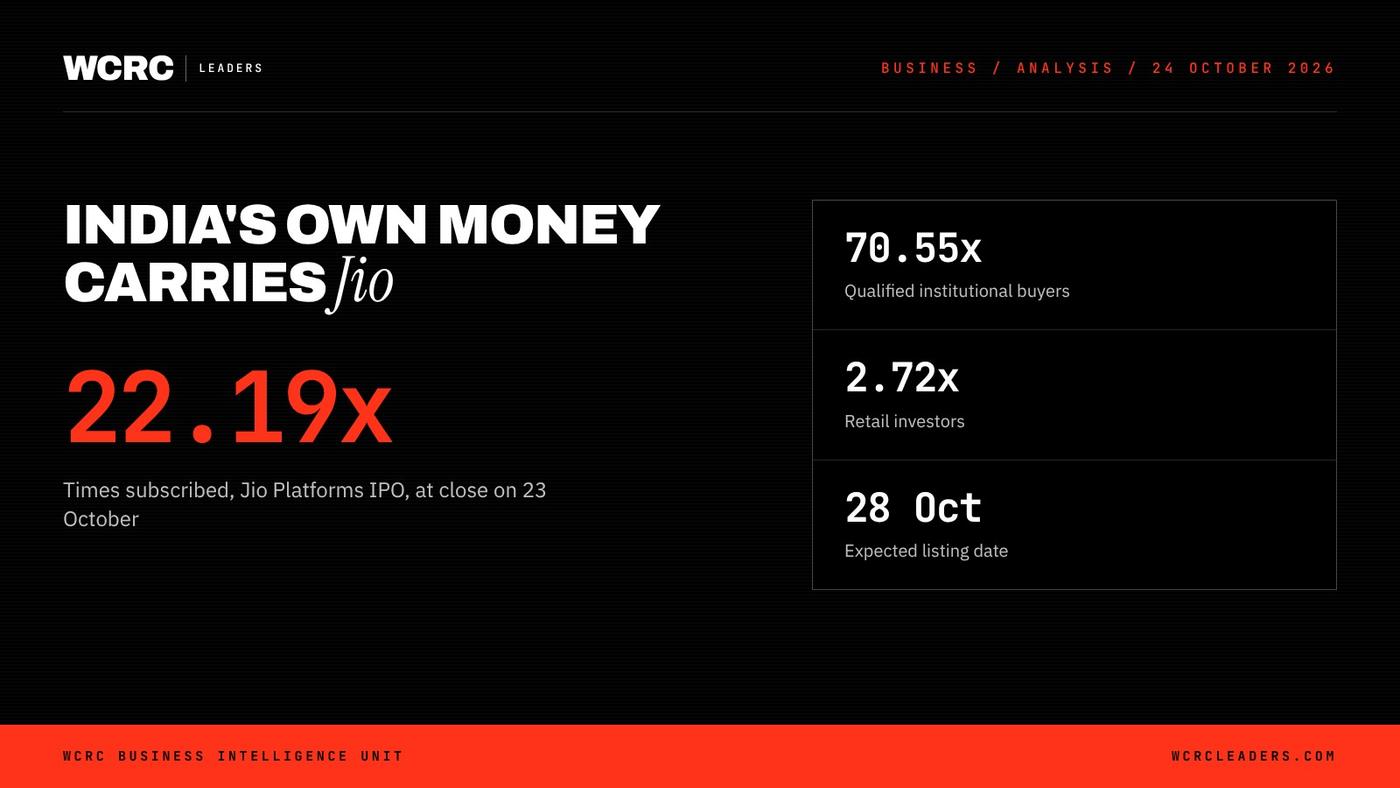
At a glance: WCRC Leaders' assessment: the Jio book shows that India's own banks, insurers and funds, not foreign money, now carry the weight of India's large equity raises. NSE's final consolidated data at 7 p.m. on 23 October shows the issue subscribed 22.19 times, led by qualified institutional buyers at 70.55 times. Retail came in at 2.72 times and Reliance shareholders at 7.60 times. Allotment is due on or about 26 October and trading on or about 28 October.
How much demand did the Jio Platforms IPO attract?
The final numbers are large by any measure. According to NSE's category-wise bid details, updated as on 23 October 2026 at 19:00, investors bid for 4,38,26,15,568 shares against 19,75,25,934 shares offered in the public book. That is 22.19 times.
At the ₹1,119 top of the price band, those bids are worth about ₹4.90 lakh crore (WCRC calculation; a small share of bids came at lower prices or at the employee discount, so the true figure is slightly lower). For context, Reliance Industries told the exchanges in June 2020 that the Abu Dhabi Investment Authority's investment valued Jio Platforms at ₹4.91 lakh crore of equity. In other words, the money bid in three days roughly matched what the whole company was worth six years ago.
The public book is smaller than the headline issue. The red herring prospectus provides for up to 27 crore new shares. The 19.75 crore shares in the public book leave about 7.25 crore shares, or roughly ₹8,110 crore at the cap, which is consistent with an anchor allocation close to the 60% ceiling of the institutional portion (WCRC calculation; the anchor allotment itself is covered in our earlier report on the fresh issue and anchor book).
Who actually bid, and who held back?
The category split tells a sharper story than the headline multiple.
| Category | Shares offered | Shares bid | Times |
|---|---|---|---|
| Qualified institutional buyers | 4.90 crore | 345.76 crore | 70.55 |
| Non-institutional investors | 3.64 crore | 51.04 crore | 14.00 |
| of which bids above ₹10 lakh | 2.43 crore | 38.62 crore | 15.89 |
| of which ₹2 lakh to ₹10 lakh | 1.21 crore | 12.42 crore | 10.22 |
| Retail individual investors | 8.50 crore | 23.12 crore | 2.72 |
| Employees | 0.47 crore | 1.37 crore | 2.93 |
| Eligible RIL shareholders | 2.23 crore | 16.98 crore | 7.60 |
| Total | 19.75 crore | 438.26 crore | 22.19 |
Source: NSE bid details, 23 October 2026, 19:00.
Institutions placed about 79% of all shares bid. Within that, NSE's breakdown shows domestic banks, financial institutions and insurers bid for 152.50 crore shares, mutual funds for 35.71 crore and foreign institutional investors for 123.93 crore. Domestic institutions together outbid foreign ones by roughly half again.
Retail investors were the most cautious large group. A 2.72 times retail book is solid, but it trails every other category except employees. About 90% of retail shares were bid at the cut-off price, which means individual investors accepted whatever price the issue settles at rather than trying to pick a lower one.
The Reliance shareholder quota, at 7.60 times, was nearly three times as oversubscribed as the general retail portion. Existing RIL investors were far keener than first-time investors in the group.
What does the book say about domestic and Gulf capital?
Analysis. Two points stand out.
First, the institutional book was led at home. Indian banks and insurers alone bid for more shares than all foreign institutions combined. For a ₹30,213 crore primary issue, that is a meaningful shift. It suggests India's insurance and pension pools, plus mutual funds fed by monthly investment plans, can now absorb an issue of this size without relying on foreign demand.
Second, Gulf capital's role here is mostly as an existing owner, not as a fresh bidder. As we reported in Gulf funds hold 5.32% and are not selling, Saudi Arabia's Public Investment Fund, a Mubadala subsidiary and an ADIA-linked trust together held 47.63 crore shares before the issue. This is a fresh issue with no offer for sale, so they keep every share. On the 920.90 crore shares in issue after the IPO, set out in the issue advertisement, their combined stake falls to about 5.17% (WCRC calculation). At the cap, that holding is worth about ₹53,300 crore.
Exchange data does not name individual bidders. Any Gulf sovereign funds that bid as foreign portfolio investors sit inside the ₹1.39 lakh crore foreign institutional line, along with every other overseas fund. Claims about how much Gulf money entered the public book cannot be confirmed until allotment disclosures are filed.
Is the price justified by the demand?
Demand and value are different questions. The issue advertisement puts the post-issue market capitalisation at ₹10,30,490.55 crore at the cap, or ₹10.30 lakh crore. On fiscal 2026 diluted earnings, that is 33.31 times, against a peer average of 22.35 times listed in the same document.
Analysis. Institutions bidding 70 times their quota are signalling that they expect allotment to be scarce, so many will have bid well beyond what they want to hold. Heavy oversubscription often inflates bid sizes; it does not by itself prove the premium to peers is earned. Reliance remains in control, with its holding falling to about 64% after the issue, according to the advertisement.
What happens next: allotment, listing and lock-ins
The issue advertisement sets out an indicative timetable:
- On or about Monday 26 October: basis of allotment finalised by the registrar, KFin Technologies.
- On or about Tuesday 27 October: refunds and unblocking of ASBA funds; shares credited to demat accounts.
- On or about Wednesday 28 October: trading begins on BSE and NSE.
Retail allotment will be thin. The retail portion is 8.50 crore shares, which is about 70.9 lakh minimum lots of 12 shares (WCRC calculation). If more retail applicants applied than there are lots, allotment of one lot each will be decided by lottery.
Lock-ins come next. Under SEBI's rules, half of each anchor's shares are locked in for 30 days from allotment and half for 90 days. On a 26 October allotment, that points to around 25 November 2026 and 24 January 2027 (WCRC calculation). Pre-issue shareholders other than the promoter face a six-month lock-in under SEBI's rules, which would run to late April 2027. Reliance, as promoter, is subject to longer lock-in terms set out in the prospectus.
What should CEOs and boards take from this?
For Indian boards planning a large listing, the message is that depth is now domestic. A primary raise of this size found far more institutional demand at home than abroad. That reduces the risk of a deal being pulled because foreign funds turn cautious.
For Gulf boards and sovereign funds, Jio shows the value of entering early. Holders who came in during 2020 are now sitting on a stake priced at more than double the 2020 equity value, without selling a share.
For Asian investors and conglomerates, the gap between institutional and retail appetite is a caution. Large-cap Indian issues are being priced for institutions. Retail investors are participating, but at a far lower intensity.
The WCRC View
From the WCRC Business Intelligence Unit.
The call: the Jio book is a vote of confidence in India's domestic savings system more than in any single foreign investor. Banks, insurers and mutual funds bid for more than 188 crore shares between them. That is the real news, and it changes how Indian promoters should plan large raises.
Who gains: Reliance gains a market price for its digital arm and fresh capital to repay Jio's borrowings, as the prospectus intends. The Gulf funds that bought in 2020 gain a liquid, marked-to-market stake. Domestic institutions gain access to a large, widely held technology stock.
Who should be careful: retail applicants who expect a large allotment, and anyone treating 22 times as proof of value. A 33 times earnings multiple against a 22 times peer average leaves less room for disappointment once trading starts.
What leaders should do now: CFOs and boards with listings in the pipeline should test their own issues against domestic institutional demand first. Gulf investors weighing Indian pre-IPO stakes should note that early entry, not the IPO itself, delivered the return.
What WCRC will watch: the basis of allotment on 26 October, the listing price on 28 October, the anchor lock-in expiries on or around 25 November and 24 January, and Jio's first results as a listed company.
Separately, Jio's parent, Reliance Industries, is named among India's Most Loved 250 Workplaces 2026 by WCRC. For background on how anchor books work, see our anchor investors explainer.
Quick answers
Q: How many times was the Jio Platforms IPO subscribed? A: 22.19 times overall, according to NSE's final bid details at 7 p.m. on 23 October 2026, with bids for 438.26 crore shares against 19.75 crore offered.
Q: Which investor category bid the most? A: Qualified institutional buyers, at 70.55 times their portion. Non-institutional investors bid 14.00 times, Reliance shareholders 7.60 times, employees 2.93 times and retail investors 2.72 times.
Q: When will Jio Platforms shares list? A: The issue advertisement gives an indicative date of on or about Wednesday 28 October 2026 on BSE and NSE, after allotment on or about 26 October.
Q: What is Jio Platforms worth at the issue price cap? A: About ₹10.30 lakh crore of post-issue market capitalisation at ₹1,119 a share, according to the issue advertisement.
Vedanta doubles Gamsberg, and Ramaphosa now wants a zinc smelter
Anchor investors in Indian IPOs: why the 60% book sets the tone

Bajaj Finance lines up ₹17,500 crore as AI agents take on service

$133bn: what India's rupee defence is costing its biggest banks
Jio Platforms IPO: Gulf funds hold 5.32% and are not selling
Détente in two-month instalments: planning for China after the Washington summit
Filed under