Business
Adani Ports raises FY27 capex by ₹3,000 crore as overseas ports surge
APSEZ grew second-quarter revenue 24% and profit 18%, then raised its spending plan halfway through the year. The question for boards is what that bet says about Indian trade.
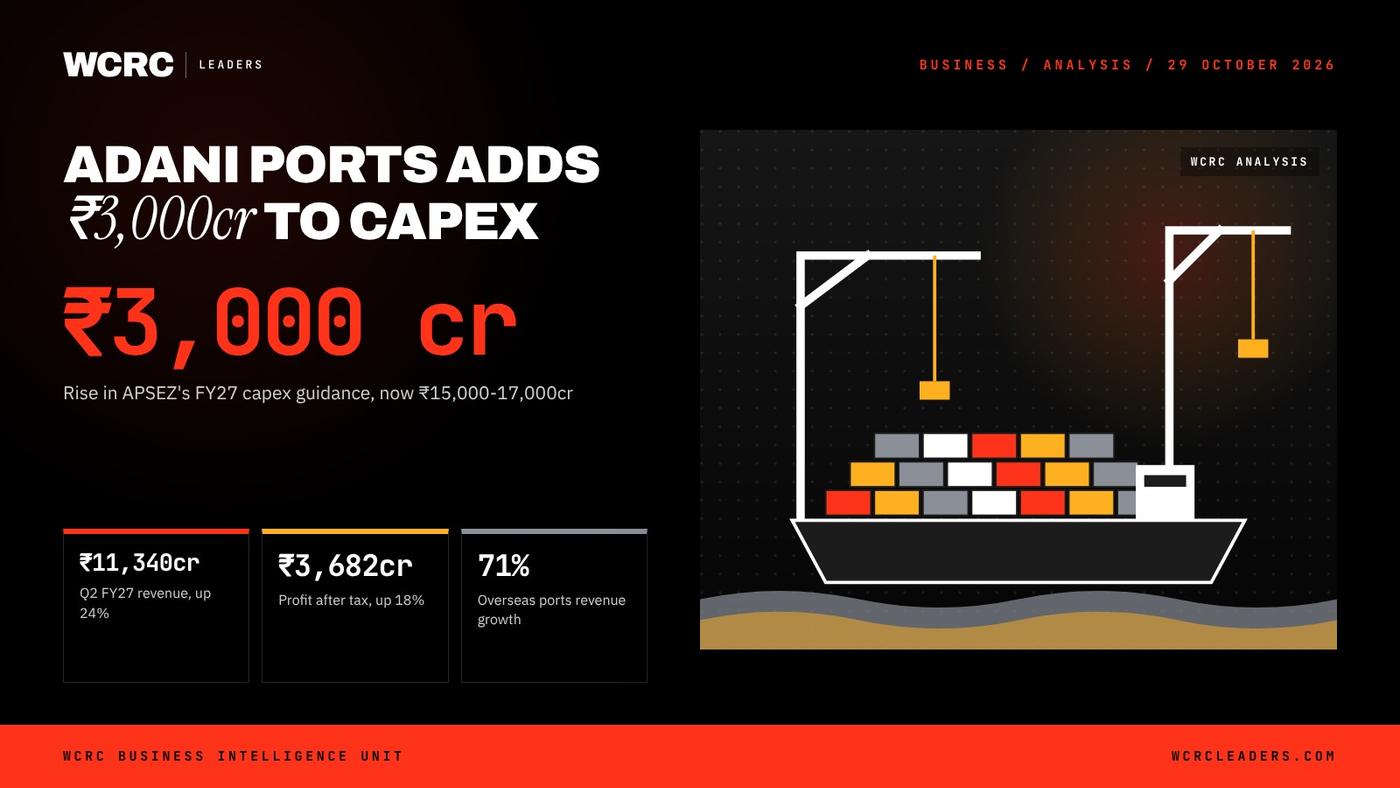
At a glance: WCRC Leaders' assessment: Adani Ports is betting that Indian and Indian Ocean trade will keep growing through the West Asia disruption, and it is funding that bet from cash flow rather than leverage. On 28 October 2026, Adani Ports and Special Economic Zone (APSEZ) reported Q2 FY27 revenue of ₹11,340 crore and profit after tax of ₹3,682 crore. It lifted FY27 revenue and EBITDA guidance by ₹1,000 crore each and capex guidance by ₹3,000 crore, to ₹15,000-17,000 crore.
What did Adani Ports report for the September quarter?
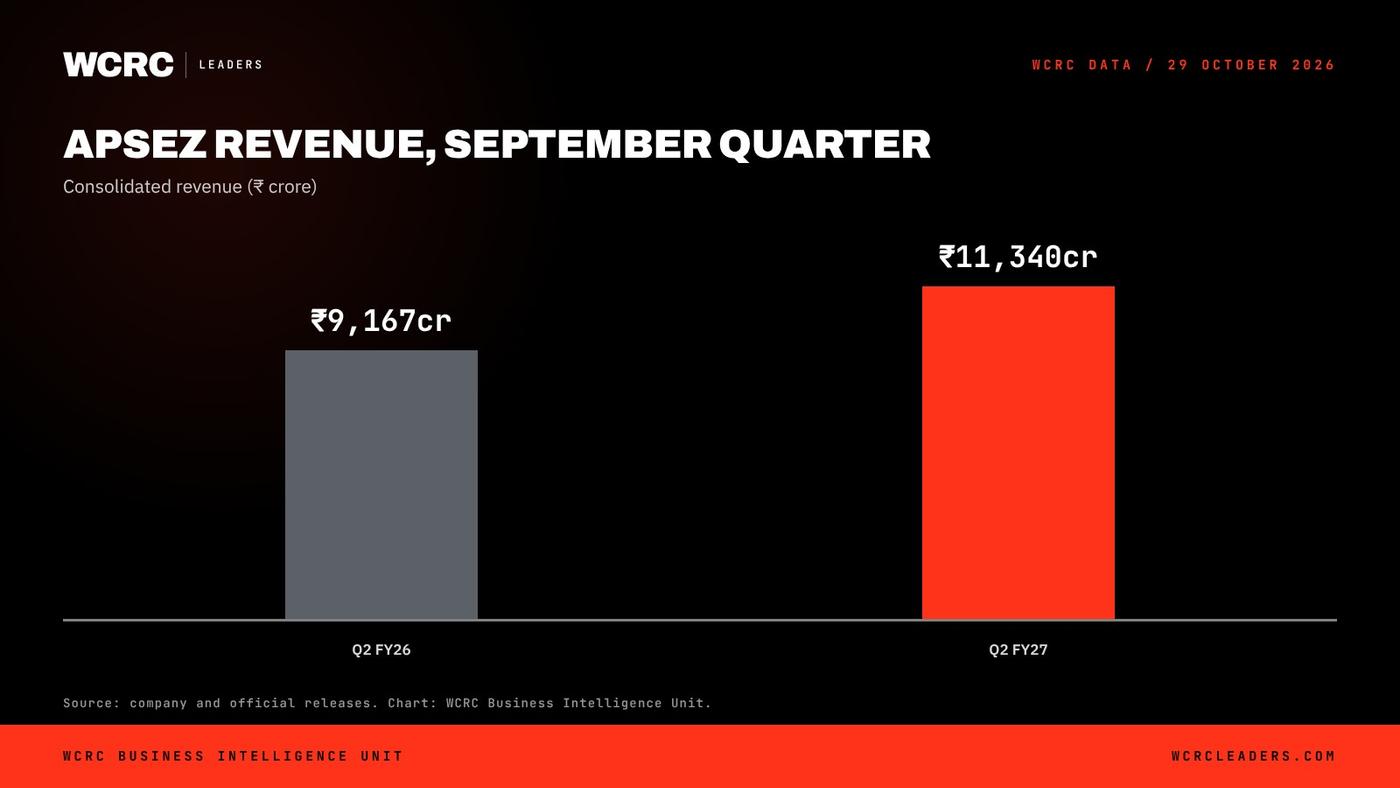
Adani Ports and Special Economic Zone, one of WCRC 1000, India's Most Valuable Enterprises 2026, published its results from Ahmedabad on 28 October. For the quarter to 30 September 2026, consolidated revenue rose 24% to ₹11,340 crore from ₹9,167 crore a year earlier. EBITDA rose 23% to ₹6,807 crore. Profit after tax rose 18% to ₹3,682 crore from ₹3,120 crore.
For the half year, revenue was ₹22,161 crore (up 21%), EBITDA ₹13,347 crore (up 21%) and profit ₹7,332 crore (up 14%).
The quarter was stronger than the first. In Q1 FY27, revenue grew 19% and profit 10%, and the company said its rail container volumes were hit by the Middle East crisis. In Q2, logistics container volumes rose 15% quarter on quarter to 167,453 TEUs, which the company called a strong recovery from a first quarter "impacted by the West Asia crisis".
The domestic port business handled 118 million tonnes (MMT) of cargo, up from 115.3 MMT in Q1. APSEZ put its share of all-India cargo at 27.3% and its share of container cargo at 44.4%, with domestic capacity of 671 MMT.
WCRC analysis: read through the Category Command Model, a model in WCRC's Brand & Marketing Codex that asks who leads a category and by how much, those shares describe command, not just leadership: more than a quarter of all Indian cargo and close to half of its containers. That lead is what lets APSEZ raise spending mid-year without straining its balance sheet.
Where is the growth actually coming from?
The headline hides a shift in mix. Domestic ports remain the profit engine, with revenue of ₹7,177 crore (up 13%) and EBITDA of ₹5,201 crore at a 72.5% margin, about three-quarters of the group total.
The fastest growth is elsewhere. International ports revenue rose 71% to ₹1,839 crore, and EBITDA more than tripled, up 236% to ₹878 crore. International volumes reached 24 MMT against 10 MMT a year earlier, helped by the Colombo West International Terminal in Sri Lanka, record container volumes in Tanzania and the NQXT terminal in Australia. Marine revenue rose 57% to ₹1,007 crore, with the fleet at 138 vessels against 127 a year ago. Logistics revenue rose 21% to ₹1,273 crore, though its EBITDA rose only 8%, to ₹237 crore.
Under the release headline "One platform, four growth engines", Ashwani Gupta, Whole-time Director and CEO, called Q2 "another stellar quarter", with domestic ports anchoring earnings.
WCRC analysis: in the terms of Corporate Value Intelligence, WCRC's framework for interpreting enterprise value, the mix matters more than the headline growth. Domestic ports earn margins above 70% but grow more slowly; the new engines grow faster at lower margins (47.7% for international ports, under 19% for logistics). Value rests on whether each new rupee of capital earns close to the domestic return. Boards should expect group margins to drift, not expand, and judge management on return on capital.
Why raise capex now, and can the balance sheet carry it?
The most telling line in the release is the capex revision. FY27 capex guidance moves from ₹12,000-14,000 crore to ₹15,000-17,000 crore, a 23% rise at the midpoint. APSEZ said first-half capex had run ahead of plan at ₹10,521 crore, and linked the upgrade to faster investment towards its Ambition 2031 targets of ₹91,500 crore revenue and ₹52,000 crore EBITDA.
"As we accelerate investments toward our Ambition 2031 objectives, our balance sheet remains exceptionally strong," Gupta said.
The figures support the claim, with one caveat. First-half operating cash flow was ₹13,327 crore, leaving free cash flow of ₹2,806 crore after capex. Gross debt stood at ₹57,717 crore and cash at ₹12,502 crore, giving net debt of 1.8 times EBITDA against a self-imposed ceiling of 2.5 times, which is unchanged. S&P raised APSEZ's long-term rating to BBB (Stable) in June, which the company said matches India's sovereign rating. The caveat: average debt maturity has shortened to 4.9 years from 5.2 years, so refinancing discipline will matter as spending rises.
WCRC analysis: Ambition 2031 implies revenue roughly doubling from the FY27 guidance midpoint of ₹45,000 crore in four years, or annual growth of about 19%. The revised guidance band implies 14% to 19% growth this year. Management is therefore guiding to the bottom-to-middle of its own long-term trajectory, and spending ahead of it.
What are the big projects behind the spending?
Three moves show where the money goes.
- Vizhinjam, Kerala. The deep-water transhipment port began export-import operations this quarter. In June, MSC Group's terminal arm TiL agreed to invest USD 1.397bn for a 49% stake in the Vizhinjam concessionaire, on a total deal value of USD 2.85bn, subject to approvals. APSEZ called it the single largest foreign private investment in Indian port infrastructure. Capacity is planned to rise from 1.6 million TEUs to 5.7 million TEUs by December 2028.
- Colombo, Sri Lanka. Phase II of the Colombo West International Terminal, a USD 750m investment with John Keells Holdings and the Sri Lanka Ports Authority, doubled capacity to 3.2 million TEUs in September. The terminal handled 2 million TEUs in its first 18 months.
- Paradip, Odisha. APSEZ won a 30-year concession for two dry bulk berths adding 18 MMT of mechanised capacity on India's east coast.
WCRC analysis: Vizhinjam and Colombo are a direct play for transhipment cargo that has moved through Colombo's public terminals, Singapore and the Gulf. MSC's 49% stake both shares the capital load and anchors volumes.
What does this say about Indian demand and capex?
APSEZ is a read-through on the physical economy. Its domestic cargo growth, higher realisations and container share point to steady trade and industrial activity, consistent with India's core sector growth of 7.9% in September, which WCRC covered earlier this month. It also sits alongside the record order inflows reported by L&T in its Q2 FY27 results: private infrastructure owners and contractors are both still committing capital.
The West Asia factor cuts both ways. Q1 showed how quickly a Gulf shock reaches Indian rail and container logistics; Q2 showed how fast volumes recover. WCRC analysis: in the terms of the Fortress Model of Crisis Leadership, a model in WCRC's Guru Management Codex, APSEZ's response reads as defence first and expansion second. It held its 2.5 times leverage ceiling through the disruption and raised guidance only once volumes came back.
For Gulf boards, India's port owners are building alternative transhipment capacity on the subcontinent and in Sri Lanka while regional operators, including DP World under new Asia Pacific leadership, reposition. After the Strait of Hormuz attacks, route diversity is a board question, not an operational one.
What does it say about leadership and governance?
On WCRC's own record, Adani Ports & SEZ was named among India's Most Loved 250 Workplaces 2026, selected by the Business Intelligence Unit of WCRC, and Adani Ports is a WCRC MegaBrand in ports and terminals. The full report and evidence are available from WCRC on request.
The leadership signal is predictability under pressure: modest, specific guidance raises, an unchanged leverage ceiling and free cash flow disclosed alongside the capex increase. Lenders and minority shareholders want that pattern from a capital-heavy group, and the S&P upgrade suggests it is being rewarded.
The WCRC View
The call: APSEZ's capex raise is a confident, cash-backed bet that Indian and Indian Ocean trade will keep growing through regional disruption. It is the right call for a company with 1.8 times leverage and a domestic business earning 72.5% margins. In Category Command terms, the domestic lead is funding the challenge for transhipment cargo against Colombo, Singapore and the Gulf.
Who gains: Exporters and importers on both Indian coasts, who get more capacity and route choice; MSC, which secures a long-term Indian anchor; and Indian EPC and equipment suppliers. Rival Gulf and Southeast Asian transhipment hubs face more competition for subcontinent cargo over three to five years.
What boards should do now: CEOs in India, the Gulf and Asia with trade-exposed supply chains should map how much cargo moves through a single hub or route and test a Hormuz-style disruption against it. Infrastructure boards should note the APSEZ playbook, which reads well against the Fortress Model: protect the balance sheet first, then pair a growth push with a stated leverage ceiling and a credible partner sharing the capital.
What WCRC will watch: Whether logistics and international returns rise as volumes recover, the Corporate Value Intelligence test of this capex; whether the TiL investment in Vizhinjam receives approvals and the 5.7 million TEU expansion stays on its December 2028 timetable; free cash flow in the second half as capex accelerates; and how debt maturity moves from 4.9 years.
WCRC models applied: Corporate Value Intelligence (WCRC 1000), Category Command Model (Brand & Marketing Codex), Fortress Model of Crisis Leadership (Guru Management Codex).
Quick answers
Q: What were Adani Ports' Q2 FY27 results? A: For the quarter to 30 September 2026, APSEZ reported revenue of ₹11,340 crore (up 24%), EBITDA of ₹6,807 crore (up 23%) and profit after tax of ₹3,682 crore (up 18%).
Q: How did APSEZ change its FY27 guidance? A: It raised revenue guidance to ₹44,000-46,000 crore and EBITDA guidance to ₹26,000-27,000 crore, up ₹1,000 crore each, and capex guidance to ₹15,000-17,000 crore, up ₹3,000 crore. Its net debt to EBITDA ceiling of 2.5 times is unchanged.
Q: Which business grew fastest? A: International ports. Revenue rose 71% to ₹1,839 crore and EBITDA rose 236% to ₹878 crore, with volumes of 24 MMT against 10 MMT a year earlier.
Q: How leveraged is Adani Ports? A: Net debt was 1.8 times EBITDA at 30 September 2026, with gross debt of ₹57,717 crore and cash of ₹12,502 crore. S&P rates it BBB (Stable).
Vedanta doubles Gamsberg, and Ramaphosa now wants a zinc smelter
Anchor investors in Indian IPOs: why the 60% book sets the tone

Bajaj Finance lines up ₹17,500 crore as AI agents take on service

$133bn: what India's rupee defence is costing its biggest banks
Jio Platforms IPO: Gulf funds hold 5.32% and are not selling
Détente in two-month instalments: planning for China after the Washington summit
Filed under