Business
Sun Pharma's profit falls 36% as it pays for Organon and a US lawsuit
India's largest drugmaker grew revenue by 11.9% in the September quarter, but ₹12,688 million of one-off charges, for a US antitrust settlement and its $11.75bn Organon takeover, cut reported profit by more than a third. On the same day, the US cleared its psoriasis biologic for a second disease.
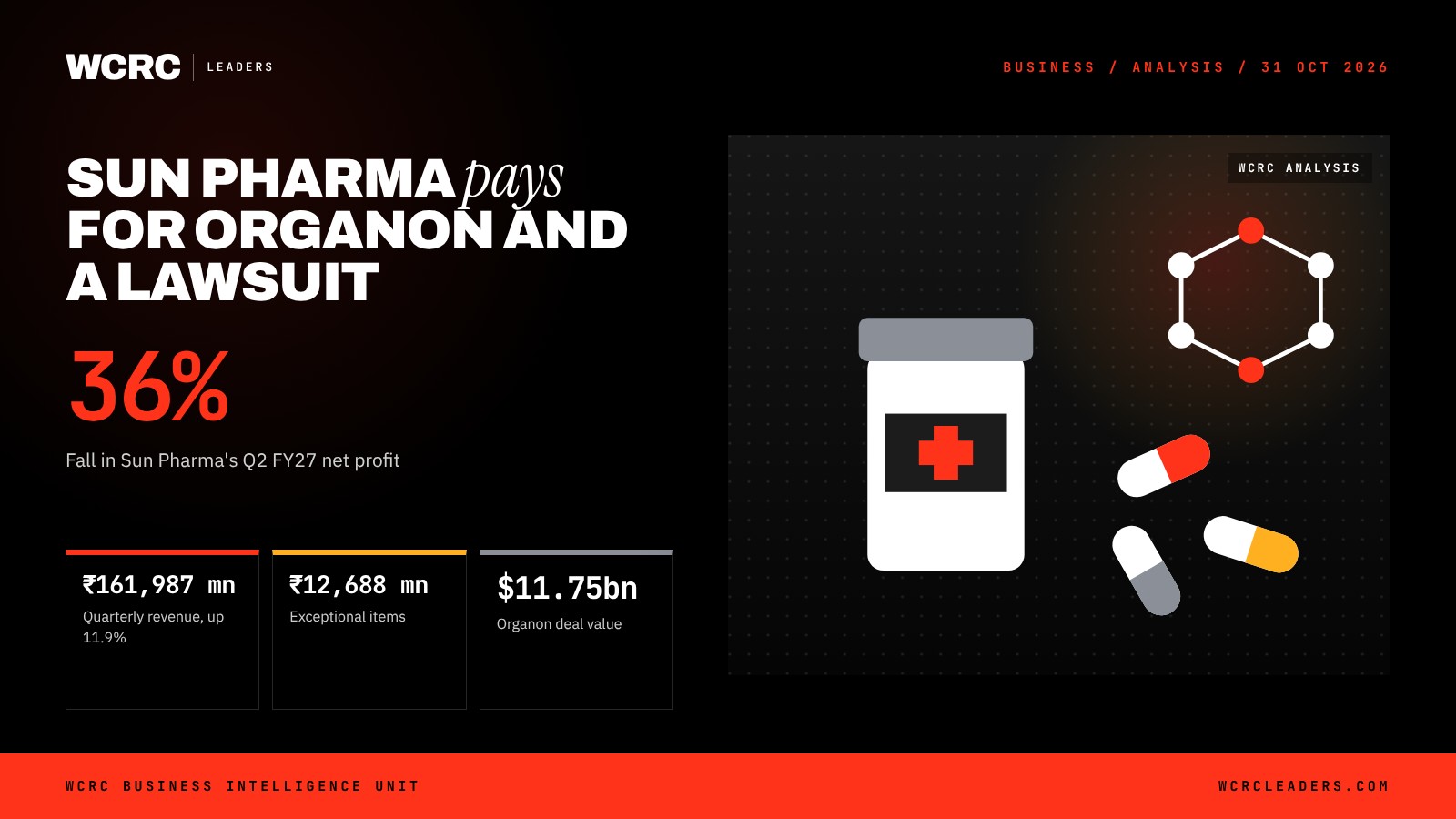
At a glance: WCRC Leaders' assessment: Sun Pharma's 36% profit fall is the cost of a deliberate clean-up and a bet on scale, and the operating business underneath is still growing. Sun Pharmaceutical Industries reported Q2 FY27 results on 30 October 2026. Revenue rose to ₹161,987 million, but exceptional items of ₹12,688 million, mostly a US litigation settlement and Organon deal costs, cut profit to ₹19,885 million. Leaders in India, the Gulf and Asia should read it as the first bill for the Organon acquisition.
What did Sun Pharma report for the September quarter?
Sun Pharmaceutical Industries, one of WCRC 1000, India's Most Valuable Enterprises 2026, reported consolidated revenue from operations of ₹161,987.1 million for the quarter to 30 September 2026, up 11.9% from ₹144,783.1 million a year earlier. Net profit attributable to shareholders fell to ₹19,885.3 million from ₹31,179.5 million, a drop of 36.2%. Earnings per share fell to ₹8.3 from ₹13.0.
The fall did not come from the trading business. Profit before exceptional items and tax rose 6.3% to ₹44,282.0 million. The company put EBITDA at ₹47,439 million, up 4.8%, with a margin of 29.3%, and gave an adjusted net profit of ₹31,620 million, close to last year's reported figure. Research and development spending was ₹7,784 million, or 4.8% of sales.
For the half year to September, profit attributable to shareholders was ₹48,833.2 million, against ₹53,965.8 million in the first half of FY26, down 9.5%.
Managing Director Kirti Ganorkar said: "Our performance during the quarter was driven by strong momentum in India, Emerging Markets and Rest of World."
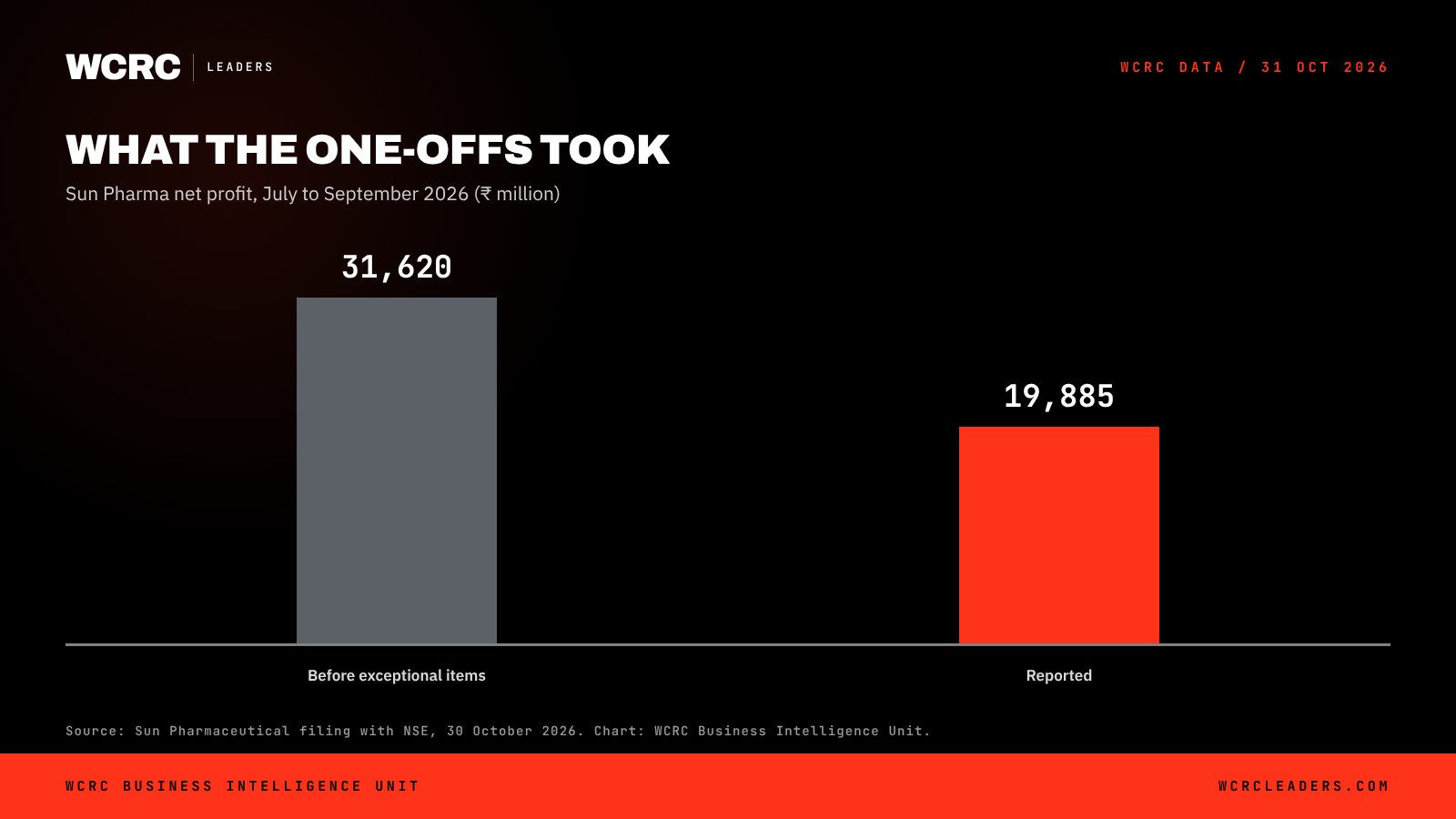
What were the ₹12,688 million of exceptional items?
Two items made up the charge. The larger was ₹9,226.7 million, inclusive of legal cost. In the words of the filing, on 10 September 2026 Sun Pharmaceutical Industries, Inc., Taro Pharmaceutical Industries Ltd. and Taro Pharmaceuticals U.S.A., Inc. "have signed a settlement agreement with a plaintiff in the In re Generic Pharmaceuticals Pricing Antitrust Litigation in the Eastern District of Pennsylvania". The company recorded a corresponding tax benefit of ₹953.4 million in the quarter.
The filing describes a settlement with one plaintiff. It does not say the wider litigation has ended. A year earlier, in the first half of FY26, Sun booked ₹5,303.6 million for an End Payer class settlement in the same broad area of US litigation.
The second item was ₹3,461.6 million of costs for the proposed acquisition of Organon & Co. Organon-related costs in the half year now total ₹5,131.6 million, and the notes say more are expected in later periods.
How big is the Organon bet, and where does it stand?
Sun signed a definitive agreement on 27 April 2026 to buy all of Organon's shares for US$14.00 each in cash, at an enterprise value of US$11.75 billion, according to both companies' filings. Organon's shareholders approved the deal on 23 July 2026. Sun now indicates closing by the fourth quarter of FY27, that is, by March 2027, subject to approvals.
Organon was spun off from Merck in 2021. It sells more than 70 products in women's health and general medicines, including biosimilars, in about 140 countries. It reported 2025 revenue of US$6.2 billion, adjusted EBITDA of US$1.9 billion and debt of US$8.6 billion. The April announcement said the combined group would have revenue of about US$12.4 billion, a presence in 150 countries, a top-three global position in women's health and the seventh-largest biosimilars business in the world. Innovative medicines would make up 27% of revenue.
Sun plans to pay with cash and committed bank financing, and expects net debt of 2.3 times EBITDA after the deal. Today it still holds a net cash position of US$3.3 billion and has completed a debut issue of non-convertible debentures worth ₹7,816 crore. In April, Mr Ganorkar said: "Together, we will become a partner of choice for acquiring and launching new products."
For India Inc, the scale stands out. It is among the largest outbound acquisitions by an Indian company, alongside bids such as Tata Motors' €3.9bn move for Iveco.
Is the specialty pivot working?
Partly. Global innovative medicines sales, Sun's specialty brands such as ILUMYA, reached US$356 million in the quarter, up 6.9%, and 21.1% of sales. India formulations grew 17.3% to ₹55,523 million, and emerging markets rose 7.6% in dollar terms to US$350 million. The weak spot was the US, where formulation sales fell 8.2% to US$455 million.
The ILUMYA news matters here. In a release on 30 October, Sun said the US Food and Drug Administration had approved ILUMYA (tildrakizumab-asmn) for adults with active psoriatic arthritis, on the basis of the Phase 3 INSPIRE-1 and INSPIRE-2 trials. The release puts the number of Americans living with psoriatic arthritis at about 2.4 million. North America CEO Rick Ascroft called the approval "another important innovative medicine milestone for Sun Pharma".
What does it mean for Indian pharma, the Gulf and Asia?
This section is WCRC analysis.
For Indian pharma, Sun is testing a model the industry has talked about for a decade: use cash from US generics and a strong Indian business to buy scale and brands abroad, rather than build them one product at a time. If it works, peers will face pressure from boards and investors to follow. If integration stumbles, the lesson will be read across the sector.
For the Gulf, the combined group's focus on women's health, biosimilars and branded generics fits what large public and insured health systems buy: trusted brands at lower cost than originator biologics. Gulf buyers and distributors should expect a larger, more assertive Indian supplier at the tender table after closing, and should plan supply and pricing talks with that in mind.
For Asia, the deal shows that Indian companies are now bidding for Western assets that were once sold only between US and European groups. The financing is also a signal: with India's 10-year yield at 7.46%, Sun is mixing rupee debentures with offshore bank lines.
The WCRC View
The WCRC Business Intelligence Unit reads this quarter as a planned cost, not a broken business. Profit before one-offs grew, India grew by double digits and the specialty line kept rising. The 36% fall is the price of settling part of an old US dispute and paying advisers for the largest bet in Sun's history.
Read through Corporate Value Intelligence, WCRC's framework for interpreting enterprise value, the market's question is not this quarter's profit. It is whether a company with US$3.3 billion of net cash should move to 2.3 times net debt to buy Organon. That trade is worth it only if the combined group grows its innovative share and cash flow fast enough to cut debt quickly.
Read through WCRC's Governance Shield, which asks whether reputation is protected at board level, the settlement is the right kind of story for the board: a known risk, sized and booked in full, with plain disclosure. The open risk is the rest of the US pricing litigation. Boards should ask for a clear view of what remains.
In the terms of SeeClear, a model in WCRC's Guru Management Codex, leaders should separate fact from projection. The fact is ₹12,688 million of one-offs and growing core earnings. The projection is that Organon will lift Sun into the global top 25. Until the deal closes, the second is a plan, not a result.
What leaders should do now: CEOs of Indian mid-size drugmakers should test their own balance sheets for a bolt-on abroad; Gulf health buyers should prepare for a bigger Sun at the tender table; Asian investors should track net debt, not headline profit.
What WCRC will watch next: Organon closing by March 2027, the ILUMYA launch in psoriatic arthritis, any further US litigation settlements and the US formulations trend. Sun Pharma is also a WCRC MegaBrand in generics and formulations and was selected among India's Most Loved 250 Workplaces 2026 by the Business Intelligence Unit of WCRC. Integrating a workforce the size of Organon's will test that culture. The full report and evidence are available from WCRC on request.
WCRC models applied: Corporate Value Intelligence, Governance Shield (Brand & Marketing Codex), SeeClear (Guru Management Codex).
Quick answers
Q: Why did Sun Pharma's Q2 FY27 profit fall? A: Net profit attributable to shareholders fell 36.2% to ₹19,885.3 million because of ₹12,688.3 million of exceptional items: ₹9,226.7 million for a settlement with a plaintiff in US generic drug pricing antitrust litigation and ₹3,461.6 million of Organon deal costs.
Q: How much revenue did Sun Pharma report? A: Revenue from operations was ₹161,987.1 million for the quarter to 30 September 2026, up 11.9% from ₹144,783.1 million a year earlier.
Q: What is the value of the Organon deal? A: Sun is paying US$14.00 per Organon share in cash, at an enterprise value of US$11.75 billion. Organon shareholders approved it on 23 July 2026, and Sun indicates closing by March 2027.
Q: What did the FDA approve on 30 October? A: The FDA approved ILUMYA (tildrakizumab-asmn) for adults with active psoriatic arthritis, adding to its 2018 approval for moderate-to-severe plaque psoriasis.
Adani Ports raises FY27 capex by ₹3,000 crore as overseas ports surge
Vedanta doubles Gamsberg, and Ramaphosa now wants a zinc smelter
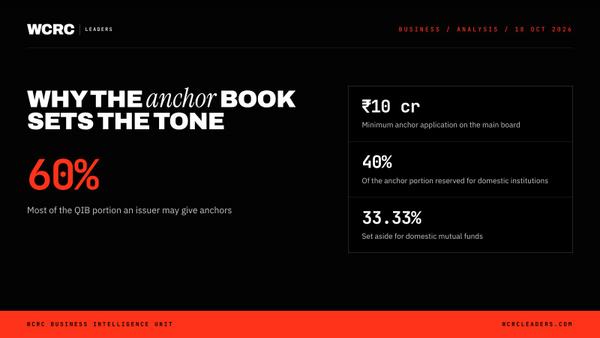
Anchor investors in Indian IPOs: why the 60% book sets the tone

Bajaj Finance lines up ₹17,500 crore as AI agents take on service

$133bn: what India's rupee defence is costing its biggest banks
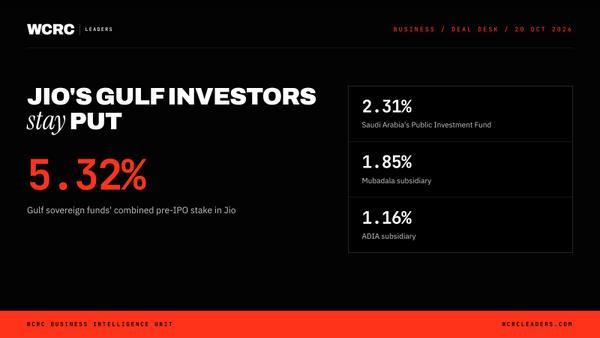
Jio Platforms IPO: Gulf funds hold 5.32% and are not selling
Filed under