Business
HPCL earns ₹3,625 crore as $116 crude tests India's oil bill
Hindustan Petroleum is back in profit after a ₹12,265 crore loss in the June quarter, but its numbers show exactly where the Gulf crisis lands in India: fat refining margins, capped pump prices and a growing LPG bill that someone will have to pay.
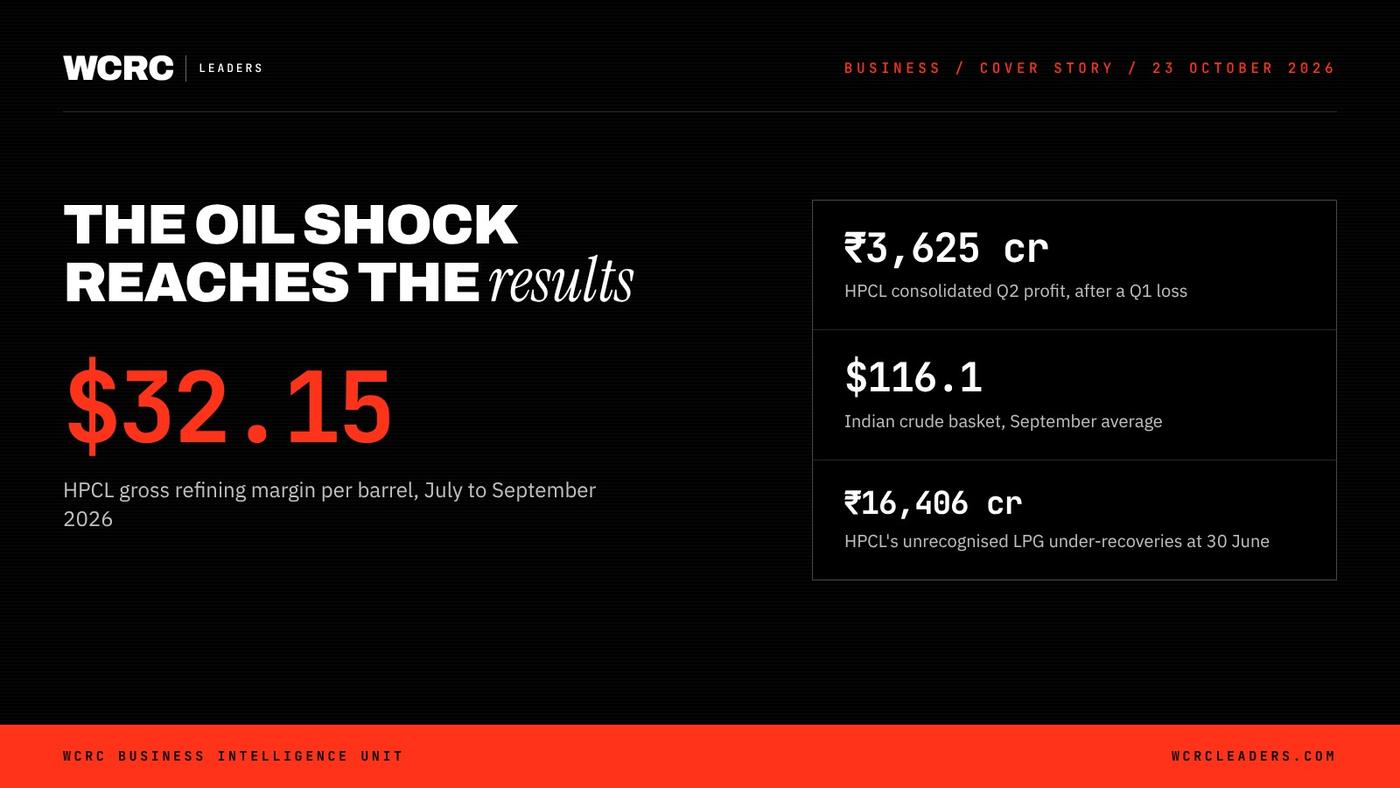
At a glance: WCRC Leaders' assessment: HPCL's return to profit is a refining windfall, not a recovery, and the real cost of the Gulf crisis is sitting in unbooked LPG losses and India's import bill rather than in the headline number. Hindustan Petroleum Corporation (HPCL) reported its July to September 2026 results on 22 October. Consolidated net profit was ₹3,625 crore, against ₹3,859 crore a year earlier, after a June-quarter loss. The Reserve Bank of India says the Indian crude basket averaged $116.1 a barrel in September. Every Indian board buying fuel, freight or power should read these numbers closely.
What did HPCL actually report?
HPCL, the state-controlled refiner and fuel retailer, posted a standalone net profit of ₹3,483 crore for the second quarter of FY27, against ₹3,830 crore a year earlier, a fall of about 9%. On a consolidated basis, profit was ₹3,625 crore against ₹3,859 crore, down about 6%. Revenue from operations rose to ₹1,39,140 crore from ₹1,10,323 crore, an increase of roughly 26%, according to the company's results release.
The quarter only looks steady because of what came before it. In the June quarter, HPCL reported a standalone net loss of ₹11,526.41 crore and a consolidated loss of ₹12,264.67 crore, according to its stock exchange filing of 22 July. For the half year to September, the company is still in the red: a standalone net loss of ₹8,044 crore and a consolidated loss of ₹8,639 crore, against half-year profits of ₹8,201 crore and ₹7,970 crore a year earlier.
The operating business ran hard. HPCL's refineries ran at 100% of capacity, processing 6.20 million tonnes of crude, and combined petrol and diesel sales grew 10% to 7.78 million tonnes. The company said it delivered these results "in the midst of the ongoing West Asia crisis". Debt stood at ₹65,458 crore.
How does a Gulf crisis become a cost in an Indian company's results?
Through two channels that pull in opposite directions. The first is refining. When crude and product prices spike, a refiner that can keep buying crude earns a wide spread on what it makes. HPCL's gross refining margin before export cess was $32.15 a barrel in the September quarter, against $8.80 a year earlier. For the half year it was $27.89, against $5.95.
The second channel is marketing. HPCL sells petrol, diesel and cooking gas at prices that do not move freely with world markets. The June-quarter filing said "suppressed marketing margins on certain products" hurt profitability, even as the refining margin averaged $23.80 a barrel in that quarter. In plain terms, the refinery earns the windfall and the retail network gives much of it back.
The scale of the input shock is clear from official data. The RBI's Governor said on 7 October that the Indian basket of crude rose from an average of $82.0 a barrel in July to $90.2 in August and $116.1 in September, after what the RBI called "the sudden reescalation of the West Asia conflict in September". India's wholesale price data for September, released on 14 October, show inflation in crude petroleum and natural gas at 57.32% year on year, and in mineral oils at 40.02%. WCRC's earlier reading of that 11.39% wholesale inflation print set out how this flows into input costs well beyond the oil sector.
Is the refining windfall real, or is the bill just deferred?
Both. The refining margin is real cash. The LPG losses are real too, but most of them are not yet in the accounts.
HPCL's June-quarter filing explains the mechanism. The Ministry of Petroleum and Natural Gas sanctioned ₹7,920 crore of compensation for HPCL's domestic LPG under-recoveries, to be paid in 12 equal monthly instalments and recognised monthly from November 2025. Three instalments, ₹1,980 crore, were booked in April to June. On that schedule, six instalments worth ₹3,960 crore fall in the April to September half year (WCRC calculation from the filing).
Against that, the filing reported a cumulative unrecognised LPG "negative buffer" of ₹16,405.92 crore at 30 June 2026, up from ₹12,798.67 crore at 31 March. That is more than ₹3,600 crore of cooking-gas losses added in one quarter and not yet booked.
The government's own statements show how big this has become. Petroleum Minister Hardeep Singh Puri told the Lok Sabha on 12 March 2026 that oil marketing companies had been approved ₹30,000 crore of compensation against losses of about ₹40,000 crore in 2024-25. He also said India had imported about 60% of its LPG from Gulf states before the crisis, and that "consumer prices have been shielded from global market conditions".
Analysis: Shielding consumers moves the cost onto two balance sheets: the oil marketing companies' and, eventually, the government's. Investors should treat HPCL's quarterly profit as provisional until it is clear how, and when, the growing LPG gap is settled.
Why does the board point at HPCL matter?
Because a company carrying this much policy risk needs a fully staffed board. In their review report on the June-quarter results, HPCL's statutory auditors noted that "the Company does not have the required number of independent directors on its Board", as required under SEBI's Listing Regulations, for the period from 1 April 2026 to the date of the report. The auditors said the matter did not modify their conclusion.
Analysis: The shortfall is not unusual among state-owned companies, where independent directors are appointed through the government. But the timing is poor. HPCL's board is deciding how to carry five-figure crore LPG losses and how to fund capex of ₹3,819 crore in the half year. Minority shareholders rely on independent directors to test those calls, and investors in listed state enterprises should keep asking until the seats are filled.
What does it mean for India's import bill and current account?
India buys most of its crude abroad, so a $30-plus rise in the basket price in two months feeds straight into the trade account. The RBI said the current account deficit stood at 0.5% of GDP, or $4.2 billion, in the April to June quarter, "well below the sustainable levels". That figure predates the September spike.
The RBI raised its repo rate by 25 basis points to 5.50% on 7 October, citing supply-side pressures and oil price volatility, and projected CPI inflation of 5.2% for 2026-27. WCRC examined what that first rate hike since 2023 means for capex. Analysis: If September's crude prices hold through the winter, the current account will widen from its comfortable first-quarter level, the rupee will stay under pressure, and the government will face a choice between higher retail prices and a larger fiscal bill for compensation. Exporters have offered some cover; WCRC's review of India's $476bn half-year showed services and electronics holding up.
What should CEOs in India, the Gulf and Asia do now?
In India: Treat the oil shock as a cost already in the system, not a risk on the horizon. Wholesale fuel inflation is in double digits, borrowing costs are rising, and fuel price controls can change quickly once compensation bills mount. Price contracts, freight agreements and working capital lines should be re-tested now at $110 to $120 crude.
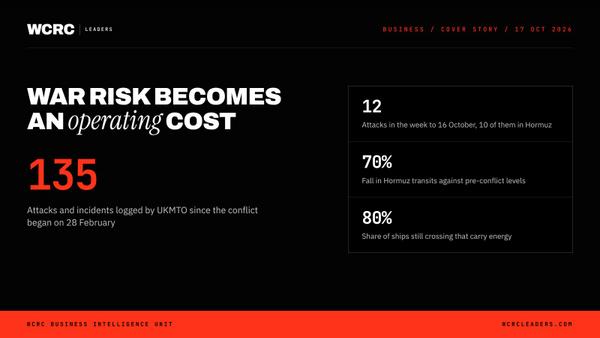
In the Gulf: National oil companies and traders selling into India face a buyer that is diversifying fast. Puri told Parliament that non-Hormuz sourcing rose to about 70% of India's crude imports, from 55% before the conflict, and that India now buys crude from 40 countries. Gulf suppliers should expect tougher terms and more competition for long-term Indian contracts. WCRC's tracker of 135 attacks since February explains why Indian buyers are paying for that diversity.
Across Asia: Importers of crude and LPG face the same split between refining winners and retail losers. Boards should ask how exposed they are if a state-backed fuel seller changes prices without warning.
The WCRC View
From the WCRC Business Intelligence Unit:
- What it means. HPCL's quarter is the clearest case yet of how a Gulf supply shock is absorbed in India: refiners collect windfall margins, retailers hold prices, and the gap is parked in unbooked LPG losses and future government compensation. The headline profit tells you less than the ₹16,406 crore LPG buffer does.
- Who gains and who loses. Integrated refiners with high run rates gain on margins; consumers gain from protected prices for now. Minority shareholders of oil marketing companies, the exchequer and energy-intensive manufacturers carry the cost.
- What leaders should do now. Plan on crude at or above $110 through the March quarter. Lock in freight and fuel where possible. Ask suppliers and customers in oil-linked sectors how they would cope with a sudden retail price revision.
- For boards of state-linked listed companies. Fill independent director seats before investors force the question. A board under-strength on independents is a weak base for decisions worth thousands of crores.
- What WCRC will watch next. The full September-quarter auditor review at HPCL; the LPG buffer at 30 September; the RBI's December policy meeting; and October trade data, which will show the first full month of crude above $100 in the import bill.
Quick answers
Q: What was HPCL's net profit for Q2 FY27? A: Consolidated net profit was ₹3,625 crore, against ₹3,859 crore a year earlier. Standalone net profit was ₹3,483 crore, against ₹3,830 crore.
Q: Why did HPCL make a loss in the first half of FY27? A: A June-quarter consolidated loss of ₹12,264.67 crore, linked to suppressed marketing margins on regulated products, outweighed the September-quarter profit. The half-year consolidated loss was ₹8,639 crore.
Q: What was HPCL's refining margin? A: Gross refining margin before export cess was $32.15 a barrel in Q2 FY27 and $27.89 for the half year, against $8.80 and $5.95 a year earlier.
Q: What did the Indian crude basket average in September 2026? A: The RBI's 7 October statement put it at $116.1 a barrel, up from $90.2 in August and $82.0 in July.
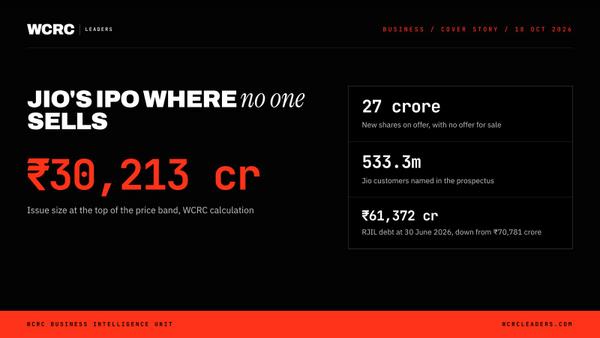
Jio Platforms' ₹30,213 crore IPO: why no one is selling

Rubio in Mumbai: India-US trade deal is "very, very close"
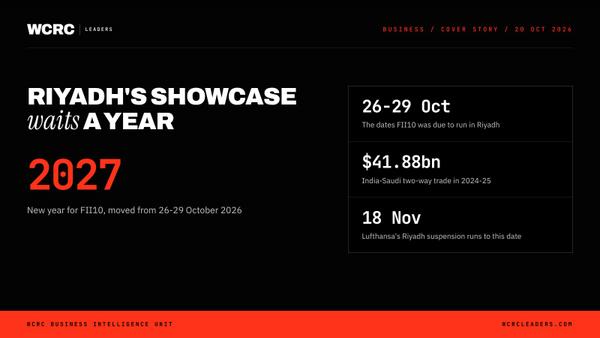
FII10 slips to 2027: what Riyadh's delay means for CEOs and boards
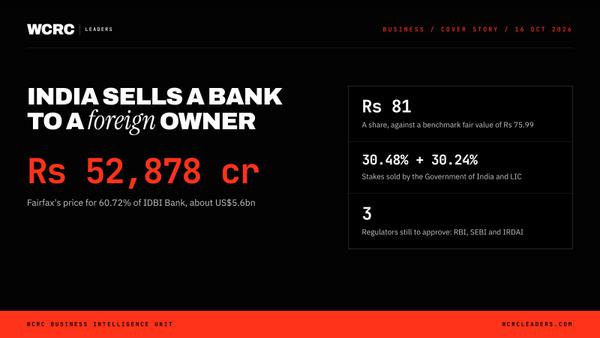
Fairfax wins IDBI Bank: inside India's Rs 52,878 crore bank sale
The $111bn integration test: how Skydance will be run
135 attacks since February: what Gulf and Indian boards must price in
Filed under