Business
Indian Oil's ₹21,630 crore quarter: who wins a Gulf oil shock
India's biggest state-owned refiner moved from a loss to a profit nearly three times last year's as Brent hit $131 a barrel. The same crude cycle that paid for it could take part of it back when prices fall.
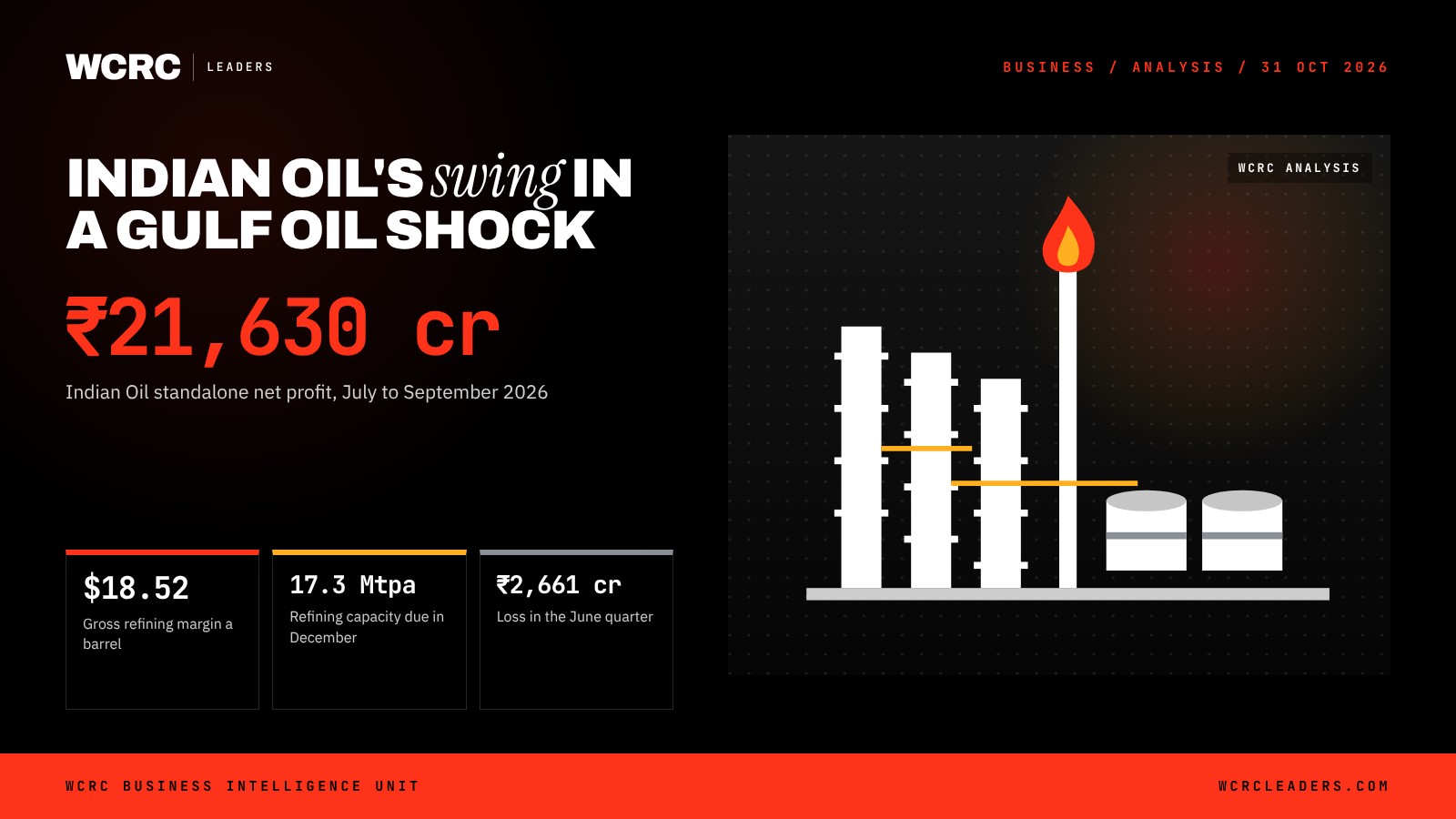
At a glance: WCRC Leaders' assessment: Indian Oil's sharp swing shows that a state refiner can profit from a Gulf war, but the gain rests on stocks and margins that reverse when crude falls, so boards should treat it as a cash window, not a new normal. On 30 October 2026, Indian Oil Corporation reported standalone net profit of ₹21,630.03 crore for July to September, against a ₹2,661.37 crore loss in April to June. Three refinery expansions adding 17.3 million tonnes a year are due in December.
What did Indian Oil report?
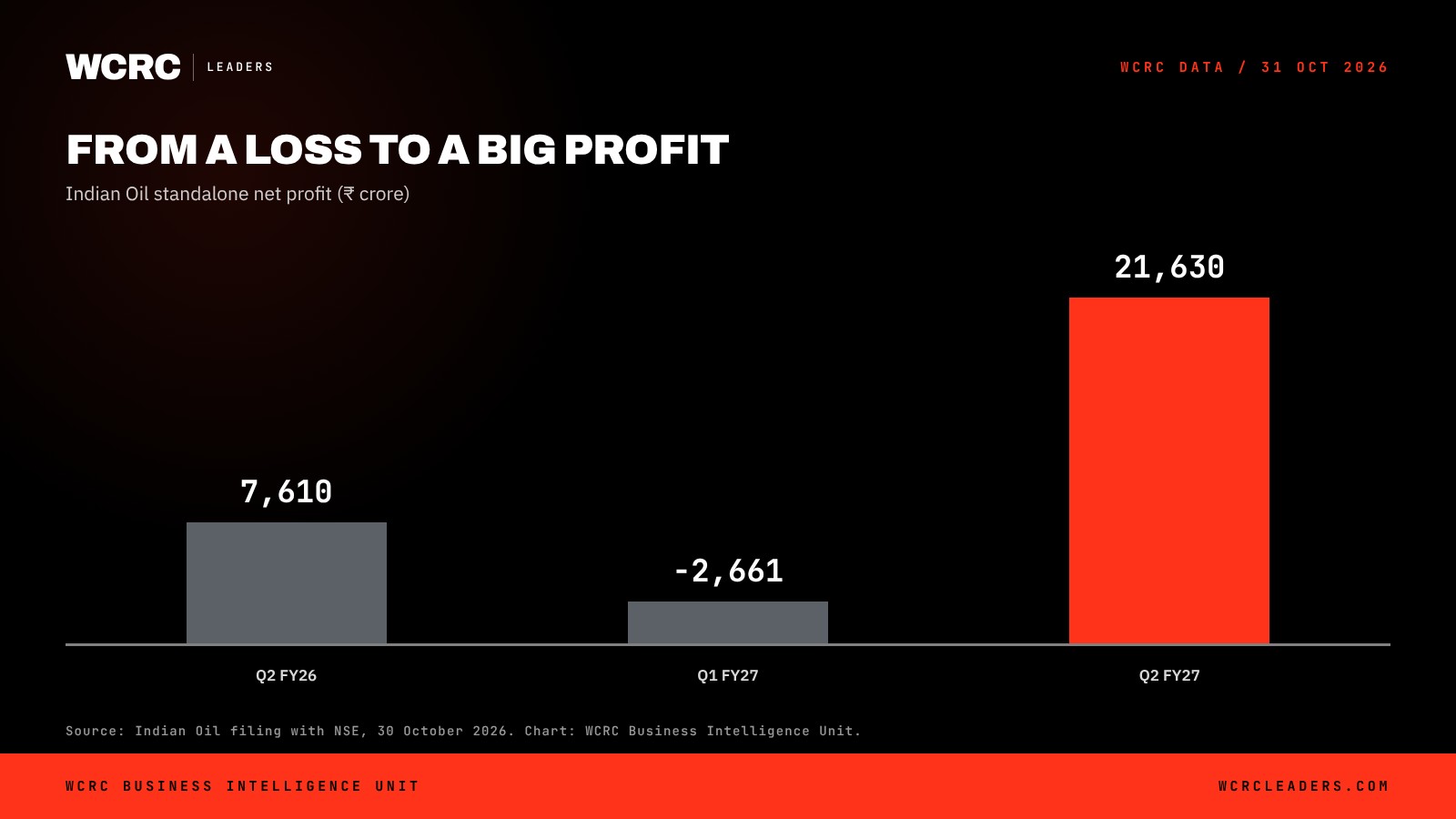
Indian Oil Corporation, one of WCRC 1000, India's Most Valuable Enterprises 2026, filed results on 30 October that read like two different companies. In the June quarter it lost ₹2,661.37 crore. In the September quarter it earned ₹21,630.03 crore, nearly three times the ₹7,610.45 crore of the same quarter last year.
Revenue from operations was ₹2,62,935.58 crore, up 29.5% on a year ago, though below the ₹2,75,971.77 crore of the June quarter. Profit before tax was ₹26,616.62 crore and earnings per share were ₹15.71.
For the half year, standalone profit was ₹18,968.66 crore, against ₹13,295.05 crore a year earlier. On a consolidated basis, profit attributable to the company's shareholders was ₹21,407.87 crore for the quarter.
The investor handout puts the gross refining margin, net of the special additional excise duty, at $18.52 a barrel, up from $15.59 in the June quarter. Refineries ran at 102.3% of capacity, down from 109.4%, and processed 18.1 million tonnes of crude against 19.2 million tonnes. The share of cheaper high-sulphur crude rose to 54.6% from 48.9%.
Why did a Gulf war produce a profit?
The quarter coincided with the worst of the Gulf supply shock. The US Energy Information Administration's October outlook records that Brent averaged $114 a barrel in September, $23 more than in August, and peaked at $131 on 15 September after attacks on Saudi Arabia's East-West pipeline. Middle East production shut-ins, which peaked at 10.9 million barrels a day in May, were still 4.8 million barrels a day in September, led by Saudi Arabia and Iran.
The government also helped. Note 4 of the filing shows a cumulative negative LPG buffer of ₹32,505.69 crore at 30 September, the gap between what cooking gas costs and what households pay. The government approved ₹14,486 crore in compensation, paid in 12 monthly instalments, and Indian Oil booked ₹7,243.02 crore of it, for April to September, as revenue in the half year.
WCRC analysis: there are three engines in a quarter like this. Product prices rose faster than crude costs, which lifted the refining margin. Crude bought at lower prices and held in tanks was sold as fuel at higher prices. And compensation arrived for LPG losses already absorbed. The June quarter loss came despite a $15.59 margin, which points to the marketing side, where pump prices did not keep pace with crude, as the drag. India's 11.39% wholesale inflation print shows where those costs went next.
Where does the inventory risk sit?
The filing's change-in-inventories line shows stocks grew by about ₹20,925 crore in the June quarter, and were broadly flat in the September quarter. Indian Oil went into the price spike carrying a large stock of crude and products.
That cuts both ways. The EIA expects Brent to average $105 in the fourth quarter of 2026, then fall to $87 by the second quarter of 2027 and $74 by the end of 2027, as convoys and bypass routes restore Gulf exports. It expects most regional production back to pre-conflict levels by the end of June 2027.
WCRC analysis: if that path holds, the tailwind turns into a headwind. Crude bought at $105 would be sold into a falling market, and refining margins usually compress as supply returns. Read through WCRC's Corporate Value Intelligence framework, investors should value this quarter's profit as largely cyclical. The durable value lies in what is being built, not in what the tanks happened to hold in September.
In the terms of SeeClear, a model in WCRC's Guru Management Codex, the task for the board is to separate fact from projection: the fact is a ₹21,630 crore quarter; the projection would be to plan dividends, borrowing or pricing as if $114 crude and an $18.52 margin were permanent.
Who wins and who loses when crude swings?
The winners this quarter were refiners with spare capacity and flexible crude slates. Indian Oil's rising use of high-sulphur grades suggests it bought what was available and cheaper. State refiner Hindustan Petroleum Corporation, also one of WCRC 1000, India's Most Valuable Enterprises 2026, told a similar story, as WCRC set out in its analysis of HPCL's ₹3,625 crore quarter.
The losers are harder to see on a results page: the exchequer, which pays LPG compensation, and fuel-intensive businesses such as airlines, logistics and chemicals. The government is also taxing part of the margin: notifications dated 26 March 2026 reset the special additional excise duty on fuel exports, which is why Indian Oil reports its margin net of that levy.
Gulf crude suppliers sit in an unusual spot. Higher prices help per barrel, but lost volumes hurt. India's petroleum ministry said in March that about 70% of the country's crude imports now come from outside the Strait of Hormuz, from 40 countries. WCRC's tracker of 135 attacks since February shows why buyers diversified.
Indian Oil's fuel brand carries its own exposure. Indian Oil, a WCRC MegaBrand in fuel retail networks, is the benchmark brand in that category. Read through WCRC's Trust Equity Model, a fuel retailer's trust is tested by whether pumps stay supplied and prices stay predictable in a crisis. Keeping both through a war builds equity that outlasts the margin cycle.
What changes when the new refineries start?
The investor handout lists three expansions, all due in December 2026:
- Panipat: 15 to 25 million tonnes a year, ₹38,231 crore, 95.0% complete
- Gujarat: 13.7 to 18 million tonnes a year, ₹18,936 crore, 90.1% complete
- Barauni: 6 to 9 million tonnes a year, ₹18,113 crore, 92.5% complete
Together they add 17.3 million tonnes a year, close to the 18.1 million tonnes Indian Oil processed in the whole September quarter.
Spending, however, is behind plan. Half-year capital expenditure was ₹12,162 crore, about 37% of the ₹32,700 crore target for the year, with ₹6,083 crore in refining.
WCRC analysis: timing matters. If the new units start just as the EIA expects Gulf supply to return, Indian Oil adds capacity into a softer margin market, but also into a cheaper crude market. Each new tonne needs crude, and Gulf producers keen to rebuild volumes will compete hard for those term contracts. That gives Indian buyers bargaining power they did not have in March.
What should leaders in India, the Gulf and Asia do now?
For Indian CEOs, the result is a reminder that state refiners are both suppliers and shock absorbers. A profit this size makes pump price cuts and LPG relief politically easier, so energy-intensive firms should plan for some easing of input costs, but not bank on it before the June 2027 supply recovery.
For Gulf boards, India is not a captive buyer. A refiner adding 17.3 million tonnes of capacity while sourcing most crude from outside Hormuz will reward reliability and pricing.
The WCRC View
The WCRC Business Intelligence Unit reads Indian Oil's quarter as a windfall, not a reset. Rising crude, a firm refining margin and LPG compensation lined up in the same three months. None of them is permanent.
Refiners with flexible crude slates and large stocks win in a spike. Fuel-intensive businesses and the exchequer quietly lose. Gulf suppliers gain on price but lose share.
The board's priority, in the spirit of SeeClear, is to lock in the cash, not the narrative: fund the December expansions and the lagging capex plan from this profit, and stress-test the inventory book against the EIA's $87 crude case for mid-2027.
Under Corporate Value Intelligence, the lasting value is the 17.3 million tonnes of new capacity. Under the Trust Equity Model, Indian Oil's brand gains most if it is seen to pass relief to customers when crude falls.
WCRC will watch three things: whether all three expansions start on time in December, the inventory and margin hit in the December quarter, and how much of the ₹32,505.69 crore LPG buffer the government eventually covers.
WCRC models applied: SeeClear, Corporate Value Intelligence, Trust Equity Model.
Quick answers
Q: How much did Indian Oil earn in the September 2026 quarter? A: Standalone net profit was ₹21,630.03 crore, against a ₹2,661.37 crore loss in the June quarter and ₹7,610.45 crore a year earlier. Revenue rose 29.5% to ₹2,62,935.58 crore.
Q: What was Indian Oil's refining margin? A: The gross refining margin, net of the special additional excise duty, was $18.52 a barrel, up from $15.59 in the June quarter.
Q: When will Indian Oil's refinery expansions be ready? A: Panipat, Gujarat and Barauni are 90% to 95% complete and due in December 2026, adding 17.3 million tonnes a year.
Q: Why could profits fall in coming quarters? A: The EIA expects Brent to fall from $105 in late 2026 to $87 by mid-2027. Falling crude can cut inventory values and refining margins.
Adani Ports raises FY27 capex by ₹3,000 crore as overseas ports surge
Vedanta doubles Gamsberg, and Ramaphosa now wants a zinc smelter
Anchor investors in Indian IPOs: why the 60% book sets the tone
Sun Pharma's profit falls 36% as it pays for Organon and a US lawsuit

Bajaj Finance lines up ₹17,500 crore as AI agents take on service

$133bn: what India's rupee defence is costing its biggest banks
Filed under