Business
Vedanta doubles Gamsberg, and Ramaphosa now wants a zinc smelter
President Cyril Ramaphosa opened the second phase of Vedanta's Gamsberg zinc mine on 16 October. The roughly $600m expansion doubles ore capacity at a remote Northern Cape pit, and puts a refinery decision on the table.
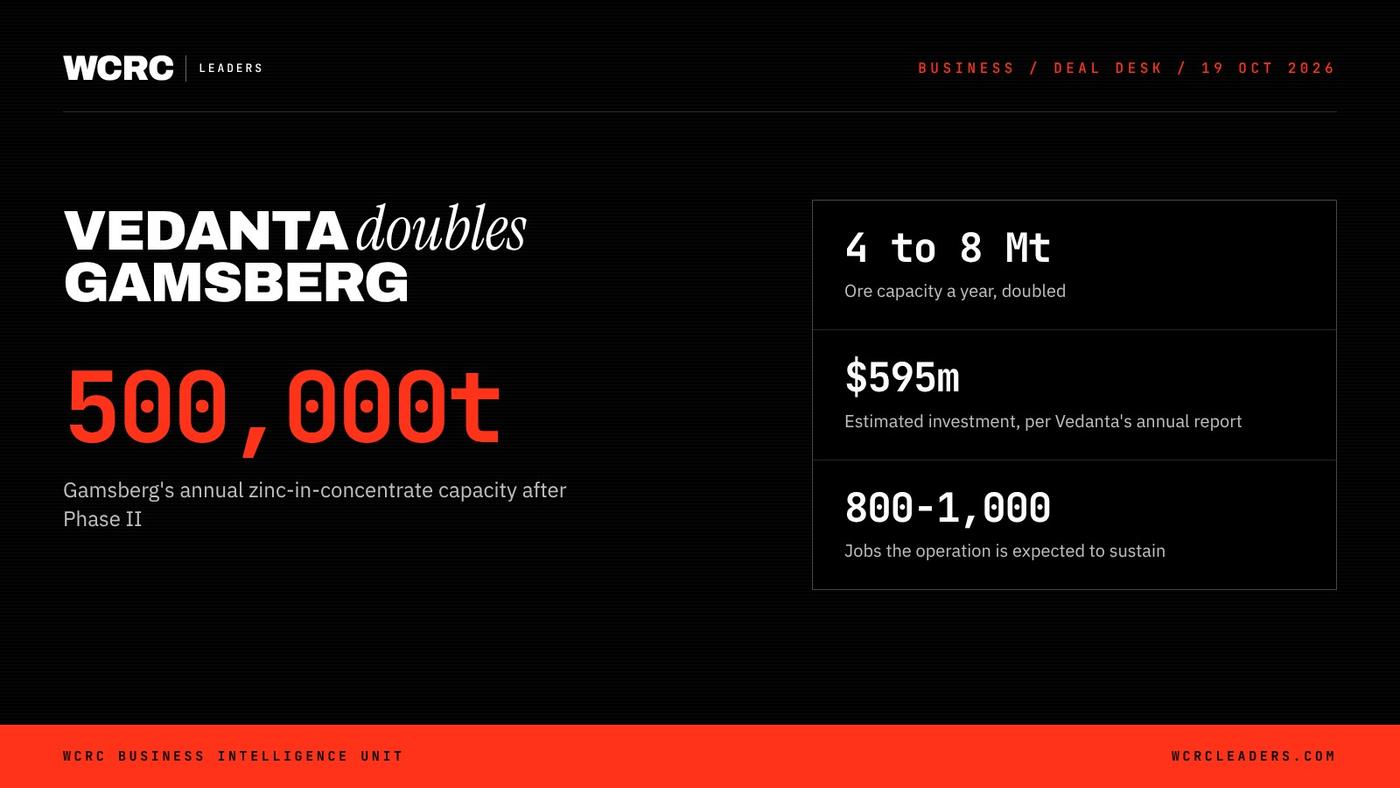
At a glance: WCRC Leaders' assessment: Gamsberg Phase II turns Vedanta's South African zinc arm from a side asset into a second growth engine, but the real test is whether the promised smelter follows within the next 12 months. On 16 October 2026 at Aggeneys, President Ramaphosa and Vedanta Resources director Priya Agarwal Hebbar inaugurated a concentrator that doubles ore capacity from about 4 million to 8 million tonnes a year and lifts zinc-in-concentrate capacity to about 500,000 tonnes. It is the largest step yet in Vedanta's plan to reach about 3 million tonnes of zinc and lead a year by 2031.
What exactly opened at Aggeneys?
The Gamsberg Phase II concentrator plant, run by Vedanta Zinc International (VZI) in the Khâi-Ma municipality of the Namakwa district. The South African Presidency says the expansion doubles annual ore capacity from approximately 4 million to 8 million tonnes and raises zinc-in-concentrate capacity to approximately 500,000 tonnes a year. More than 1,500 people worked on construction, and the operation is expected to sustain 800 to 1,000 jobs once running. The President also noted that Phase II was completed without a fatality.
Vedanta's own FY2025-26 annual report puts the estimated investment at $595m including interest during construction, and lists the new infrastructure: a 19.5 km power line for an additional 26.2 MVA, an 8.5 megalitre-a-day reservoir and a new tailings dam. The company's production release of 3 October told the exchanges that "Gamsberg Phase 2 commissioned in Q2FY27 with saleable production expected to start from Oct'26."
The government had billed the project as "among the largest mining investments in South Africa in the past decade."
How big is this for Vedanta's zinc business?
Big in relative terms, modest against the parent. In the quarter to 30 September 2026, Zinc International produced 53,000 tonnes of mined metal, 46,000 tonnes of it from Gamsberg, according to Vedanta's production release. Hindustan Zinc's Indian mines produced 271,000 tonnes in the same quarter, a record second quarter.
Vedanta's post-demerger investor deck sets out where this is meant to go. It targets VZI capacity of 525,000 tonnes a year in FY27, up from 325,000 tonnes in FY26, and 1 million tonnes by 2030. Hindustan Zinc is meant to reach 2 million tonnes. Together the group aims to move zinc and lead output from about 1.3 million tonnes in FY26 to about 3 million tonnes by 2031. The same deck pencils in about $1bn of FY30 EBITDA from VZI, against about $3.4bn from Hindustan Zinc and a group figure of about $5bn, up from about $2.65bn in FY26.
That makes the South African arm the group's second-largest projected earner. It also matters for ownership. Vedanta held 60.71% of Hindustan Zinc at 31 March 2026, according to Hindustan Zinc's investor presentation, with the Government of India holding 27.92%. Every rupee of Indian zinc profit is shared with minority holders and the state. VZI's growth, by contrast, is not split with a listed subsidiary's other shareholders in the same way.
Why does the demerger make Gamsberg more important?
Vedanta's five-way restructuring took effect on 1 May 2026, its filing to the exchanges confirms. Shareholders received one share each in Vedanta Aluminium Metal, Talwandi Sabo Power, Malco Energy (oil and gas) and Vedanta Iron and Steel for every Vedanta share held.
What remains in Vedanta Limited is a zinc-led company: Hindustan Zinc, Zinc International, copper, the FACOR ferrochrome business, Nicomet nickel and a set of critical-mineral blocks. With aluminium and oil gone, zinc is now the main story the residual company tells investors, and Gamsberg is the only part of that story outside India.
WCRC analysis: For the demerged Vedanta, Gamsberg Phase II is the proof point that it can deliver growth capex on time abroad. Ore charging was targeted for July 2026 and saleable output for October 2026; the company met that window. That record will be weighed when investors judge the far larger promises still to come, including Hindustan Zinc's doubling and a South African smelter.
What is the smelter question, and when will it be answered?
This was the heart of Ramaphosa's speech. "Why should the mineral wealth beneath our soil create more industrial opportunities elsewhere than it creates here at home?" he asked. "South Africa must progressively move beyond being primarily a producer and exporter of raw and semi-processed commodities."
He said government welcomed "Vedanta's ambition to establish zinc smelting capacity in the Northern Cape" and would work with the company on power and infrastructure. He did not announce an investment decision. Vedanta is the anchor investor in the planned Namakwa Special Economic Zone, which the President wants linked to the proposed Boegoebaai port and the Northern Cape Industrial Corridor.
Vedanta's investor deck is more specific: it says a 500,000-tonne-a-year smelter contract is to be awarded in FY27, which ends on 31 March 2027. Power price is the obvious constraint. "Electricity must not only be available. It must also be affordable and competitively priced," Ramaphosa said, a rare admission of the cost problem facing energy-hungry refining in South Africa.
What does the zinc market look like as the new tonnes arrive?
Mixed. The International Lead and Zinc Study Group's April 2026 forecast expected refined zinc demand to rise 1.3% to 14.00 million tonnes in 2026 and world mine output to rise just 0.3% to 12.55 million tonnes, leaving a deficit of 19,000 tonnes. Its preliminary data for January to June 2026, published in August, showed a different picture: a refined surplus of 120,000 tonnes, with reported stocks up 92,000 tonnes.
The detail matters for Gamsberg. ILZSG data show world mine production fell 2.6% in the first half, while refined output rose 1.3%, driven by 5.9% growth in China; outside China, refined output fell 3.4%. A mine that adds concentrate when mine supply is shrinking should find buyers. A smelter that adds metal into a market already in refined surplus faces a harder case, unless it serves local and regional demand. India was one of the countries where zinc usage grew.
What does it say about India and Africa?
Ramaphosa greeted India's High Commissioner, Prabhat Kumar, from the podium, recalled engaging Indian business leaders at the 18th BRICS Summit in New Delhi in September, and said more than 150 Indian companies now operate in South Africa. "Vedanta stands among the important examples of this partnership," he said.
Vedanta committed about R21bn at South Africa's first investment conference in 2018. Ramaphosa opened Phase I in 2019; he returned seven years later for Phase II. Few Indian groups have that kind of head-of-state relationship in Africa, and fewer have turned a pledge into producing assets on schedule.
For Indian boards weighing overseas resource bets, the lesson is that host governments now want more than a mine. South Africa's ask is explicit: process here, hire locally, and fund community assets such as the JF Boeboe Van Wyk Oncology Centre in Springbok, which VZI opened with the provincial government in February.
The WCRC View
The call: Gamsberg Phase II is a clean execution win and strengthens the case for the demerged Vedanta as a focused zinc company. It does not yet make South Africa a zinc processing hub. That depends on a smelter decision Vedanta itself has dated to FY27.
Who gains: Vedanta shareholders, who get a growing earnings stream outside the Hindustan Zinc minority structure. Namakwa, which gains a permanent workforce of up to 1,000. South Africa, which can point to a 2018 pledge that delivered. Indian investors in Africa, who gain a reference case.
Who carries risk: Vedanta, if it commits to a power-hungry smelter before electricity prices and the Boegoebaai port are settled, and while refined zinc is in surplus. Rival concentrate suppliers, who face a larger competitor in seaborne markets.
What leaders should do now: Boards of Indian and Gulf companies building resource capacity abroad should budget for beneficiation demands from the start, not treat them as a later negotiation. Treat infrastructure partners, especially power utilities, as part of the deal, not as a given.
What WCRC will watch: whether the smelter contract is awarded by 31 March 2027; Gamsberg's mined metal in Vedanta's Q3 FY27 production release in early January; ILZSG's next forecast for 2027; and progress on the Namakwa Special Economic Zone.
For context on India's metals champions, see WCRC's coverage of Hindalco's legacy and how JSW Steel became the spine of Indian infrastructure.
Quick answers
Q: When and where was Gamsberg Phase II inaugurated? A: On Friday 16 October 2026 at Aggeneys in South Africa's Northern Cape, by President Cyril Ramaphosa with Vedanta Resources director Priya Agarwal Hebbar.
Q: How much capacity does it add? A: Ore capacity doubles from about 4 million to 8 million tonnes a year, and zinc-in-concentrate capacity rises to about 500,000 tonnes a year.
Q: How much did it cost? A: Vedanta's annual report estimates $595m including interest during construction, part of a roughly R21bn commitment made in 2018.
Q: Will South Africa get a zinc smelter? A: Not yet decided. Ramaphosa welcomed Vedanta's ambition, and Vedanta's investor deck says a 500,000-tonne smelter contract is to be awarded in FY27.
Filed under