Technology
Infosys cuts FY27 guidance to 1-2% as AI reaches 10.5% of revenue
Infosys signed $5.2bn of large deals and grew AI revenue 29% in a quarter, then lowered its full-year growth outlook for the second time in three months. India's IT bellwether has the order book and the AI story. What it does not yet have is growth.
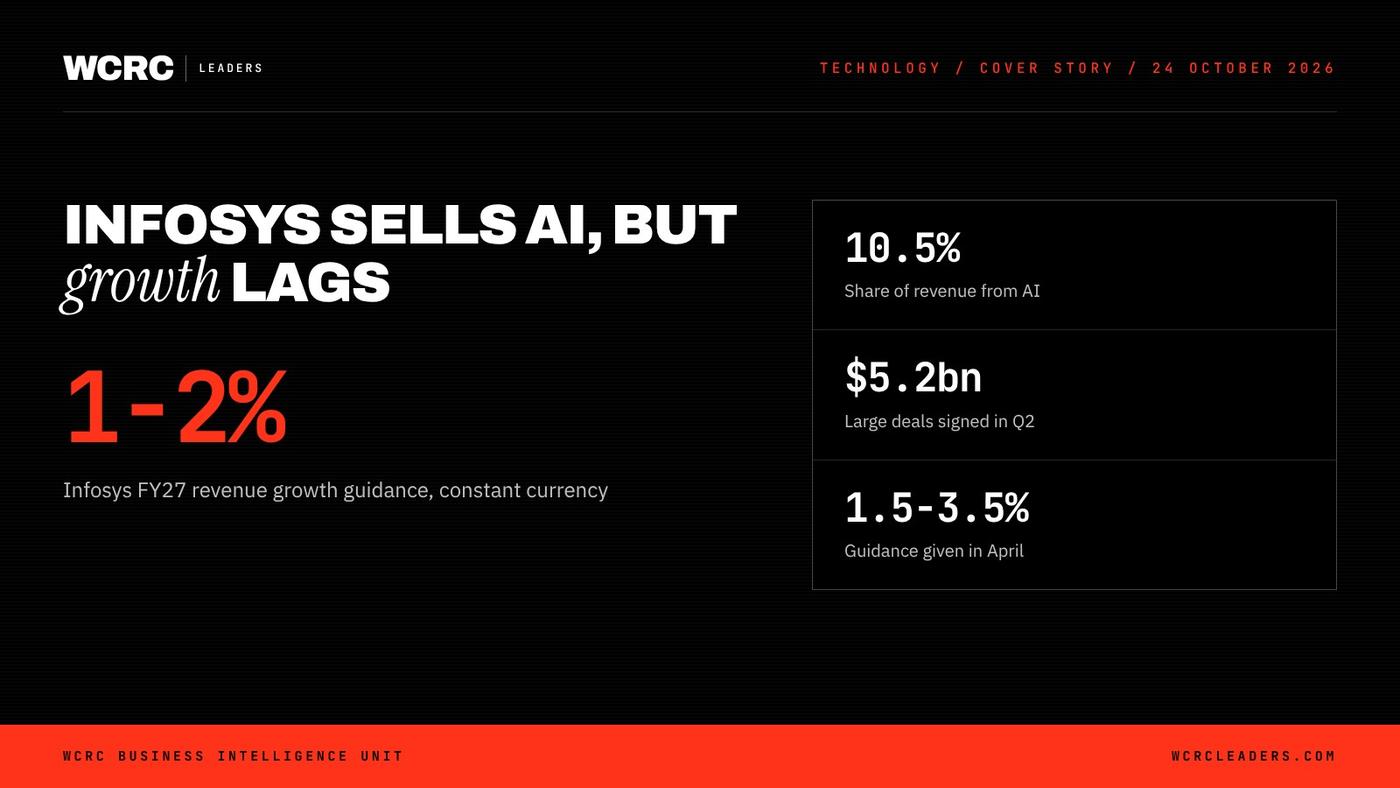
At a glance: WCRC Leaders' assessment: Infosys has proved it can sell AI, but not yet that AI adds to the business rather than replacing the work it already does. On 23 October 2026 the Bengaluru company reported Q2 FY27 revenue of $5,145m, up 1.5% year on year in constant currency, and narrowed FY27 guidance to 1-2%, from 1.5-3.0% in July and 1.5-3.5% in April. For Indian IT boards, the Gulf clients they serve and the graduates they hire, the gap between bookings and revenue is now the central question.
What did Infosys report for the September quarter?
Revenue for the quarter ended 30 September 2026 was $5,145m, up 1.3% year on year in dollars and 1.5% in constant currency. Sequential growth in constant currency was 1.2%. In rupees, revenue reached ₹49,244 crore, up 10.7%, a figure flattered by a much weaker rupee.
Net profit was ₹7,823 crore, against ₹7,364 crore a year earlier, a rise of about 6%. The operating margin held at 21.0%. Free cash flow was ₹8,898 crore ($928m), down 8.1% in rupees and 15.7% in dollars, though still 113.3% of net profit by the company's own measure. The board declared an interim dividend of ₹26 per share, 13% more than last year.
Large deal value was $5.2bn, of which 62% was net new, and it included one mega deal worth more than $2bn. That compares with $3.6bn in the June quarter. AI accounted for 10.5% of revenue, up from 8.2% in the first quarter, and grew 29% quarter on quarter.
"We had strong large deals of $5.2 billion, including a mega deal of over $2 billion," said Salil Parekh, chief executive and managing director. "Our AI revenue was at 10.5% and grew 29% quarter-on-quarter."
Why cut guidance after a quarter of record-looking wins?
This is the second downgrade of the year. Infosys opened FY27 in April with a growth range of 1.5-3.5% in constant currency, trimmed it to 1.5-3.0% in July, and now guides 1-2%. The top of the range has fallen from 3.5% to 2% in six months. Margin guidance of 20-22% was kept.
For context, Infosys grew 3.1% in constant currency in FY26, on revenue of $20,158m. First-half FY27 growth was 1.9%. A full-year outcome of 1-2% therefore implies a softer second half, the period in which large deals signed this year were expected to start billing.
Chief financial officer Jayesh Sanghrajka described the margin as delivered "amidst heightened volatility" and said "focus on cost and operational efficiency measures while making the required investments, have led to stable margins." The release does not name the client behind the mega deal or say when it begins to contribute.
The vertical mix in the fact sheet shows where the pressure sits. Hi-Tech revenue fell 17.3% year on year in constant currency and retail fell 7.7%. Manufacturing slipped 0.7%. Against that, life sciences grew 32.5%, energy, utilities, resources and services grew 7.3% and communications grew 4.1%. Financial services, the largest vertical at 28.0% of revenue, grew 2.1%.
Is AI adding revenue, or replacing it?
This is the question boards should take from the quarter. Infosys's own figures allow a rough calculation. WCRC analysis: 10.5% of $5,145m is about $540m of AI revenue in Q2, against roughly $417m (8.2% of $5,082m) in Q1. On those figures, revenue outside AI fell by about 1.3% in the quarter, from roughly $4,665m to $4,605m.
Infosys does not define AI revenue in the release, and some of the increase may reflect reclassification of existing work as projects add AI components. Even so, the arithmetic points to the shift that investors and clients have expected: AI-led delivery compresses effort on traditional application maintenance, testing and support, and the new AI work does not yet fully offset what it displaces. Large deals that are 62% net new still tend to promise productivity savings to the client, which means less billable work per dollar of contract value.
That is the bellwether's problem in one line. The order book is growing faster than revenue, and the AI line is growing faster than the business.
What does it mean for the hiring pyramid?
Headcount rose by 4,480 in the quarter to 332,542, but it was only 551 higher than a year earlier. Voluntary attrition in IT services eased to 12.7% from 13.0% in June and 14.3% a year ago. Utilisation excluding trainees rose to 85.4%. Infosys gives no fresher hiring figure in its quarterly documents.
The pattern of flat staff numbers over a year, falling attrition and tighter utilisation suggests a company that is producing more output per person rather than adding people. WCRC analysis: that is consistent with what WCRC reported on Anthropic's internal study, where junior technical hires fell from 27% to 9%. If the broad base of graduate engineers stops widening, India's IT model, built on a large pyramid of junior staff billed under a few senior architects, changes shape. The split between AI and GCC hiring on one side and IT services on the other is already visible in India's job market.
How does Infosys compare with its peers?
Infosys at least has the bookings. Wipro's large-deal value fell 58.6% quarter on quarter to $674m, and Rishad Premji's company guided December-quarter IT services revenue to a change of -1.5% to +0.5% in constant currency. At Tech Mahindra, Mohit Joshi's turnaround reached a 14.8% margin, still short of its 15% goal. Across the sector, the story this quarter is margin discipline and deal momentum, with little top-line growth to show for either.
Infosys is also gaining ground in global capability centres. Its own release cites leader ratings for GCC set-up capabilities in India and AI-native GCC services. That matters because multinationals that build their own centres in Bengaluru, Hyderabad or Pune take work in-house that once went to outsourcers. Helping clients build and run those centres is how Indian IT firms are trying to keep a share of that spending.
What should Gulf clients and the rupee story tell boards?
The rupee did much of the work in the headline numbers. WCRC analysis based on Infosys's reported figures: the quarter's revenue implies an average of about ₹96 to the dollar, against about ₹88 a year earlier. That is why rupee revenue grew 10.7% while dollar revenue grew 1.3%. For exporters, a weaker rupee cushions margins. It does not create demand, and investors in Indian IT now look through it. WCRC has examined what defending the rupee is costing India's largest banks.
The release does not break out Middle East revenue or name Gulf clients. WCRC analysis: for Gulf banks, energy groups and government entities buying technology services, a supplier base that is chasing growth and holding margins through efficiency is a strong negotiating position. Expect sharper pricing on renewals, more outcome-based and AI-linked contracts, and more willingness to staff local delivery centres. Infosys's energy, utilities, resources and services vertical, which grew 7.3%, is the segment most relevant to Gulf energy companies.
The WCRC View
The call. Infosys has shown it can win large deals and sell AI. It has not shown that the two add up to growth. Until revenue outside AI stops shrinking, a 10.5% AI share is evidence of a business changing its mix, not one getting bigger.
Who gains. Clients gain most. Productivity savings promised in large deals flow to the buyer first. Global capability centres gain as multinationals keep more work in-house. Investors who value cash generation will note free cash flow above net profit and a 13% higher dividend.
Who is exposed. Graduates entering IT services, mid-tier vendors without Infosys's scale, and cities whose economies rest on headcount growth in IT.
What leaders should do now. Indian IT boards should ask management to disclose how AI revenue is defined and how much is new work. CEOs buying services in India, the Gulf and Asia should renegotiate around outcomes and AI-driven productivity rather than headcount. HR leaders should plan for a narrower intake of entry-level engineers and invest in reskilling.
What WCRC will watch. When the $2bn-plus mega deal begins to bill; whether Infosys holds 1-2% or cuts again with its third-quarter results; any definition of AI revenue; and year-on-year headcount, which has been close to flat.
Infosys is named among India's Most Loved 250 Workplaces 2026 by WCRC.
Quick answers
Q: What is Infosys's revised FY27 revenue guidance? A: Revenue growth of 1-2% in constant currency, announced on 23 October 2026, down from 1.5-3.0% in July and 1.5-3.5% in April. Operating margin guidance of 20-22% was retained.
Q: How much of Infosys's revenue comes from AI? A: AI was 10.5% of Q2 FY27 revenue, up from 8.2% in Q1, and grew 29% quarter on quarter, according to the company.
Q: How large were Infosys's deal wins in the September quarter? A: Large deal value was $5.2bn, 62% of it net new, including one mega deal worth more than $2bn.
Q: What dividend did Infosys declare? A: An interim dividend of ₹26 per share, 13% higher than last year.

Your customers will send their agents: what the Personal Agent Protocol means for the board
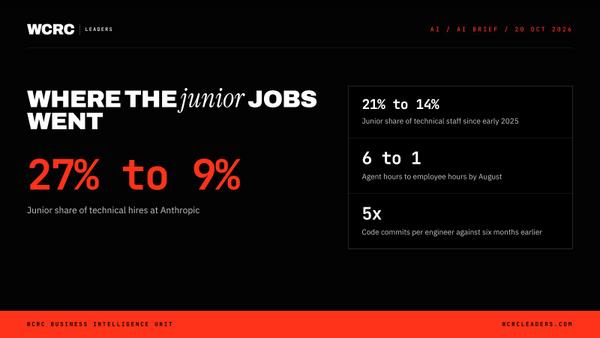
Junior hires fall to 9% at Anthropic: a warning for India's IT pyramid
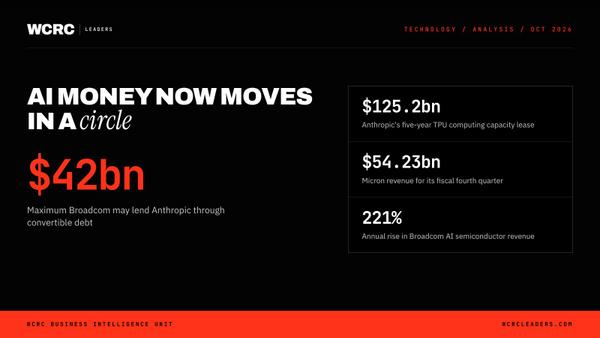
Supplier-funded compute: what CFOs should read into the AI financing loop
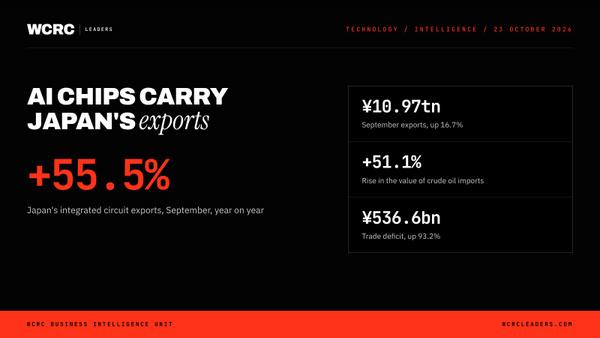
AI chips lift Japan's exports 16.7% as oil nearly doubles its deficit

China's 40-technology export list puts India's solar push on notice
TSMC and ASML post records, and ASML says supply falls short to 2028
Filed under