Business
IndiGo lifts yields 34% but a 67% fuel bill leaves a ₹1,879 crore loss
Asia's biggest low-cost carrier proved it can raise fares in a war. Its September quarter shows that pricing power alone cannot carry an airline through a fuel shock, and why boards should look hard at hedging, capacity and currency.
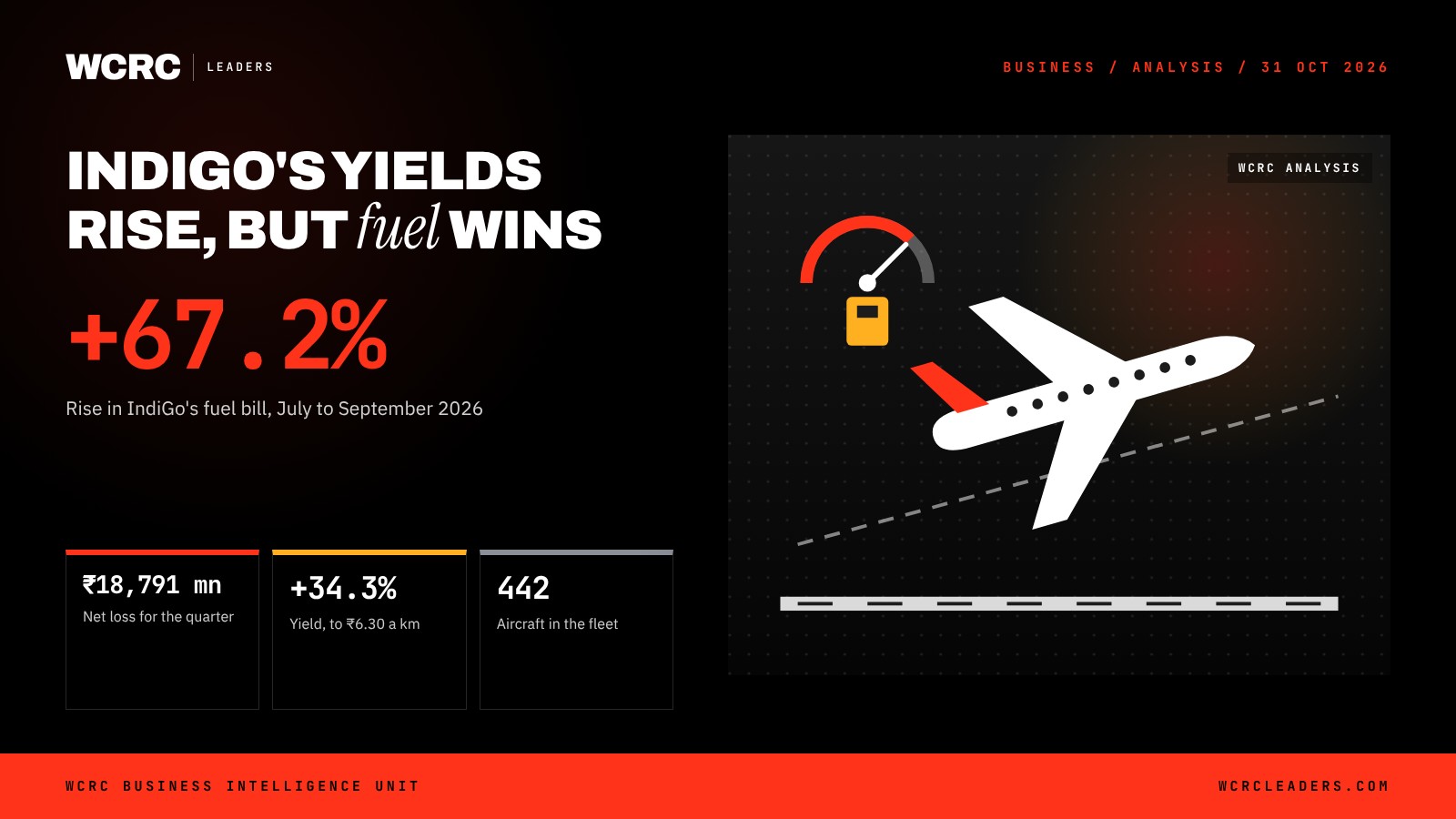
At a glance: WCRC Leaders' assessment: IndiGo has shown more pricing power than any low-cost carrier is supposed to have, but the West Asia fuel shock has turned that strength into a holding action, not a profit engine. On 29 October 2026, InterGlobe Aviation reported a net loss of ₹18,791 million for July to September, against ₹25,821 million a year earlier. Revenue rose 25.9% and yield 34.3%, yet fuel cost jumped 67.2% and passengers fell 4.7%. Excluding currency effects, a small profit became a ₹7,237 million loss.
What did IndiGo report for the September quarter?
InterGlobe Aviation, one of WCRC 1000, India's Most Valuable Enterprises 2026, released its results for the second quarter of fiscal 2027 on 29 October. Revenue from operations rose 25.9% to ₹233,638 million. The net loss narrowed to ₹18,791 million, or about ₹1,879 crore, from ₹25,821 million in the same quarter of 2025.
The headline improvement is misleading. A year ago almost the whole loss came from the rupee: excluding foreign exchange, IndiGo made a profit of ₹1,039 million in the September 2025 quarter. This year, excluding forex, it lost ₹7,237 million. On WCRC's arithmetic from the two releases, the currency hit shrank from about ₹26,860 million to about ₹11,554 million, while the underlying business swung into the red.
The cause is plain in the cost lines. Fuel cost rose 67.2% to ₹99,668 million and fuel cost per seat kilometre 68.9%. EBITDAR excluding forex fell to ₹36,153 million, a margin of 15.5%, from 20.5% a year earlier.
Chief executive Willie Walsh said the "seasonally soft September quarter saw exceptionally elevated fuel costs and continued geopolitical turmoil." The airline, he said, "responded with prudent capacity reduction and yield management, supporting strong revenue performance but only partially offsetting the higher costs."
How much pricing power did IndiGo show?
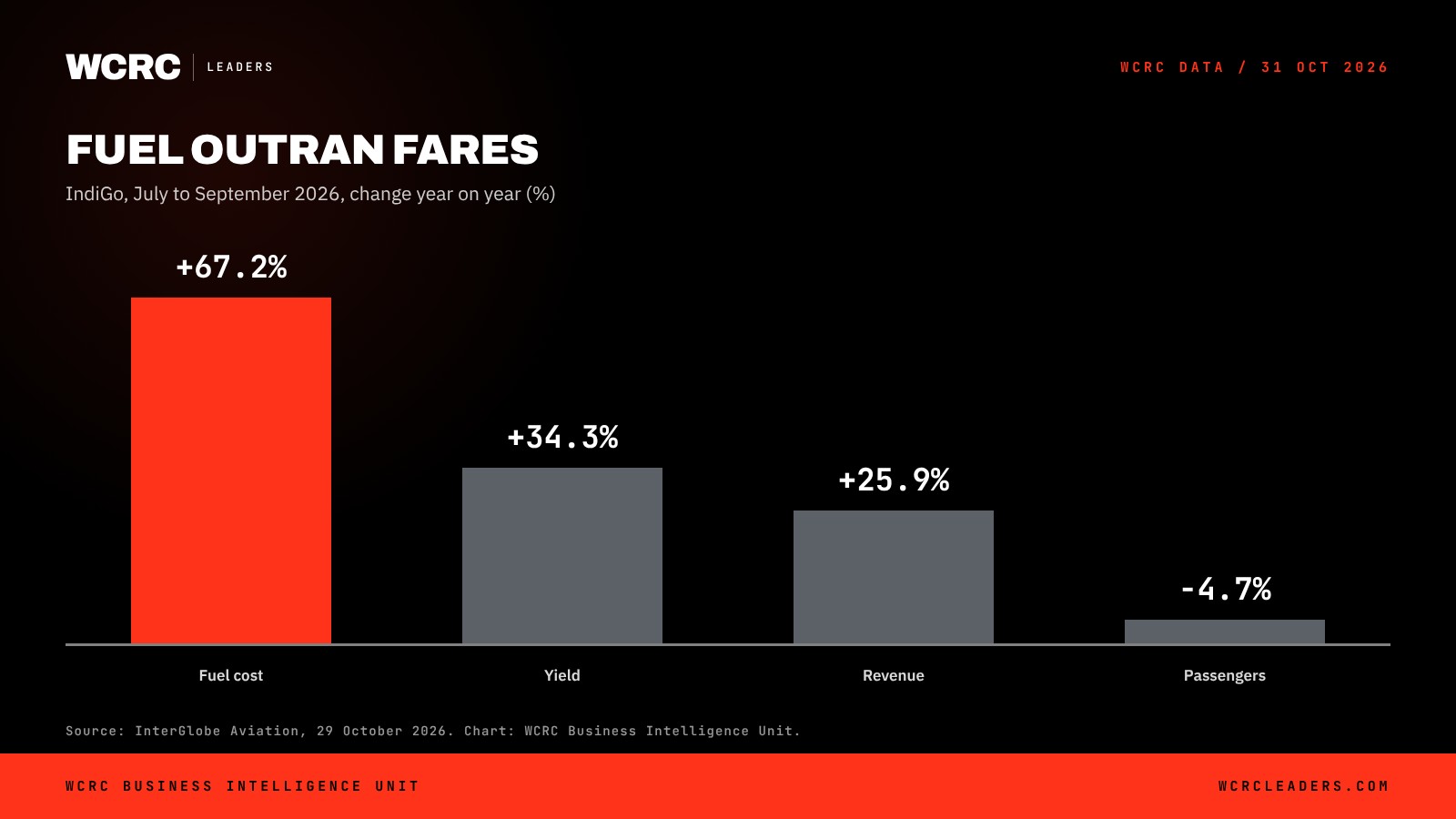
A great deal. Yield, the average fare per passenger kilometre, rose 34.3% to ₹6.30, from ₹4.69 a year earlier, while capacity fell 1.0% and traffic 3.7%. Passengers carried dropped 4.7% to 27.5 million and the load factor slipped 2.2 points to 80.3%.
Put the two lines side by side. Revenue grew by about ₹48,085 million year on year. Fuel cost grew by about ₹40,050 million. Roughly 83 paise of every extra rupee of revenue went straight to the fuel bill, before a single non-fuel cost increase is counted.
Read through WCRC's Price Power Model, BMC-19 in the Brand & Marketing Codex, which asks how much premium a brand can charge before buyers switch, the answer here is two-sided. IndiGo pushed fares up by a third and lost under 5% of its passengers, which says customers had few alternatives and valued the network. But the lower load factor shows where the ceiling sits.
IndiGo, a WCRC MegaBrand in low-cost airlines, kept its operating record intact: on-time performance of 91.3% at ten major airports and a cancellation rate of 0.35%. In the terms of WCRC's Trust Equity Model, BMC-04, which measures how much pressure a brand's trust can absorb, that reliability is what has let IndiGo charge war-time fares without a collapse in demand. Trust is the reserve being drawn down.
Why does the West Asia war hit India-Gulf flying hardest?
The government's own figures explain the split. When the Union Cabinet approved a Price Stabilisation Fund of up to ₹10,000 crore on 3 June 2026, it cited "exceptional fuel price volatility arising from the West Asia crisis." International aviation turbine fuel rose nearly 2.5 times, from ₹60.50 a litre in March 2026 to ₹142 in May. Domestic fuel prices were capped, while fuel for international operations was priced at import parity. The Cabinet noted that airlines had "reduced or suspended services on several international routes."
IndiGo's ticket charges track that shock on its Gulf network. On 14 March it introduced a fuel charge of ₹900 per sector for the Middle East, citing a "significant surge in fuel prices" linked to "ongoing geopolitical issues in the Middle East." From 2 April it revised the charge to ₹3,000 for GCC and Middle East sectors up to 2,000 km and ₹5,000 beyond, saying international fuel prices "have more than doubled in the last month."
The Gulf matters to IndiGo in a way it does not to most Asian low-cost carriers. The corridor carries India's migrant workers, its pilgrims to Jeddah and Medina, and its business travellers to Dubai and Riyadh. In March, the Ministry of Civil Aviation arranged for Muscat to serve as an en-route alternate airport for Gulf and Saudi destinations, and IndiGo was cleared to start Mumbai to Riyadh services from 12 March. WCRC has tracked the attacks on Gulf infrastructure and the Riyadh airport closure that sit behind those decisions.
The lesson for Gulf boards is that the India corridor is resilient in demand but not in cost. Fares rose sharply and travellers kept flying, but international routes carry the uncapped fuel price.
What should boards learn about hedging and capacity?
First, separate fact from fear before acting. SeeClear, a model in WCRC's Guru Management Codex drawn from Adi Shankaracharya, asks leaders to tell the rope from the snake before a major decision. IndiGo's results show two different snakes. The currency loss, ₹11,554 million on WCRC's arithmetic, comes from rupee moves on dollar obligations such as leases. The fuel loss is an operating cost. The release shows a forex hedging gain of ₹1,778 million but discloses no fuel hedging. Boards should ask which exposure they have covered and which they are simply absorbing.
Second, capacity discipline worked, but it has limits. IndiGo cut seat kilometres by 1.0% and lifted yield sharply. Yet non-fuel unit costs rose 14.6%, because a growing fleet costs money whether or not it flies full. The fleet reached 442 aircraft, a net addition of ten in the quarter, including four A321XLR long-range narrowbodies. The company expects capacity to grow by early single digits in the December quarter.
Third, the balance sheet buys time. Total cash stood at ₹526,854 million on 30 September, of which ₹399,290 million was free cash, up from ₹385,167 million a year earlier. Total debt including lease liabilities rose to ₹873,031 million from ₹748,138 million. Read through WCRC's Corporate Value Intelligence framework for interpreting enterprise value, investors are now valuing IndiGo less on this quarter's loss than on whether that cash cushion and market share survive the fuel cycle intact.
What comes next for IndiGo and its rivals?
The December quarter is India's peak travel season, which should help yields. Walsh said the airline remains "focused on managing the near-term challenges while continuing to invest for the future," and that "India's long-term aviation opportunity remains compelling." The open questions are the war, crude prices and the government's fuel support, which runs for 36 months with annual review. For how the oil shock is moving through Indian results, see WCRC's analysis of HPCL's September quarter and India's 11.39% wholesale inflation.
The WCRC View
The call. IndiGo has proved it can price through a crisis. It has not proved it can profit through one. A 34.3% yield rise against a 67.2% fuel rise is a defensive win, and the swing from an underlying profit to an underlying loss shows how little room is left.
Who gains. In the short term, the strongest balance sheet gains share. With ₹399,290 million of free cash, IndiGo can hold its network while weaker rivals shrink. Read through the Price Power Model, the winner of a fuel shock is the brand whose customers stay at a higher fare, and IndiGo has shown that.
The risk. In the terms of the Trust Equity Model, high fares draw down trust that took years to build. If war-time fares outlast the war, the Promise Gap Model, BMC-06, becomes the right lens: a low-cost brand charging premium prices risks the distance between what it claims and what it delivers.
What leaders should do now. Boards in India, the Gulf and Asia with heavy energy or dollar exposure should apply SeeClear and split their risks: fuel, currency and demand are different problems needing different hedges. IndiGo is also among India's Most Loved 250 Workplaces 2026, selected by the Business Intelligence Unit of WCRC; holding that culture through cost cuts will matter as much as holding fares.
What WCRC will watch. The December-quarter yield and load factor, any disclosure on fuel hedging, the pace of A321XLR deployment on longer international routes, and whether the government's fuel support starts to be recovered in 2027.
WCRC models applied: Price Power Model (BMC-19), Trust Equity Model (BMC-04), Promise Gap Model (BMC-06), SeeClear (Guru Management Codex), Corporate Value Intelligence.
Quick answers
Q: How much did IndiGo lose in the September 2026 quarter? A: InterGlobe Aviation reported a net loss of ₹18,791 million (about ₹1,879 crore) for the quarter ended 30 September 2026, against a loss of ₹25,821 million a year earlier. Excluding foreign exchange effects, the loss was ₹7,237 million.
Q: Why did IndiGo's fuel cost rise so sharply? A: Fuel cost rose 67.2% to ₹99,668 million. The government says international jet fuel prices rose nearly 2.5 times between March and May 2026 because of the West Asia crisis.
Q: Did IndiGo raise fares? A: Yes. Yield rose 34.3% to ₹6.30 per kilometre. Passengers fell 4.7% to 27.5 million and the load factor fell to 80.3%.
Q: How big is IndiGo's fleet and cash position? A: IndiGo had 442 aircraft on 30 September 2026, including four A321XLRs, and total cash of ₹526,854 million, of which ₹399,290 million was free cash.
Adani Ports raises FY27 capex by ₹3,000 crore as overseas ports surge
Vedanta doubles Gamsberg, and Ramaphosa now wants a zinc smelter
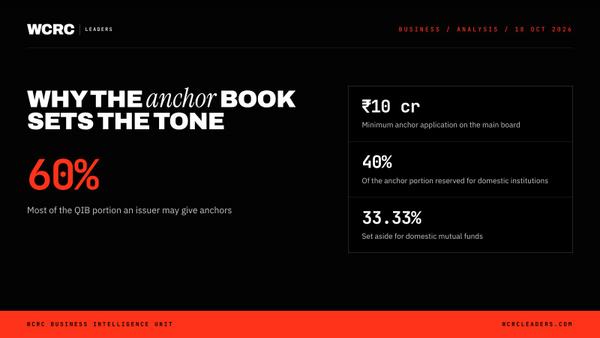
Anchor investors in Indian IPOs: why the 60% book sets the tone
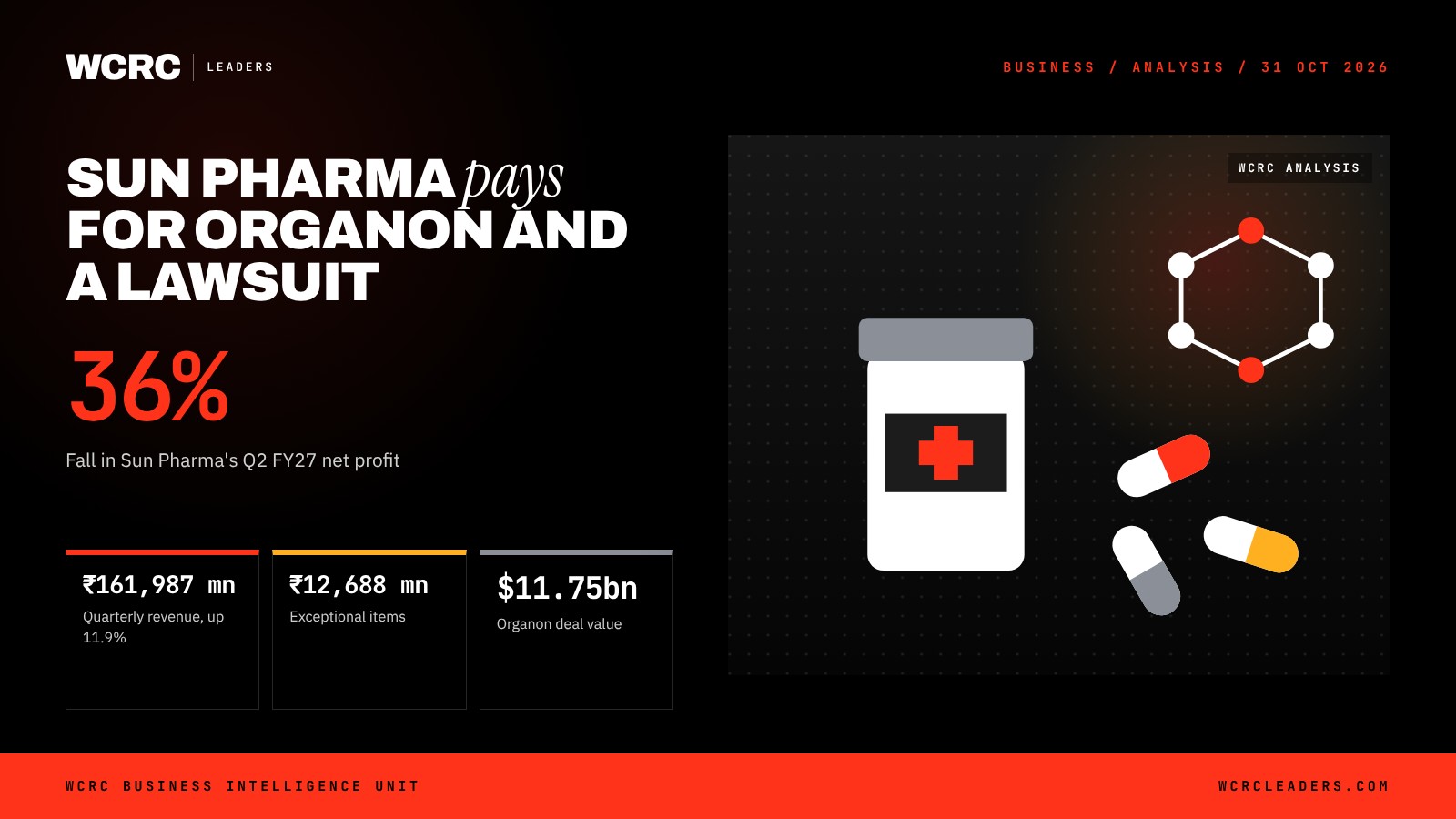
Sun Pharma's profit falls 36% as it pays for Organon and a US lawsuit

Bajaj Finance lines up ₹17,500 crore as AI agents take on service

$133bn: what India's rupee defence is costing its biggest banks
Filed under