Business
135 attacks since February: what Gulf and Indian boards must price in
Shipping attacks in Gulf waters reached 12 in a single week, and operations at Riyadh's main airport were suspended after repeated strikes. For companies in India and the Gulf, war risk is no longer an event to wait out. It is an operating cost to be budgeted.
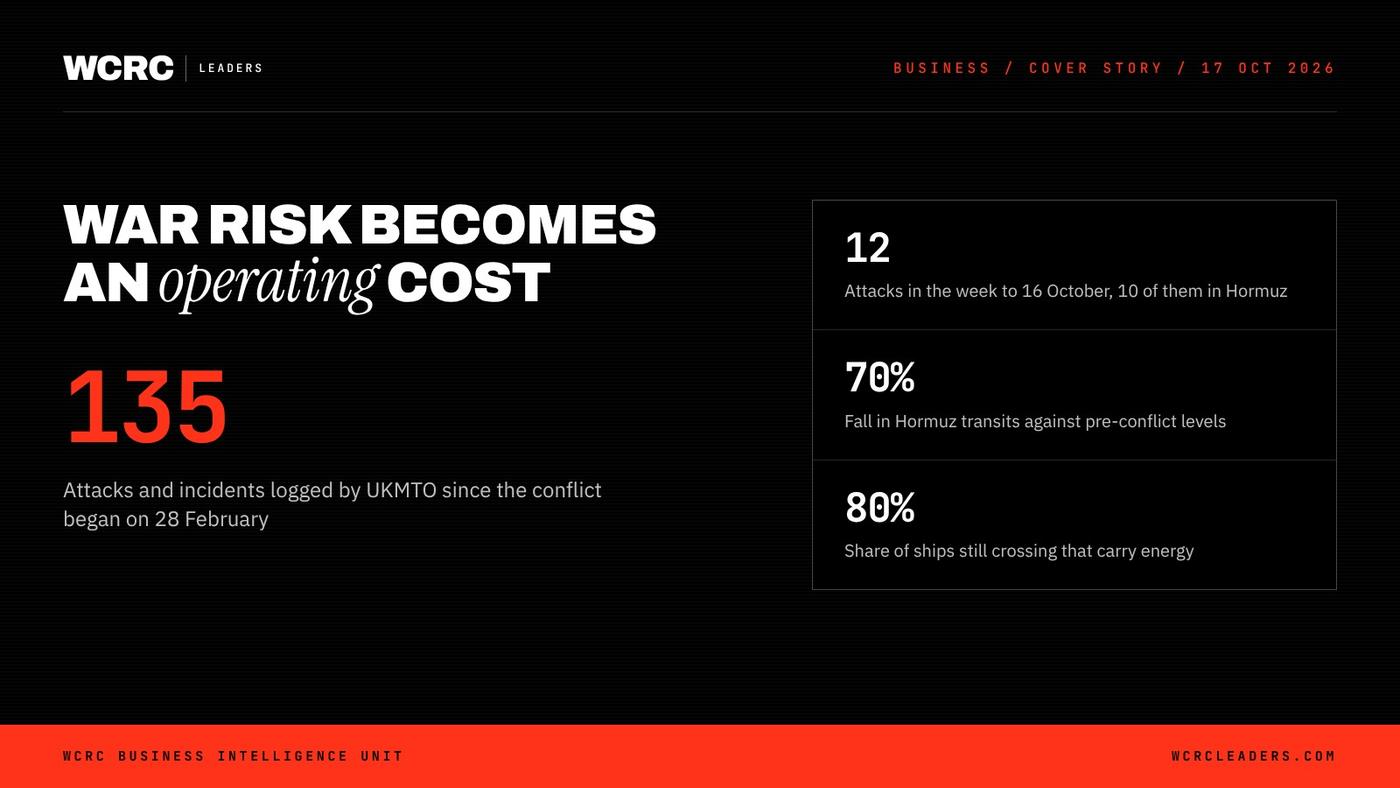
At a glance: WCRC Leaders' assessment: boards in India and the Gulf should now plan on the basis that disruption in Hormuz and Gulf airspace lasts at least into 2027, and treat recovery as the upside case. The UK Maritime Trade Operations (UKMTO) centre logged 12 attacks in the week ending 16 October, 10 of them in the Strait of Hormuz, taking the total to 135 events since the conflict began on 28 February. Transits through the strait are about 70% below pre-conflict levels. In Riyadh, operations at King Khalid International Airport were suspended after an attack on 10 October, and the suspension was extended on 12 October.
What happened at sea this week?
UKMTO's weekly overview for the week ending 16 October records 12 attacks: 10 in the Strait of Hormuz, one in the Arabian Gulf and one in the Gulf of Oman. It puts the running total at 135 events since 28 February, 228 days into the conflict, with 84 incidents reported in the strait itself.
Two incidents stand out. On 13 October a container ship sailing out through the Strait of Hormuz was struck by what UKMTO calls an "unknown projectile". The vessel caught fire, drifted and sank on 14 October, about four nautical miles north-west of Ras Shaykh Masud. UKMTO says the crew were evacuated without injury. That same day, two more container ships were hit, suffered minor damage and kept sailing.
On 11 October a products tanker in the Gulf of Oman was hit by a drone and its crew evacuated. By 14 October the ship was drifting about 50 nautical miles north-east of Sohar port. UKMTO, citing India's Ministry of External Affairs, records two crew members missing.
UKMTO does not say who carried out the attacks. Separately, US Central Command said it disabled a vessel on 11 October after it ignored repeated warnings and tried to run the ongoing naval blockade, and reported its crew safe.
The figures understate the risk. UKMTO notes that most vessels that are attacked do not report the incident, which "limits" its ability to confirm the true number. It also recorded 23,166 anomalous AIS positions in seven days and eight vessel reports of satellite positioning interference in the week.
How much trade still moves through Hormuz?
Very little compared with before the conflict. UKMTO counts 125 outbound and 129 inbound transits in the latest week, down from 129 and 146 the week before, and says the combined total is "approximately 70% below pre-conflict levels". The Joint Maritime Information Center (JMIC) reports that 80% of the ships still crossing are energy carriers.
Under normal conditions the strait matters hugely: the US Energy Information Administration (EIA) estimates oil flows through it averaged about 20 million barrels a day in 2024. That is about a fifth of global petroleum liquids consumption. Asian buyers took 84% of the crude and condensate and 83% of the liquefied natural gas that passed through, and China, India, Japan and South Korea together took 69% of its crude flows. The EIA put the capacity of Saudi and Emirati bypass pipelines that could be used during a disruption at only about 2.6 million barrels a day.
For Gulf exporters and manufacturers, a ship sinking in an outbound lane matters as much as any price signal. Shippers now have to price the risk that the cargo itself is lost, not just delayed.
What is happening at Riyadh's main airport?
Saudi Arabia's General Authority of Civil Aviation (GACA) said that King Khalid International Airport was attacked on the afternoon of 10 October and that operations were "temporarily suspended" while damage and safety were assessed. In a follow-up statement GACA said the attack killed 12 people and injured 309, some of them critically. A further attack on the airport on 11 October killed one person and injured 11, according to GACA.
On 12 October GACA extended the suspension so that it could complete procedures "to verify the safety and operational readiness of the airport's facilities". None of the GACA statements reviewed for this article gives a date for reopening.
Riyadh is not the only airport hit. Between 5 and 11 October GACA reported attacks on airports in Jazan, Najran, Abha and Dammam, as well as an earlier strike on the Riyadh airport on 6 or 7 October. GACA has not named who was responsible. The Secretary-General of the Gulf Cooperation Council, Jasem Mohamed Albudaiwi, condemned what he called Houthi militia attacks on the Jazan and Najran airports.
What does this mean for India's energy bill?
India has cut its dependence on the strait, but not removed it. At an inter-ministerial briefing in March, the Ministry of Petroleum and Natural Gas said India was buying crude from about 40 countries, and that about 70% of its crude imports were coming via routes outside Hormuz, up from about 55%. The country uses about 5.5 million barrels of crude a day. Gas and cooking fuel were more exposed. The ministry said about 60% of India's LPG is imported and about 90% of those imports pass through Hormuz. About 47.4 million standard cubic metres a day of gas supply was affected by force majeure at the time.
Prices are the second channel. In its October Short-Term Energy Outlook, the EIA forecast that Brent crude would average $105 a barrel in the fourth quarter of 2026, $14 higher than its forecast a month earlier. It expects an average of $96 for 2026, against $69 in 2025. It assumes oil flows from the Middle East "will remain constrained through the fourth quarter of 2026". It expects recovery to come through convoys, bypass routes and more ship-to-ship transfers, and warns that attacks on Saudi Arabia's East-West pipeline point to continued volatility. The EIA expects Brent to ease to $84 in 2027.
For Indian companies, higher import costs reach input prices and margins at a time when borrowing costs are also rising, after India's first rate hike since 2023.
What are governments telling shipowners and travellers?
India's maritime regulator has made Hormuz voyages conditional, not banned. Circular 47 of 2026 from the Directorate General of Maritime Administration, dated 5 August, says shipowners, managers and recruitment agencies that put Indian seafarers on ships transiting the strait must take adequate precautions, keep the DG Communication Centre informed of each transit and obtain each seafarer's individual consent. Masters must keep heightened security vigilance and apply ISPS Code security plans.
This matters to any company that employs Indian crew. Because each seafarer can decline, no Hormuz voyage is certain until the crew has agreed.
In March the government said about one crore Indians, roughly 10 million people, live in Gulf Cooperation Council countries. With Riyadh's main airport shut, moving staff, crews and urgent spare parts now depends on other airports and road links.
Who pays for the extra risk?
This section is WCRC analysis. Insurance is where the risk turns into a bill. War-risk cover for ships is typically quoted voyage by voyage and can be changed at short notice. A sinking in the outbound lane, together with an official admission that most attacks go unreported, gives underwriters every reason to price higher and to set tighter conditions. Shippers should expect those costs to be passed on through freight rates and surcharges, and buyers of goods sold on delivered terms will bear them.
Gulf ports with direct access to open water, and the overland corridors behind them, gain relevance. This is one reason the UAE-Saudi rail and grid pact now looks like a resilience measure as much as an integration project. Indian refiners and fuel retailers carry most of the price risk. Exporters to the Gulf carry most of the logistics risk.
The WCRC View
The WCRC Business Intelligence Unit's call is that disruption is now the operating condition, not a shock to be waited out. With transits 70% down, a ship sunk in the strait and operations at the Saudi capital's main airport suspended with no reopening date announced, boards should plan on disruption lasting into 2027 and treat any recovery as upside.
Re-base the budget. Run 2027 plans against an oil price in the region of the EIA's fourth-quarter forecast of $105, not its 2027 forecast of $84. Build freight and war-risk surcharges into landed costs and customer contracts now, and review delivered-price terms that leave you carrying that risk.
Map the Hormuz exposure line by line. Identify every input, shipment and customer that depends on a transit through the strait, including LPG, petrochemicals and Gulf-made components. For each one, name an alternative supplier, route or port, and its cost.
Protect people first. For staff based in Saudi Arabia, set up evacuation and travel plans that do not rely on Riyadh's main airport. For crews, make sure managers and recruitment partners are following the consent and reporting rules in DGMA Circular 47.
Read your insurance before you need it. Check war, political-violence and business-interruption wordings for exclusions covering drones, airports and supplier outages. Confirm cover is in place before each voyage, not after.
What WCRC will watch next: any GACA notice on reopening King Khalid International Airport, the next UKMTO weekly figures, the EIA's 10 November outlook, and any new advisory from India's maritime regulator.
Quick answers
Q: How many attacks did UKMTO record in the week ending 16 October? A: Twelve: 10 in the Strait of Hormuz, one in the Arabian Gulf and one in the Gulf of Oman, taking the total since 28 February to 135 events.
Q: How far has Hormuz traffic fallen? A: UKMTO says combined transits are about 70% below pre-conflict levels, and 80% of the ships still crossing are energy carriers.
Q: Is King Khalid International Airport open? A: GACA suspended operations after the attack on 10 October and extended the suspension on 12 October for safety checks. Its statements reviewed for this article give no reopening date.
Q: Can Indian seafarers sail through Hormuz? A: Yes, with conditions. DGMA Circular 47 of 2026 requires owners to take adequate precautions, inform the DG Communication Centre of each transit and obtain each seafarer's consent.
Filed under