WCRC Intelligence
India's 11.39% wholesale inflation: the margin squeeze is here
Factory-gate prices in India are rising more than twice as fast as shop prices. With fuel and power up 25.85% a year and the RBI now tightening, the cost of a crude oil shock has landed on corporate margins.
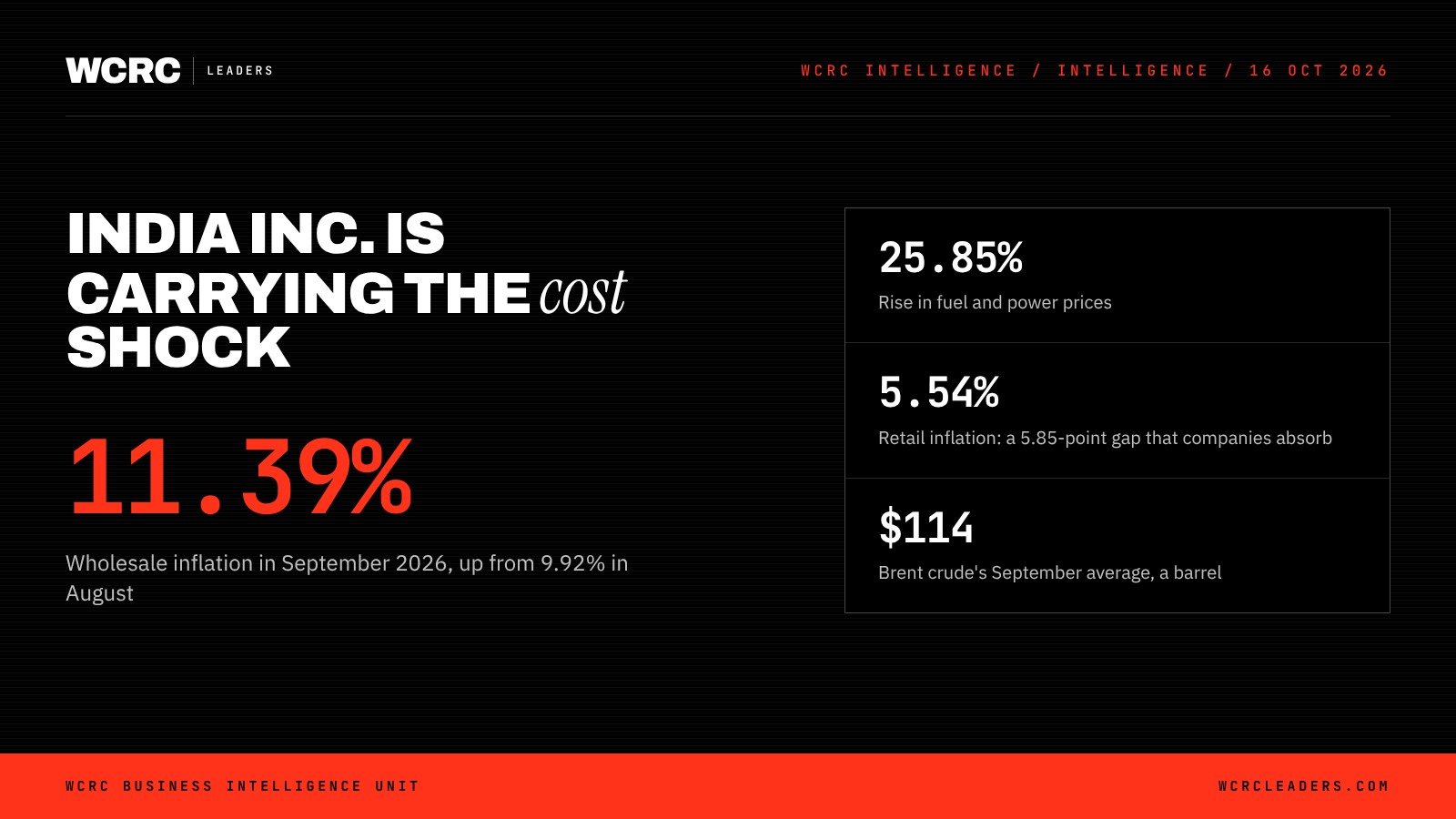
At a glance: WCRC Leaders' assessment: India Inc. is absorbing a cost shock that consumers have not yet paid for, and the next two quarters will separate companies with pricing power from those without it. Wholesale price inflation rose to 11.39% in September 2026 from 9.92% in August, the Office of the Economic Adviser said on 14 October. Retail inflation was 5.54%. The 5.85-point gap is a measure of the costs companies are carrying, at the moment the Reserve Bank of India has raised rates and Brent crude averaged $114 a barrel.
What did the September numbers show?
The Wholesale Price Index (base 2022-23) rose 11.39% year on year in September, on provisional data published by the Office of the Economic Adviser in the Department for Promotion of Industry and Internal Trade. That is up from 9.92% in August and 9.78% in July. In a single month the index climbed from 110.8 to 112.5, a rise of about 1.5%.
Fuel drove the jump. The fuel and power group, which makes up about 14% of the index, rose 25.85% from a year earlier, up from 22.93% in August. Inside it, mineral oils (petroleum products) rose 40.02% and crude petroleum and natural gas 57.32%. Coal and lignite rose 9.31%. Electricity prices fell 0.43%, the one group where administered pricing is still holding the line.
The bigger worry for industry sits in manufactured products, which carry about 63% of the index weight. Inflation there rose to 9.76% from 8.37%. The official release lists the groups that pushed it up, and they are the basic inputs of Indian industry:
- Basic metals: 16.96%
- Chemicals and chemical products: 16.74%
- Textiles: 13.85%
- Rubber and plastic products: 13.47%
- Electrical equipment: 11.93%
- Food products: 9.44%
Primary articles rose 8.67% and the WPI food index 8.66%, against 7.76% and 7.05% in August.
Why is wholesale inflation so far ahead of retail inflation?
The Ministry of Statistics and Programme Implementation reported on 12 October that the Consumer Price Index (base 2024=100) rose 5.54% in September, up from 4.83% in August. Rural inflation was 6.08% and urban 4.88%. Consumer food inflation was 7.74%.
The gap between the two indices has widened from 5.09 percentage points in August to 5.85 points in September. The WPI tracks goods at the first point of bulk sale and gives heavy weight to fuel, metals and chemicals. The CPI tracks what households pay, and gives large weight to services, rent and items whose prices change slowly. The CPI's electricity, gas and other fuels group rose only 3.24% in September, because retail fuel and power tariffs are largely set by government and utilities.
WCRC analysis: A gap of this size usually means one thing for companies. Their costs have risen faster than the prices they can charge end customers. The trial Input Producer Price Index for manufacturing, published alongside the WPI on an experimental basis, points the same way. It rose from 104.2 to 106.1 between August and September, about 1.8%. The Output PPI for manufactured products rose from 109.7 to 111.0, about 1.2%. Inputs went up faster than outputs in a single month. The figures may be revised, but the direction matches.
Where is the oil shock coming from?
The US Energy Information Administration said in its October Short-Term Energy Outlook that the Brent spot price averaged $114 a barrel in September, $23 higher than in August, and peaked at $131 on 15 September. It linked the rise to "increased attacks on oil infrastructure and tankers around the Middle East", including attacks on Saudi Arabia's East-West pipeline, which temporarily halted a route that bypasses the Strait of Hormuz. It also cited tight diesel markets and high tanker and insurance costs.
The EIA expects relief, but not soon. It forecasts Brent at $105 a barrel in the fourth quarter of 2026, falling to an average of $84 in 2027 as Middle East output recovers by the end of the second quarter of 2027.
For India, which imports most of its crude, this is a direct hit on input costs. The Ministry of Commerce and Industry said on 2 October that it had extended its RELIEF support for exporters facing West Asia logistics disruptions and extended the RoDTEP export duty remission scheme to 31 December 2026.
How is the RBI responding?
The Monetary Policy Committee raised the repo rate by 25 basis points to 5.50% on 7 October, a unanimous decision and the first increase since February 2023. It changed its stance from neutral to "calibrated tightening" by a 4 to 2 vote and said "rate cuts are off the table in the near term".
The resolution pointed to "high energy and other commodity prices, the pass through of which is still continuing", and to the "indirect impact of supply side pressures (in production cost through energy and other inputs)". It projected CPI inflation at 5.2% for 2026-27, peaking at 6.0% in the October to December quarter, and growth at 7.1%. The committee meets next on 2 to 4 December. WCRC's coverage of the decision, India's first rate hike since 2023, looks at the effect on borrowers and festive demand.
What does this mean for margins, pricing and capex?
WCRC analysis: The effect will vary sharply by sector.
Margins. Companies that buy metals, chemicals, polymers, fuel and freight, and sell to consumers, are most exposed. Paints, packaged consumer goods, tyres, textiles, auto components and airlines fall in this group. The September quarter results now starting will show some of the hit. The October to December quarter will show more, because the steepest fuel rises came in September.
Pricing. The rise in CPI to 5.54% shows that some costs are reaching shoppers. Rural inflation at 6.08% suggests the pressure is greatest where household budgets are thinnest. That limits how far consumer companies can raise prices before volumes suffer. Suppliers with cost pass-through clauses, and upstream producers of metals, chemicals and crude, are better placed.
Capex. Higher input costs raise the price of new plants and equipment, and a 5.50% repo rate raises the cost of funding them. Companies that committed capital before the shock, at lower costs, gain an advantage over late movers. Boards will be tempted to delay. The better question is which projects still clear their hurdle rate if Brent stays above $100 into early 2027, as the EIA forecast for the fourth quarter suggests it may.
What does it mean for the Gulf and Asia?
WCRC analysis: Gulf producers that can move oil through bypass routes benefit from higher prices, but the EIA assumes Middle East output shut-ins averaging 4.5 million barrels a day in the fourth quarter. High prices on lower volumes do not help everyone equally. Gulf companies supplying Indian industry, from petrochemicals to fertilisers, will find Indian buyers more price sensitive. For Asian manufacturers that compete with India in textiles, chemicals and engineering goods, the shock is shared. Relative advantage will go to economies with cheaper energy contracts or stronger currencies. WCRC's earlier analysis of the UAE-Saudi rail and grid pact shows how the region is building alternative routes for trade and power.
The WCRC View
The WCRC Business Intelligence Unit reads September's 11.39% as the point where an oil shock becomes a margin story. The 5.85-point gap between wholesale and retail inflation is the clearest public measure of costs that companies are holding for now. It cannot stay this wide for long. Either consumer prices rise further or margins fall.
Who gains: upstream producers of crude, metals and chemicals, and suppliers with contractual pass-through. Who loses: consumer-facing manufacturers buying commodity inputs, energy-heavy services such as aviation and logistics, and smaller firms without hedges or pricing power.
What leaders should do now. CFOs should rebuild budgets for the second half on a Brent range of $100 to $115, not on pre-conflict prices. Boards should ask management for a clear split of cost increases they have passed on and those they are absorbing, by product line. Procurement teams should review fuel and freight hedges and contract terms with suppliers, and capex committees should re-run hurdle rates at the new repo rate.
What WCRC will watch next: the October WPI and Input PPI on 16 November, the October CPI on 12 November, the RBI's December meeting, and September-quarter margin disclosures from consumer and industrial companies. A narrowing of the WPI-CPI gap driven by falling fuel prices would be good news. A narrowing driven by rising retail prices would not.
Quick answers
Q: What was India's wholesale inflation in September 2026? A: 11.39% year on year (provisional), up from 9.92% in August, according to the Office of the Economic Adviser's release of 14 October 2026.
Q: What drove the increase? A: Fuel and power prices, up 25.85%, with mineral oils up 40.02%. Manufactured products rose 9.76%, led by basic metals, chemicals, textiles and rubber and plastics.
Q: How does it compare with retail inflation? A: CPI inflation was 5.54% in September, so wholesale inflation ran 5.85 percentage points higher, up from a 5.09-point gap in August.
Q: When is the next WPI release? A: The October 2026 WPI, Output PPI and trial Input PPI are due on Monday, 16 November 2026.
Filed under