Business
GAIL doubles its profit to ₹4,650 crore through the Gulf gas shock
India's state gas utility earned more than twice last year's September-quarter profit, even as Gulf LNG cargoes were cut and the government rationed gas by decree. The result shows who holds the pipes, and the flexibility, when supply breaks.
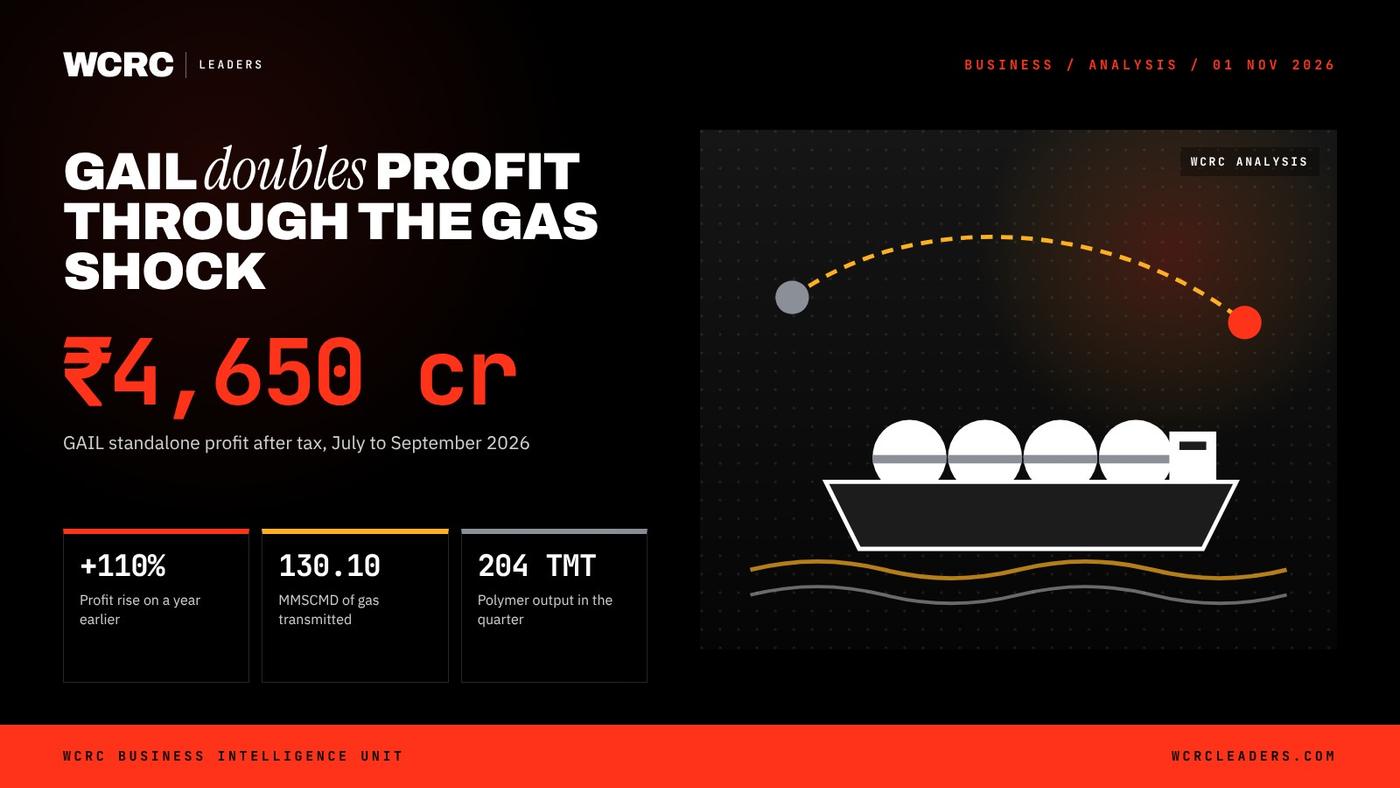
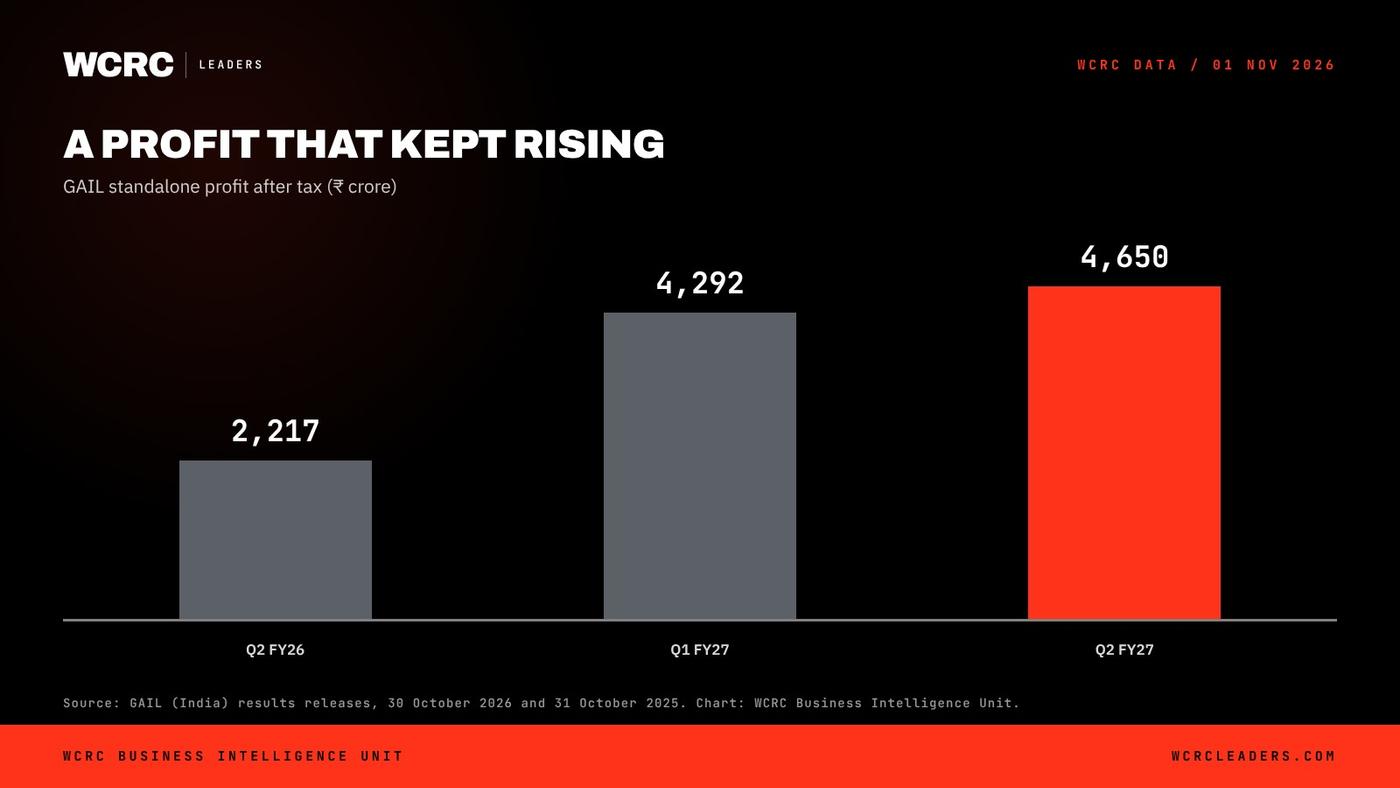
At a glance: WCRC Leaders' assessment: GAIL more than doubled its half-year profit through a Gulf supply crisis because it owns the grid and a portfolio that does not depend on one sea lane, and Gulf sellers should read that as a warning about how Indian buyers will contract next. On 30 October 2026 GAIL (India) reported standalone profit after tax of ₹4,650 crore for July to September, against ₹2,217 crore a year earlier. Half-year profit rose to ₹8,943 crore from ₹4,104 crore.
What did GAIL report for the September quarter?
GAIL (India), one of WCRC 1000, India's Most Valuable Enterprises 2026, reported standalone revenue from operations of ₹45,924 crore for the second quarter of 2026-27, up from ₹38,981 crore in April to June and ₹35,031 crore in the same quarter of 2025-26, a rise of about 31%. Profit after tax was ₹4,650 crore, up from ₹4,292 crore in the first quarter and about 110% above the ₹2,217 crore of a year earlier. Profit before tax was ₹5,838 crore, against ₹2,823 crore a year ago.
For the half year to 30 September, standalone revenue reached ₹84,905 crore, against ₹69,824 crore, and profit after tax ₹8,943 crore, against ₹4,104 crore. On a consolidated basis, profit attributable to shareholders was ₹9,385 crore, against ₹4,342 crore, on revenue of ₹88,651 crore.
The physical numbers moved too. Natural gas transmission averaged 130.10 million standard cubic metres a day (MMSCMD), up from 122.36 in the June quarter and 123.59 a year ago. Polymer production recovered to 204 thousand tonnes (TMT) from just 51 TMT in April to June. Liquid hydrocarbon output rose to 256 TMT from 232, and LPG transmission to 1,130 TMT from 1,077. Gas marketing volume was 97.23 MMSCMD, up on the June quarter's 93.82 but below the 105.49 of a year earlier.
Chairman and managing director Deepak Gupta, who took charge on 1 March 2026, the day after the Gulf conflict began, said: "Our foremost priority has remained meeting customer requirements and ensuring uninterrupted supplies." He added that "throughout this challenging period, our teams have demonstrated remarkable resilience and agility".
How did a supply shock become a profit surge?
On 5 March, Petronet LNG told the stock exchanges it had received a force majeure notice from QatarEnergy and had passed corresponding notices to its offtakers, Indian Oil Corporation, Bharat Petroleum and GAIL. Four days later the petroleum ministry issued the Natural Gas (Supply Regulation) Order, 2026, under the Essential Commodities Act. It cited disrupted LNG shipments through the Strait of Hormuz, guaranteed full supply to household piped gas, CNG and LPG production, set fertiliser plants at 70% and industry at 80% of recent use, and named petrochemical plants, GAIL's Pata complex among them, as the first to be curtailed.
That explains the June quarter's collapse in polymer output to 51 TMT, and its recovery to 204 TMT in July to September. It does not explain the profit. GAIL's release gives no cause, saying only that "the quarter reflected resilience in transmission and Natural Gas marketing performance."
WCRC analysis: the numbers point to margin, not volume. Gas marketing volume fell about 8% year on year, yet profit doubled, and in the June quarter GAIL earned ₹4,292 crore with its petrochemical plant largely idle. The earnings engine therefore sits in transmission and gas trading. GAIL operates the grid that every diverted molecule had to cross, and under the March order it manages diversions with the Petroleum Planning and Analysis Cell. It also holds LNG from outside the Gulf: its 20-year contract with Cheniere's Sabine Pass, about 3.5 million tonnes a year indexed to the US Henry Hub benchmark, loads on the Gulf of Mexico, not the Gulf of Arabia. When Asian gas is scarce, cargoes priced off an American benchmark become far more valuable.
Why does it matter for Qatar and UAE suppliers?
Qatar remains India's anchor supplier. Petronet LNG, one of WCRC 1000, India's Most Valuable Enterprises 2026, signed in February 2024 for 7.5 million tonnes a year of Qatari LNG for 20 years from May 2028. GAIL itself signed a 10-year agreement with ADNOC Gas in January 2024 for 0.5 million tonnes a year. Both routes run through Hormuz, where combined transits were about 70% below pre-conflict levels in mid-October, as WCRC set out in its tracker of 135 attacks since February.
QatarEnergy has already drawn the lesson for itself. As WCRC reported, it has contracted up to 3 million tonnes a year from Woodside's Louisiana LNG, its second US purchase in a week.
WCRC analysis: GAIL's quarter gives Indian buyers evidence for the next negotiating round. A buyer with US-linked supply and control of its own grid earned through the crisis; a buyer tied to one route did not. Read through WCRC's Trust Equity Model, which asks how much trust a brand holds and how much pressure it can absorb, Gulf suppliers have spent trust since March. Qatar and the UAE will likely need to offer more than price to win India's 2030s volumes: delivery guarantees, flexible destination terms, or cargoes from outside the Gulf, as QatarEnergy's own US contracts now make possible.
Who pays, and who gains, inside India?
The losers are gas users at the back of the queue. Fertiliser plants were held to 70%, industry to 80%, and refineries were cut to about 65% of past consumption under the March order. For many manufacturers, that meant lost output or costlier substitutes. WCRC's reading of Indian Oil's ₹21,630 crore quarter showed the same pattern in oil: state energy companies with assets and stock in hand profited while fuel-intensive businesses absorbed the cost.
GAIL is also spending. Capital expenditure in the half year reached ₹7,600 crore against an annual plan of about ₹12,900 crore, up from the plan of about ₹11,500 crore it gave in July. Last year's first-half capex was ₹4,838 crore. Most of this year's spend came early: ₹6,176 crore in April to June and ₹1,425 crore in July to September.
Through WCRC's Corporate Value Intelligence framework, the question for investors is how much of this profit is structural. The grid, the higher capex plan and the transmission volumes are durable. Trading margins earned while Asian gas was scarce are not, and they will compress as Hormuz traffic recovers.
What should CEOs and boards do now?
For Indian industry, the March order is the real lesson. It overrides existing gas sale agreements, so a contract alone did not protect supply. Boards of gas-dependent manufacturers should know where they sit in the priority list and what a 20% cut costs them per month.
For Gulf boards and Asian utilities alike, GAIL's numbers make the case for a second loading coast on a single results page.
The WCRC View
GAIL's half year shows where value sits in a supply shock. Profit more than doubled not because GAIL sold more gas, but because it owns the network, manages the diversions and holds LNG priced off a benchmark the Gulf conflict did not touch. That combination is GAIL's moat, and it held.
The winners are GAIL's shareholders, protected households and transport users, and US LNG exporters, whose contracts proved their worth in Asia. The losers are Indian industrial users cut to 80% or less, and Gulf sellers whose reliability is now being priced by their customers.
In the terms of the Fortress Model of Crisis Leadership, a model in WCRC's Guru Management Codex, Deepak Gupta's chairmanship has been a crisis test from its first day. The company says supplies stayed uninterrupted, and the recovered petrochemical plant is the visible result. The Resilience Factor among WCRC's seven leadership parameters is what boards should now ask every energy-dependent business to show.
What leaders should do now: Indian manufacturers should model gas curtailment as a standing risk, not a one-off. Indian gas buyers should use this moment to win better terms from Qatar and the UAE. Gulf suppliers should offer route and delivery assurance before those contracts are signed. GAIL is also a WCRC MegaBrand in LNG, gas infrastructure and transmission, and its brand equity in a crisis rests on keeping that supply promise.
What WCRC will watch: whether GAIL's trading margins hold as Hormuz traffic recovers, whether the Natural Gas (Supply Regulation) Order is eased, how much of the ₹12,900 crore capex plan is spent by March 2027, and the terms of India's next Qatari and Emirati LNG contracts.
WCRC models applied: Trust Equity Model, Fortress Model of Crisis Leadership, Resilience Factor (seven leadership parameters), Corporate Value Intelligence.
Quick answers
Q: How much profit did GAIL make in July to September 2026? A: Standalone profit after tax was ₹4,650 crore, against ₹2,217 crore in the same quarter of 2025-26 and ₹4,292 crore in April to June 2026, on revenue of ₹45,924 crore.
Q: What were GAIL's half-year results? A: Standalone profit after tax for April to September 2026 was ₹8,943 crore, against ₹4,104 crore. Consolidated profit attributable to shareholders was ₹9,385 crore, against ₹4,342 crore.
Q: Why did GAIL's polymer output fall and recover? A: The March 2026 Natural Gas (Supply Regulation) Order named petrochemical plants, including GAIL's Pata complex, as the first to be curtailed. Polymer output was 51 TMT in April to June and 204 TMT in July to September.
Q: Who leads GAIL? A: Deepak Gupta, who assumed charge as chairman and managing director on 1 March 2026. He was earlier GAIL's Director (Projects) and spent 32 years at Engineers India.
Adani Ports raises FY27 capex by ₹3,000 crore as overseas ports surge
Vedanta doubles Gamsberg, and Ramaphosa now wants a zinc smelter
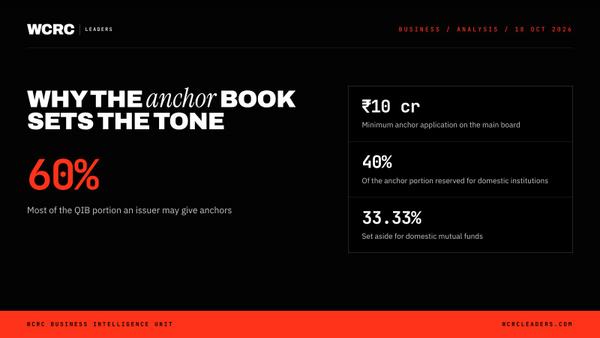
Anchor investors in Indian IPOs: why the 60% book sets the tone
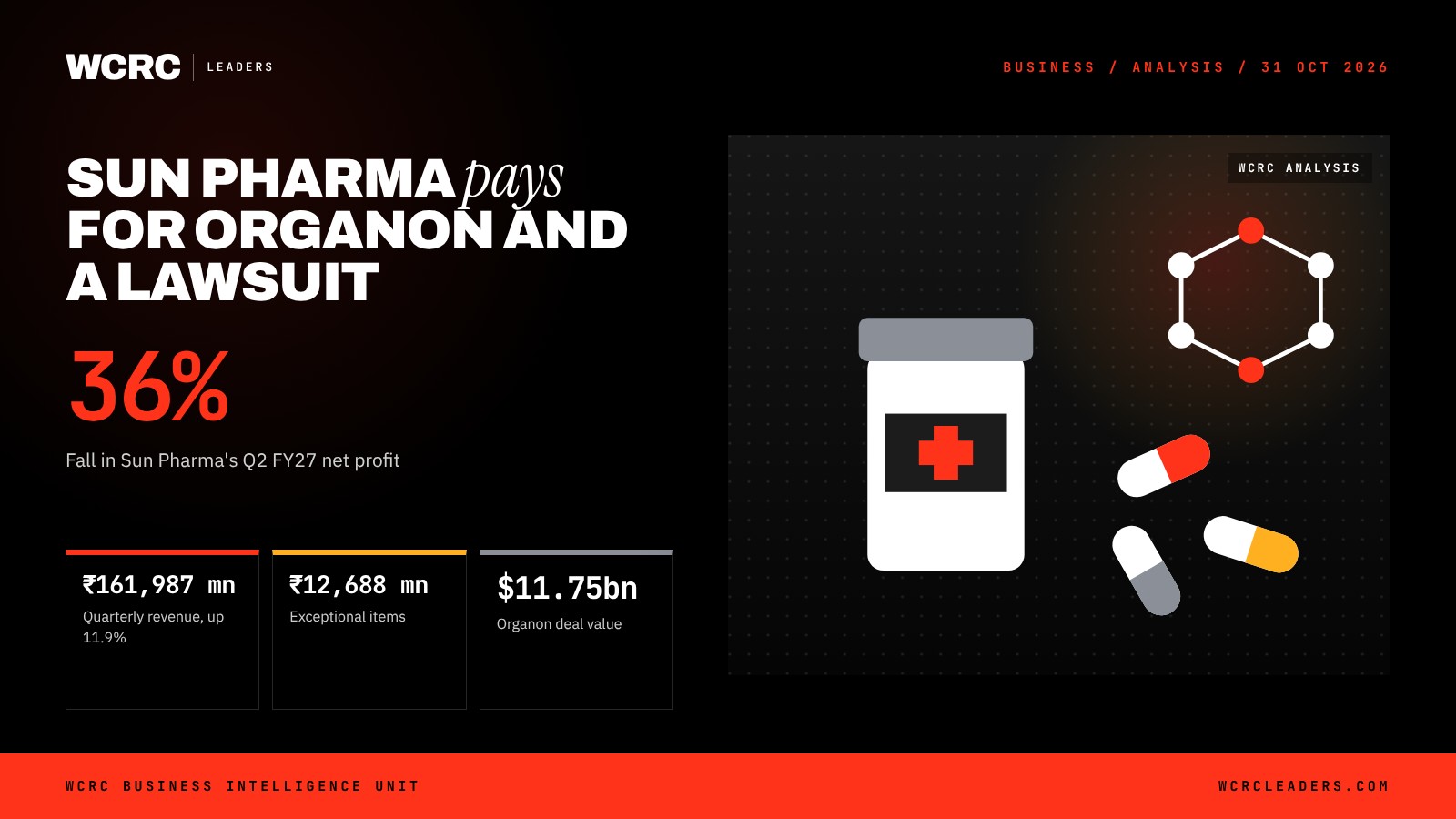
Sun Pharma's profit falls 36% as it pays for Organon and a US lawsuit

Bajaj Finance lines up ₹17,500 crore as AI agents take on service

$133bn: what India's rupee defence is costing its biggest banks
Filed under