Business
QatarEnergy's 3 Mtpa Woodside deal: the Gulf gas seller turns buyer
QatarEnergy has signed to take up to 3 million tonnes a year of liquefied natural gas from Woodside's Louisiana LNG project for 20 years, its second US purchase in a week. For Asian buyers, including India's Petronet LNG and GAIL, the supplier they rely on is building a second, non-Gulf source of its own.
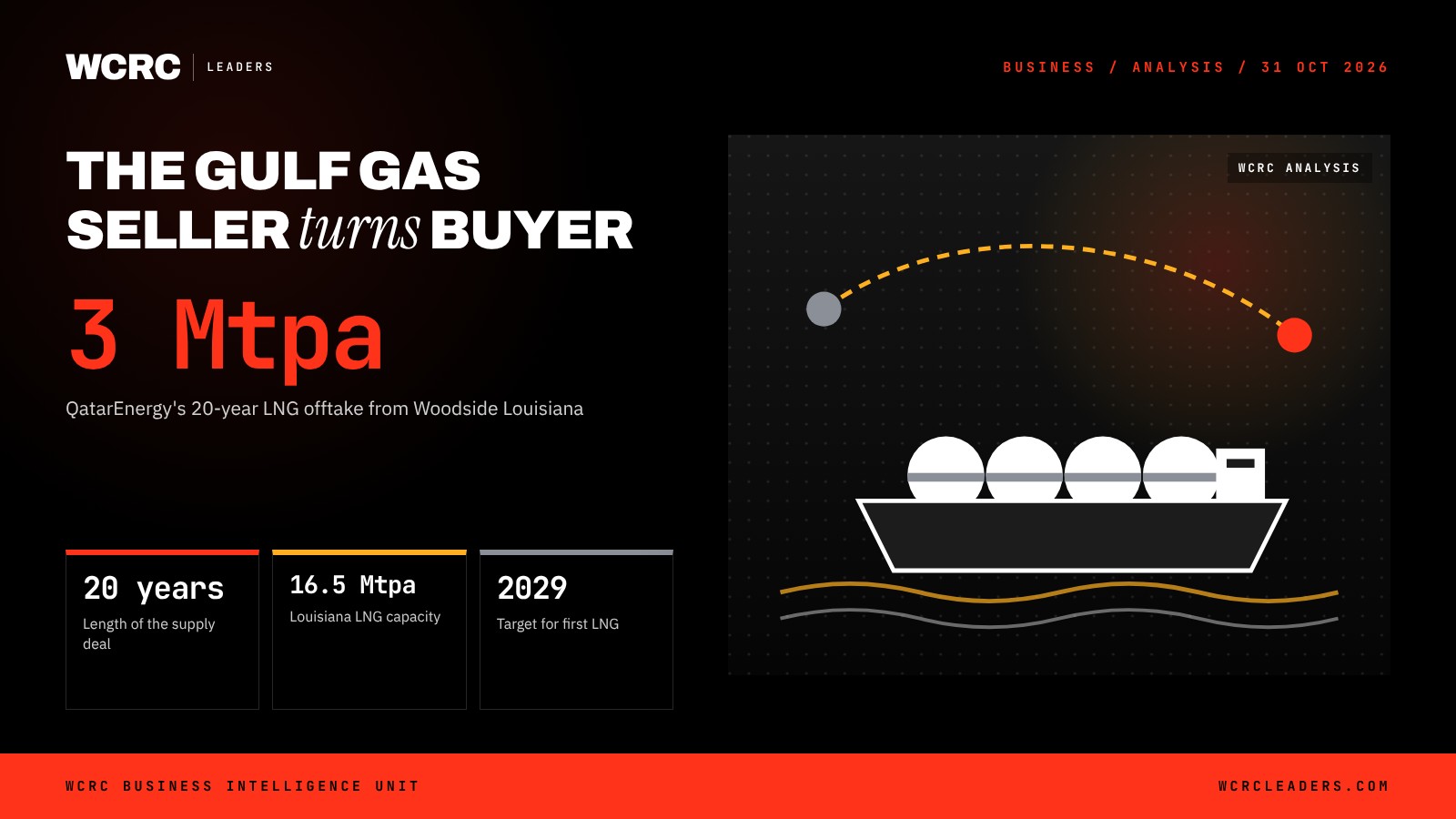
At a glance: WCRC Leaders' assessment: QatarEnergy is buying insurance, not gas, and Asian buyers should read the Woodside contract as a signal to diversify their own supply in the same way. Woodside said on 29 October 2026 that QatarEnergy will take up to 3 Mtpa of LNG, free on board, from Louisiana LNG for 20 years. Supply starts with Train 2 and reaches the full volume with Train 3. The three-train, 16.5 Mtpa project targets first LNG in 2029.
What exactly did QatarEnergy and Woodside agree?
Woodside Energy Group announced the long-term sale and purchase agreement on Thursday 29 October 2026 in a release filed with the US Securities and Exchange Commission. QatarEnergy will buy up to 3 Mtpa of LNG for 20 years from the Louisiana LNG project, under construction near Lake Charles, Louisiana.
The cargoes are sold free on board (FOB), which means QatarEnergy takes title at the Louisiana terminal and decides where each ship goes. Deliveries begin with the start-up of Train 2 and rise to 3 Mtpa when Train 3 starts. Woodside will supply the contract from its share of volumes in the project's infrastructure holding company, through Woodside Energy (LA) Investments LLC. Price terms were not disclosed.
Woodside chief executive Liz Westcott called it "a strong vote of confidence in Louisiana LNG" that "represents a significant step in building the project's long-term customer base." She said the contract builds on the earlier Uniper agreement and that "together, these contracts provide sustained revenue certainty for a material portion of Louisiana LNG production as we progress the project towards first LNG." Louisiana LNG, she added, gives Woodside "geographically diverse supply."
Woodside approved the project in April 2025 at a total capital cost of $17.5bn, with Stonepeak taking a 40% stake in the infrastructure holding company.
Why would a Gulf exporter buy American gas?
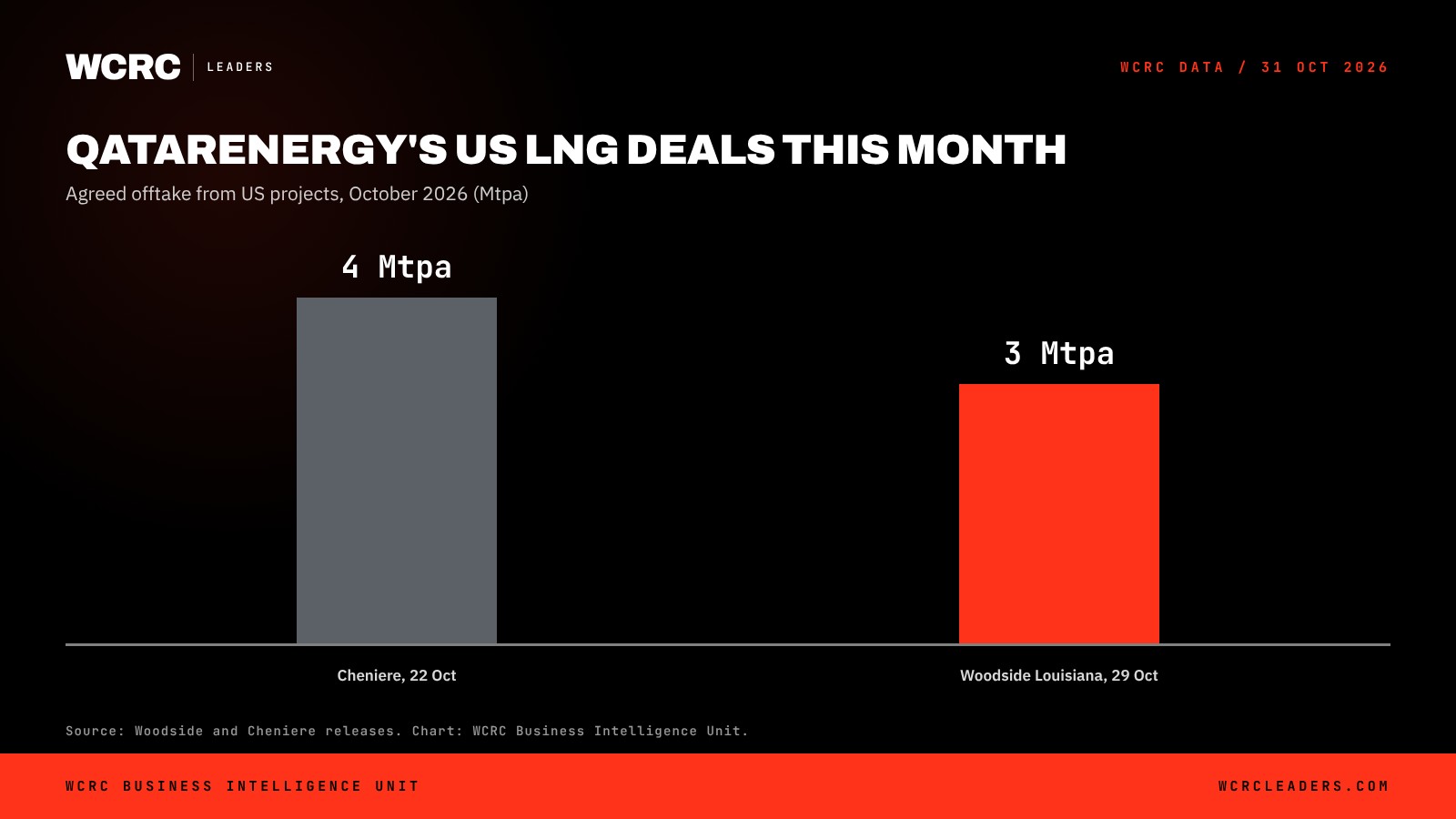
This is the second such move in eight days. On 22 October, Cheniere Energy said its Sabine Pass and Corpus Christi subsidiaries had signed agreements to supply QatarEnergy with 4 Mtpa, 2 Mtpa from each site, FOB from the early 2030s through the end of 2054, priced on the US Henry Hub benchmark plus a fixed fee. One of the Sabine Pass tonnes depends on Cheniere taking a positive investment decision on its expansion. Taken together, QatarEnergy has contracted up to 7 Mtpa of US Gulf Coast LNG in October alone.
At home, QatarEnergy is still growing. In February 2024 it said its North Field expansions would lift Qatar's LNG production capacity to about 142 Mtpa before the end of the decade, almost 85% above levels at the time. So the US contracts are not about shortage of gas in the ground.
WCRC analysis: they are about where the gas leaves from. Every tonne of Qatari LNG ships from one coast through one sea lane. US FOB tonnes load on the Gulf of Mexico, sail to Europe across the Atlantic or to Asia via other routes, and are priced off a different benchmark. For a portfolio seller with 20-year promises to customers in Europe and Asia, a second loading coast lowers concentration in geography, in shipping routes and in price exposure at the same time. Westcott's phrase, "geographically diverse supply", describes the buyer's logic as well as the seller's.
WCRC has already set out what Gulf security risk now costs boards in its analysis of attacks across the region. The Woodside contract is how a state-owned supplier prices the same risk into a two-decade decision.
What does it mean for India's Petronet LNG and GAIL?
India is exposed on both sides of this trade. Petronet LNG, one of WCRC 1000, India's Most Valuable Enterprises 2026, signed a 20-year agreement in February 2024 for QatarEnergy to supply 7.5 Mtpa from May 2028, delivered ex-ship to terminals across India on QatarEnergy's fleet. That makes Qatar the anchor of India's long-term LNG book for the 2030s.
GAIL (India), one of WCRC 1000, India's Most Valuable Enterprises 2026, took the other route early. Its 2011 contract with Cheniere's Sabine Pass Liquefaction covers about 3.5 Mtpa for 20 years from first commercial delivery, FOB and indexed to Henry Hub plus a fixed component.
WCRC analysis: by the early 2030s, GAIL and QatarEnergy will both be lifting cargoes from Sabine Pass. India's main supplier is now buying from the same American coast that India's gas utility chose 15 years ago. That narrows the gap between "Gulf" and "US" supply that Indian planners have used to diversify. Petronet's ex-ship contract puts the delivery obligation on QatarEnergy, and a seller with more sources is, in principle, a more dependable counterparty. The open question is price: Qatari term LNG and Henry Hub-linked LNG move on different drivers.
WCRC's coverage of HPCL's September quarter showed how quickly energy prices reach Indian margins. Gas contracts signed now set India's exposure well into the 2040s.
What does it signal for Asian buyers and Gulf strategy?
For Japanese, Korean, Chinese and South-East Asian utilities, the lesson is the same one QatarEnergy has just acted on: concentration is a risk even when the supplier is reliable. WCRC expects their tenders for the 2030s to ask more about loading-point diversity and route options, not only price and volume.
For the Gulf, the deal marks a shift in how national oil companies think about their role. A pure producer sells what it pumps. A portfolio player buys and sells across regions to keep its promises. Cheniere's chief executive, Jack Fusco, called QatarEnergy "a cornerstone of the global LNG industry".
Read through WCRC's Trust Equity Model, which asks how much trust a brand holds and how much pressure it can absorb, this is a supplier spending money to defend its reputation for reliability. In LNG, trust is the product: 20-year buyers sign because they believe the cargoes will come. A second loading coast lets QatarEnergy absorb a disruption without breaking that belief.
What comes next, and when?
The timeline matters. Louisiana LNG targets first LNG in 2029, and QatarEnergy's volumes begin only with Train 2, so the contract helps in the next decade, not this year. Cheniere's QatarEnergy volumes start in the early 2030s. Petronet's new Qatari supply begins in May 2028. WCRC expects further Louisiana LNG offtake announcements as the trains advance.
In the terms of SeeClear, a model in WCRC's Guru Management Codex, boards should separate fact from projection here. The fact is a signed, disclosed contract with dates and volumes. The projection, in either direction, is that the Gulf is either permanently unsafe or quickly back to normal. QatarEnergy has not bet on either; it has bought optionality.
The WCRC View
QatarEnergy is buying insurance. The Woodside and Cheniere contracts, up to 7 Mtpa of US Gulf Coast LNG signed in eight days, show a Gulf exporter choosing to own non-Gulf supply rather than rely only on its own coast. That is a deliberate, long-dated hedge, and it raises the bar for every buyer that still sources from one region.
The winners are clear. Woodside gains a creditworthy anchor customer and, in Westcott's words, revenue certainty for a material part of Louisiana LNG. US exporters gain a validation that Gulf demand can underwrite American projects. Indian and Asian buyers gain a supplier that should find it easier to keep its delivery promises.
What leaders should do now: Indian gas buyers, city gas companies and power generators should test their 2030s contract books for loading-point and route concentration, not only price. Boards in the Gulf and Asia should treat supply diversity as a measure of resilience, the WCRC Resilience Factor among the seven leadership parameters, and ask management to show it.
Through WCRC's Corporate Value Intelligence lens, contracted long-term volumes are a core part of enterprise value for Indian gas companies such as Petronet and GAIL. Where those volumes come from, and on what benchmark, will increasingly shape how investors value them.
What WCRC will watch: further QatarEnergy offtake from US projects, any change to Petronet's or GAIL's sourcing mix, the Train 2 timetable at Louisiana LNG, and Cheniere's investment decision on the Sabine Pass expansion that underpins part of QatarEnergy's volume.
WCRC models applied: Trust Equity Model, SeeClear, Resilience Factor (seven leadership parameters), Corporate Value Intelligence.
Quick answers
Q: How much LNG will QatarEnergy buy from Woodside? A: Up to 3 million tonnes a year for 20 years from Louisiana LNG, on a free-on-board basis, starting with Train 2 and reaching 3 Mtpa with Train 3.
Q: When does Louisiana LNG start producing? A: Woodside targets first LNG in 2029 from the three-train, 16.5 Mtpa foundation project near Lake Charles, Louisiana.
Q: Is this QatarEnergy's only US LNG purchase? A: No. On 22 October 2026 Cheniere said it will supply QatarEnergy with 4 Mtpa from Sabine Pass and Corpus Christi from the early 2030s through 2054, priced on Henry Hub plus a fixed fee.
Q: How are Indian buyers linked to these deals? A: Petronet LNG has a 20-year contract for 7.5 Mtpa of Qatari LNG from May 2028, and GAIL holds a 20-year contract for about 3.5 Mtpa from Cheniere's Sabine Pass.
Adani Ports raises FY27 capex by ₹3,000 crore as overseas ports surge
Vedanta doubles Gamsberg, and Ramaphosa now wants a zinc smelter
Anchor investors in Indian IPOs: why the 60% book sets the tone
Sun Pharma's profit falls 36% as it pays for Organon and a US lawsuit

Bajaj Finance lines up ₹17,500 crore as AI agents take on service

$133bn: what India's rupee defence is costing its biggest banks
Filed under