Business
L&T's record ₹147,665 crore order haul comes with thinner margins
Larsen & Toubro has never had more work on its books. Its Q2 FY27 results show a group winning large overseas energy contracts at a faster rate than it can turn them into margin.
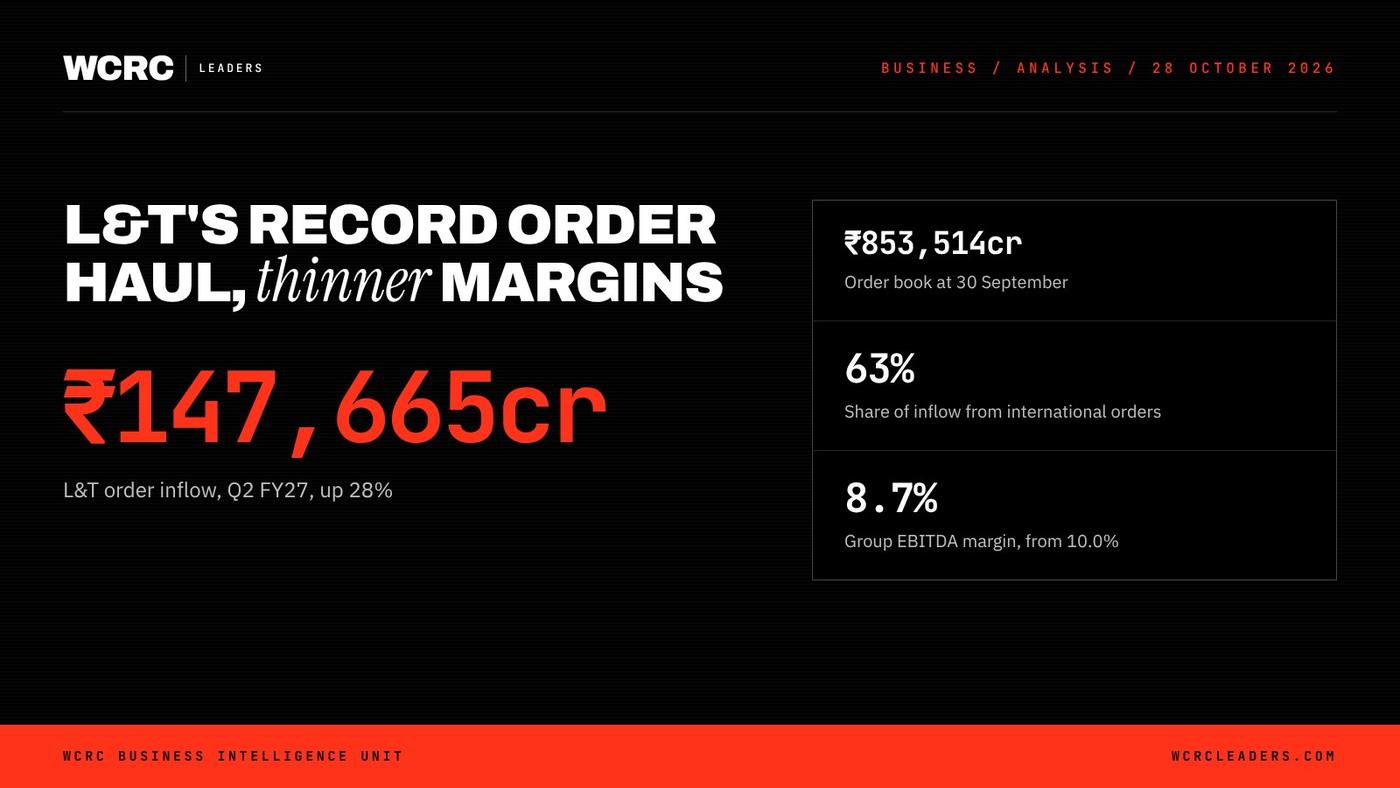
At a glance: WCRC Leaders' assessment: L&T has secured years of revenue, but with group EBITDA margin down to 8.7%, the next test is execution, not order winning. On 27 October 2026, Larsen & Toubro, one of WCRC 1000, India's Most Valuable Enterprises 2026, reported second-quarter revenue of ₹78,750 crore, up 16%, and profit of ₹5,202 crore, up 33%. Order inflow reached a record ₹147,665 crore, 63% of it international, taking the order book to ₹853,514 crore.
What did L&T report for the September quarter?
The headline numbers are strong. Consolidated revenue for the quarter ended 30 September 2026 rose 16% to ₹78,750 crore, from ₹67,984 crore a year earlier. Consolidated profit after tax rose 33% to ₹5,202 crore, from ₹3,926 crore. Order inflow rose 28% to ₹147,665 crore, from ₹115,784 crore, which the company describes as a record for a quarter.
The order book stood at ₹853,514 crore on 30 September, up 15% since March 2026. International work makes up 54% of it.
For the half year, revenue rose 11% to ₹146,692 crore and profit rose 24% to ₹9,325 crore. Order inflow for the six months was ₹255,678 crore, up 22%.
Chairman and Managing Director S. N. Subrahmanyan described it as "yet another record quarterly order inflow" and said "the highest ever order book at ₹8.5 lakh crore provides multi-year revenue visibility." He linked the result to "continued customer confidence and our ability to secure large and complex orders", and said the company would keep what he called "a risk calibrated approach to" bidding and execution.
Why is profit rising faster than operating earnings?
This is the part of the results boards should study. Group EBITDA rose just 1% to ₹6,845 crore, and EBITDA margin fell to 8.7% from 10.0% a year earlier. For the half year it was 8.8%, against 10.0%.
WCRC analysis: had L&T held last year's 10.0% margin on this quarter's revenue, EBITDA would have been about ₹7,875 crore, roughly ₹1,030 crore more than it reported. Profit after tax rose 33% while EBITDA barely moved, so the extra profit came from below the operating line. Financial Services helped: its profit before tax rose to ₹1,319 crore from ₹989 crore, and its income rose 27% to ₹5,307 crore. Investors will want the remaining drivers set out in the full annexures before treating 33% as the new run rate.
The segment numbers show where the margin went:
- Infrastructure & Utilities: customer revenue ₹25,133 crore (up 6%), margin 5.7% against 6.2%. The company cites "cost pressures and change in sales mix."
- Energy, Conventional: revenue ₹17,285 crore (up 29%), margin 7.4% against 8.2%. L&T puts this down to "a higher proportion of orders in early stages of execution."
- Energy, Green: revenue ₹11,493 crore (up 43%), margin 6.0% against 6.2%.
- Manufacturing & Products: revenue ₹4,480 crore (up 34%), margin up to 15.7% from 13.5%.
- Technology, Platforms & Services: revenue ₹14,826 crore (up 11%), margin 19.5% against 20.0%.
So the core projects businesses, which carry most of the order book, earn margins in the single digits. The higher-margin units are too small to offset that.
Where are the orders coming from?
They are coming from overseas, and mostly from energy. International orders were worth ₹92,375 crore, or 63% of the quarter's inflow. International revenue was ₹45,870 crore, or 58% of the total, up from about 51% in the June quarter.
Energy, Conventional booked ₹78,413 crore of orders, more than double a year earlier. The company says the growth came from "multiple high-value orders in the Hydrocarbon – Offshore & Onshore" and CarbonLite Solutions businesses. That one segment brought in more than half the group's orders, and its order book now stands at ₹286,888 crore.
Other segments were weaker. Infrastructure & Utilities orders fell 13% to ₹35,509 crore, Green Energy orders fell 45% to ₹6,558 crore, and Realty orders fell 12%. Domestic orders, by WCRC's calculation, were about ₹55,290 crore.
The results release does not break down international orders by country, and it does not name Saudi Arabia, the UAE or Qatar. The Gulf is plainly part of the picture: on 30 September, L&T announced that its Transportation Infrastructure vertical had secured twin contracts in Dubai. Readers should treat any country-level split of the hydrocarbon wins as unconfirmed until L&T publishes it.
Is the Gulf a growth engine or a risk?
It is both, and L&T says so. Its outlook states that the Middle East poses "varied downside risks to global growth and investment activity." Gulf producers keep spending on offshore and onshore oil and gas capacity, and L&T is one of the few contractors with the scale to take on that work.
WCRC analysis: the risk is in execution, not demand. Shipping disruption and attacks in Gulf waters, which WCRC has tracked in what Gulf and Indian boards must price in, raise the cost of moving equipment, insuring sites and keeping staff in place. Hydrocarbon contracts in their early stages, which L&T itself blames for the weaker margin, are the most exposed to those costs. If the contracts are fixed-price, L&T takes most of that cost.
For Gulf clients, the numbers say L&T has the capacity and the appetite. For Gulf boards picking contractors, the questions are how much of the risk-calibrated bidding the chairman describes has gone into these contracts, and how escalation clauses are written.
What does it say about India's capex cycle?
The home market is mixed. Revenue grew and domestic orders held up, but the main domestic order engine, Infrastructure & Utilities, booked 13% fewer orders than a year ago.
L&T's outlook calls India's macro fundamentals resilient in the first half, but warns that inflation "remains a concern, arising from food price volatility, elevated energy costs, and weather-related disruptions." It notes that the Reserve Bank of India raised the repo rate by 25 basis points to 5.50% and moved its stance to "calibrated tightening". WCRC set out what that move means for corporate investment in India's first rate hike since 2023, and industrial activity stayed firm in September's 7.9% core-sector growth.
WCRC analysis: higher rates put a squeeze on private capex and state budgets at the same time. L&T's heavy international tilt protects it from a slower Indian order cycle, but it also means the group's results now depend more on Gulf energy spending than on Indian infrastructure.
What does the balance sheet show?
Cash generation improved. Net cash from operations for the half year was ₹5,750.53 crore, against ₹3,816.13 crore a year earlier. The group used ₹12,600.67 crore in investing activities and ended the period with ₹14,620.39 crore in cash and cash equivalents. The reported debt-equity ratio was 1.02.
Development Projects, which holds the Green Energy investments, had no revenue and a small operating loss of ₹16 crore. That reflects a business still in its investment phase.
L&T's brand, a WCRC MegaBrand in heavy engineering and industrial equipment, is counting on scale. The company is also named among India's Most Loved 250 Workplaces 2026 by WCRC. That matters for a group that needs large project teams in difficult locations.
The WCRC View
The call. L&T's order book, at ₹853,514 crore, is close to three years of revenue at the first half's pace (WCRC calculation). Visibility is not the issue. Margin is. A record inflow means little if the work is priced at single-digit margins in a region where costs can move fast.
Who gains. Gulf energy clients gain a contractor with capacity and balance-sheet depth. L&T's suppliers in India gain from export-linked volumes. Shareholders gain on profit, but much of the 33% growth came from below the operating line, so it should not be read as better project economics.
What leaders should do now. Gulf boards awarding large energy contracts should look at escalation, force majeure and insurance terms now, not after costs rise. Indian boards in the L&T supply chain should plan for demand linked to Gulf projects and push for price-adjustment clauses. Investors and directors should track whether conventional energy margins recover as the early-stage orders mature.
What WCRC will watch. Group EBITDA margin in the December quarter against this quarter's 8.7%. Any country-level disclosure of the Gulf order book. Infrastructure & Utilities order inflow as a gauge of India's public capex after the rate rise. Operating cash flow against the growing order book.
Quick answers
Q: What profit did L&T report for Q2 FY27? A: Consolidated profit after tax was ₹5,202 crore for the quarter ended 30 September 2026, up 33% from ₹3,926 crore a year earlier.
Q: How big was L&T's order inflow? A: A record ₹147,665 crore, up 28%. International orders made up 63%, or ₹92,375 crore.
Q: Why did L&T's margin fall? A: Group EBITDA margin fell to 8.7% from 10.0%. L&T cites cost pressures and sales mix in Infrastructure & Utilities, and a higher share of early-stage orders in conventional energy.
Q: How large is L&T's order book? A: ₹853,514 crore at 30 September 2026, up 15% since March, with 54% international.
Vedanta doubles Gamsberg, and Ramaphosa now wants a zinc smelter
Anchor investors in Indian IPOs: why the 60% book sets the tone

Bajaj Finance lines up ₹17,500 crore as AI agents take on service

$133bn: what India's rupee defence is costing its biggest banks
Jio Platforms IPO: Gulf funds hold 5.32% and are not selling
Détente in two-month instalments: planning for China after the Washington summit
Filed under