People
DP World hands Asia Pacific to its CFO, Jason Varsamidis
DP World has promoted the finance chief of its Asia Pacific business to run it. The timing matters: the group's home port is handling far fewer boxes, and Asia is where its growth now comes from.
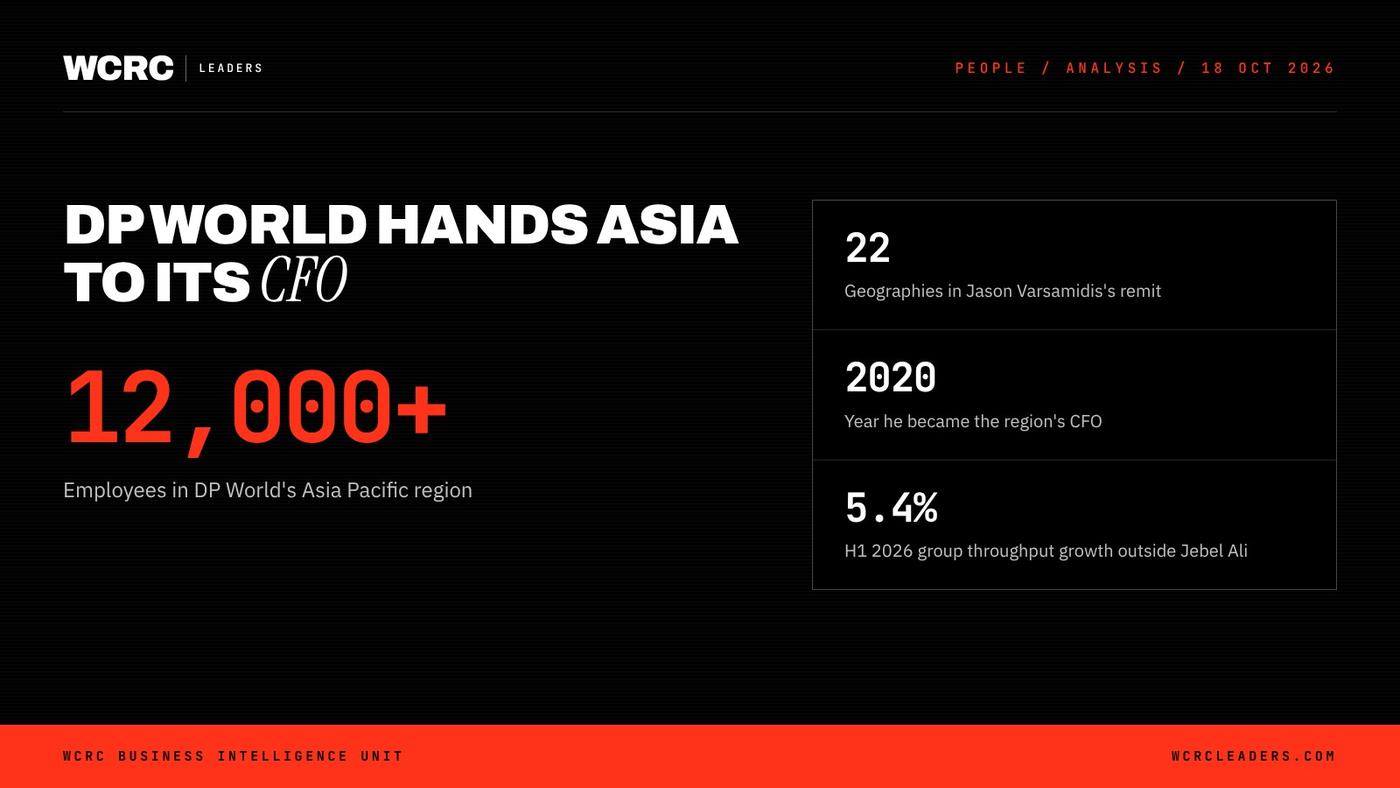
At a glance: WCRC Leaders' assessment: DP World has put a capital allocator in charge of its fastest-growing region, a sign that the next phase in Asia will be judged on returns and logistics margins rather than on new berths alone. On 15 October 2026 DP World named Jason Varsamidis chief executive officer and managing director, Asia Pacific, effective immediately. He has been the region's CFO since 2020 and now leads ports, terminals and logistics across 22 geographies with more than 12,000 employees. A new regional CFO has not yet been named.
Who is Jason Varsamidis, and what has DP World announced?
DP World announced from Singapore on 15 October 2026 that Jason Varsamidis is its new chief executive officer and managing director for Asia Pacific, effective immediately. The role covers the region's ports, terminals and logistics businesses across 22 geographies and more than 12,000 employees.
He is a company lifer. Varsamidis joined P&O Ports, DP World's predecessor, in 1997. He was chief financial officer of DP World Australia for seven years before becoming CFO of DP World Asia Pacific in 2020. His DP World profile lists earlier roles as regional treasurer, manager of operations projects (infrastructure) and national manager of business strategy. He holds a Master of Applied Finance.
DP World says his remit includes regional strategy, operational performance, end-to-end supply chains and the growth of its integrated logistics business. Group chief executive Yuvraj Narayan said: "Jason is a highly respected leader with a deep understanding of our business and the markets in which we operate." The company says it will announce the regional CFO arrangements separately.
The release does not name a predecessor. Glen Hilton held the title in DP World's May 2026 releases; the company has not said what he will do next.
Why put a finance chief in charge of a ports business?
Ports are among the most capital-hungry businesses a board can own: concessions run for decades, quay walls are paid for up front, and geopolitics can move volumes in weeks. DP World invested $1.5 billion across its portfolio in the first half of 2026 and expects to invest about $3 billion over the full year.
The group's numbers show why capital discipline now sits at the top of the agenda. In the six months to 30 June 2026 revenue rose 13.1% to $12.7 billion, but adjusted EBITDA fell 5.6% to $2.86 billion. The group did not publish a margin. On WCRC's calculation from the reported figures, adjusted EBITDA fell from about 27% of revenue to about 22.5%. Revenue is growing faster in lower-margin logistics, while the highest-margin asset, Jebel Ali, is under pressure.
Analysis: a CFO who has spent six years signing off Asia Pacific capital requests knows which terminals earn their cost of capital and which do not. That is a different skill from winning a new concession. It suggests DP World wants its next Asian dollars to go into assets that can be sweated quickly: warehouses, inland links and logistics contracts that sit around existing berths.
The appointment also fits a pattern at the top of the group. Narayan was appointed DP World's CFO in 2005, became group deputy CEO and CFO in November 2021, and was named group CEO in February 2026. A former group finance chief has now chosen a finance-trained regional head.
What does he inherit?
He inherits a region that is still growing while the group's core slows. DP World's gross throughput fell 5.7% to 42.8 million TEU in the first half of 2026. Excluding Jebel Ali, it rose 5.4% to 39.7 million TEU, and DP World named Asia Pacific among the regions that grew.
The Asia Pacific network is in the middle of a logistics build-out. In August 2026 DP World opened an 11,514 square metre warehouse in the Johor-Singapore Special Economic Zone, the first of two planned in Malaysia, with a Kuala Lumpur site due later this year. It said it runs 16 ports and terminals across the region, has warehouses coming in the Philippines and Thailand by year-end, and already runs facilities in Singapore, Hong Kong, Sydney and Icheon in South Korea. In May 2026 it secured a five-year extension, to April 2031, for the B5 berth at Laem Chabang, where its joint venture handled a record 1.936 million TEU in 2025.
He also has three open items: choosing his own successor as CFO, lifting returns in a logistics-led growth mix, and holding on to customers who rerouted cargo this year once Gulf routes recover.
What does this mean for the Gulf?
The Gulf is where the pressure starts. The attacks on shipping covered in WCRC's 17 October cover story are not repeated here; the official figures tell the business story. DP World's half-year results said Jebel Ali is "fully operational with no physical damage", but that "the regional conflict has temporarily reduced vessel traffic". The group reported total throughput of 42.8 million TEU, or 39.7 million TEU outside Jebel Ali. On WCRC's calculation, that implies Jebel Ali handled about 3.1 million TEU in the first half, down from about 7.8 million a year earlier, a fall of close to 60%.
In March 2026 DP World said it was monitoring the Strait of Hormuz closely and running Dubai's ports with enhanced security. It has since expanded inland connectivity to offset lower vessel calls.
Analysis: when the home hub is constrained, regions that can fund themselves and add earnings carry more weight in the group. Asia Pacific is now one of them. A regional chief who speaks the language of the group treasury is well placed to argue for capital when Dubai has less to spare.
What does it mean for India and Asian supply chains?
India is not in Varsamidis's patch. DP World runs it through a separate region that covers the Subcontinent, Central Asia, the Levant and Egypt, led by Rizwan Soomar. That region holds the group's Indian terminals: two at Nhava Sheva and one each at Mundra, Chennai and Cochin, with about 6 million TEU of combined capacity. A 2.19 million TEU terminal at Tuna-Tekra in Gujarat is due in 2027. DP World also owns more than 100 container rakes in India and is investing $207 million (Rs 1,800 crore) in rail freight. On 7 October 2026 it opened a second phase of the Nhava Sheva Business Park, about Rs 500 crore of investment adding roughly 1 million square feet of warehousing.
The link to India is still real, because the two regions compete for the same group capital and serve the same shippers. Indian exporters to Southeast Asia, Korea and Australia move cargo between DP World's Indian gateways and the terminals and warehouses Varsamidis now runs. If Gulf transhipment stays thin, more India-Asia cargo will move on direct services. That favours operators with assets at both ends.
For Asian manufacturers, the signal is about what DP World will sell: berths, warehousing in special economic zones and inland transport as one contract. Analysis: a finance-led chief is likely to price that bundle with care.
The move adds to the Gulf's C-suite churn, and the region's bets on land routes, such as the UAE-Saudi rail and grid pact, point the same way: less reliance on a single sea lane.
The WCRC View
The WCRC Business Intelligence Unit reads this as a continuity appointment with a clear financial mandate. DP World has chosen a 29-year insider who knows the Asian balance sheet line by line, at the moment the group most needs its non-Gulf regions to deliver.
Who gains. Asia Pacific gains standing inside the group. Large shippers in Southeast Asia and Australia gain room to negotiate long, bankable logistics contracts.
What leaders should do now. CEOs whose supply chains run through Jebel Ali should test alternative routings through Asian and Indian gateways and lock in capacity before contract season. Boards should ask their logistics teams which DP World services in Asia are now offered as a bundle, and price that against their current forwarders.
What to watch. Three markers: who DP World names as Asia Pacific CFO, which tells you how much independence the region will have; whether second-half results show Asia Pacific logistics margins improving; and whether new Asian capital goes to warehouses and inland links rather than new berths.
The leadership lesson. In a capital-heavy business facing a shock, boards are promoting the people who know where the cash goes. For family groups and listed infrastructure firms in India and the Gulf, the finance seat is becoming the most direct route to the CEO's chair.
Quick answers
Q: Who is DP World's new Asia Pacific CEO? A: Jason Varsamidis, appointed chief executive officer and managing director, Asia Pacific, on 15 October 2026, effective immediately. He had been the region's CFO since 2020.
Q: How big is the region he runs? A: DP World says it covers 22 geographies and more than 12,000 employees across ports, terminals and logistics.
Q: Does his role include India? A: No. DP World runs India through a separate region covering the Subcontinent, Central Asia, the Levant and Egypt, led by Rizwan Soomar.
Q: Who replaces him as CFO? A: DP World has not named a successor. It says it will announce the regional CFO arrangements separately.
Filed under