Recognitions
Tata Motors posts 42% volume jump as its €3.9bn Iveco bid nears close
India's largest truck maker sold 135,114 commercial vehicles in the September quarter and swung back to profit. Within a week it expects to own Iveco, and with it a European brand that it must now learn to run.
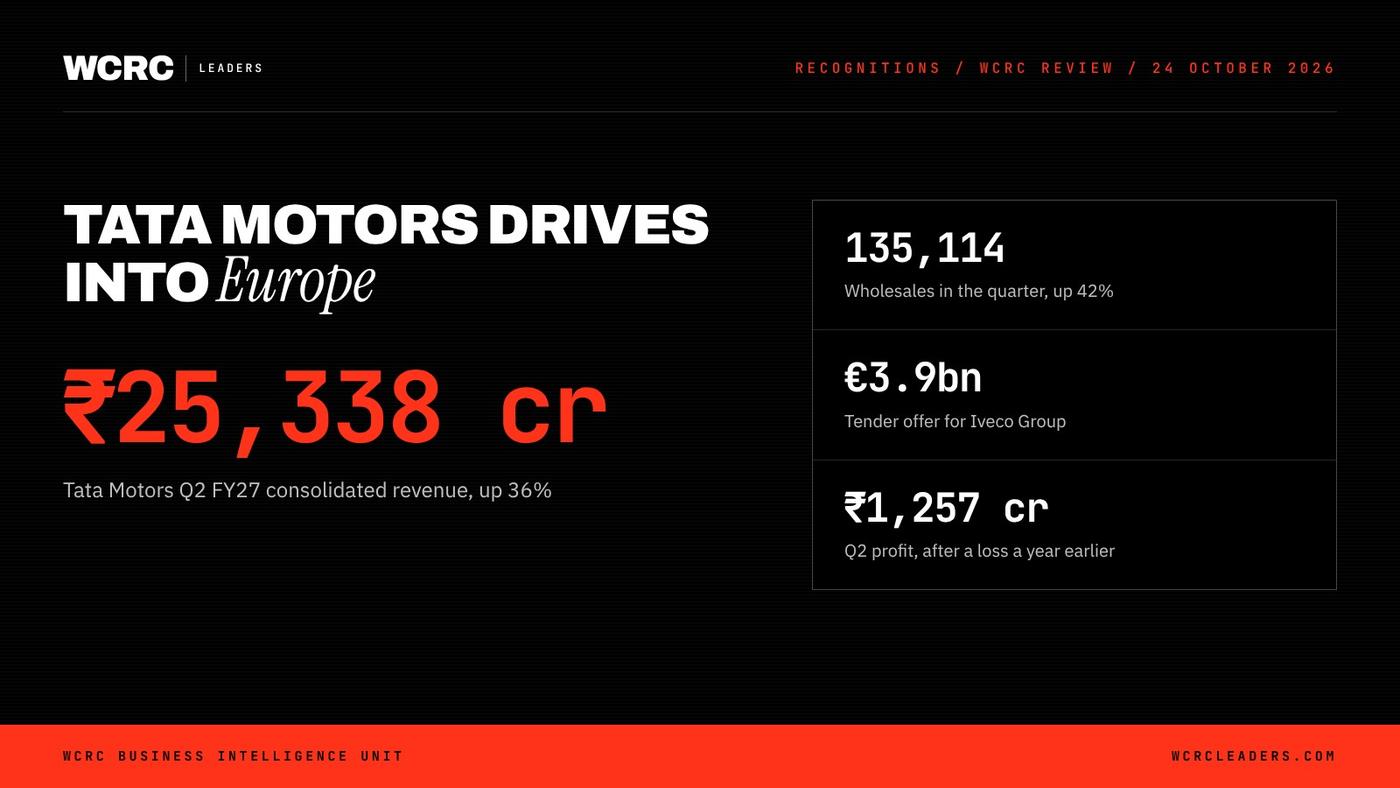
At a glance: WCRC Leaders' assessment: Tata Motors enters the Iveco era with its home brand at full strength, but the deal will be judged on whether an Indian owner can keep a European marque European while sharing its technology. On 23 October, Tata Motors Ltd, the commercial vehicles company created by the October 2025 demerger, reported Q2 FY27 consolidated revenue of ₹25,338 crore, up 36%, and a profit of ₹1,257 crore attributable to shareholders against a loss a year earlier. Its tender offer for Iveco Group closes on 26 October, with settlement set for 30 October.
What did Tata Motors report for the September quarter?
The numbers come from the company's results filing and investor presentation to the Indian exchanges on 23 October. Consolidated revenue from operations was ₹25,338 crore, against ₹18,585 crore a year earlier. Profit for the period was ₹1,254 crore, of which ₹1,257 crore was attributable to shareholders, compared with a loss of ₹867 crore in Q2 FY26. The company said the swing was led by a lower mark-to-market loss on its holding in Tata Capital. The quarter still carried a fair value loss of ₹708 crore on that investment.
The standalone business, which holds the Indian truck and bus operations, was stronger. Revenue rose 42% to ₹23,930 crore, EBITDA rose 31% to ₹2,806 crore and profit after tax was ₹2,138 crore, against a loss of ₹1,021 crore a year earlier. Free cash flow was ₹4,600 crore. Net cash reached ₹11,300 crore standalone and ₹15,900 crore consolidated.
Margins tell the more honest story. Standalone EBITDA margin slipped 90 basis points to 11.7% as steel and rubber costs rose. "Commodity cost pressures persisted through the first half and remain a headwind," said Girish Wagh, managing director and chief executive. Chief financial officer GV Ramanan said the company "maintained margins sequentially through rigorous cost management, operating efficiencies and calibrated pricing actions."
How broad was the volume growth?
Very broad. Wholesales for the quarter were 135,114 units, up 42.7% from 94,681, according to the company's 1 October sales statement. Domestic sales rose 30.9% to 113,982. Heavy trucks grew 40.3% to 33,756 units, intermediate and light trucks 24.4%, passenger carriers 35.2% and small cargo vehicles and pickups 26.2%.
The standout line was international business: 21,132 units, up 177.3% from 7,620. The investor presentation attributes that jump to an order from Indonesia. One large government-linked contract is not the same as a broad export franchise, and the company's own priority for the coming quarter is to "diversify and scale" international business while managing geopolitical volatility.
At home, Tata Motors holds a 36.2% share of the domestic commercial vehicle market for the first half on registration data, up 110 basis points on FY26, and 55.7% in heavy trucks. Electric vehicle volumes rose 143% in the quarter. Wagh said growth rates "are expected to moderate in the second half against a higher base."
What exactly is Tata Motors buying?
Iveco Group, the Turin-based maker of trucks, buses and engines, without its defence business, which had to be separated before the offer could complete. The offeror, TML CV Holdings B.V., opened its all-cash tender on 7 September at €14.10 a share, and raised it on 9 October to €14.40, calling that its "best and final" price. If every one of the 271,215,400 shares is tendered, the payout is about €3.91 billion. Tata Motors puts the maximum value at roughly ₹42,561 crore.
Iveco's shareholders approved all offer-related resolutions at an extraordinary general meeting on 16 October. That vote matters: it cut the minimum acceptance level from 95% to 80% of common shares. Exor, Iveco's largest shareholder, has irrevocably committed to tender its stake of about 27.06%. As of 22 October, 35% of shares had been tendered, according to Tata Motors' presentation. The offer closes on 26 October and settlement is scheduled for 30 October, subject to the offer conditions being met. Ramanan said the deal is on track "within the indicated timeline of end October," with consolidation from next quarter.
What does Iveco add to the Tata brand?
Analysis. Three things that Tata Motors could not build quickly on its own.
First, brands and segments. The Iveco perimeter brings the Daily van, the Eurocargo, S-Way, T-Way and X-Way trucks, a bus range from Urbanway to Crossway and Evadys, the FPT powertrain business and Iveco Capital. Tata's acquisition deck, published in July 2025, credits Iveco with about 65% of Europe's upper-end light commercial vehicle segment and roughly half of the EU intercity bus market. These are positions earned over decades, in markets where Tata trucks have barely been seen.
Second, geography. About 75% of Iveco's industrial revenue comes from Europe and 12% from South America, the deck shows. Tata's strength is India, South Asia, Africa and the Middle East. On the deck's figures, the two together sold about 545,000 vehicles, with combined revenue near ₹2.07 lakh crore, more than half of it from Iveco.
Third, technology. FPT engines run on diesel, natural gas, hydrogen, electric and hybrid systems, and Iveco makes its own high-voltage battery packs. Europe's emissions rules have forced Iveco to master technology that Indian rules will demand next. Tata has said it plans to invest up to €1.5 billion a year in the combined business.
The brand risk runs the other way. Iveco customers buy an Italian engineering name, not an Indian parent. Tata's best precedent is Jaguar Land Rover, where it left the marques visibly British and funded them. The same discipline will be needed in Turin.
What should Indian and Asian buyers in Europe take from this?
Analysis. The deal offers four practical lessons for boards in India, the Gulf and Asia weighing European targets.
Sequence the approvals. The offer could not launch until competition, foreign investment, foreign subsidies and other clearances were in hand, and the defence unit was carved out. Tata raised its price by €0.30 a share partly to reflect "a slight delay" caused by authorisations in a few jurisdictions. Timelines in Europe slip, and that has a cost.
Secure the anchor shareholder. Exor's irrevocable commitment, and the Iveco board's unanimous recommendation, gave the offer credibility from the first day.
Pay for structure, not just shares. The back-end resolutions approved on 16 October allow a demerger and delisting if Tata reaches 80%. Without them, a 95% hurdle could have stalled the deal.
Protect the balance sheet at home. Tata committed bridge financing of €3.8 billion and targets repaying acquisition debt within four years. Its ₹11,300 crore standalone net cash, and ₹4,600 crore of quarterly free cash flow, are what make that target believable.
For Gulf fleet operators and sovereign-backed logistics groups, the combined group will offer one supplier for Indian-built trucks and European-built premium vans and coaches. That is a new kind of bargaining partner.
The WCRC View
The call. The WCRC Business Intelligence Unit views Tata Motors' commercial vehicle brand as stronger at home than at any point since the demerger: volume up 42.7%, a 55.7% share in heavy trucks, and net cash that funds a European purchase without strain. Iveco is a bet on capability, not volume.
Who gains. Iveco gains a well-capitalised owner with a large low-cost engineering base. Tata gains a European premium position, FPT's multi-fuel powertrains and a route into South America. Indian component suppliers stand to gain if procurement is pooled.
Who is exposed. Margins are already under commodity pressure, and international growth this quarter rested heavily on one Indonesian order. Integration costs arrive just as Wagh expects growth to moderate.
What leaders should do now. Boards planning outbound deals should study the order of operations here: anchor shareholder first, regulatory map second, back-end structure third. Fleet buyers in the Gulf and Asia should start conversations early about combined product and service offers.
What WCRC will watch. The final acceptance level after 26 October, settlement on 30 October, the first consolidated quarter including Iveco, and whether Tata keeps the IVECO name, Turin leadership and European plants front and centre.
WCRC's own record. Tata Motors is named among India's Most Loved 250 Workplaces 2026, selected by the Business Intelligence Unit of WCRC. For more on the wider Tata ecosystem, read Noel Tata wants Tata Trusts to build institutions, not just fund them. On how Europe is managing pressure on its vehicle industry, see Is negotiated export restraint the new trade tool? The EU-China hybrid car deal, and for India's broader export picture, India's $476bn half-year.
Quick answers
Q: What was Tata Motors' Q2 FY27 profit? A: Consolidated profit attributable to shareholders was ₹1,257 crore, against a loss of ₹867 crore in Q2 FY26. Standalone profit was ₹2,138 crore.
Q: How many vehicles did Tata Motors sell in Q2 FY27? A: 135,114 commercial vehicles, up 42.7%. Domestic sales were 113,982, up 30.9%, and international business was 21,132, up 177.3%.
Q: When does the Iveco tender offer close? A: The acceptance period ends on 26 October 2026, with settlement scheduled for 30 October 2026, subject to the offer conditions, including a minimum acceptance of 80%.
Q: What is Tata Motors paying for Iveco? A: €14.40 a share in cash, cum dividend, or about €3.91 billion if all shares are tendered. Tata Motors puts the maximum value at about ₹42,561 crore.
No strings attached: what the MacArthur model teaches about recognising talent
Wipro's 58.6% large-deal drop puts Rishad Premji to the test
The 'alternative Nobel' goes to an AI accountability pioneer

What makes a business recognition credible

Navi Pillay and leadership through institutions

What this year's Nobel prizes teach about long bets and open sharing
Filed under