WCRC Intelligence
India's 10-year yield hits 7.46% as reserves fall $64.7bn from peak
India's foreign exchange reserves have fallen for six straight weeks, and the bill for defending the rupee is now showing up in the bond market. The government, states and companies all face higher borrowing costs going into the second half of the financial year.
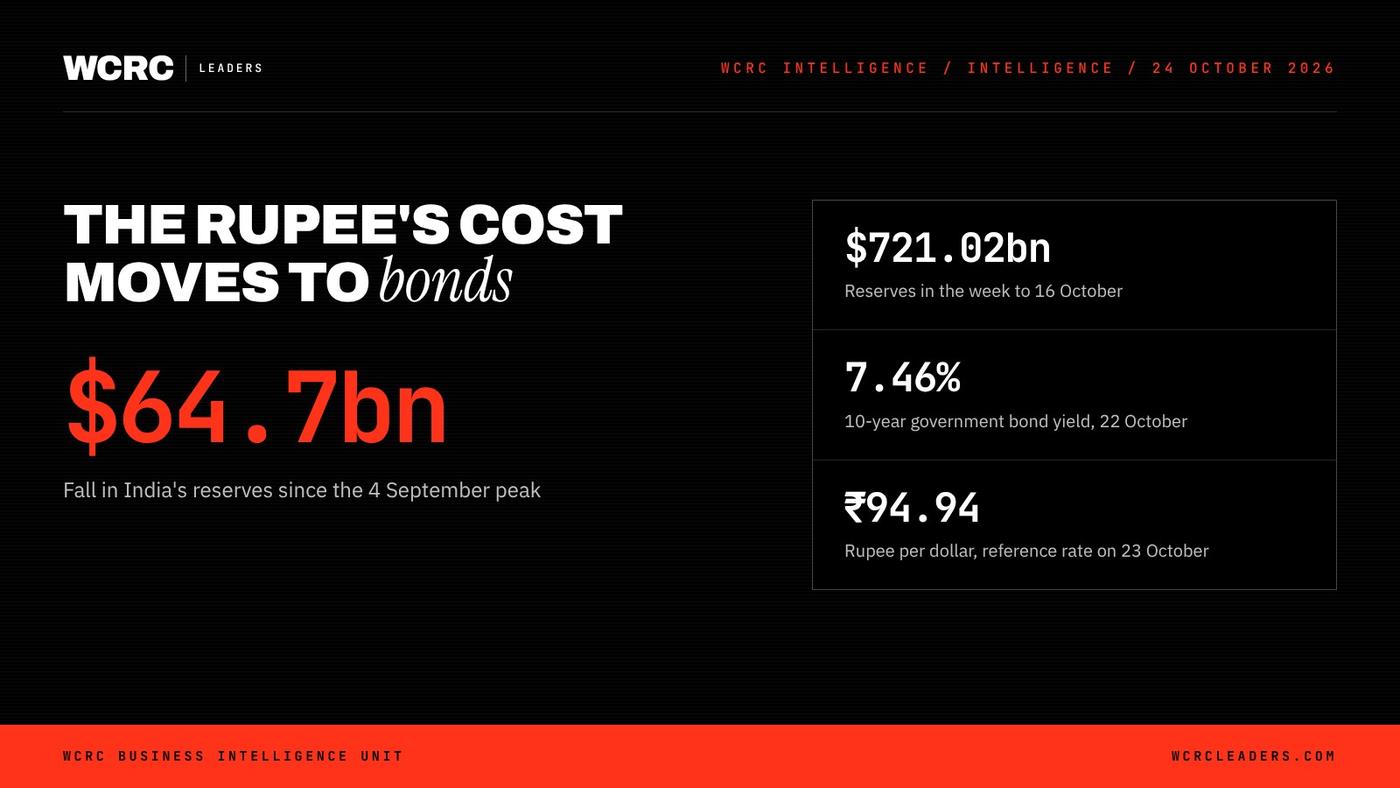
At a glance: WCRC Leaders' assessment: India's currency defence has moved its cost from the rupee to the yield curve, and borrowers should plan for money to stay dear into 2027. Reserves fell $5.01bn to $721.02bn in the week to 16 October, according to the Reserve Bank of India (RBI), and are now $64.69bn below the $785.71bn record of 4 September. The 10-year government bond yield was 7.46% on 22 October, up from a 6.73% auction cut-off on 3 July.
What did the RBI's latest data show?
The RBI's Weekly Statistical Supplement, released on 23 October, put total reserves at $721,016m in the week to 16 October, down $5,011m on the week. Foreign currency assets, the main working part of the reserves, fell $5,758m to $591,847m. Gold rose $706m to $105,800m.
The record came in the week to 4 September, when reserves reached $785,706m after a single-week jump of $44,903m. That jump followed the RBI's special dollar-rupee swap window for foreign currency non-resident bank deposits. WCRC has covered its cost to the banks in $133bn: what India's rupee defence is costing its biggest banks.
The RBI's weekly releases have recorded a fall every week since then:
| Week to | Total reserves ($m) | Weekly change ($m) |
|---|---|---|
| 4 Sep | 785,706 | +44,903 |
| 11 Sep | 780,782 | -4,924 |
| 18 Sep | 765,901 | -14,881 |
| 25 Sep | 747,557 | -18,343 |
| 2 Oct | 734,605 | -12,952 |
| 9 Oct | 726,027 | -8,578 |
| 16 Oct | 721,016 | -5,011 |
Figures for 11 September and 2 October are WCRC calculations from the adjacent published weeks.
WCRC analysis: the six weekly falls add up to $64.69bn. Reserves are now $19.79bn below the $740.80bn they held on 28 August, the week before the swap money arrived. The weekly falls have got smaller for three weeks in a row, from $18.34bn to $5.01bn. The heaviest outflow may be over; the drain has not stopped.
The rupee has held steady while this happened. The Financial Benchmarks India (FBIL) reference rate was ₹94.9432 to the dollar on 23 October. WCRC calculation: the rupee and dollar values in the RBI's reserves table imply about ₹94.95 now, against about ₹94.83 at the end of March and about ₹87.97 a year ago.
Why are bond yields rising so fast?
The clearest measure is the RBI's own auction record for the 6.94% government bond maturing in 2036, the current 10-year benchmark. Its cut-off yields were:
- 5 June: 6.9686%
- 3 July: 6.7275%
- 31 July: 6.8117%
- 28 August: 6.9136%
- 25 September: 7.1450%
- 16 October: 7.3955%
The RBI website listed the same bond at 7.46% on 22 October, and the Clearing Corporation of India's indicative yield was 7.4553%. WCRC calculation: that is 73 basis points above the 3 July cut-off. The auction price fell from ₹101.50 to ₹96.91, a loss of 4.5% in capital value.
Three forces are working together. First, the Monetary Policy Committee raised the repo rate by 25 basis points to 5.50% on 7 October. It moved its stance to "calibrated tightening" and said rate cuts were off the table for now. WCRC covered the decision in India's first rate hike since 2023.
Second, the RBI has been selling bonds. On 11 September it announced ₹1,00,000 crore of open market sales in three tranches, citing "a review of current and evolving liquidity conditions". On 9 October it announced a further ₹25,000 crore, and the 23 October supplement records that sale settling on 14 October. In January the RBI was still buying bonds. The turn is sharp. WCRC analysis: the swap window brought tens of billions of dollars, and so a large amount of rupee money, into the banking system. The RBI is now taking that money back out. The RBI absorbed between ₹1,34,268 crore and ₹2,43,633 crore of surplus funds every day from 12 to 18 October.
Third, supply keeps coming. The government's calendar for October 2026 to March 2027 schedules ₹7,86,000 crore of dated bonds over 23 weekly auctions. Of that, ₹2,07,000 crore, or 26.3%, is in 10-year paper.
How much more does government borrowing now cost?
On 23 October the RBI sold ₹19,000 crore of a 2031 bond at 7.3589% and ₹14,000 crore of a 2066 bond at 7.9339%. The first auction was covered about 1.8 times and the second about 2.1 times, with nothing left for the primary dealers to take up.
WCRC analysis: if the second-half programme prices 67 basis points above early-July levels, which is the rise in the benchmark's auction cut-off to 16 October, the government takes on about ₹5,266 crore a year in extra interest on that issuance alone. This illustrates scale; it is not a budget forecast.
States pay more. The indicative 10-year state bond yield, a Karnataka 2036 issue, was 8.03% on 22 October, 57 basis points above the central government benchmark. WCRC analysis: that spread raises the cost of state capital spending on roads, power and water.
What does it mean for corporate refinancing?
Company bonds and many bank loans are priced off the government yield curve and the repo rate. Both have moved against borrowers. An RBI Bulletin article published on 23 October found that 125 basis points of repo cuts in the easing cycle lowered the weighted average lending rate on new bank loans by 93 basis points. WCRC analysis: if that pass-through works in reverse at a similar rate, the October rate rise and the move in yields will reach loan pricing within months, not quarters.
The curve is steep. The 91-day Treasury bill yielded 5.73% on 22 October, against 7.46% for the 10-year bond and 7.86% for 30-year debt. Treasurers who borrow short to save on interest swap a rate risk for a refinancing risk, while the RBI says it is in no hurry to ease.
Banks are short of funds too. On 15 October, bank credit was growing 18.2% a year against 16.7% for deposits. Lenders short of deposits will pay more for wholesale funding and pass it on.
What should Gulf and Asian holders of Indian debt do?
For a foreign investor, returns now depend on the bond price more than the currency. The rupee has hardly moved in a month. The benchmark bond's price has fallen 4.5% since July, which wipes out more than seven months of its 6.94% coupon. The offsetting point is that new money now earns more. The 10-year yield is above every benchmark auction cut-off since June, and Friday's auctions cleared at 7.36% for five years and 7.93% for 40 years.
WCRC analysis: the reserve drain matters to these investors because it shows how much protection the RBI has left. At $721bn, India still holds one of the world's larger buffers. But $64.7bn has gone in six weeks, and the swap money will have to be repaid when those contracts mature.
The WCRC View
The call. The WCRC Business Intelligence Unit judges that India has chosen a stable rupee over cheap money. The swap window and reserve sales held the currency near ₹95. The cost has moved to the bond market, through open market sales, a rate rise and heavy supply. We expect the 10-year yield to stay above 7.25% until the RBI's reserves stop falling and the December policy decision is known.
Who gains and who loses. Savers, bond funds buying new paper and banks with spare liquidity gain. The central government, states with large borrowing programmes, highly indebted companies and any business that has to refinance in the next 12 months lose.
What CEOs and CFOs should do now. Fix rates on new borrowing where pricing allows, rather than wait for a fall that the RBI has ruled out for now. Stress-test 2027 refinancing at 75 to 100 basis points above today's cost. Treat cheap short-term money as a bridge, not as funding.
For Gulf and Asian investors. The entry yield has improved, but the reserve data is the signal to watch. Building positions gradually beats a single large allocation while reserves are still falling.
What WCRC will watch next. The next weekly reserves figure on 30 October, for the week to 23 October. The RBI's December policy meeting, scheduled for 2 to 4 December. Every Friday bond auction under the second-half calendar, and whether the RBI announces any further open market sales.
Quick answers
Q: How much have India's forex reserves fallen? A: RBI data show reserves at $721.02bn in the week to 16 October, down $5.01bn on the week and $64.69bn below the record $785.71bn of 4 September.
Q: What is India's 10-year government bond yield? A: The 6.94% 2036 benchmark was at 7.46% on 22 October on the RBI website. Its auction cut-off was 6.7275% on 3 July and 7.3955% on 16 October.
Q: Why is the RBI selling government bonds? A: The RBI announced ₹1,25,000 crore of open market sales between 11 September and 9 October, citing a review of current and evolving liquidity conditions.
Q: How much will the government borrow from October to March? A: ₹7,86,000 crore of dated bonds over 23 weekly auctions, 26.3% of it in 10-year bonds.

The AI trade economy: chips and servers now carry almost half of world trade growth

Bank of Korea holds at 3.00% and keeps more hikes on the table

The AI adoption gap: what the World Bank's new numbers say about emerging markets

Jio's IPO, China's GDP: the leaders' week ahead, 19 to 25 October

India's core sector grows 7.9% in September despite the oil shock

The $6 trillion question: is AI spending outrunning AI revenue?
Filed under