Business
stc's SAR 60.1bn nine months: margins hold, but the third quarter slips
The Gulf's largest telecom group kept its nine-month EBITDA margin flat at 31.9% through a year of regional conflict. The third quarter, worked out from stc's own figures, tells a tighter story, and the money is moving to towers, data centres and digital subsidiaries.
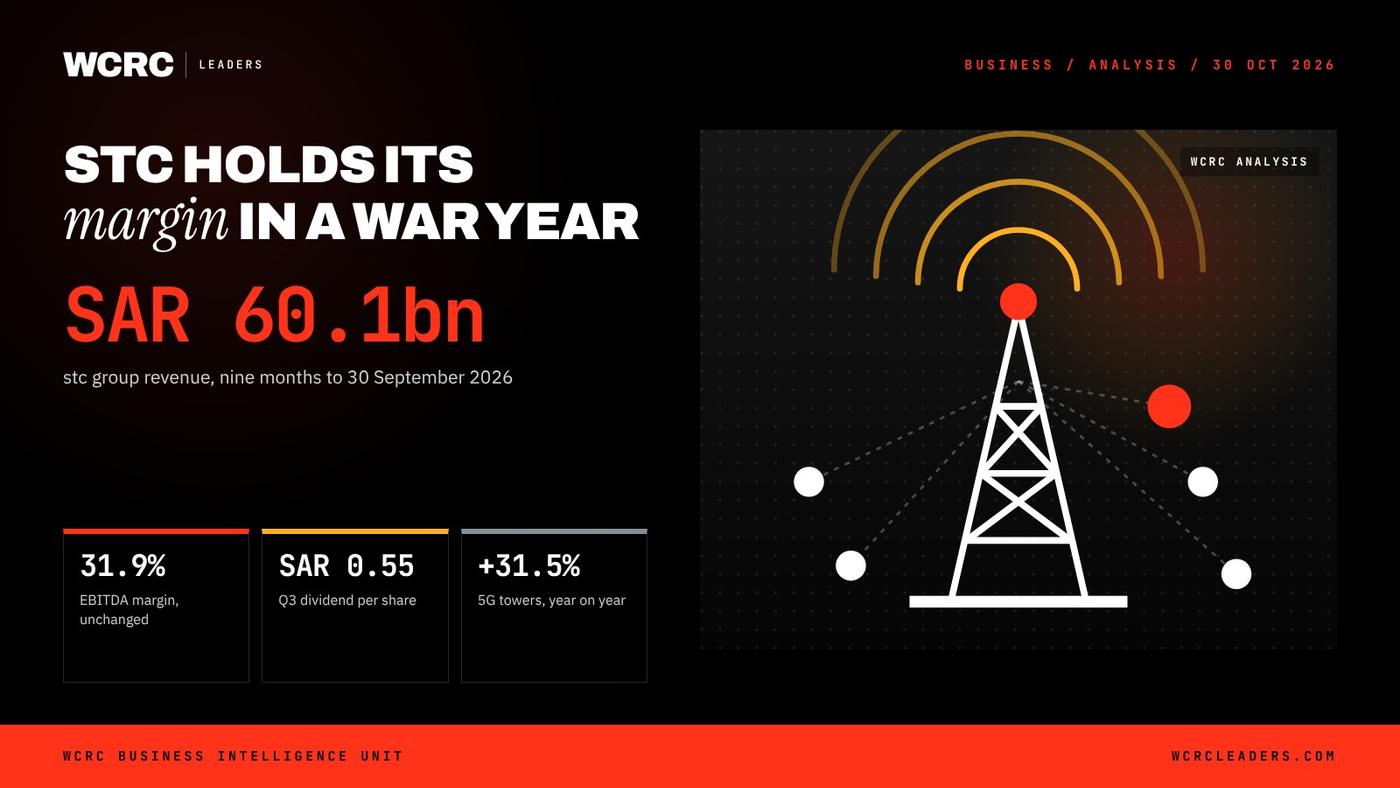
At a glance: WCRC Leaders' assessment: stc has proved that a Gulf national champion can protect its margin and its dividend through a war year, but the third quarter shows that the core Saudi business is now growing at about 1% and the group's next decade depends on subsidiaries, 5G and data-centre connectivity. stc group reported revenue of SAR 60.1bn for the nine months to 30 September 2026, up 3.7%, with EBITDA of SAR 19.15bn and a SAR 0.55 quarterly dividend.
What did stc report for the nine months?
stc group published its results for the nine months to 30 September 2026 on its investor relations site this week. Revenue rose 3.7% to SAR 60,096m from SAR 57,924m a year earlier. Gross profit grew 5.2% to SAR 29,362m.
EBITDA rose 3.5% to SAR 19,150m. The EBITDA margin held at 31.9%, exactly where it stood a year ago. Operating profit increased 4.1% to SAR 11,282m.
Net profit fell 5.7% to SAR 10,918m from SAR 11,579m. stc says that, excluding non-recurring items in both periods, net profit grew 2.6%. The release does not describe or quantify those items.
The board declared a dividend of SAR 0.55 a share for the third quarter, in line with its dividend policy, taking distributions for the nine months to SAR 8.2bn. Group chief executive Olayan Mohammed Alwetaid said in the release that "stc will remain a partner in building the Kingdom's digital future".
The balance sheet stays conservative. Net debt stood at 0.61 times EBITDA, and the group carries A+ ratings from Fitch and S&P, Aa3 from Moody's and AAA from Tassnief. Free cash flow fell to SAR 4.1bn from SAR 5.2bn, which stc attributes to higher capital spending on growth and strategic priorities.
Did the margin really hold through the conflict?
Over nine months, yes. Within the third quarter, less so. stc does not publish standalone quarterly figures in this release, but subtracting its first-half numbers from the nine-month totals gives a clear picture. This is WCRC's arithmetic from stc's own published figures.
Third-quarter revenue was about SAR 19,986m, up roughly 3.7% on SAR 19,264m a year earlier. Quarterly EBITDA, however, was about SAR 6,182m, slightly below the SAR 6,208m of the same quarter in 2025. That puts the quarterly EBITDA margin near 30.9%, against about 32.2% a year earlier and 32.3% for the first half of 2026. Quarterly operating profit fell about 3% and reported net profit about 12%, though that last figure includes the unexplained one-off items.
The context matters. The regional conflict that began on 28 February has brought 135 recorded attacks on shipping by mid-October and strikes on Riyadh's main airport. stc's release does not mention the conflict at all. The published figures cannot show how much of the third-quarter squeeze comes from the conflict and how much from costs in growth businesses. What is clear is that revenue kept growing at the same pace, and the group is spending more, not less.
Where is the growth coming from?
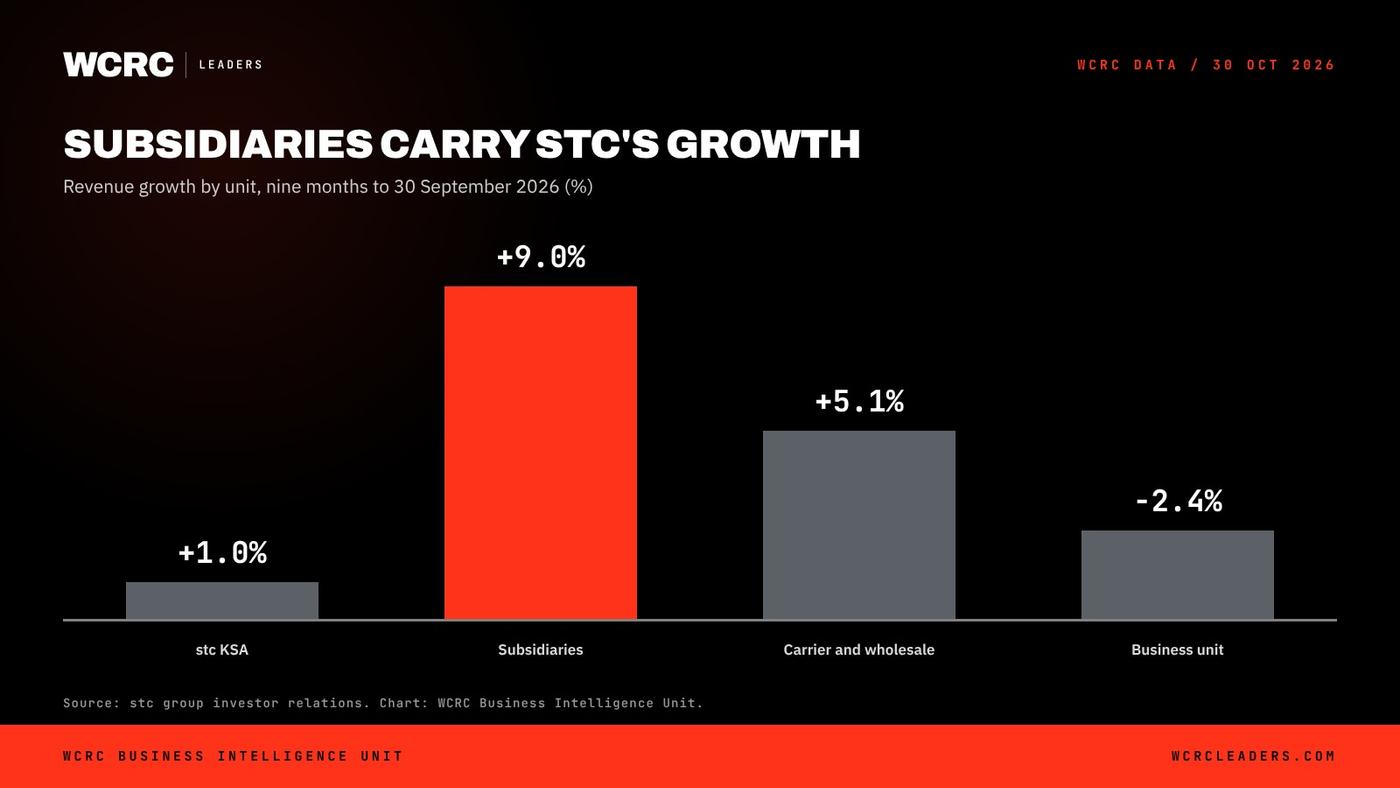
Not from the core Saudi telecom business. stc KSA revenue rose just 1.0%. Its commercial unit grew 2.0%, carrier and wholesale grew 5.1%, and the business unit fell 2.4%.
The subsidiaries carry the story. Their revenue rose 9.0%, led by solutions, center3 (the group's data-centre and connectivity arm), STC Bank, specialized and sirar. Subsidiaries' gross profit jumped 39.4%.
The network numbers point the same way. 5G towers rose 31.5% year on year to 12,380, up from 12,120 at the end of June. Mobile subscribers in the Kingdom grew 4.8% to 30.6 million, fixed subscribers 4.0% to 6.2 million, and fibre-connected households 7.0% to 3.95 million.
At LEAP 2026, stc signed agreements with Ericsson and with Cisco and Intel, both named among WCRC's World's 100 Most Powerful Brands, on 5G, autonomous networks and advanced computing. It also signed with AMD on computing and AI, with AWS on cloud, and with EZDITEK and DataVolt on data-centre connectivity.
How does stc compare with etisalat and the region?
The two Gulf giants reported within days of each other. etisalat's first results under its restored name showed nine-month revenue up 10.0% and an EBITDA margin of 46.4%, with headline profit lifted by the Vodafone stake sale. Excluding that gain, etisalat's nine-month net profit was below the prior year.
stc grows more slowly and earns a lower margin, but gives a cleaner picture of a domestic champion: flat nine-month margin, steady dividend, low leverage. etisalat spans 38 countries; stc is a Saudi infrastructure company with a growing services arm. Boards should compare strategies, not just ratios.
Analysis: read through WCRC's models, what does this tell leaders?
Read through WCRC's Trust Equity Model, part of the WCRC Brand & Marketing Codex, which asks how much pressure a brand can absorb, stc's year is a strong signal. A national operator that keeps adding mobile and fibre customers, expands 5G and pays the same dividend every quarter while its home market faces attacks is building the kind of trust that governments, banks and enterprise buyers price in.
In the terms of the Fortress Model of Crisis Leadership in WCRC's Guru Management Codex, the visible choice is to keep investing through the crisis. Free cash flow fell by a fifth because capital spending rose. That is a deliberate trade: less cash today for more towers, fibre and data-centre links tomorrow.
SeeClear, another model in the same codex, asks leaders to separate fact from projection. The fact is a flat nine-month margin. The projection, that the margin is safe, is not yet supported by the third quarter, which slipped by more than a point. Leaders reading these results should hold both.
Through WCRC's Corporate Value Intelligence lens, the value question is mix. A core business growing at 1% is a utility. Subsidiaries growing at 9%, with gross profit up nearly 40%, are where future enterprise value will be decided.
What does it mean for India and Asia?
For India, the parallels are direct. Bharti Airtel, one of WCRC 1000, India's Most Valuable Enterprises 2026, and Jio, a WCRC MegaBrand in mobile network operators, face the same question stc is answering: how to grow once mobile penetration is high. Gulf sovereign money already sits inside India's telecom story, as WCRC noted when Gulf funds held 5.32% of Jio Platforms ahead of its listing.
The tower angle matters too. stc's 31.5% jump in 5G towers is the kind of build-out that keeps passive infrastructure owners such as Indus Towers, one of WCRC 1000, India's Most Valuable Enterprises 2026, in demand across the region.
For Indian IT services and Asian equipment makers, stc's subsidiaries and its data-centre connectivity deals are a customer pipeline. Saudi enterprise digitisation is a live market even as the business segment of stc KSA shrank 2.4%: the work is moving to the group's solutions and center3 arms, not disappearing.
The WCRC View
The WCRC Business Intelligence Unit's call: stc has passed the resilience test of 2026 on the measures that matter most to its owners, a flat nine-month margin, a steady SAR 0.55 dividend and leverage of 0.61 times EBITDA. That is a real achievement in a year of regional conflict.
But the third quarter is the warning. Our reading of stc's own figures shows quarterly EBITDA slightly lower year on year and a margin near 30.9%. If that persists into the fourth quarter, the full-year margin will slip and the "margins held" story will need rewriting.
Who gains: suppliers and partners in 5G, cloud, chips and data-centre connectivity, including Indian IT services firms and Asian network equipment makers. Who must adapt: anyone selling to stc's core Saudi business, which is growing at about 1%.
What leaders should do now: Gulf boards should judge telecom champions on subsidiary growth and capital discipline, not headline profit, which is clouded by one-offs at both stc and etisalat. Indian and Asian telecom CEOs should note that stc is funding future growth by accepting lower free cash flow, a choice their own investors will ask them to defend or copy.
What WCRC will watch: stc's fourth-quarter EBITDA margin, the disclosure of the non-recurring items, center3's data-centre connectivity deals, and whether free cash flow recovers as capital spending peaks.
WCRC models applied: Trust Equity Model (Brand & Marketing Codex), Fortress Model of Crisis Leadership and SeeClear (Guru Management Codex), Corporate Value Intelligence.
Quick answers
Q: What was stc group's revenue for the nine months to September 2026? A: SAR 60,096m (about SAR 60.1bn), up 3.7% from SAR 57,924m a year earlier, according to stc's investor relations release.
Q: Did stc's net profit rise or fall? A: Reported net profit fell 5.7% to SAR 10,918m. Excluding non-recurring items in both periods, stc says net profit rose 2.6%.
Q: What dividend did stc declare for the third quarter of 2026? A: SAR 0.55 a share, in line with its dividend policy, bringing nine-month distributions to SAR 8.2bn.
Q: How fast is stc expanding 5G? A: Its 5G towers rose 31.5% year on year to 12,380 by the end of September 2026.
Adani Ports raises FY27 capex by ₹3,000 crore as overseas ports surge
Vedanta doubles Gamsberg, and Ramaphosa now wants a zinc smelter
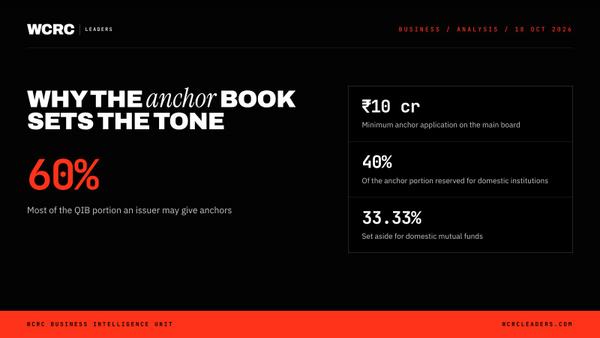
Anchor investors in Indian IPOs: why the 60% book sets the tone

Bajaj Finance lines up ₹17,500 crore as AI agents take on service

$133bn: what India's rupee defence is costing its biggest banks
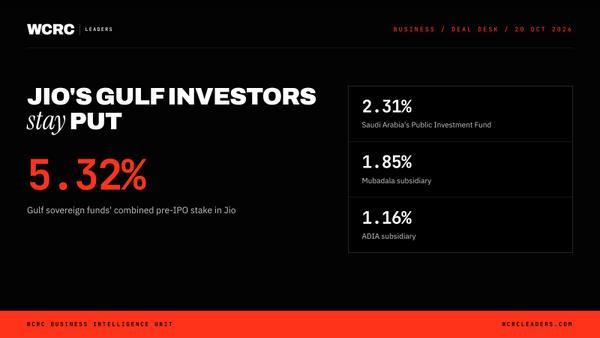
Jio Platforms IPO: Gulf funds hold 5.32% and are not selling
Filed under