Business
etisalat's first results under its old name: Vodafone exit lifts profit
The Abu Dhabi group's first quarter back under the etisalat name delivered a headline profit of AED 11.2bn, almost four times last year's. Strip out the AED 8.0bn gain from selling its whole Vodafone stake and the business grew profit 7%. The more interesting bet is the name itself.
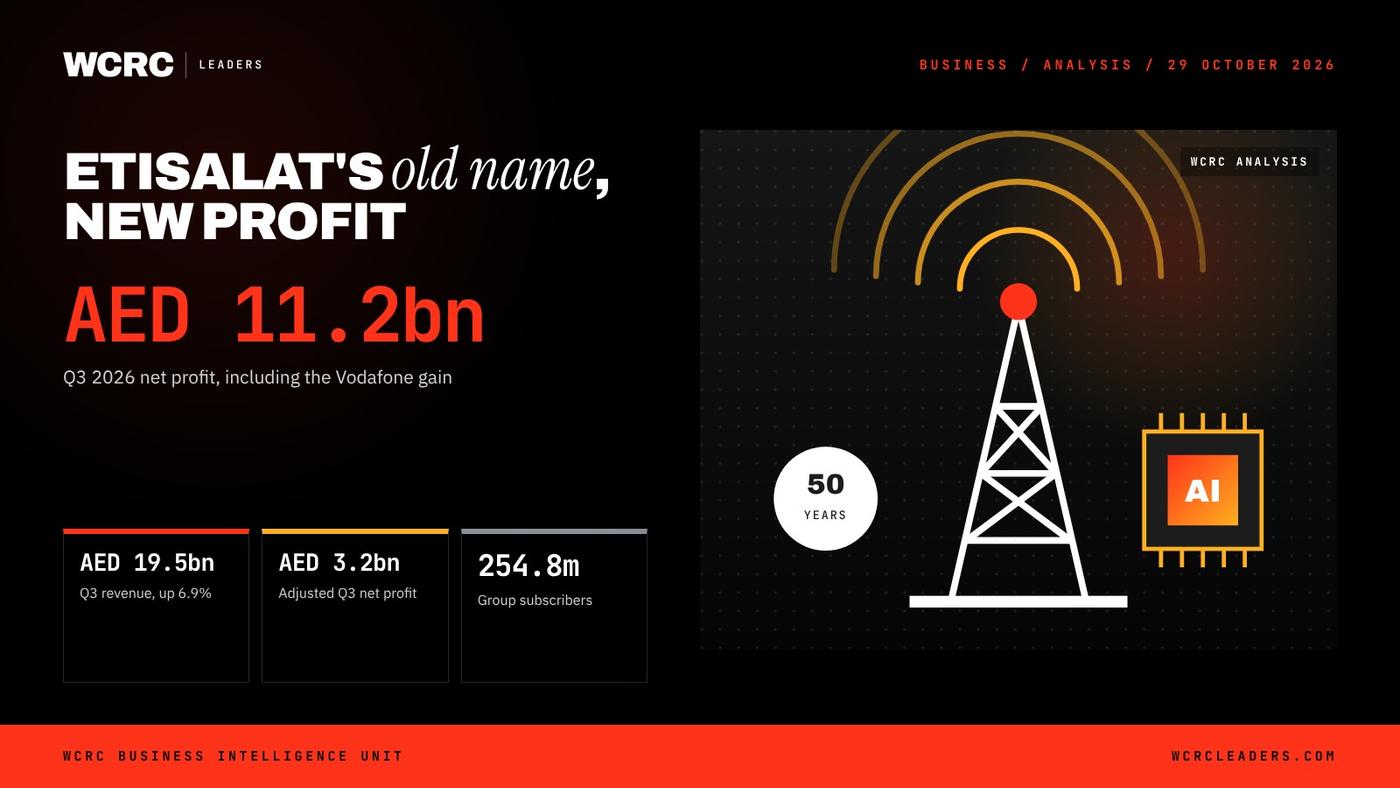
At a glance: WCRC Leaders' assessment: the Vodafone exit flatters the quarter, but the bigger strategic move is the return to a 50-year-old name, which trades a global-sounding brand for deep home-market trust just as the group sells itself as an AI infrastructure company. On 27 October 2026, etisalat reported Q3 revenue of AED 19.5bn, up 6.9%, EBITDA of AED 9.0bn and net profit of AED 11.2bn. It now serves 254.8 million subscribers.
What did etisalat report?
etisalat, selected as e& (Etisalat) among the Middle East 50 Most Powerful Brands by the Business Intelligence Unit of WCRC, said consolidated revenue for the quarter to 30 September reached AED 19.5bn, up 6.9% on AED 18.2bn a year earlier.
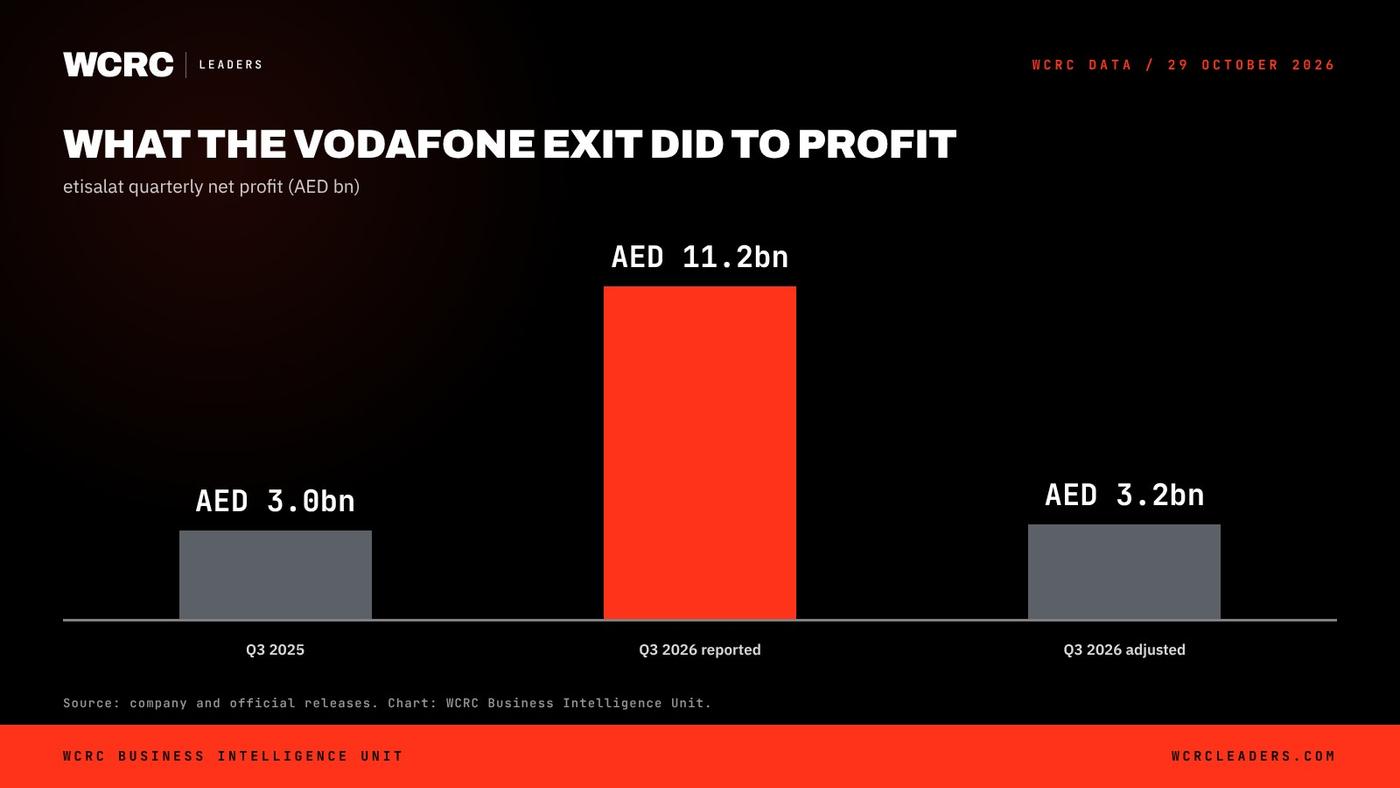
EBITDA rose 5.1% to AED 9.0bn, a margin of 46.1%. The group's own highlights put the telecom margin at 47.4%. Net profit was AED 11.2bn, against AED 3.0bn in the third quarter of 2025, and earnings per share were AED 1.29.
That headline includes a one-off gain of about AED 8.0bn from the Vodafone sale. Excluding it, the company put Q3 net profit at AED 3.2bn, or AED 0.37 a share, which it described as 7% growth year on year.
For the first nine months, revenue was AED 57.6bn, up 10.0%, and EBITDA AED 26.7bn, up 10.3%, at a margin of 46.4%. Nine-month net profit was AED 17.2bn, up 45.9%, or AED 9.2bn excluding the Vodafone gain.
The subscriber base reached 254.8 million, up 29.4%. In the UAE, subscribers rose 5.2% to 16.5 million. Net debt stood at AED 17.7bn, or 0.50 times EBITDA, according to the group's investor pages.
How big was the Vodafone exit?
In July 2026 the group, then still trading as e&, completed the transfer of its 3,944,743,685 ordinary shares in Vodafone Group. The buyer was Vega, an acquisition vehicle wholly owned by the Niel family group, with the shares transferred to three banks: BNPP Financial Markets, Crédit Agricole Corporate and Investment Bank, and Société Générale.
Gross cash proceeds were AED 21.5bn (USD 5.84bn), about 110.5 pence a share. With the final dividend, the company put total consideration at AED 21.9bn (USD 5.95bn).
WCRC analysis: The sale ends one of the Gulf's most visible strategic stakes in a European telecom group. It turns a minority holding the group did not control into cash at a moment when it is asking investors to fund an AI and connectivity build-out. With net debt at half of EBITDA, the balance sheet now has room for acquisitions, network spending or higher returns to shareholders. The release, which notes the sale "provides additional financial flexibility", says nothing about which.
Is the underlying business as strong as the headline?
Partly. Three points stand out.
Margins slipped. EBITDA grew 5.1% against revenue growth of 6.9%. WCRC analysis: On the release's own table, Q3 2025 EBITDA of AED 8.5bn on revenue of AED 18.2bn implies a margin near 46.7%, so the 46.1% this quarter is roughly half a point lower. Still among the richest margins in global telecoms, but drifting down.
The record needs a footnote. The release headline calls the nine months a record. Excluding the Vodafone gain, nine-month profit of AED 9.2bn sits below the AED 11.8bn the group reported for the first nine months of 2025. The release does not explain what lifted last year's base, so the like-for-like trend over nine months is unclear. The 7% Q3 figure is the cleaner read.
Growth is international. UAE subscribers grew 5.2%; the group total grew 29.4%. WCRC analysis: Almost all of the subscriber expansion is coming from the group's wider footprint, which spans 38 countries across the Middle East, Asia, Africa and central and eastern Europe. That matters for the rename, because those customers mostly meet the group through local brands, not the parent name.
Why go back to the etisalat name?
The group was founded in 1976 and has spent its 50th anniversary year returning to the name it started with. Its homepage now reads: "We are etisalat. We always have been. We always will be."
The release ties the change to strategy. The group "set out a new vision to become a leading AI-powered and enabling telco and moved forward under the etisalat name, symbolising the central role of connectivity in the AI era."
Group CEO Masood M. Sharif Mahmood said: "This gives the etisalat brand, which means 'communications', a renewed purpose with a new and deeper meaning. Connectivity is no longer just about moving data, for us."
He added that as AI moves into "core enterprise and government operations, the foundational connectivity, compute, and secure infrastructure powering it become more critical." Earlier in October, the group said it plans to lift international connectivity capacity to more than 500 terabits per second by 2030, over 25 times today's level.
WCRC analysis: Read through WCRC's Distinctiveness Code, a Brand & Marketing Codex model that asks whether a brand is ownable or generic in its category, the logic is clear. A short symbol-led name is hard to own in a crowded digital category. A word that means "communications" in Arabic, carried by the UAE's founding operator for half a century, is not.
The Sensory Signature Model asks whether look, sound and feel make a brand instantly known. For millions of UAE residents, the etisalat name already carries that recognition; the sound of the brand is decades deep. The task now is to make the visual identity work as hard.
Who gains from the heritage bet, and what is the risk?
The Trust Equity Model in the same codex asks how much trust a brand holds and how much pressure it can absorb. WCRC analysis: The case for etisalat is trust. Governments and large enterprises buying sovereign cloud, cyber security and AI capacity tend to choose suppliers they have relied on for years, and the release leans on "enduring customer relationships" for exactly that reason. Recent releases on the group's site, from an AI management certification to a secure-hosting service for government, point the same way.
The risk is the Pulse Gap, the model that compares how the market sees a brand with how its customers see it. At home, customers never stopped calling the operator etisalat. Investors and international partners, by contrast, were taught a different name for several years and now need to learn the old one again, while the 29% subscriber growth lives in markets where neither name is the customer-facing brand. A heritage name can read as confident in Abu Dhabi and as a step backwards in a European or Asian boardroom.
What does it mean for CEOs and boards in India, the Gulf and Asia?
For Gulf boards, the quarter shows how state-linked champions are redeploying capital: out of passive foreign stakes, into infrastructure they control. It sits alongside wider board-level questions on Gulf risk and leadership change covered in WCRC's review of the Gulf's C-suite churn and what Gulf and Indian boards must price in after 135 attacks.
For Indian telecom and digital infrastructure leaders, the comparison is direct. Operators everywhere are trying to be paid as AI infrastructure rather than as utilities, a theme in Gulf funds' role in the Jio Platforms IPO. etisalat's answer is to lead with balance-sheet strength and an old, trusted name.
For Asian groups weighing a rebrand, the lesson cuts the other way. Names are assets on the balance sheet of trust; changing them, or changing them back, has a cost that never shows in the accounts.
The WCRC View
The call. Headline profit is a one-off; the 7% underlying growth and a sub-0.5x leverage ratio are the numbers that matter. The return to etisalat is a sound trust play at home and an unproven one abroad.
Who gains. Government and enterprise buyers in the UAE, who get a supplier betting its name on sovereign, secure AI infrastructure. Shareholders gain optionality: AED 21.9bn of consideration and low debt give the board choices it did not have a year ago.
Who is exposed. The parent brand in international markets, where the Pulse Gap is widest, and EBITDA margin, which slipped about half a point while the group spends to build capacity.
What leaders should do now. Before any rename, run the Distinctiveness Code test: is the new name more ownable than the old? Spend the trust equity of a heritage brand on products that need trust, such as sovereign cloud and security, not on commodity data. In the terms of WCRC's Corporate Value Intelligence, the framework behind WCRC's work on why companies hold their value position, boards should judge the Vodafone proceeds by what they buy, not by the gain they booked.
What WCRC will watch. How the Vodafone cash is used, and when; whether the EBITDA margin stabilises above 46%; and whether a single etisalat brand architecture follows across the 38-country footprint or stays a home-market name.
WCRC models applied: Distinctiveness Code, Sensory Signature Model, Trust Equity Model and Pulse Gap (Brand & Marketing Codex); Middle East 50 Most Powerful Brands; Corporate Value Intelligence.
Quick answers
Q: What was etisalat's Q3 2026 net profit? A: AED 11.2bn, against AED 3.0bn a year earlier. Excluding an AED 8.0bn one-off gain from the Vodafone sale, net profit was AED 3.2bn, up 7%.
Q: How much did etisalat receive for its Vodafone stake? A: Gross cash proceeds were AED 21.5bn (USD 5.84bn), and total consideration including the final dividend was AED 21.9bn (USD 5.95bn). The transfer completed in July 2026.
Q: Why did e& change its name back to etisalat? A: The group, founded in 1976, returned to its original name in its 50th year, saying it reflects the central role of connectivity in the AI era. Its new vision is to become "a leading AI-powered and enabling telco".
Q: How many subscribers does etisalat have? A: 254.8 million across the group, up 29.4%, including 16.5 million in the UAE, up 5.2%.
Adani Ports raises FY27 capex by ₹3,000 crore as overseas ports surge
Vedanta doubles Gamsberg, and Ramaphosa now wants a zinc smelter
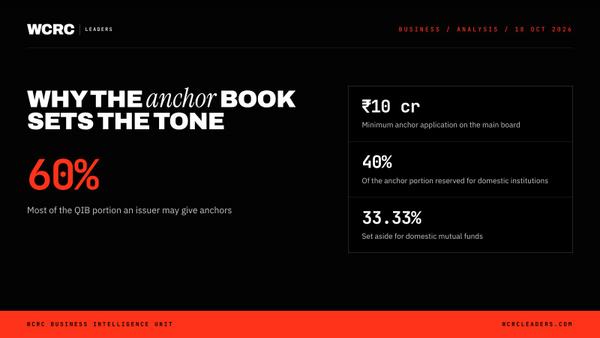
Anchor investors in Indian IPOs: why the 60% book sets the tone

Bajaj Finance lines up ₹17,500 crore as AI agents take on service

$133bn: what India's rupee defence is costing its biggest banks
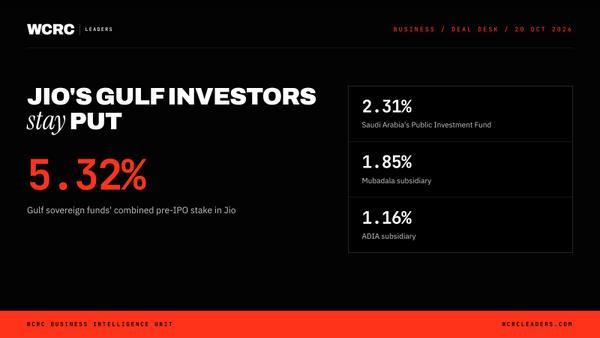
Jio Platforms IPO: Gulf funds hold 5.32% and are not selling
Filed under