Business
NTPC's ₹7,351 crore quarter: the growth arm starts to carry weight
India's state-owned power major grew its standalone profit by 14% in the September quarter. Its group profit grew almost three times as fast, because the businesses outside the parent are now doing much of the lifting.
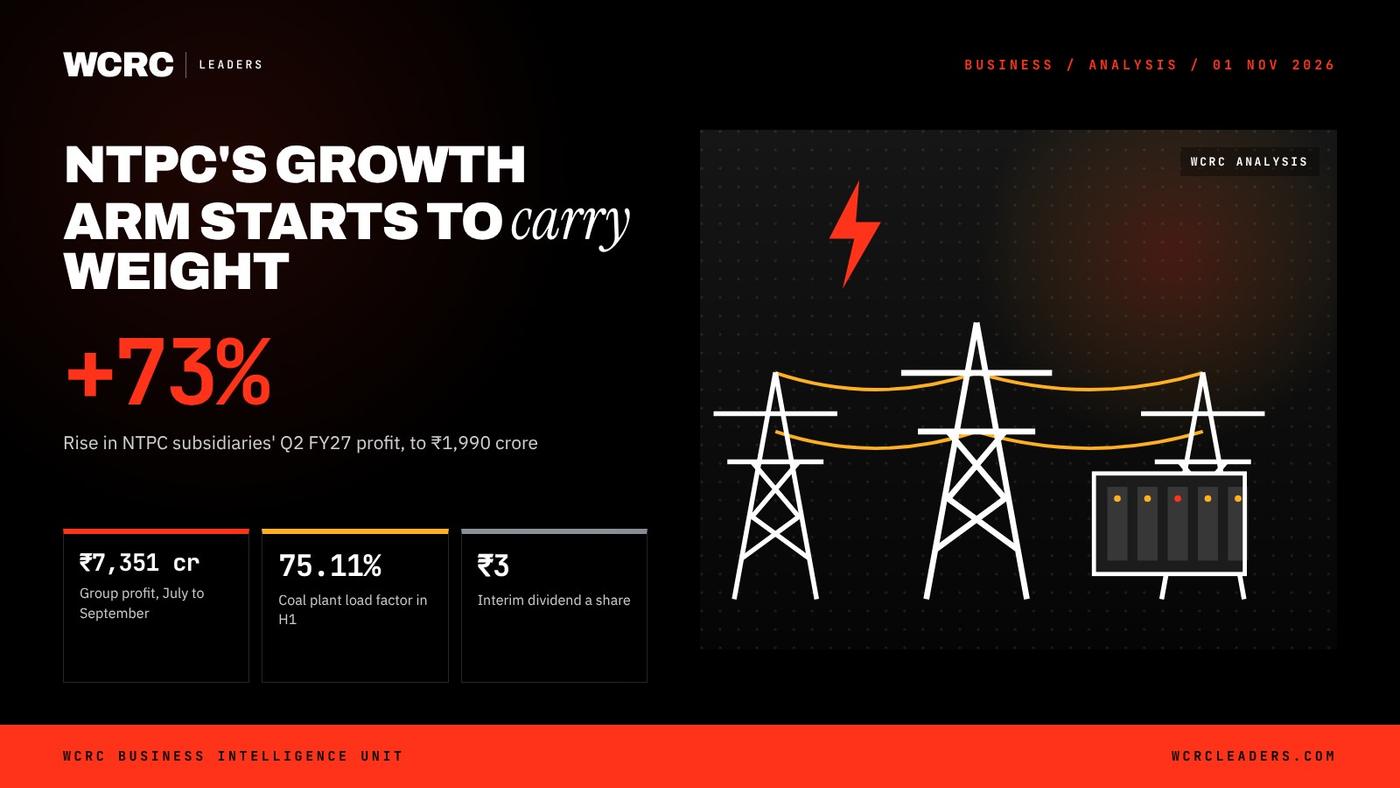
At a glance: WCRC Leaders' assessment: NTPC has become a two-engine company, and the engine that is growing faster now sits outside the parent's balance sheet. On 31 October 2026 the state-owned utility reported Q2 FY27 group profit after tax of ₹7,351 crore, up 40.7%, against standalone growth of 14%. Profit from subsidiaries rose 73% to ₹1,990 crore. Its coal fleet ran at a 75.11% plant load factor in the first half. For boards, the lesson is about governing a legacy core and a growth arm side by side.
What did NTPC report for the September quarter?
NTPC, one of WCRC 1000, India's Most Valuable Enterprises 2026, published unaudited results for the quarter and half year ended 30 September 2026 on 31 October.
The parent company's numbers were solid rather than spectacular. Standalone total income rose about 15% to ₹46,842 crore, from ₹40,689 crore a year earlier. Standalone profit after tax rose 14% to ₹5,320 crore, from ₹4,653 crore. NTPC put this down mainly to higher generation and better operating efficiency. For the half year, standalone profit reached ₹10,662 crore, up 13.1% from ₹9,428 crore.
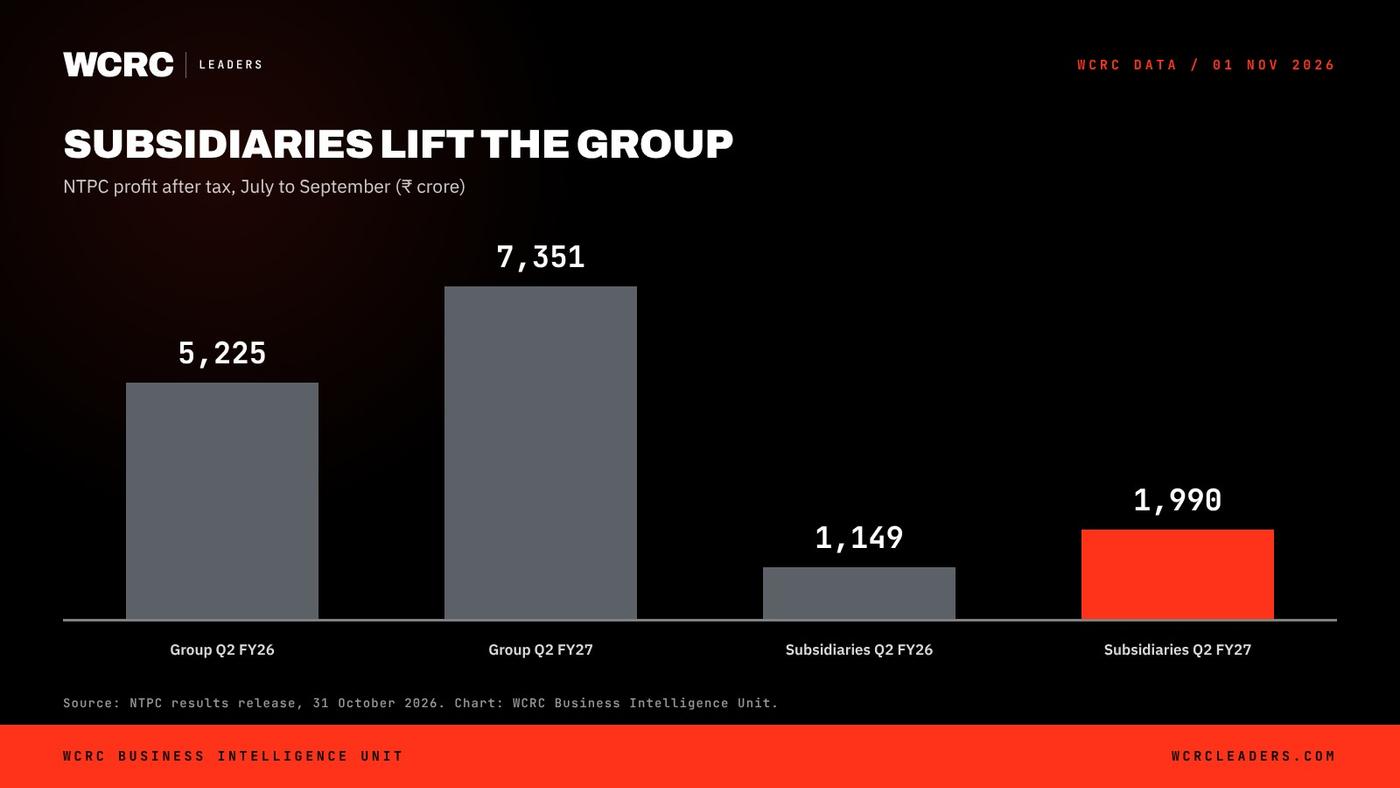
The group picture is where the story changes. Consolidated Q2 profit after tax rose 40.7% to ₹7,351 crore, from ₹5,225 crore. Profit from subsidiaries rose 73% to ₹1,990 crore, from ₹1,149 crore. For the half year, group profit was ₹14,247 crore, up 25.7% from ₹11,334 crore.
The board also declared a first interim dividend of ₹3 per share for FY 2026-27, equal to 30% of paid-up equity capital.
Why does the gap between standalone and group profit matter?
Because it shows where growth is coming from. A WCRC calculation from the company's figures: subsidiary profit was equal to about 27% of group profit in Q2 FY27, up from about 22% a year earlier. Over the first half, group profit exceeded standalone profit by ₹3,585 crore, against ₹1,906 crore in the first half of FY26. That gap nearly doubled in a year.
NTPC's subsidiaries include its listed renewables arm, NTPC Green Energy, also one of WCRC 1000, India's Most Valuable Enterprises 2026, along with thermal joint ventures and subsidiaries such as Patratu Vidyut Utpadan Nigam, in which an NTPC subsidiary holds 74%. NTPC's own release does not break the ₹1,990 crore down by company, so it is not yet possible to say how much of the jump came from renewables and how much from new thermal units. That breakdown is the first thing an investor should ask for.
The direction, however, is clear from NTPC's own targets. In May 2026 the group said it had crossed 90 GW of installed capacity, with about 32 GW under construction, and set a target of 149 GW by 2032, including 60 GW from renewables. It added 5,488 MW of solar, wind and pumped storage capacity in FY26. Much of that build sits in subsidiaries.
How is the coal core holding up?
Well, by the standard of India's fleet. NTPC's coal stations ran at a plant load factor of 75.11% in the first half of FY27, against 68.35% for the rest of the country's coal fleet. That is a lead of almost seven percentage points.
This matters for two reasons. First, the coal core still produces the cash and the standalone profit that fund the growth arm. A utility whose thermal plants run more hours on the same fixed cost earns more on every rupee already sunk. Second, it shows that India still leans hard on coal at peak. Solar now covers much of the midday load, but evenings and monsoon weeks still fall back on thermal plants.
The board's challenge is that the profitable core and the faster-growing arm need different things. One needs reliability, fuel security and steady returns on regulated assets. The other needs capital, speed and commercial deals with private buyers.
Where do data centres fit?
Data centres are the newest private buyer of large, round-the-clock power, and NTPC's renewables arm has moved to serve them. On 31 October 2025 NTPC Green Energy signed a memorandum of understanding with CtrlS Datacenters to explore renewable projects of 2 GW or more supplying round-the-clock green power to CtrlS sites across India for captive use. On 24 March 2026 it signed a similar MoU with Nxtra Data, again for round-the-clock renewable supply to data centres for their own use.
Both are MoUs, not binding power purchase agreements, so neither yet shows up in profit. But they point to where demand is heading. Rival groups are making the same move: Adani Enterprises, one of WCRC 1000, India's Most Valuable Enterprises 2026, has tied up more than 1.2 GW of data-centre capacity, as WCRC set out in its analysis of Adani Enterprises' ₹6,316 crore quarter. Critical infrastructure is following the same logic: the Reserve Bank's new facility, covered in RBI's Bhubaneswar data centre, is a reminder that every such site needs power that does not fail. Globally, the AI power build is already reshaping equipment makers' results, as Hitachi's first half showed.
Round-the-clock green power is hard to deliver. It needs solar and wind blended with storage or pumped hydro, which NTPC is building. The utility that can bundle firm thermal backing with green supply has an edge over a pure renewables developer.
What should boards running a legacy core and a growth arm take from this?
Read through WCRC's Corporate Value Intelligence framework for interpreting enterprise value, the question for NTPC is whether markets value the group as one regulated utility or as a utility plus a growth business. When subsidiaries supply more than a quarter of group profit, the old valuation lens starts to miss part of the picture. Analysis: the more the growth arm contributes, the more pressure there will be to show its numbers separately and clearly.
In the terms of SeeClear, a model in WCRC's Guru Management Codex, boards should separate fact from projection before they decide. The fact is a 73% rise in subsidiary profit in one quarter. The projection is that data-centre MoUs will become contracts and that renewables will keep compounding at this rate. One strong quarter, with no published split by subsidiary, does not prove the second.
There is a brand question too. NTPC is a WCRC MegaBrand in public sector power brands, selected by the Business Intelligence Unit of WCRC. Read through the Brand Stretch Model in WCRC's Brand & Marketing Codex, which asks whether a new product can credibly launch under an existing name, NTPC's reputation for reliable bulk power is an asset when it sells green power to data centres, which care most about uptime. The same name could become a drag if private buyers see it as slow or bureaucratic.
The WCRC View
NTPC's quarter is a clear signal: the legacy core still pays the bills, but the growth arm now sets the pace. Group profit grew 40.7% while the parent grew 14%, and that gap is unlikely to close soon given the 2032 target of 60 GW of renewables.
Who gains: NTPC's shareholders, who get a coal franchise that out-runs the national fleet plus a growing renewables book; and private data-centre operators, who gain a state-backed supplier able to pair firm power with green supply. Who is under pressure: pure-play renewables developers, which cannot offer the same thermal backing.
What leaders should do now. Boards in India, the Gulf and Asia that run a mature core alongside a new business should report the growth arm's profit separately, set different capital and return tests for each engine, and keep the core's operating discipline from slipping as attention moves to the new business. Gulf utilities and Asian conglomerates building renewables for AI demand face exactly this choice.
Through Corporate Value Intelligence, the test is whether the market starts to price NTPC as two businesses. Through SeeClear, the test is discipline: treat MoUs as options, not revenue. Through the Brand Stretch Model, the test is whether a public sector power name can win private, uptime-obsessed customers.
What WCRC will watch next: a published profit split by subsidiary, conversion of the CtrlS and Nxtra MoUs into signed supply contracts, NTPC Green Energy's own Q2 numbers, and whether coal plant load factors hold through the winter quarter.
WCRC models applied: Corporate Value Intelligence, SeeClear (Guru Management Codex), Brand Stretch Model (Brand & Marketing Codex).
Quick answers
Q: What was NTPC's group profit in Q2 FY27? A: Consolidated profit after tax was ₹7,351 crore for the quarter ended 30 September 2026, up 40.7% from ₹5,225 crore a year earlier.
Q: How much did NTPC's subsidiaries contribute? A: Profit from subsidiaries rose 73% to ₹1,990 crore, from ₹1,149 crore in Q2 FY26.
Q: How did NTPC's coal plants perform? A: NTPC's coal stations ran at a 75.11% plant load factor in H1 FY27, against 68.35% for the rest of India's coal fleet.
Q: What dividend did NTPC declare? A: A first interim dividend of ₹3 per equity share for FY 2026-27, equal to 30% of paid-up equity capital.
Adani Ports raises FY27 capex by ₹3,000 crore as overseas ports surge
Vedanta doubles Gamsberg, and Ramaphosa now wants a zinc smelter
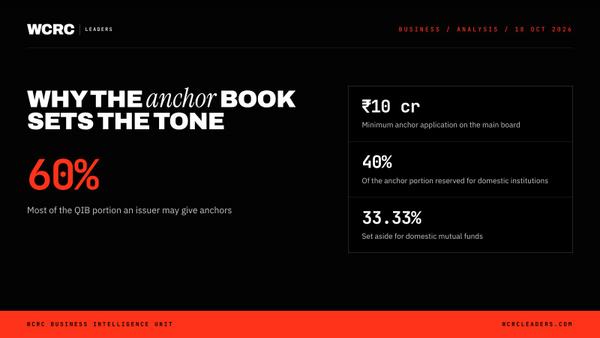
Anchor investors in Indian IPOs: why the 60% book sets the tone

Sun Pharma's profit falls 36% as it pays for Organon and a US lawsuit

Bajaj Finance lines up ₹17,500 crore as AI agents take on service

$133bn: what India's rupee defence is costing its biggest banks
Filed under