Business
Adani Enterprises' ₹6,316 crore quarter: the new businesses take over
Adani Enterprises posted a record half-year EBITDA on the back of copper, airports and solar manufacturing. The harder test is turning that operating cash into profit as Navi Mumbai and a gigawatt-scale data-centre pipeline load the balance sheet.
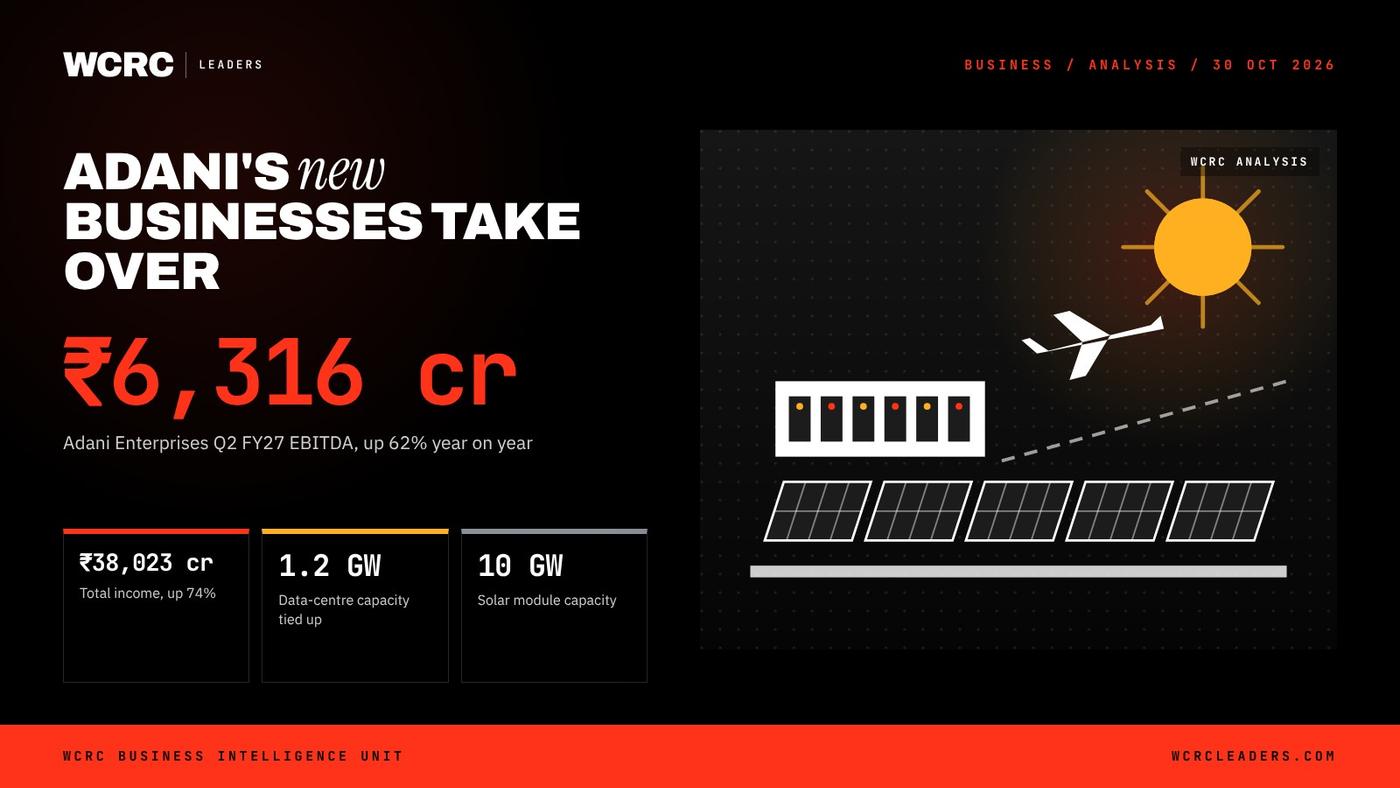
At a glance: WCRC Leaders' assessment: Adani Enterprises' incubated businesses now generate the operating earnings, but not yet the profits, so the next 18 months will be judged on conversion, not scale. On 28 October 2026 the Adani Group flagship reported Q2 FY27 total income of ₹38,023 crore, up 74%, and EBITDA of ₹6,316 crore, up 62%. Profit attributable to owners fell 55% to ₹1,492 crore against a year-earlier quarter that carried a large exceptional item. For boards in India and the Gulf, the numbers show where Indian infrastructure capital is now flowing: AI data centres, airports and clean-energy manufacturing.
What did Adani Enterprises actually report?
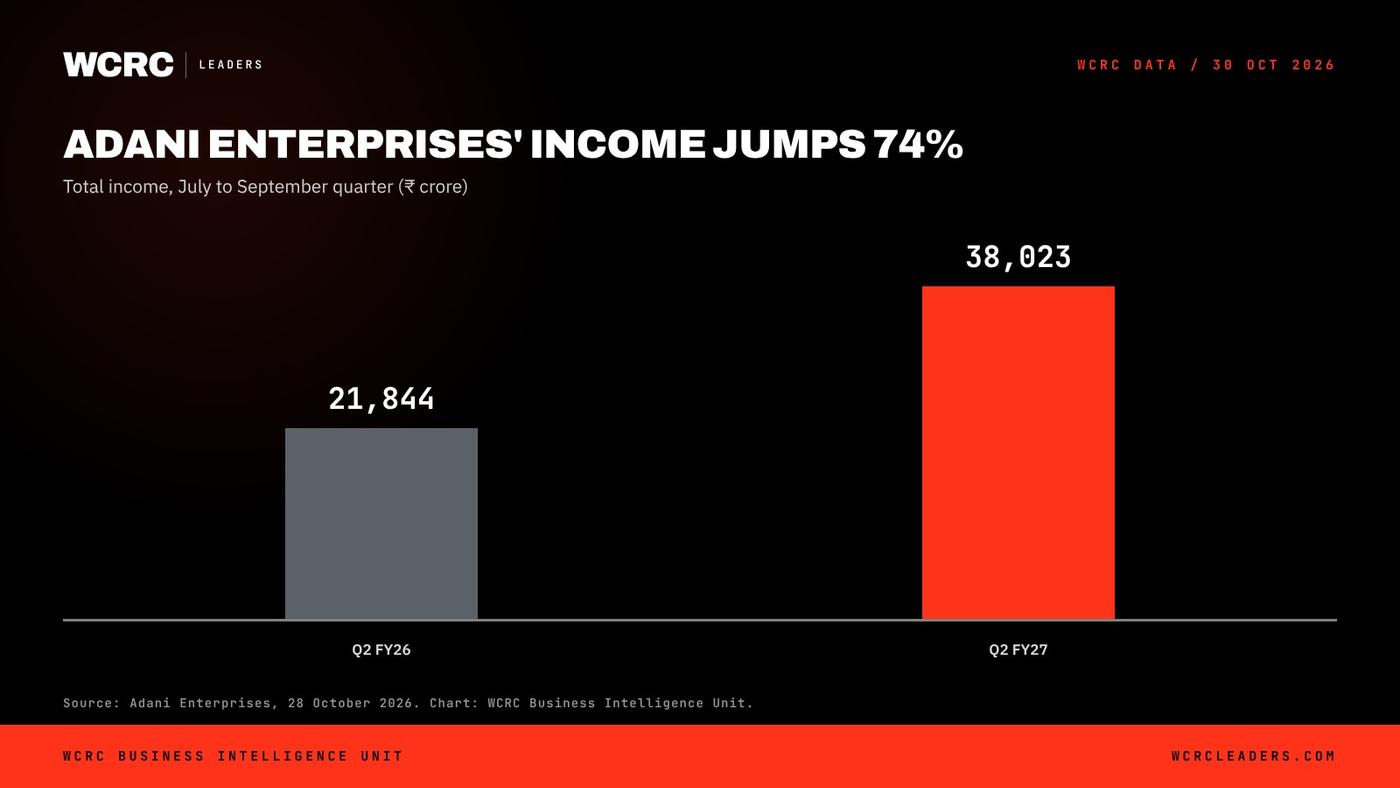
Adani Enterprises, one of WCRC 1000, India's Most Valuable Enterprises 2026, released its H1 and Q2 FY27 results from Ahmedabad on 28 October. The headline numbers are strong. Q2 total income rose 74% year on year to ₹38,023 crore, from ₹21,844 crore. EBITDA rose 62% to ₹6,316 crore. Profit before tax from continuing operations jumped 146% to ₹2,002 crore, from ₹814 crore.
Over the half year, total income reached ₹71,569 crore, up 62%, and EBITDA reached ₹11,958 crore, up 56%. The company describes that as its highest half-yearly EBITDA. H1 continuing PBT rose 45% to ₹3,297 crore, a figure the company gives excluding a one-time OFAC settlement of ₹2,644 crore during Q1 FY27. The release shows that amount as an exceptional item and does not describe the settlement further.
The fall in owners' profit needs reading with care. Q2 FY27 profit attributable to owners was ₹1,492 crore, down 55%, but the Q2 FY26 figure of ₹3,304 crore included an exceptional item of ₹3,583 crore. For the half year, owners' profit was ₹332 crore against ₹4,189 crore, reflecting the settlement in one year and the exceptional item in the other. On continuing PBT, the underlying business is growing.
CARE upgraded the company's long-term rating to AA / Stable, which the company calls the highest rating in its credit history.
Which businesses are carrying the earnings?
The scale-up came largely from businesses the group is still building out. Copper is the clearest case. Sales volume rose 5.8 times to 80.6 thousand tonnes in Q2 and 5.2 times to 145.3 thousand tonnes in the half year as the plant ramped up. The company says copper contributed EBITDA of ₹2,033 crore in H1.
Airports, one of the two businesses the company reports as "incubating", lifted Q2 EBITDA 55% to ₹1,641 crore on income of ₹3,786 crore. The new-energy arm, the ANIL ecosystem, earned EBITDA of ₹1,094 crore, down 7%, even as module sales rose 35% to 1,478 MW and wind turbine sets rose to 35 from 28.
Add the two incubating businesses together and they produced ₹2,735 crore, or about 43% of group EBITDA in Q2. Add copper's half-year contribution and the new businesses account for well over half of H1 EBITDA.
Analysis: this is the incubator model working at the operating line. The company's own description is that it builds emerging infrastructure businesses and divests them into separate listed entities. The current cohort of copper, airports, solar manufacturing and data centres is now large enough to set the group's earnings trend.
Why are airports profitable on EBITDA but loss-making before tax?
Airports posted a Q2 pre-tax loss of ₹290 crore against a profit of ₹99 crore a year earlier, and an H1 loss of ₹484 crore. The company attributes the decline to higher depreciation after capitalising Navi Mumbai Airport. Once a large asset is in service, its cost runs through the income statement before traffic builds.
Traffic did not help this quarter. Passengers fell 6% to 21.2 million and air traffic movements fell 4%, though cargo rose 11% to 3.2 lakh tonnes.
The ramp at Navi Mumbai is now scheduled. On 25 October Air India Group and Adani Airports said Air India Express will run four daily domestic flights from Navi Mumbai from December 2026, with Kuwait services planned from January 2027, subject to approvals, and West Asia routes including Jeddah, Riyadh, Dammam, Doha, Muscat and Sharjah moving over by the IATA Northern Summer 2027 season. Those Gulf routes matter: they are the traffic that should start to absorb the depreciation.
How big is the AI data-centre bet?
AdaniConnex received a new 240 MW hyperscale order in Navi Mumbai, taking cumulative tied-up capacity past 1.2 GW. Operational capacity rose to 94.6 MW in the quarter, with 10 MW handed to customers in Noida and 19.2 MW in Pune.
The gap between 94.6 MW running and more than 1.2 GW contracted is the story. In February the Adani Group committed $100bn to renewable-powered, AI-ready data centres by 2035, expanding AdaniConnex's 2 GW platform towards 5 GW, with Google, Microsoft and Flipkart named as partners. On 13 October Adani Enterprises and Jabil signed a non-binding MoU for a 50:50 joint venture to make AI racks, servers, cooling and power equipment in India. Gautam Adani said the AI sector "will require an entire new industrial architecture".
Power is the constraint every AI build meets, and the group has it in-house. The solar module line reached 10 GW after 4.3 GW of TopCon capacity was commissioned in September, with a further 6 GW cell line on schedule. The $100bn release ties the data-centre plan to Adani Green Energy, a WCRC MegaBrand in green hydrogen and new energy, and its 30 GW Khavda project. WCRC has tracked the demand side of this build in Microsoft's $677bn backlog.
What does this mean for Gulf capital and India's infrastructure build?
Gulf capital is already inside the group's expansion. In July Adani Enterprises and International Resources Holding, an Abu Dhabi natural resources platform owned by IHC, agreed a 50:50 joint venture for a USD 11.5bn alumina, aluminium and power project in Odisha. Syed Basar Shueb, chief executive of IHC, said IHC is "building long-term platforms in industries that will define the future of the global economy." Sister company Adani Ports, a WCRC MegaBrand in ports and terminals, is raising its own spending, as WCRC reported in Adani Ports' FY27 capex raise.
Analysis: for sovereign and family-office investors in Abu Dhabi, Doha and Riyadh, Adani Enterprises offers something rare, direct exposure to Indian AI infrastructure, airports and critical minerals through one listed vehicle. The CARE upgrade lowers the cost of the debt that will fund it. Gulf funds have shown appetite for Indian platforms, as seen in the Jio Platforms IPO. The trade-off is execution risk across several capital-heavy projects at once.
Read through WCRC's Corporate Value Intelligence framework for interpreting enterprise value, the market will value Adani Enterprises less on its trading heritage and more on how quickly contracted capacity, such as 1.2 GW of data centres and Navi Mumbai's new routes, turns into pre-tax profit.
The WCRC View
The WCRC Business Intelligence Unit's call: Adani Enterprises has proved it can build new businesses to scale; it has not yet proved it can make them profitable at the same pace. EBITDA up 62% with airports in a pre-tax loss is the signature of a company early in a heavy depreciation cycle.
In the terms of SeeClear, a model in WCRC's Guru Management Codex, boards should separate fact from projection. The fact is 94.6 MW of operating data centres and 21.2 million quarterly passengers. The projection is 1.2 GW tied up and a 5 GW ambition. Investors and partners should price the first and track the second.
Read through WCRC's Governance Shield, from the Brand & Marketing Codex, the OFAC settlement and the CARE upgrade sit on opposite sides of the same ledger. A settlement booked as a one-time item and a stronger credit rating give the board room to argue that reputational risk is being managed. That argument must be sustained by disclosure.
Who gains: hyperscalers wanting Indian capacity with captive green power, and Gulf investors seeking listed Indian infrastructure exposure. Who must act: Indian CEOs planning AI workloads should lock capacity early, and Gulf boards weighing co-investment should insist on project-level reporting.
What WCRC will watch next: airport pre-tax results once Air India Express and IndiGo move routes to Navi Mumbai from December, the AdaniConnex operational figure against its 1.2 GW contracted base, and definitive agreements on the Jabil joint venture.
WCRC models applied: Corporate Value Intelligence, SeeClear (Guru Management Codex), Governance Shield (Brand & Marketing Codex).
Quick answers
Q: What were Adani Enterprises' Q2 FY27 results? A: Total income rose 74% to ₹38,023 crore, EBITDA rose 62% to ₹6,316 crore and continuing PBT rose 146% to ₹2,002 crore. Profit attributable to owners fell 55% to ₹1,492 crore against a base that included an exceptional item.
Q: Why did Adani's airports post a loss? A: Airports EBITDA rose 55% to ₹1,641 crore, but higher depreciation after Navi Mumbai Airport was capitalised produced a Q2 pre-tax loss of ₹290 crore.
Q: How much data-centre capacity has AdaniConnex secured? A: After a new 240 MW hyperscale order in Navi Mumbai, cumulative tied-up capacity exceeds 1.2 GW. Operational capacity was 94.6 MW at the end of the quarter.
Q: What is the OFAC item in the results? A: The company recorded a one-time OFAC settlement of ₹2,644 crore during Q1 FY27 as an exceptional item. The results release gives no further detail.
Adani Ports raises FY27 capex by ₹3,000 crore as overseas ports surge
Vedanta doubles Gamsberg, and Ramaphosa now wants a zinc smelter
Anchor investors in Indian IPOs: why the 60% book sets the tone

Bajaj Finance lines up ₹17,500 crore as AI agents take on service

$133bn: what India's rupee defence is costing its biggest banks
Jio Platforms IPO: Gulf funds hold 5.32% and are not selling
Filed under