WCRC Intelligence
China's profits jump 14.4%: chips and metals boom, steel and cars bleed
China's factories made 15.5% more profit in the first nine months of 2026, but the gains sit almost entirely in electronics, metals and chemicals. Those are the industries where India competes and where the Gulf sells.
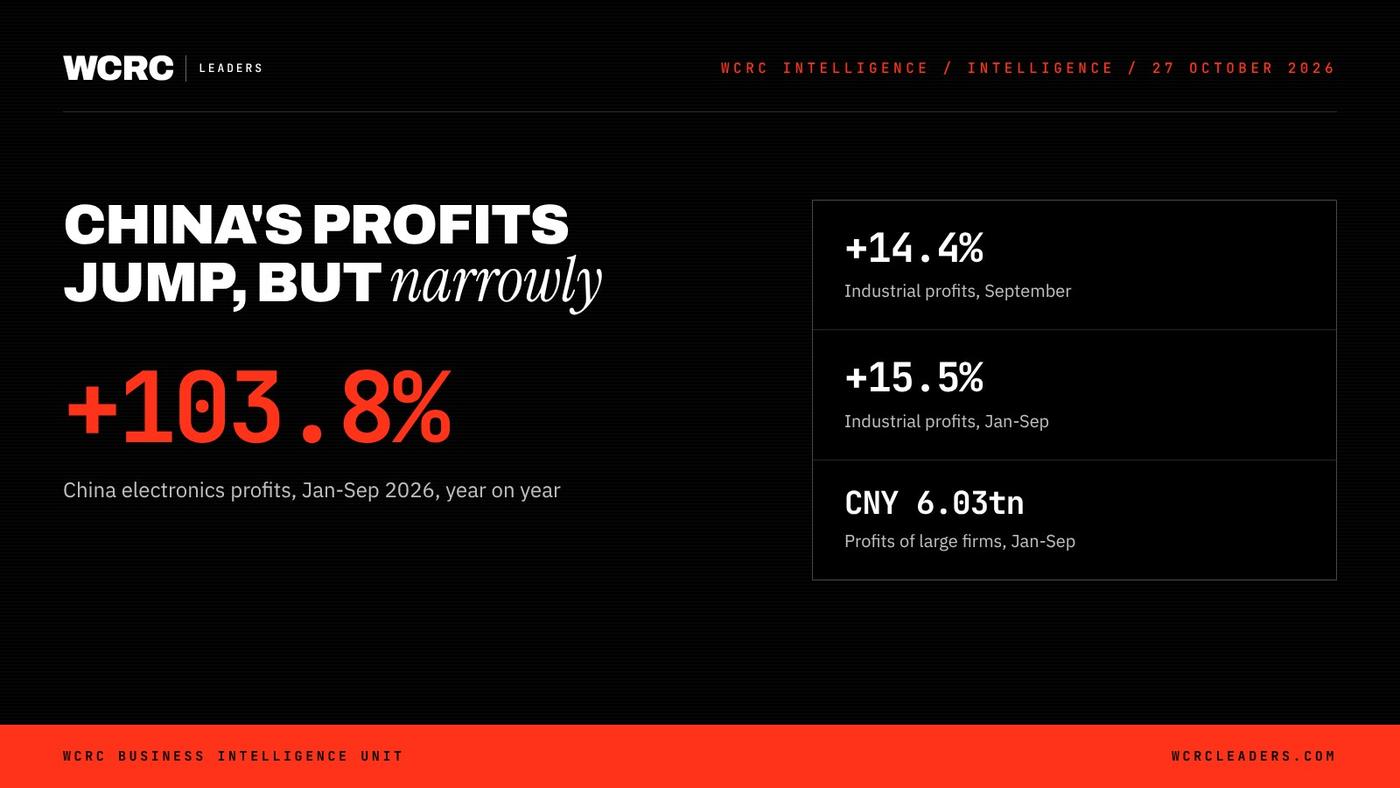
At a glance: WCRC Leaders' assessment: China's profit recovery is narrow and export-led, which means sharper competition for Indian electronics makers and Gulf metals sellers, and continued price pressure for anyone selling steel or cars into Asia. On 27 October 2026, China's National Bureau of Statistics (NBS) reported that profits at large industrial firms rose 14.4% year on year in September and 15.5% for January to September, to CNY 6.03tn. Computers and electronics profits more than doubled. Steel profits fell 73.3%.
What did China report on 27 October?
China's industrial enterprises above designated size, firms with annual revenue of at least CNY 20m, earned total profits of CNY 6,033.74bn between January and September. That is 15.5% more than a year earlier on the NBS's comparable basis. In September alone, profits rose 14.4%, a sharp pick-up from August, when monthly growth was 4.2%.
Revenue grew far more slowly than profit, up 6.6% to CNY 106.21tn. Costs rose 6.1%. The operating margin widened to 5.68%, 0.44 percentage points higher than a year earlier. Of every CNY 100 of revenue, costs took CNY 85.02, down CNY 0.45.
By broad sector, mining profits rose 38.2% to CNY 881.37bn and manufacturing rose 17.0% to CNY 4,573.80bn. Electricity, heat, gas and water supply fell 14.3%.
By ownership, shareholding companies did best, up 20.8%. State-controlled firms rose 13.1% and private firms 8.7%. Foreign-invested firms, including those from Hong Kong, Macao and Taiwan, managed only 0.5%. That last figure deserves a board's attention: multinationals manufacturing in China are not sharing in the rebound.
The balance sheet is less comfortable. Receivables rose 10.0% to CNY 29.77tn and finished-goods inventories rose 11.6% to CNY 7.37tn, both faster than revenue. The average collection period stands at 71.6 days.
Where exactly is the money being made?
In a handful of industries. Computers, communications and other electronic equipment earned CNY 985.19bn, up 103.8%, on revenue growth of 21.0%. Yu Weining, chief statistician of the NBS industry department, said electronics alone added 9.6 percentage points to total profit growth. He linked the gains to electronic materials and semiconductor components, citing demand for AI computing power and advanced memory.
High-technology manufacturing as a whole grew profits 52.0%, and now accounts for 25.5% of all industrial profit, up 6.2 points.
Raw materials are the second engine. Nonferrous metal smelting and rolling earned CNY 442.55bn, up 79.7%. Nonferrous ore mining rose 68.0%. Chemical raw materials and products rose 49.2%, chemical fibres 81.7% and coal mining 57.0%. Oil refining swung back to profit, CNY 84.22bn, which the NBS attributed in part to higher international crude prices. The NBS says raw-material industries together grew profits 44.9%.
Prices explain much of the metals story. The NBS producer price data for September show nonferrous smelting prices up 21.4% year on year, against a headline producer price rise of 5.0%.
Who is losing in China, and why does it matter outside?
Steel and cars. Ferrous metal smelting and rolling earned just CNY 24.34bn on CNY 5.55tn of revenue, a margin of under half a percent, and profits fell 73.3%. In January to August the fall was 62.4%, so the squeeze is deepening. Steel prices at the mill gate fell 0.2% in September even as the wider index rose.
Car manufacturing profits fell 22.8% to CNY 267.54bn, worse than the 16.0% decline to August. Revenue still grew 2.6%, but costs grew 3.8% and factory-gate car prices were 2.0% lower than a year ago. Non-metallic minerals, which include cement and glass, fell 46.9%. Electrical machinery, home to much of the battery and solar supply chain, fell 5.9% despite revenue growth of 11.3%.
WCRC analysis: an industry that keeps growing revenue while its profits shrink is selling more at lower prices. When the home market cannot absorb that volume, the surplus tends to look for buyers abroad. China's goods exports rose 29.6% in September, as WCRC reported in its analysis of China's 4.5% third-quarter growth. The NBS put industrial capacity utilisation at 73.1% for the third quarter.
What does it mean for Indian manufacturers?
For electronics, China's boom is both competition and confirmation. India's electronics exports rose 70.44% to $5.31bn in September, the fastest of any major goods group, as WCRC noted in its review of India's half-year export figures. Contract manufacturers such as Dixon Technologies, one of WCRC 1000, India's Most Valuable Enterprises 2026, are riding the same AI and device cycle. The difference is that Chinese suppliers now have twice the profit pool to fund price cuts, capacity and component depth. China's proposed controls on 40 technologies, including 23 in AI, add a second risk: access to Chinese know-how may get slower, as WCRC explained in its report on the export-control list. Public comments close on 15 November.
For steel, the message is defensive. Chinese mills earning almost nothing at home have every reason to keep exporting. Tata Steel, one of WCRC 1000, India's Most Valuable Enterprises 2026, JSW Steel, one of WCRC 1000, India's Most Valuable Enterprises 2026, and other Indian producers face that pressure in export markets across Asia and the Gulf, and at home wherever trade protection leaves gaps.
For metals, China's nonferrous windfall points the other way. Higher aluminium, copper and zinc prices support Indian producers such as Hindalco Industries, one of WCRC 1000, India's Most Valuable Enterprises 2026, and Hindustan Zinc, one of WCRC 1000, India's Most Valuable Enterprises 2026, which reported a record quarter, as WCRC covered in its look at Hindustan Zinc's $671m quarter.
For cars, China's falling margins and prices raise the odds of more aggressive Chinese vehicle exports into third markets. Volume leaders such as Maruti Suzuki India, one of WCRC 1000, India's Most Valuable Enterprises 2026, compete with that pricing in export destinations from Africa to West Asia rather than at home.
Tata Steel, JSW Steel, Hindalco Industries, Maruti Suzuki India and Dixon Technologies were also selected among India's Most Loved 250 Workplaces 2026 by the Business Intelligence Unit of WCRC.
What does it mean for the Gulf?
The Gulf sells China the inputs of its strongest industries. Aluminium, polymers and refined products are among the region's main industrial exports, and China's nonferrous smelting profits up 79.7%, chemicals up 49.2% and refining back in profit point to firm demand and firm prices for now.
WCRC analysis: the catch is that Chinese smelters and chemical plants that are profitable again will run harder, and some of that output competes with Gulf metal and petrochemicals in third markets, including India. Gulf producers gain on price and lose some market share as Chinese supply recovers. Indian buyers of polymers and aluminium, and petrochemical producers such as Reliance Industries, one of WCRC 1000, India's Most Valuable Enterprises 2026, sit in the middle of that contest.
Utilities are the warning light. Power and heat generation profits fell 17.9% even as crude prices rose, which suggests Chinese energy users are not passing higher fuel costs on. That limits how far Gulf energy sellers can push prices into China.
The WCRC View
From the WCRC Business Intelligence Unit:
- This is a two-speed recovery, not a broad one. Electronics and metals carry the numbers; steel, cars, cement and power are going backwards. Leaders should read the 15.5% headline as a sector story, not a signal that Chinese demand overall is back.
- Indian electronics makers win on volume and lose on margin. The AI hardware cycle is lifting both countries, but Chinese suppliers now have a much larger profit cushion. Indian boards should lock in component supply and price long-term contracts while the cycle lasts.
- Steel and auto exporters should plan for cheaper Chinese competition through 2027. Margins near zero at home push Chinese mills and carmakers abroad. Indian and Gulf producers should check where their export markets overlap with China's and prepare trade-remedy cases early.
- Gulf metals and petrochemicals sellers have a price window, not a guarantee. Strong Chinese margins today invite more Chinese capacity tomorrow. Use current prices to secure offtake agreements with India and ASEAN buyers.
- What WCRC will watch next: whether September's 14.4% monthly gain holds in the January to October figures the NBS normally publishes in late November; the outcome of China's technology export-control consultation after 15 November; and whether rising receivables and inventories at Chinese firms turn into deeper export discounting.
Quick answers
Q: How much did China's industrial profits grow in September 2026? A: Profits at industrial firms above designated size rose 14.4% year on year in September, and 15.5% for January to September, to CNY 6.03tn, according to the NBS.
Q: Which Chinese industries grew profits fastest? A: Computers, communications and electronics (+103.8%), chemical fibres (+81.7%), nonferrous metal smelting (+79.7%), nonferrous mining (+68.0%) and coal mining (+57.0%).
Q: Which industries lost ground? A: Ferrous metal smelting (steel) fell 73.3%, non-metallic minerals 46.9%, car manufacturing 22.8% and power and heat supply 17.9%.
Q: How did profits differ by ownership? A: Shareholding companies rose 20.8%, state-controlled firms 13.1%, private firms 8.7% and foreign-invested firms 0.5%.
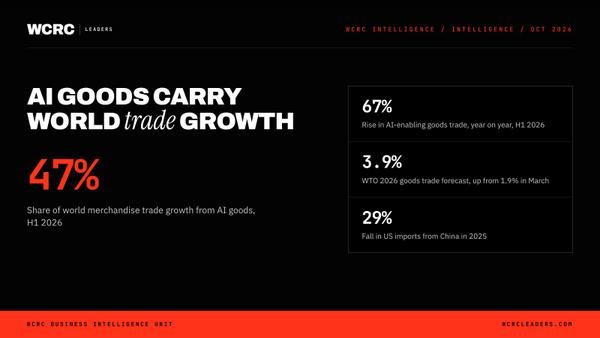
The AI trade economy: chips and servers now carry almost half of world trade growth
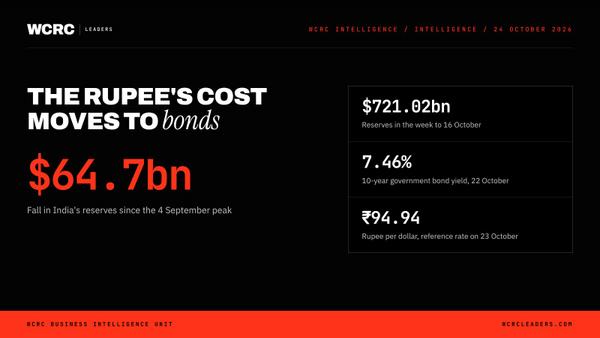
India's 10-year yield hits 7.46% as reserves fall $64.7bn from peak
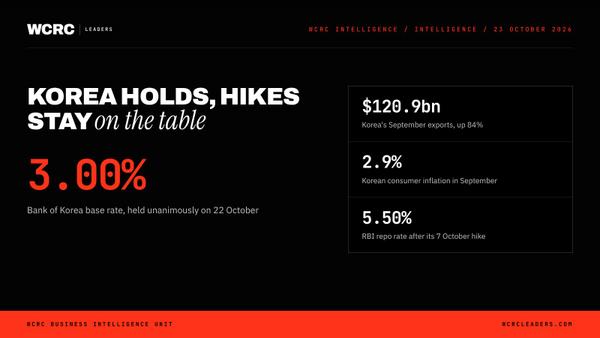
Bank of Korea holds at 3.00% and keeps more hikes on the table

The AI adoption gap: what the World Bank's new numbers say about emerging markets

Jio's IPO, China's GDP: the leaders' week ahead, 19 to 25 October
Singapore's core inflation cools to 2.0% as India and Japan heat up
Filed under