Business
Hyundai India tops ₹20,000 crore revenue as costs cut profit 24%
Hyundai Motor India sold more cars than in any quarter before and crossed ₹20,000 crore of quarterly revenue for the first time. Commodity costs took four points off its operating margin, and profit fell by almost a quarter in Tarun Garg's third quarter as its first Indian MD and CEO.
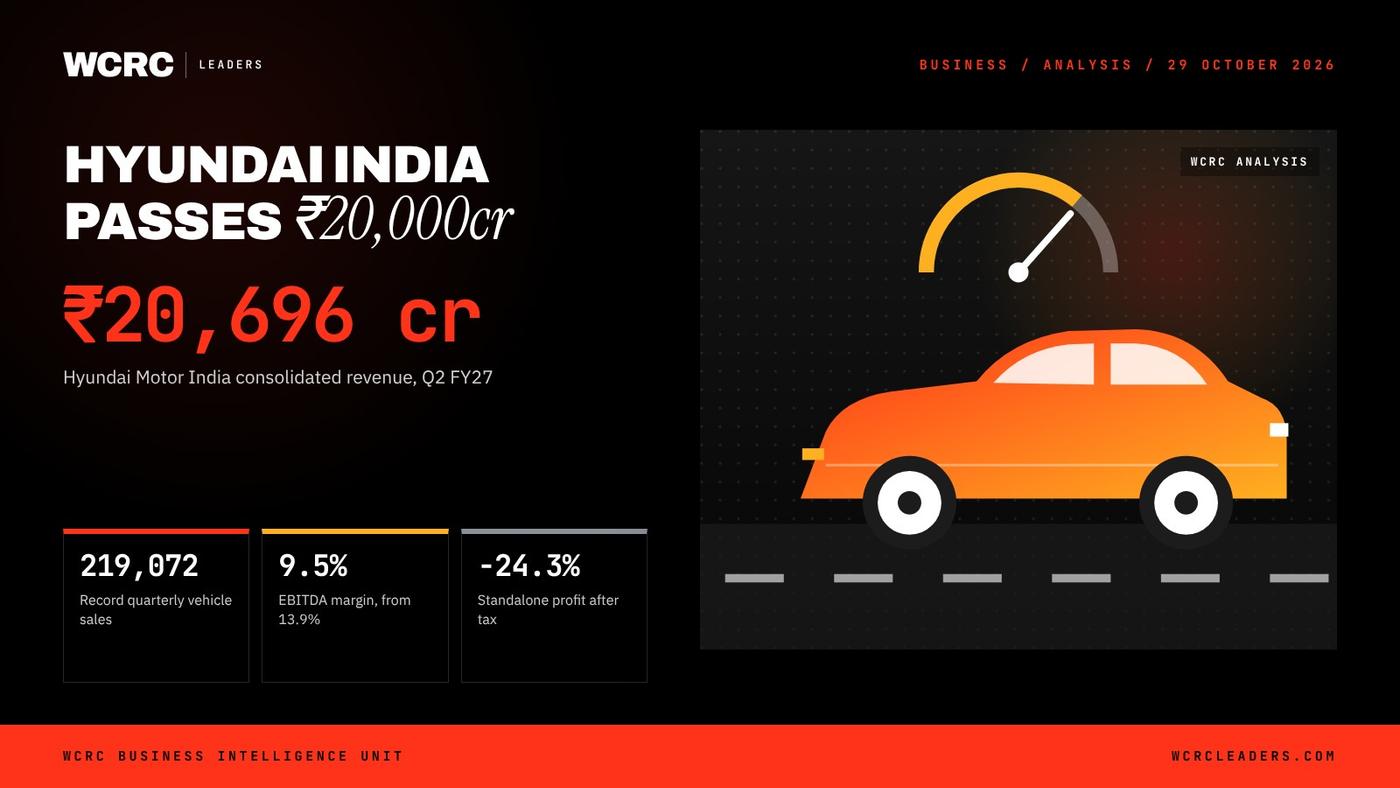
At a glance: WCRC Leaders' assessment: Hyundai India has proved it can win back volume, but not yet that it can pass on costs, so the BAYON launch and the Pune plant must now earn margin as well as share. On 28 October 2026 the board approved results for the quarter to 30 September. Consolidated revenue rose 18.5% to ₹20,696 crore on record sales of 219,072 vehicles. EBITDA margin fell to 9.5% from 13.9%, and standalone profit after tax fell 24.3% to ₹1,188.6 crore.
What did Hyundai Motor India report?
Hyundai Motor India, one of WCRC 1000, India's Most Valuable Enterprises 2026, reported standalone revenue from operations of ₹20,191 crore for the July to September quarter, up 18.3% from ₹17,061 crore a year earlier. Standalone profit after tax fell 24.3% to ₹1,188.6 crore from ₹1,570.2 crore.
On a consolidated basis, revenue was ₹20,696 crore, up 18.5%, and profit after tax was ₹1,196.2 crore against ₹1,572.3 crore. The company said this was the first time quarterly revenue had passed ₹20,000 crore since its inception. The previous best in its recent filings was ₹18,916 crore in the March 2026 quarter.
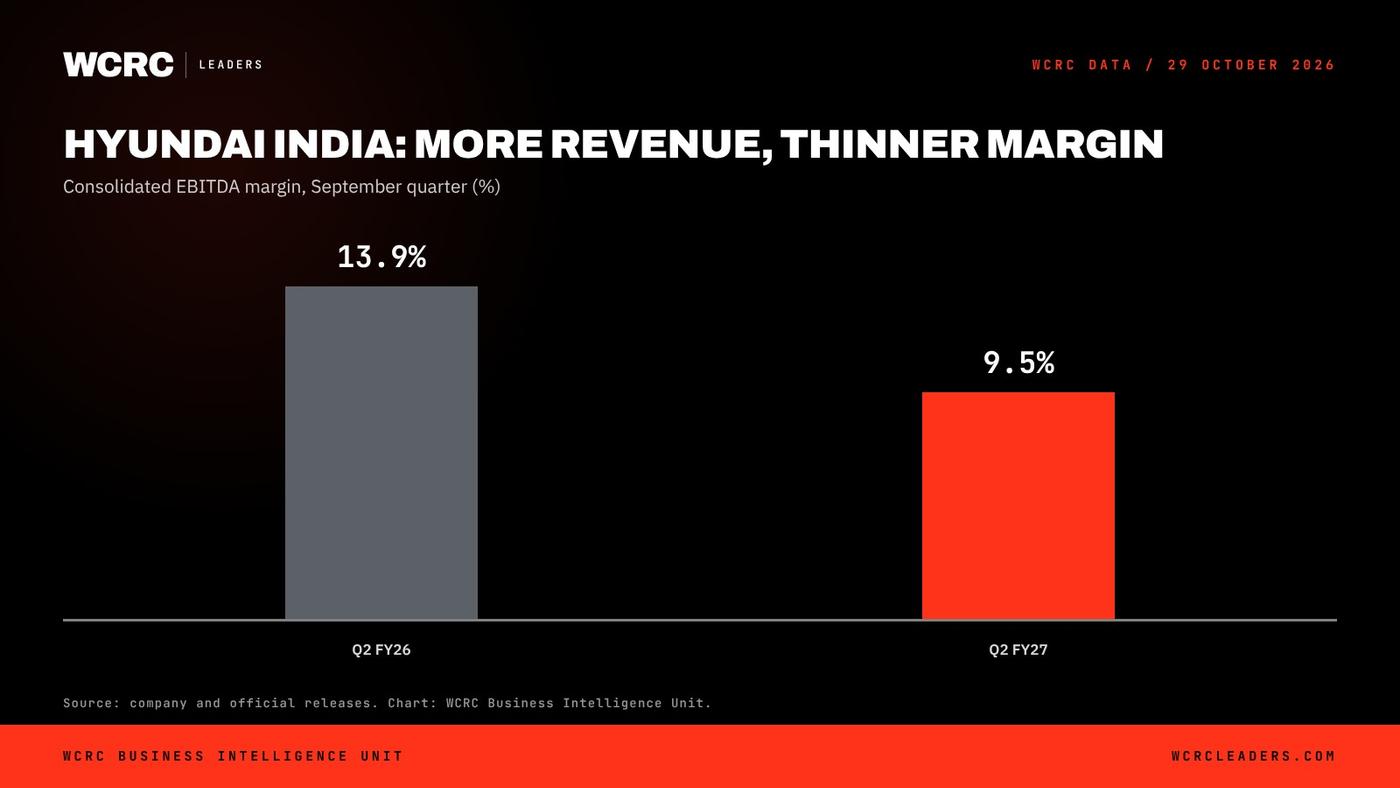
The company's own EBITDA measure, which excludes other income, was ₹1,974.5 crore, down from ₹2,428.9 crore. That is a margin of 9.5%, against 13.9% a year ago and 9.3% in the June quarter. For the first half of the year, consolidated revenue rose 9.3% to ₹37,031 crore while profit after tax fell 29.1% to ₹2,084.8 crore.
Managing Director and CEO Tarun Garg called it "a milestone quarter for HMIL, marked by record volumes," and said "elevated commodity costs weighed on the quarter's profitability."
Where did the volume come from?
Total sales were 219,072 units, up 14.7% year on year and 23% on the June quarter. Domestic sales rose 18.8% to 165,772. Exports, including fully built cars and kits, rose about 4% to 53,300, and 38% on the June quarter.
The company said rural penetration reached an all-time high of 26.6% of sales and that CNG cars made up a record 19.1%.
Pricing held up. The investor presentation shows average selling price up 2% year on year, to about ₹8.07 lakh per car from ₹7.91 lakh, and domestic discounts down 8.2% to about ₹23,000 per car from ₹25,000. The company describes this as a "Quality of Sales" strategy.
WCRC analysis: revenue grew about 3.6 points faster than volume, so mix and price did add value. In the terms of WCRC's Price Power Model, which asks how much premium a brand can charge before buyers switch, Hyundai showed some pricing strength: it cut discounts and still grew domestic volume by almost a fifth. The limit is that a 2% rise in selling price could not keep pace with input costs. Price power that stops at 2% is not enough to protect margin in a commodity spike.
Why did profit fall when sales rose?
Costs grew faster than revenue. Standalone total expenses rose 24% to ₹18,845 crore. The cost of materials consumed rose 29.1% to ₹15,731 crore, against revenue growth of 18.3%.
WCRC analysis: taking materials, bought-in stock and the change in inventories together, the material bill rose from about 71.8% of standalone revenue to 75.7%. That gap of roughly four points is almost exactly the fall in EBITDA margin. Other expenses rose 24.7% and employee costs 21.3%, while depreciation rose only 6.4%. Inventories of finished goods and work in progress also built up by about ₹526 crore during the quarter, consistent with stocking ahead of the festive season and the BAYON launch.
Hyundai is not alone. Maruti Suzuki, also one of WCRC 1000, reported record volumes and a 27% fall in quarterly profit, which it linked to commodity costs tied to the West Asia conflict (see Maruti Suzuki's record quarter and 27% profit fall). India's wholesale inflation has run well ahead of retail prices (see India's 11.39% wholesale inflation and the margin squeeze).
How does Hyundai stand against its rivals?
Hyundai is a WCRC MegaBrand in mainstream mass-market cars; Maruti Suzuki is a WCRC MegaBrand in entry-level and value cars.
WCRC analysis: read through WCRC's Category Command Model, which asks who leads a category and by how much, the September quarter widened the gap at the top in absolute terms. Maruti's total sales rose 26.5% to 696,654 vehicles, against Hyundai's 14.7% to 219,072. Hyundai's response is to fight on mix rather than volume alone: rural reach, CNG and SUVs at a higher selling price. That holds only if the products keep pulling buyers without deeper discounts.
The company's next moves are dated. The BAYON, a mid-size SUV priced from ₹9,99,900 ex-showroom, launched on 26 October and will be exported to more than 50 markets. Garg described it as the beginning of "Hyundai's next golden product cycle in India." The results release says a dedicated mass-market electric car is due in the January to March 2027 quarter.
What do the Pune plant and the group's $15.5bn plan change?
On 14 October the company opened its plant at Talegaon, Pune, with installed capacity of 170,000 units a year, rising in phases to 320,000 by 2030, and an investment of up to ₹11,000 crore. With Chennai, combined capacity is planned to reach nearly 1.14 million units a year by 2030. The new Venue is built only at Pune and is exported.
A day earlier, Hyundai Motor Group announced a USD 15.5 billion investment in India from 2026 to 2032, covering manufacturing at Hyundai Motor India and Kia India, about USD 700 million for research and development, supplier localisation and future mobility. Executive Chair Euisun Chung said India "remains one of Hyundai Motor Group's most important and strategic markets globally."
WCRC analysis: new capacity raises fixed costs before it raises output. As Pune scales, the company will need higher volumes, or better prices, to keep margin from slipping further. Exports are the swing factor: they were 24% of sales this quarter, and the BAYON and Venue export plans are meant to fill the new lines.
What does it mean for CEOs and boards in India, the Gulf and Asia?
Garg took over on 1 January 2026, the first Indian national to lead the company in its history. He joined in 2019 from Maruti Suzuki, where he rose from management trainee to Executive Director. Read through WCRC's seven leadership parameters, the quarter speaks to Impact Index, with record volumes and a new plant, and tests Resilience Factor, because the profit line is where the commodity shock landed.
For Indian boards, the lesson is that volume recovery and margin recovery are separate tasks. For Gulf and Asian groups with Indian manufacturing or export exposure, Hyundai shows India being built as an export base, with BAYON and Venue aimed at dozens of markets.
Hyundai Motor India was also named among India's Most Loved 250 Workplaces 2026 by the Business Intelligence Unit of WCRC. A new plant and a new product cycle will test whether that culture travels to Pune.
The WCRC View
The call. This is a strong commercial quarter and a weak financial one. Hyundai won volume, cut discounts and lifted price, yet a four-point rise in the material bill wiped out the gain. Boards should read the ₹20,000 crore line as scale, not as profit recovery.
Who gains and who is exposed. Steel and component suppliers with pricing power gain for now. Carmakers that cannot reprice are exposed. Hyundai's Price Power is real but narrow; in the terms of the Category Command Model, it is choosing mix over a volume race with Maruti.
Value. Read through WCRC's Corporate Value Intelligence lens on enterprise value, investors will price Hyundai on margin trajectory rather than units. A 9.5% EBITDA margin against 13.9% a year ago is the number that matters.
What leaders should do now. Separate price from cost in every product line. Use launches to reset price, not to buy volume. Phase capacity spending to demand, and lock in localisation and supplier terms before the next cost swing.
What WCRC will watch. Whether EBITDA margin moves back above 10% in the December quarter as BAYON volumes arrive, how export share moves once Pune scales, and whether the mass-market EV lands on schedule in the March 2027 quarter.
WCRC models applied: Price Power Model and Category Command Model (Brand & Marketing Codex); seven leadership parameters (Impact Index, Resilience Factor); WCRC 1000 and Corporate Value Intelligence.
Quick answers
Q: What was Hyundai Motor India's revenue in Q2 FY27? A: Consolidated revenue from operations was ₹20,696 crore, up 18.5%, its first quarter above ₹20,000 crore. Standalone revenue was ₹20,191 crore, up 18.3%.
Q: Why did Hyundai India's profit fall? A: The company cited elevated commodity costs. Standalone material costs rose 29.1% against revenue growth of 18.3%, and standalone profit after tax fell 24.3% to ₹1,188.6 crore.
Q: How many cars did Hyundai India sell in the quarter? A: A record 219,072 units, up 14.7%: 165,772 in India, up 18.8%, and 53,300 exported.
Q: Who leads Hyundai Motor India? A: Tarun Garg, Managing Director and CEO since 1 January 2026, the first Indian national in the role.
Adani Ports raises FY27 capex by ₹3,000 crore as overseas ports surge
Vedanta doubles Gamsberg, and Ramaphosa now wants a zinc smelter
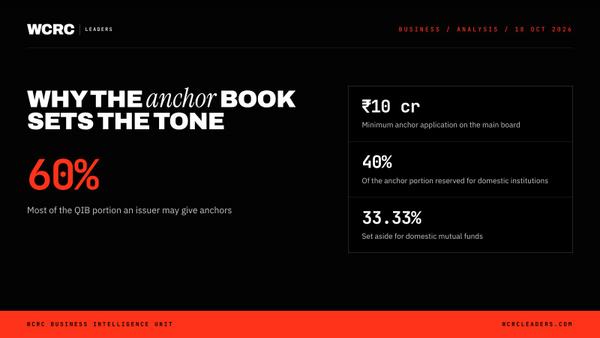
Anchor investors in Indian IPOs: why the 60% book sets the tone

Bajaj Finance lines up ₹17,500 crore as AI agents take on service

$133bn: what India's rupee defence is costing its biggest banks
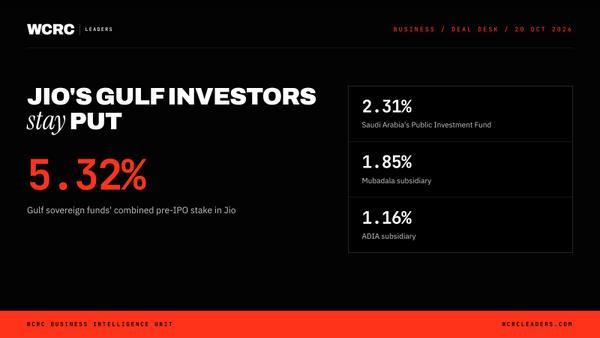
Jio Platforms IPO: Gulf funds hold 5.32% and are not selling
Filed under