Recognitions
Maruti Suzuki sells a record 696,654 cars as quarterly profit falls 27%
India's largest carmaker has won back share through a wave of SUVs and record volumes. The September quarter shows the price: commodity costs tied to the West Asia conflict and treasury losses took more than a quarter off profit.
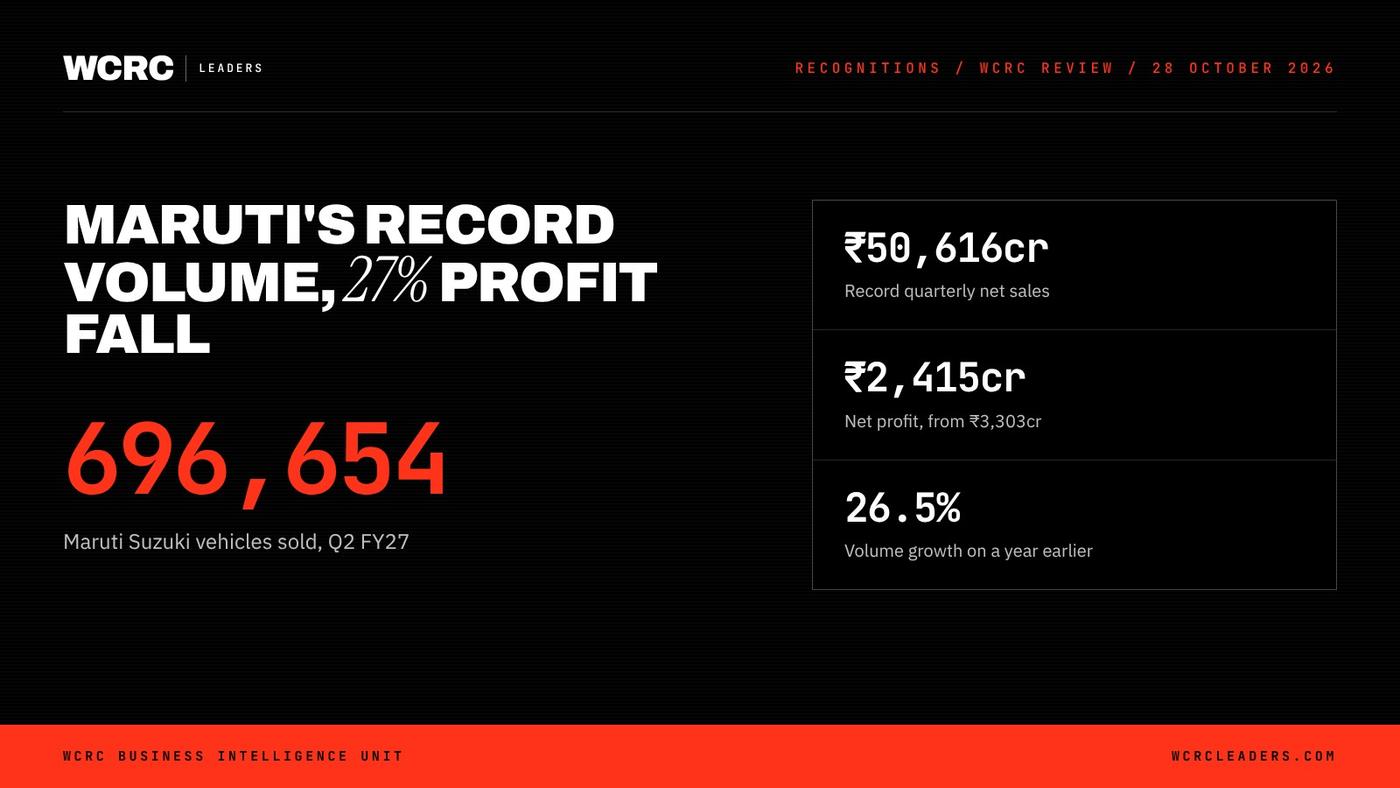
At a glance: WCRC Leaders' assessment: Maruti Suzuki has proved its brand can win the SUV buyer at scale, but Q2 FY27 shows that volume leadership no longer protects margins when input costs move against it. On 27 October 2026 the board approved results showing record quarterly volume of 696,654 units, up 26.5%, and record net sales of ₹50,616 crore. Net profit fell to ₹2,415 crore from ₹3,303 crore. For leaders, the lesson is about pricing power and balance-sheet discipline, not demand.
What did Maruti Suzuki report for the September quarter?
Maruti Suzuki India, one of WCRC 1000, India's Most Valuable Enterprises 2026, by market capitalisation, published its results for July to September 2026 (Q2 FY 2026-27) on 27 October. The headline numbers pull in opposite directions.
Volumes and sales hit new highs. The company sold 696,654 vehicles in the quarter, its highest ever, up 26.5% on a year earlier. Net sales rose to ₹506,155 million (₹50,616 crore) from ₹401,358 million, an increase of about 26%, also a quarterly record.
Profit went the other way. Operating profit (EBIT) fell to ₹28,037 million from ₹33,820 million. Net profit dropped to ₹24,149 million (₹2,415 crore) from ₹33,028 million, a fall of about 27%. The prior-year figures are restated because Suzuki Motor Gujarat, a wholly owned subsidiary, was merged into the company with effect from 1 April 2025.
On WCRC's arithmetic from the reported figures, EBIT margin narrowed to about 5.5% of net sales from about 8.4% a year earlier. The company itself does not publish a margin percentage in its release.
Why did profit fall when sales were at a record?
The company gives two reasons, and they are different in kind.
The first is operational. Maruti attributes the lower EBIT to commodity cost increases linked to the West Asia conflict. That pressure was already visible in Q1, when the company said material costs had risen. There is a small sign of relief: the release says EBIT rose 10.8% on the previous quarter.
The second is financial. In the company's words, "non-operating income declined sharply in Q2 owing to mark-to-market losses on invested surplus." In a volatile quarter, Maruti's treasury book subtracted from earnings.
Analysis: the split matters for reading the brand. The treasury loss is a timing effect that can reverse. The commodity squeeze is structural for as long as the conflict keeps metal and energy prices high, and it tests whether Maruti can pass costs on to a buyer it has spent decades training to expect value.
How has the brand held its ground in the SUV shift?
For several years the central question about Maruti was whether a brand built on small, frugal hatchbacks could follow Indian buyers into SUVs. Rivals such as Mahindra & Mahindra, Hyundai Motor India and Tata Motors Passenger Vehicles, a WCRC MegaBrand in passenger vehicles, built strong SUV franchises while Maruti's share slipped.
This quarter answers that question more clearly than any before it. Domestic SUV sales rose 68.2% year on year. The company says its "recently introduced SUVs received a strong market response" and drove the growth. Domestic market share rose 2.2 percentage points to 40.8%. In Q1 it had risen 2.3 points to 41.2%.
The small-car base has not been abandoned. Domestic small car sales rose 35.9% in Q2, after the GST-led price cut from 22 September 2025 brought buyers back. A year ago the picture was the reverse: in Q2 FY26 domestic wholesales fell 5.1% as customers waited for that tax cut.
Demand is running ahead of supply. Maruti ended the quarter with about 17 days of network inventory and roughly 200,000 pending bookings. New capacity at Kharkhoda and in Gujarat is what made the record volume possible.
Maruti Suzuki is the WCRC MegaBrand in Cars, entry and value, and is also named in the compact SUV and MPV categories of the MegaBrands universe. That breadth, from entry cars to SUVs, is the commercial asset this quarter's volume rests on.
What is happening with exports and the e Vitara?
Exports are the one line that did not grow. Maruti shipped 108,119 vehicles abroad in Q2, slightly below 110,487 a year earlier, and cited "the challenging geopolitical situation." The comparison base is high: Q2 FY26 was then the highest export quarter in the company's history.
The longer record is strong. Exports reached more than 4.47 lakh vehicles in FY 2025-26, up over 34%, and the company says it holds more than 50% of India's passenger vehicle exports. In September 2026 it reported that cumulative exports of the made-in-India Jimny 5-door, FRONX and e VITARA to Japan had passed 100,000 units. Managing Director and CEO Hisashi Takeuchi called this "a powerful endorsement of India's manufacturing excellence."
The e VITARA, Maruti's first battery electric vehicle, is built only at Hansalpur in Gujarat. Shipments to Europe began in September 2025, and it went on sale in India on 17 February 2026 with an introductory battery-as-a-service price from ₹10.99 lakh plus ₹3.99 per kilometre for the battery. Partho Banerjee, Senior Executive Officer, Marketing and Sales, said the aim was to "ensure that the e VITARA becomes the primary EV choice for customers."
Analysis: the Q2 release does not mention the e VITARA or electric vehicles at all. The EV is, for now, a brand and export statement rather than a driver of the quarter's numbers. The financing model, which separates the battery cost from the car price, is the more instructive move: it lets a value brand enter a premium-priced technology without abandoning its price promise.
What does this mean for leaders in India, the Gulf and Asia?
For Indian boards, Maruti's quarter is a case study in the gap between market share and margin. Winning back 2 points of share in a growing market is hard. Doing it while costs rise means accepting thinner margins, at least for a period.
For Gulf and wider Asian leaders, the link to the West Asia conflict is direct. The same disruption that raises commodity and energy costs for an Indian manufacturer also unsettles the export routes and markets Maruti serves. Companies with Gulf exposure should treat the conflict as a cost and demand risk at once.
Maruti's standing as an employer is part of its resilience. Maruti Suzuki India was selected among the Most Loved Workplaces in India's automotive industry by the Business Intelligence Unit of WCRC, and is also among India's Most Loved 250 Workplaces 2026. Delivering record output from new plants needs a workforce that can scale quickly. The full report and evidence are available from WCRC on request.
For a parallel read on a rival's September quarter, see WCRC's review of Tata Motors' 42% volume jump and its Iveco bid. For the trade backdrop to Asian car exports, see the EU-China hybrid car deal and negotiated export restraint.
The WCRC View
What is working. The SUV strategy has worked. A 68% rise in SUV sales and a 40.8% domestic share show that Maruti's brand now travels upmarket. The brand's value positioning, combined with new capacity, has turned a weakness of three years ago into its main growth engine.
What is not. Pricing power has not kept pace with volume. Profit fell 27% in a record quarter, and margins narrowed by about 3 points on WCRC's arithmetic. A brand built on value finds it harder than most to raise prices when commodities rise.
The treasury lesson. A large cash pile is a strength, but marked to market it can turn a cost problem into a headline profit problem. Boards with big investment books should explain to shareholders how volatile that income can be.
What leaders should do now. Separate structural costs from timing effects in every results message, as Maruti did. Protect share during demand upswings, but set a clear margin floor and the price actions that defend it.
Who gains. In the near term, buyers gain from Maruti's restraint on price. Suppliers with pricing power in metals and components gain at its expense.
What WCRC will watch next. Whether EBIT keeps recovering quarter on quarter, whether exports return to growth as geopolitical conditions settle, and whether the e VITARA moves from a brand statement to a measurable share of volume in FY27's second half.
Quick answers
Q: What were Maruti Suzuki's Q2 FY27 results? A: Net sales were a record ₹50,616 crore and volumes a record 696,654 units, up 26.5%. Net profit fell about 27% to ₹2,415 crore.
Q: Why did Maruti Suzuki's profit fall? A: The company cited commodity cost increases linked to the West Asia conflict, which cut EBIT, and mark-to-market losses on its invested surplus, which reduced non-operating income.
Q: How did Maruti's SUVs perform? A: Domestic SUV sales rose 68.2% year on year, and domestic market share rose 2.2 percentage points to 40.8%.
Q: Did Maruti's exports grow in Q2 FY27? A: No. Exports were 108,119 units, slightly below 110,487 a year earlier, which the company linked to the geopolitical situation.
No strings attached: what the MacArthur model teaches about recognising talent
Wipro's 58.6% large-deal drop puts Rishad Premji to the test
Tata Motors posts 42% volume jump as its €3.9bn Iveco bid nears close

The 'alternative Nobel' goes to an AI accountability pioneer

What makes a business recognition credible

Navi Pillay and leadership through institutions
Filed under