Business
Gulf FDI hits $99bn high, then Hormuz breaks the 2026 run
UNCTAD's first investment report on the Gulf Cooperation Council shows the region's best year in a decade. Its own early 2026 data shows the money now stalling, turning inward and leaving Gulf partners in India and Asia exposed.
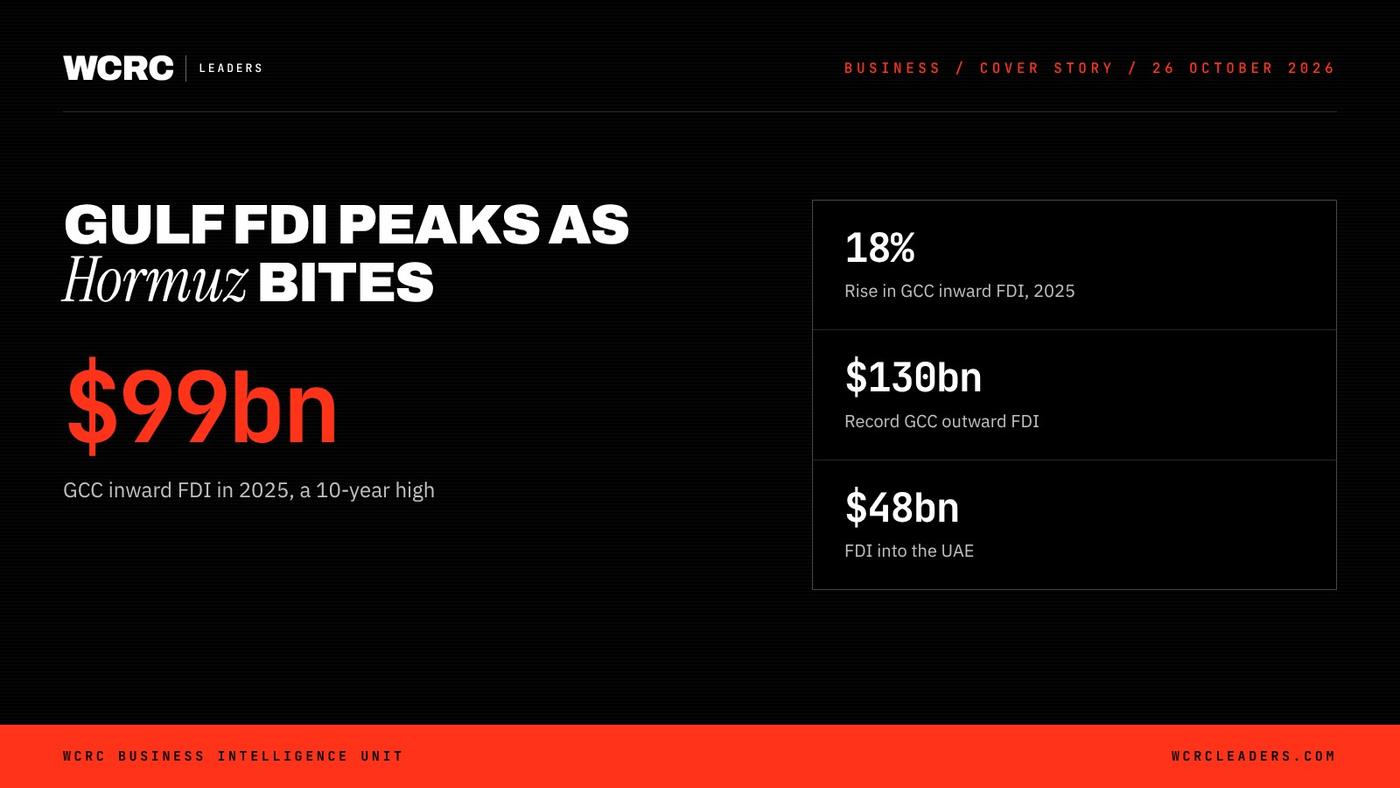
At a glance: WCRC Leaders' assessment: the Gulf's record 2025 is now a ceiling, not a floor, and Indian and Asian firms that planned on easy Gulf capital in 2027 should re-plan around a slower, more domestic and more selective investor. UNCTAD released its Gulf Cooperation Council Investment Report on 25 October 2026, as the World Investment Forum opened in Doha. It finds GCC inward FDI up 18% to about $99bn in 2025 and outward FDI up 11% to $130bn. It also finds "a sharp, region-wide weakening" in early 2026, tied to the Strait of Hormuz crisis.
What did UNCTAD find about Gulf investment in 2025?
The headline is strong. Foreign direct investment into the six GCC states rose 18% in 2025 to about $99bn ($98.5bn in the report's detailed tables), a 10-year high. The GCC took about 6% of global FDI, which grew 6% to about $1.6 trillion in the same year.
Two countries did most of the work. The UAE attracted about $48bn. Saudi Arabia drove about three quarters of the region's increase. Together they took more than four fifths of all GCC inflows.
The pipeline looked even better. Announced greenfield investment into the GCC rose 66% to about $78bn, and the number of projects rose 12% while greenfield projects fell 10% worldwide. Information and communication drew the most announced value. International project finance rose 65% to $114bn, even though the number of deals fell 16%. Telecommunications project finance more than tripled to almost $24bn, largely on the back of the $20bn Stargate UAE AI data-centre project.
The Gulf is also a bigger investor abroad than at home. Outward FDI rose 11% to a record $130bn, more than $30bn above inflows. Announced GCC greenfield projects outside the region rose from $139bn in 2016 to 2020 to $461bn in 2021 to 2025, with Egypt and the United States the leading destinations.
Where do India and Asia fit in the Gulf's investment story?
Asia is now central on both sides of the ledger. The report finds that China and India have grown in importance as sources of investment into the GCC. India was the second-largest source of announced greenfield investment into the region in 2025, after a substantial rise from 2024. China became the second-largest source over the full 2021 to 2025 period.
In the other direction, UNCTAD's Global Investment Trends Monitor No. 51 says developing Asia has been the main destination for GCC investment since 2019, taking around 40% of GCC outward flows. India is named among the destinations that drew significant Gulf money in 2021 to 2025. In the first half of 2026, GCC outflows went mainly to residential real estate in Egypt and to mining and metallurgy in India.
That two-way traffic is visible in Indian capital markets. Three Gulf sovereign funds, Saudi Arabia's Public Investment Fund, a Mubadala subsidiary and an Abu Dhabi Investment Authority subsidiary, held a combined 5.32% of Jio Platforms before its October IPO and did not sell. Jio is a WCRC MegaBrand in mobile network operators, and its parent Reliance Industries is one of WCRC 1000, India's Most Valuable Enterprises 2026. Reliance Industries was also selected among India's Most Loved 250 Workplaces 2026 by the Business Intelligence Unit of WCRC.
How badly has the Hormuz crisis hit Gulf investment in 2026?
Hard, and fast. The GCC report says the 2026 Strait of Hormuz crisis "has introduced significant uncertainty into the investment outlook for GCC countries", and that preliminary indicators for the first half of 2026 "point to a sharp, region-wide weakening of investment activity."
UNCTAD's trends monitor puts numbers on it. In the second quarter of 2026, outward investment from GCC countries fell by more than half, against both the 2021 to 2025 average and the same quarter of 2025. GCC outward international project finance fell by more than 80% in developed economies and by more than 50% in developing ones. Outward greenfield activity from the GCC fell 34% in the first half against the 2025 half-year average. Greenfield project announcements in West Asia fell 52%.
The UK Maritime Trade Operations centre has logged 135 attack events since the conflict began on 28 February, and Hormuz transits are about 70% below pre-conflict levels. Attacks on Saudi airports led the FII Institute to postpone FII10 in Riyadh to 2027. UNCTAD says the disruptions have raised transport, fuel and insurance costs and weakened investment sentiment.
Why is Gulf money turning inward, and what does Emaar's $55bn project signal?
The same UNCTAD data shows where some of the capital went. After a standstill in March and April, GCC domestic investment more than tripled year on year in the second quarter, reaching four times its 2021 to 2025 average. Most of that surge came from one project: a nearly $55bn urban district in Dubai announced by state-linked developer Emaar.
The GCC report itself flags the consequence. "A shift towards domestic investment could slow the rapid expansion of outward investment observed in recent years," it says. It also points Gulf governments towards infrastructure "that reduces dependence on vulnerable maritime chokepoints", and towards skills, technology and domestic supplier capabilities.
WCRC analysis: a single $55bn real estate commitment flatters the domestic figure and should not be read as broad-based confidence. But the direction is clear. Gulf capital is being held closer to home, in projects that governments can see and steer, while overseas sustainable development and infrastructure bets are being delayed. UNCTAD's monitor warns the conflict "could prompt Gulf investors to delay or scale back sustainable development projects in developing economies."
What does this mean for Indian and Asian firms raising Gulf capital?
Three things change for boards in India and across Asia.
First, the pool is smaller and more domestic for now. Firms counting on Gulf sovereign or strategic money for 2027 renewables, infrastructure or real estate should expect longer diligence, smaller tickets and more conditions. Sectors that kept attracting Gulf money in the first half, such as mining and metals in India, look better placed than long-dated green infrastructure.
Second, building in the Gulf is a different trade. Domestic mega-projects create demand for contractors, engineers, IT services, materials and logistics, areas where Indian and Asian firms already compete. But payment terms, insurance and supply routes now carry war-risk costs. UNCTAD's call for chokepoint-light infrastructure suggests pipelines, ports outside the strait, rail and grids will be favoured, which fits the preliminary UAE-Saudi rail and grid pact.
Third, competition for Gulf partners is rising. The UAE's tech and AI drive, led at federal level by Omar Sultan Al Olama, selected among Asia's Top 100 Emerging Leaders 2026 by the Business Intelligence Unit of WCRC, is drawing partners from across Asia. Singapore's move to CEPA talks with the UAE shows rivals are working to lock in the corridor.
What happens next?
The World Investment Forum runs in Doha until 27 October, with more than 5,000 participants, including sovereign wealth fund leaders, and nearly 50 ministers. Watch whether new Gulf commitments there point abroad or at home. UNCTAD's next global trends data in early 2027 will show whether the second-quarter fall in Gulf outward investment was a pause or a trend. FII10 is due to return to Riyadh in 2027, on dates still to be confirmed.
The WCRC View
The WCRC Business Intelligence Unit reads this report as two stories in one. 2025 confirmed that the Gulf is now a large, two-way investment hub, with India a leading source of new projects. 2026 shows how quickly that can stall when a single chokepoint is threatened.
Who gains: Gulf home markets, especially the UAE and Saudi Arabia, as capital is redeployed into domestic districts, data centres and chokepoint-light infrastructure. Indian and Asian contractors, engineers and technology firms that can deliver in the Gulf, on Gulf terms, should win work.
Who loses: Indian and Asian projects that depended on Gulf capital going abroad, especially long-dated renewables and infrastructure in developing economies, where UNCTAD expects delays or cuts.
What boards should do now: stress-test any 2027 plan that assumes Gulf co-investment, and line up a second funder. Price war-risk insurance, freight and payment delays into Gulf contracts. Shift Gulf pitches towards what Gulf states now want: domestic capability, supplier development, skills and resilient logistics.
What WCRC will watch: deal announcements at the Doha forum, Hormuz transit volumes, UNCTAD's next quarterly data, and whether Gulf sovereign funds keep holding Indian positions, as they did with Jio Platforms.
Quick answers
Q: How much FDI did the GCC attract in 2025? A: About $99bn ($98.5bn in detailed tables), up 18% and a 10-year high, according to UNCTAD's Gulf Cooperation Council Investment Report.
Q: Which Gulf countries drew the most investment? A: The UAE attracted about $48bn and Saudi Arabia drove about three quarters of the increase. Together they took more than four fifths of GCC inflows.
Q: How has the Hormuz crisis affected Gulf investment? A: UNCTAD reports a sharp, region-wide weakening in the first half of 2026. GCC outward investment fell by more than half in the second quarter, and outward greenfield activity fell 34% in the first half.
Q: Why did Gulf domestic investment rise in 2026? A: GCC domestic investment more than tripled year on year in the second quarter, mostly because of a nearly $55bn urban district project in Dubai announced by Emaar.
Jio Platforms' ₹30,213 crore IPO: why no one is selling

Rubio in Mumbai: India-US trade deal is "very, very close"
HPCL earns ₹3,625 crore as $116 crude tests India's oil bill
FII10 slips to 2027: what Riyadh's delay means for CEOs and boards
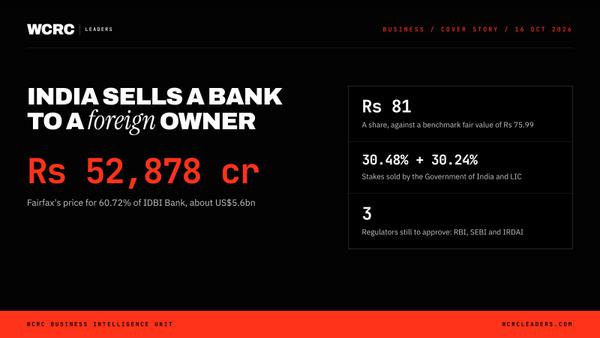
Fairfax wins IDBI Bank: inside India's Rs 52,878 crore bank sale
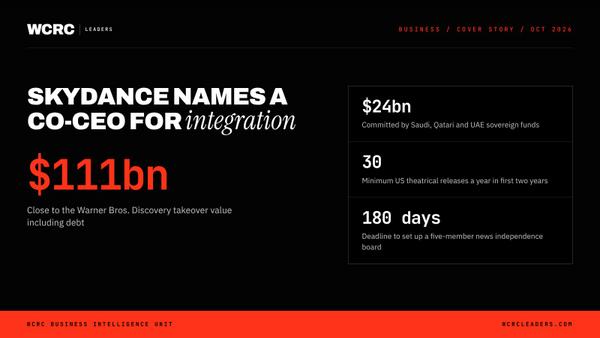
The $111bn integration test: how Skydance will be run
Filed under