Business
UAE and Singapore move to CEPA talks on $6.5bn of trade, up 25%
The UAE and Singapore have agreed to negotiate a Comprehensive Economic Partnership Agreement, add an energy taskforce with ADNOC and welcome Temasek to Abu Dhabi. The Gulf-Asia corridor is moving from goodwill to legal text.
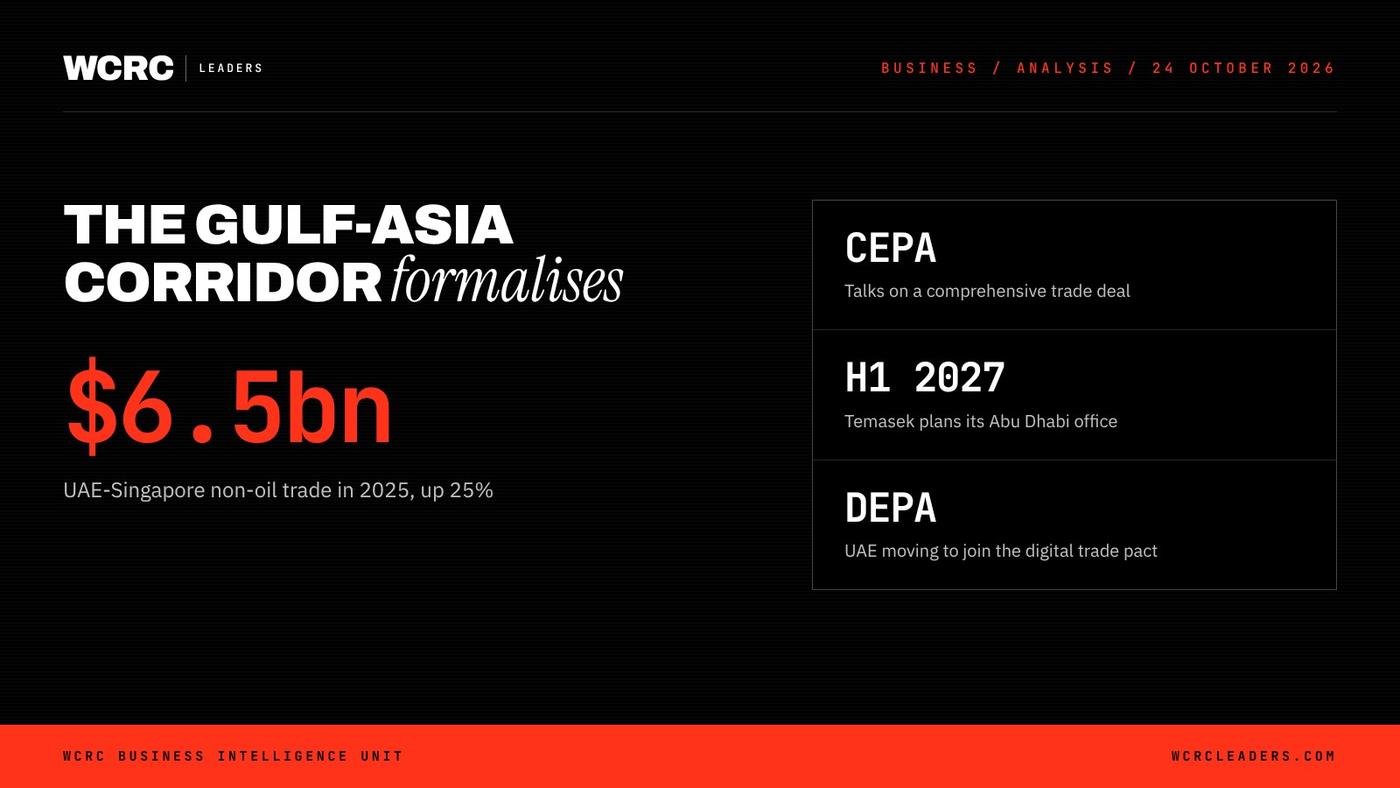
At a glance: WCRC Leaders' assessment: the trade numbers are small, but the deal turns Singapore into the UAE's rule-setting partner in Southeast Asia, and Indian companies should treat it as competition for Gulf capital, not a sideshow. On 21 October 2026 in Abu Dhabi, President Sheikh Mohamed bin Zayed Al Nahyan and Prime Minister Lawrence Wong announced their intent to launch CEPA talks, an energy taskforce and progress on the UAE joining the Digital Economy Partnership Agreement. Temasek will open an Abu Dhabi office.
What did the two leaders agree?
The headline is a trade negotiation. In the joint statement issued after the leaders met at Qasr Al Watan on 21 October, the two governments announced their intent to launch negotiations on a Singapore-UAE Comprehensive Economic Partnership Agreement (CEPA), which they said would deepen economic integration and make trade and investment easier. Singapore's Ministry of Foreign Affairs described the step as an intent to launch talks. No timetable for concluding them was published.
The numbers behind it are modest but rising fast. The UAE is Singapore's largest trading partner and investment destination in the Middle East and North Africa. Non-oil trade between the two reached about US$6.5 billion in 2025, up 25% on 2024, according to the joint statement.
Three memorandums were signed in front of the two leaders. The most commercially important is between Singapore's Ministry of Energy, Trade and Industry and the Abu Dhabi National Oil Company (ADNOC). It sets up a Joint Energy Taskforce under the Abu Dhabi-Singapore Joint Forum to explore the whole energy value chain, including trading, infrastructure and downstream activities. The other two cover water, between Singapore's PUB and the Abu Dhabi Department of Energy, and disease vector control.
The leaders also noted continuing nuclear energy cooperation involving the Emirates Nuclear Energy Company (ENEC), which runs the four-reactor Barakah plant. ENEC says Barakah supplies up to 25% of the UAE's electricity needs when fully operating. They agreed to convene a fourth Singapore-UAE Joint Committee, with artificial intelligence, cybersecurity, space and nuclear technology on the list, and Sheikh Mohamed accepted an invitation to make a State Visit to Singapore, date to be agreed.
Why does Temasek's Abu Dhabi office matter?
Because money tends to follow people on the ground. Temasek said on 30 September that it plans to open offices in Abu Dhabi and Riyadh, expected in the first half of 2027 and subject to statutory approvals. That would take it from 13 offices in nine countries to 15 across 11. Some of its portfolio companies plan to share the new hubs, and Temasek said the move would also improve its reach into Central Asia and Africa.
"The Middle East is an important part of Temasek's global network," said Dilhan Pillay Sandrasegara, Temasek's chief executive. Chia Song Hwee, who became chairman of the firm's Middle East and Africa business on 1 September, said: "Being on the ground in the Middle East will strengthen engagement with our partners."
Temasek's net portfolio value was S$518 billion (US$401 billion) at 31 March 2026. The joint statement's mention of the Abu Dhabi office puts that decision inside the state-to-state relationship.
What is the DEPA, and why is the UAE joining?
The Digital Economy Partnership Agreement was signed online in June 2020 by Singapore, Chile and New Zealand. South Korea joined in May 2024. It sets common rules on digital trade, such as electronic invoicing, data flows and digital identity. The UAE applied on 7 June 2023, and Singapore chairs its accession working group. The joint statement welcomed "substantive progress" and said both sides want to conclude the process.
Analysis: the digital agreement may matter more to business than the tariff text. A UAE inside DEPA would share digital trade rules with Singapore and Korea. A company that builds its systems to those rules could find the Gulf and parts of Asia work like one compliance zone.
How does this fit the UAE's CEPA programme?
Singapore joins a long queue. In January 2026, when the UAE signed its CEPA with the Philippines, the UAE government said it had concluded 32 such agreements, 14 of them in force. Others have followed, including Gabon in February. The UAE aims to lift non-oil foreign trade to US$1.1 trillion by 2031. In the first half of 2026 that trade reached AED1.937 trillion, up 13.1% year on year, according to the Dubai government.
India is the programme's flagship. The India-UAE CEPA was signed on 18 February 2022 and came into force on 1 May 2022. India's Ministry of Commerce puts bilateral merchandise trade at US$43.3 billion in 2020-21, before the deal. It reached US$100.06 billion in 2024-25, up 19.6%. Both governments now aim for US$100 billion of non-oil, non-precious-metal trade by 2030. India was the UAE's third-largest non-oil trading partner in the first half of 2026, at AED107.5 billion.
The India deal is not friction-free. The CEPA Joint Committee met in New Delhi in November 2025 and dealt with the allocation of India's gold tariff-rate quota, anti-dumping cases, rules of origin and Indian standards licensing. Those are the issues a Singapore text will also have to settle.
What are Singapore's existing Gulf links?
Singapore already has a regional deal. The GCC-Singapore Free Trade Agreement came into force on 1 September 2013 and removes tariffs on about 99% of Singapore's exports to the six Gulf states. A bilateral CEPA would go deeper than that baseline. Mr Wong's trip, his first to the Middle East as prime minister, began in Qatar, where he co-chaired the ninth Qatar-Singapore High-Level Joint Committee with Emir Sheikh Tamim bin Hamad Al Thani. Both governments also want to move an ASEAN-GCC free trade agreement forward while Singapore chairs ASEAN in 2027. More than 4,000 Singaporeans live in the UAE, the largest Singaporean community in the region.
Who gains, and who should worry?
Analysis. Gulf energy companies gain a trading and downstream partner in one of Asia's main refining and bunkering centres. Singapore gains a foothold for its firms and funds in the UAE, which offers access to Africa and Central Asia. That route also runs through Temasek's own reasoning for the office.
India's position is mixed. It holds the deepest CEPA and the largest trade with the UAE. But Singapore has the overlap that matters: a hub model, a sovereign investor with Gulf partners, digital rules the UAE is about to adopt, and a regional chair year in 2027. Gulf sovereign funds already sit on Indian cap tables, as WCRC noted in its coverage of Gulf investors in the Jio Platforms IPO. The question for Indian boards is whether the next round of Gulf allocations to Asia goes through Mumbai or through Singapore.
The Gulf's own integration is moving too, from the UAE-Saudi rail and grid pact to the risk boards now price after the attacks around Hormuz. The joint statement itself noted both governments' concern over continued regional tensions and their support for transit passage under the law of the sea. Energy security, not only trade, is driving these deals.
The WCRC View
From the WCRC Business Intelligence Unit.
- What it means. The UAE-Singapore CEPA is less about US$6.5 billion of trade than about who writes the rules of the Gulf-Asia corridor. With DEPA accession, an ADNOC energy taskforce and Temasek on the ground, Singapore is becoming the UAE's rule-setting partner in Southeast Asia.
- Who gains. Singapore-based traders, refiners, logistics firms and fund managers gain first, followed by Gulf energy companies seeking Asian downstream outlets. Indian firms keep a lead on volume but risk losing ground on digital rules and capital routing.
- What Indian CEOs should do now. Use the India-UAE CEPA fully: check rules-of-origin compliance, government tender preferences and services access, and bring live disputes, such as gold quota allocation, to the Joint Committee early. Boards seeking Gulf capital should present a clear Abu Dhabi case before Temasek's office opens in 2027.
- What Gulf and Southeast Asian CEOs should do. Gulf firms should map which Singapore entities could serve as Asian holding or trading hubs once CEPA terms are known. Southeast Asian firms should watch the ASEAN-GCC talks in Singapore's chair year and prepare for DEPA-style digital rules on both sides of the corridor.
- What WCRC will watch. The first CEPA negotiating round and its scope; the date of the UAE's DEPA accession; the first projects from the Joint Energy Taskforce; Temasek's Abu Dhabi licence and opening in the first half of 2027; and the State Visit to Singapore.
Quick answers
Q: What did the UAE and Singapore announce on 21 October 2026? A: Their intent to launch CEPA negotiations, a Joint Energy Taskforce with ADNOC, memorandums on water and vector control, and progress on the UAE's accession to DEPA.
Q: How large is UAE-Singapore trade? A: Non-oil bilateral trade was about US$6.5 billion in 2025, up 25% on 2024, according to the joint statement.
Q: When will Temasek open in Abu Dhabi? A: Temasek expects its Abu Dhabi and Riyadh offices to open in the first half of 2027, subject to statutory approvals.
Q: How has the India-UAE CEPA performed? A: India's Commerce Ministry reports bilateral trade of US$100.06 billion in 2024-25, up from US$43.3 billion in 2020-21, the year before the CEPA came into force on 1 May 2022.
Vedanta doubles Gamsberg, and Ramaphosa now wants a zinc smelter
Anchor investors in Indian IPOs: why the 60% book sets the tone

Bajaj Finance lines up ₹17,500 crore as AI agents take on service

$133bn: what India's rupee defence is costing its biggest banks
Jio Platforms IPO: Gulf funds hold 5.32% and are not selling
Détente in two-month instalments: planning for China after the Washington summit
Filed under