Business
Fairfax wins IDBI Bank: inside India's Rs 52,878 crore bank sale
India has chosen Prem Watsa's Fairfax to take control of IDBI Bank at Rs 81 a share. It is the first time the state has handed a bank of this size to a private, foreign-owned buyer, and it reopens a privatisation agenda many had written off.
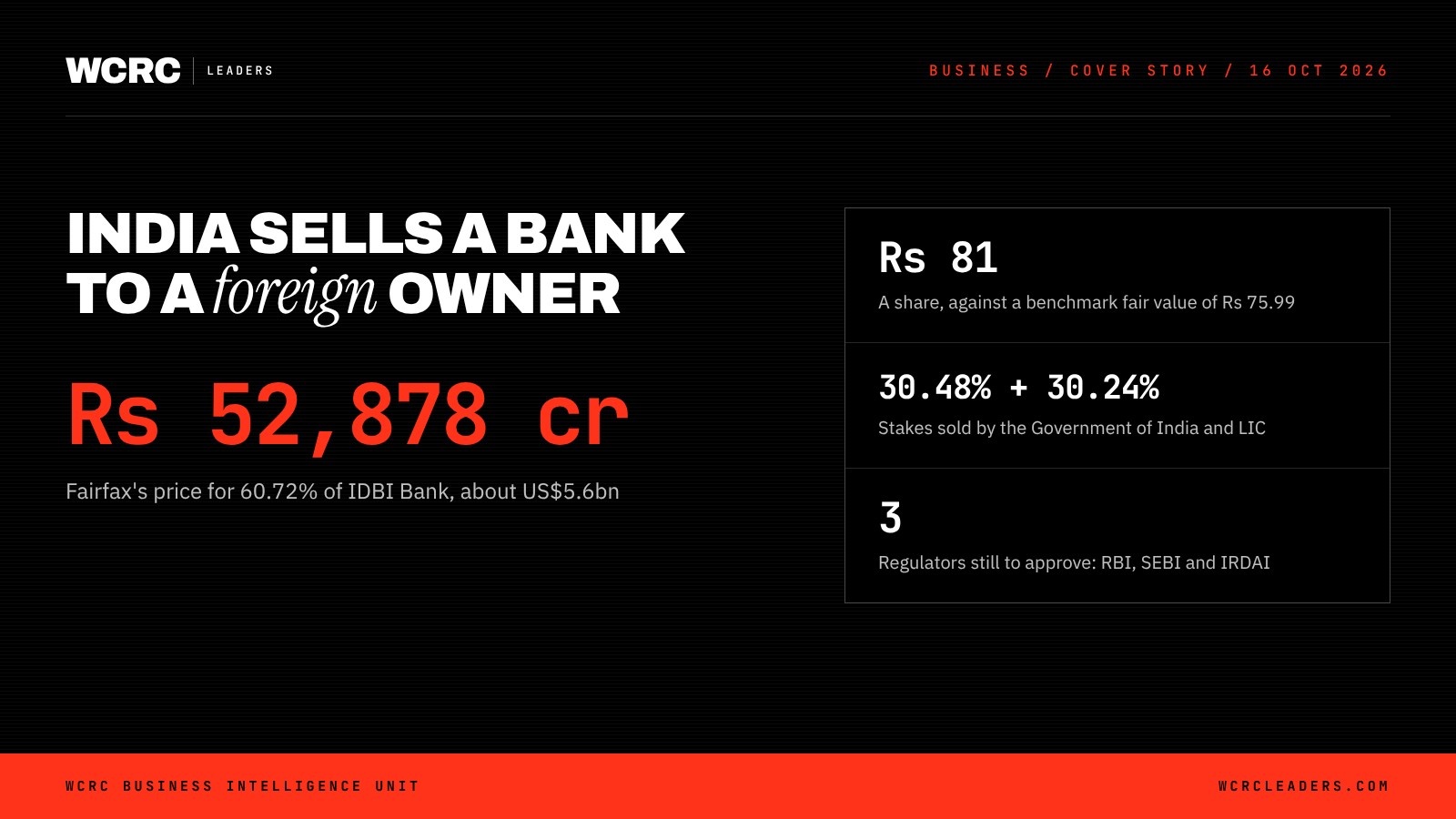
At a glance: WCRC Leaders' assessment: the IDBI sale proves India will sell a bank to a foreign owner when the price is right, and it turns Fairfax from a portfolio investor into a full-service financial group that rivals cannot ignore. On 14 October 2026 the Cabinet Committee on Economic Affairs approved 10955230 Canada Inc., a Fairfax Financial Holdings subsidiary, as buyer of a 60.72% stake for Rs 52,878.08 crore. The government sells 30.48% and LIC 30.24%. The Reserve Bank of India, SEBI and IRDAI must still approve, and no binding agreement has yet been signed.
What exactly did the government approve?
The Cabinet Committee on Economic Affairs (CCEA) named 10955230 Canada Inc., whose parent is Fairfax Financial Holdings, as the strategic buyer of 60.72% of IDBI Bank. The Ministry of Finance put the purchase consideration at Rs 52,878.08 crore. Fairfax says that is Rs 81 a share, or about US$5.6 billion, and roughly a 23% premium to IDBI Bank's book value at 30 June 2026.
The stake comes from two sellers. The government sells 30.48% and Life Insurance Corporation of India (LIC) sells 30.24%. Afterwards the government keeps 15% and LIC 19%. The CCEA has authorised the sale of the government's residual 15% in the open market. LIC will manage its 19% under its own procedures and its regulators' directions.
The Ministry of Finance describes the deal, once completed, as the largest foreign direct investment in India's financial sector so far. It is also far bigger than the Rs 18,000 crore enterprise value at which the Tata group's Talace won Air India in October 2021, the government's last landmark strategic sale.
Why did the sale take five years?
IDBI Bank's path to this point has been long. The Reserve Bank of India (RBI) placed the bank under its Prompt Corrective Action framework on 5 May 2017 because of bad loans and losses. LIC then bought a 51% controlling stake, and the RBI recategorised IDBI as a private sector bank for regulatory purposes from 21 January 2019. The RBI lifted the corrective restrictions on 10 March 2021.
The Union Budget for 2021-22 listed IDBI Bank for strategic disinvestment, alongside a plan to privatise two public sector banks and one general insurer. The CCEA gave in-principle approval for the sale with transfer of management control on 5 May 2021. The government issued its Preliminary Information Memorandum on 7 October 2022.
Only bidders found "fit and proper" by the RBI and cleared by the Ministry of Home Affairs could take part. Five parties sent expressions of interest, four qualified and two submitted financial bids. Those first bids, in 2025-26, fell short of the reserve price of Rs 94.42 a share and were rejected. The government then sought sealed best offers. Two independent valuers set an average fair value of Rs 75.99 a share as the benchmark. Fairfax's Rs 81 cleared it by about 6.6%.
Price was the sticking point throughout. IDBI's shares traded at Rs 42.40 before the 2022 memorandum, reached Rs 108.12 on 8 January 2026 and swung between Rs 61.01 and Rs 118.38 during the valuation period. The ministry set the market price aside, calling the stock thinly traded and out of line with intrinsic value.
What is Fairfax buying?
Fairfax is buying a bank that has repaired itself. For 2025-26, IDBI Bank reported net profit of Rs 9,513 crore, up 27%, on total business of Rs 6,00,789 crore. Its gross non-performing assets fell to 2.32%, net NPAs were 0.15%, provision coverage was 99.39% and its capital adequacy ratio was 26.65%. Return on assets was 2.27%. The CASA ratio, a gauge of cheap deposits, slipped to 44.59% from 46.55%.
Analysis: at Rs 81 a share, the deal values the whole bank at about Rs 87,000 crore. The new owner gets a clean, highly capitalised balance sheet with room to lend and a national branch network.
How will Fairfax reshape IDBI?
The bigger plan lies beyond the bank. Fairfax intends to contribute its interests in Go Digit General Insurance and Go Digit Life Insurance to IDBI Bank. Its listed vehicle, Fairfax India Holdings, would contribute its stake in IIFL Capital Services. Both would go in at market prices. Fairfax says the aim is a leading bank headquartered in India that spans banking, general insurance, investment banking and wealth management.
Leadership is set, subject to the RBI. Rakesh Sharma, IDBI's MD and CEO, is expected to keep running the combined business. N.S. Kannan, former CFO of ICICI Bank and former MD and CEO of ICICI Prudential Life, would be chairman. C.VR. Rajendran, former CEO of CSB Bank, joins the leadership group. Go Digit's Kamesh Goyal and IIFL Capital's management team stay in place.
Prem Watsa, Fairfax's Chairman and CEO, called the deal "a once-in-a-lifetime opportunity to purchase a majority interest in a bank". IIFL Group founder Nirmal Jain said the partnership "would create a unique opportunity for IIFL Capital to accelerate growth".
Fairfax already has a deep India footprint. At 31 December 2025, Fairfax India owned 74% of Bangalore International Airport, 40% of CSB Bank, 27.2% of IIFL Capital Services (30.6% across the Fairfax group), 15.2% of IIFL Finance and stakes in chemicals, shipping, logistics and engineering firms. Its total assets were US$4.05 billion.
What does it mean for foreign ownership and bank privatisation?
For foreign capital, the signal is clear: India will hand control of a large bank to an overseas buyer that passes the RBI's fit-and-proper test. Control is not the same as votes, however. Under the Banking Regulation Act and RBI rules, a single shareholder's voting rights in a private bank are capped at 26%, whatever its equity stake. RBI ownership rules also expect promoters to bring their holding down to 26% over 15 years. Fairfax will have to submit a compliance roadmap to the RBI.
Analysis: this sale tests whether the 2021 promise to privatise public sector banks can still be delivered. IDBI was the easiest case, as it was already classified as private and was largely owned by LIC. Selling a nationalised bank would need changes to banking law. Still, a completed sale at a price above fair value gives the government a template: a transparent auction, an independent valuation and a buyer the RBI has already vetted.
A clear issue remains open. Fairfax India's 40% of CSB Bank sits alongside control of IDBI, and the RBI will need to settle how one group can hold both. Fairfax has not said what it plans for CSB.
What happens next?
The steps from here are regulatory, and the order matters:
- Agreements. Fairfax says no binding definitive agreements have been signed and the buyer designation is not the final stage. The deal could also close without one or both of the Digit and IIFL Capital contributions.
- RBI. The buyer must present its credentials under the fit-and-proper process and a roadmap for meeting regulatory conditions. The RBI must also approve the board and leadership changes.
- SEBI and IRDAI. SEBI must review each contribution. IRDAI must approve the Digit transfer.
- Residual stakes. The government's 15% goes to the open market through the Alternative Mechanism. LIC handles its 19% separately.
- Financing. Fairfax plans to pay from cash and other sources, including existing credit lines and possible asset sales.
The WCRC View
From the WCRC Business Intelligence Unit:
- This is a credibility win for India's disinvestment programme. After failed first-round bids, the government held its line, set a benchmark from independent valuations and still sold above it. Global investors will read that as a market that keeps its word on price and process.
- Fairfax is the clear winner, and the bank's rivals should take note. Combining a clean bank with a general insurer, a life insurer and a capital markets house creates a bancassurance and wealth platform under one roof. Mid-sized private banks and stand-alone insurers face a better-funded, cross-selling competitor.
- Leaders in the Gulf and Asia should treat this as a door opening. Sovereign funds and regional banks weighing Indian financial assets now have a live precedent for foreign control of a bank, within the 26% voting cap. Boards should model what minority voting power means for their governance before they bid.
- For IDBI's corporate borrowers and employees, continuity is likely in the near term. Rakesh Sharma stays. The real change will come in products, pricing and technology once the Digit and IIFL Capital businesses are folded in.
- What WCRC will watch: the signing of the share purchase agreement, the RBI's ruling on Fairfax's CSB Bank stake, IRDAI's view on the Digit transfer, the timing of the government's 15% sale and whether a nationalised bank is next.
For more on India's banking leadership and the rate cycle that frames this deal, see our coverage of HDFC Bank's new chief executive and India's first rate hike since 2023.
Quick answers
Q: Who is buying IDBI Bank? A: 10955230 Canada Inc., a wholly owned subsidiary of Fairfax Financial Holdings. The CCEA approved it as strategic buyer on 14 October 2026.
Q: How much is Fairfax paying? A: Rs 52,878.08 crore for 60.72%, or Rs 81 a share, about US$5.6 billion. The benchmark fair value was Rs 75.99 a share.
Q: Will the government and LIC still own part of IDBI Bank? A: Yes. The government keeps 15%, which it plans to sell in the open market, and LIC keeps 19%.
Q: Is the deal final? A: No. No binding agreements have been signed, and approvals are still needed from the RBI, SEBI and IRDAI.
Filed under