Business
FII10 slips to 2027: what Riyadh's delay means for CEOs and boards
Saudi Arabia's flagship investor summit will not meet next week. After a run of deadly strikes on Riyadh's main airport, the "Davos in the Desert" has moved to 2027, and the question for leaders is no longer whether to fly in, but how to keep deals moving without the room.
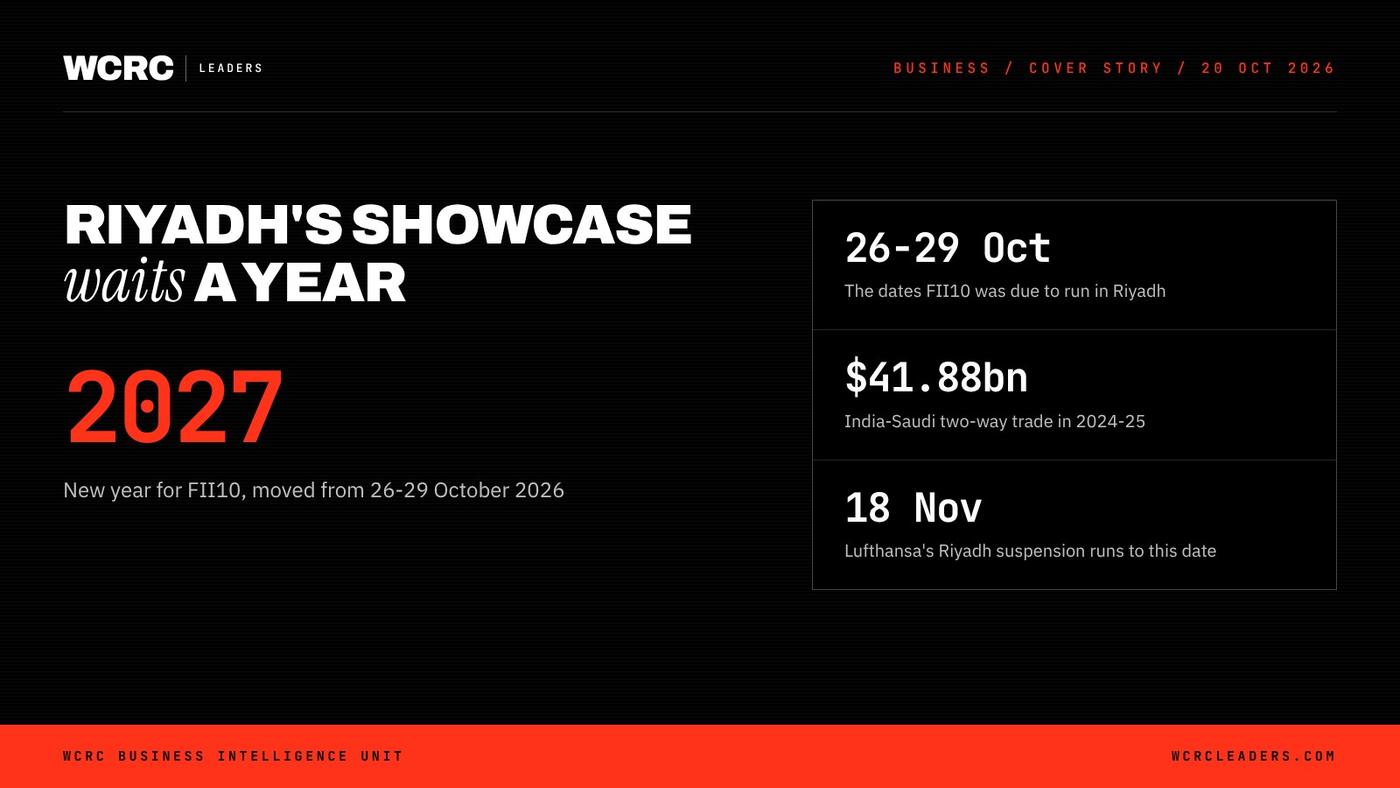
At a glance: WCRC Leaders' assessment: the FII10 delay is a security decision, not an investment verdict, but it moves the burden of Saudi dealmaking from one headline week to the steady, unglamorous work of boardrooms and duty-of-care plans. The FII Institute has postponed its tenth conference, set for 26 to 29 October in Riyadh, to 2027. It follows attacks on Riyadh's King Khalid International and Abha airports that have killed at least 16 people since 6 October, by WCRC's count of the aviation regulator's figures.
What exactly has been postponed, and what did the organisers say?
The FII Institute has moved FII10, themed "The Power of Legacy", out of its 26 to 29 October 2026 slot in Riyadh. Its website now carries a "FII10 moving to 2027" notice and a message from its chief executive, HRH Princess Dr Maha Bint Mishari Al Saud.
"This decision comes from a deep commitment to our partners, members, speakers, and delegates," the institute says, adding that it wants the tenth edition to deliver "the full scale, extraordinary quality, and unforgettable impact" its community expects. The practical points matter more to delegates: "All current registrations and partnerships remain completely valid," and "We will announce the new 2027 dates very soon." The institute says its teams "will be reaching out to each of you directly over the coming days".
The statement does not mention security. The FII Institute says its conference has drawn 65,000 attendees from 136 nationalities over its history.
It is not alone. The Saudi Retail Forum's website now reads "SRF moves to March 2027". In March, the Ministry of Economy and Planning said the World Economic Forum's April meeting in Jeddah had been rescheduled "in light of current regional developments", date still to be announced.
What happened at Riyadh's airport?
The trigger is a sequence of strikes on civil aviation that the General Authority of Civil Aviation (GACA) has set out in its own statements, published by the Saudi Press Agency:
- 6 and 7 October: separate attacks hit Abha International Airport and King Khalid International Airport in Riyadh. GACA reported two deaths and 28 injuries at Abha, and one death and eight injuries in Riyadh.
- 10 October: an afternoon attack on King Khalid International. GACA's follow-up statement put the toll at 12 dead, from Saudi Arabia, Bangladesh, the United States, Egypt, Jordan, Syria, Palestine and Sudan, and 309 injured, some critically. GACA said "operations at the airport have been temporarily suspended".
- 11 October: a further attack on the airport killed one Pakistani resident and injured 11.
- 12 October: GACA extended the suspension to complete safety and readiness checks, without giving an end date.
The Coalition to Restore Legitimacy in Yemen said on 8 October that Houthi attacks on the Riyadh and Abha airports "will not go unpunished", and reported strikes on 82 military targets in Yemen.
The British government's travel advice, updated on 17 October, now advises against all but essential travel to Saudi Arabia outside the Yemen border zone, where it advises against all travel. It says further airport attacks are "very likely" and tells British nationals to "stay away from King Khalid International Airport until it is secure".
Which airlines have pulled out, and for how long?
Carrier notices show how wide the disruption runs, and how long some expect it to last:
- Lufthansa Group: Riyadh suspended up to and including 18 November 2026; Dammam suspended to 30 November across Lufthansa, SWISS, Austrian and Edelweiss (notice of 13 October).
- Qatar Airways: flights to and from Riyadh and Dammam "temporarily suspended", with no end date (alert of 12 October).
- Cathay Pacific: Dubai and Riyadh services cancelled to 31 January 2027, a decision first posted on 28 September, before the airport strikes, which reflects wider regional risk.
- Air India and Air India Express: flights to and from Jeddah, Riyadh and Dammam suspended until 24 October 2026, according to the airline's travel advisory.
- IndiGo: Riyadh, Jeddah, Dammam and Madinah flights cancelled until 24 October 2026 (inclusive), according to its travel advisory.
For India, this is not a niche route problem. Saudi Arabia is India's fifth-largest trading partner, with two-way trade of $41.88bn in 2024-25, and about 2.74 million Indians live in the kingdom, according to India's Ministry of External Affairs. IndiGo, one of the carriers now grounded on Saudi routes, has been selected by the Business Intelligence Unit of WCRC among India's Most Loved 250 Workplaces 2026.
Does this dent Vision 2030's investor pitch?
The numbers Riyadh brings to investors are still strong. Official figures published on 16 October show foreign direct investment inflows reached SAR159bn in 2025, up 33.5% on 2024, with the stock of FDI at SAR1.059 trillion. The National Investment Strategy targets FDI at 5.7% of GDP, and more than 700 international companies have been licensed to set up regional headquarters in Riyadh. Vision 2030 has entered its third phase, covering 2026 to 2030.
Analysis: FII is where sovereign funds, asset managers and ministries sign memoranda in public, and where the kingdom shows Riyadh is a place executives want to be. A delay removes that stage at a moment when the regional headquarters policy asks companies to put senior people in the city full time. The investment case does not change in a week; the risk premium that boards attach to Riyadh-based staff and travel may.
With the WEF Jeddah meeting still undated and other forums moving into 2027, next year's calendar is crowding, which favours events with the clearest security assurances.
What does it mean for Gulf and Indian dealmaking?
Analysis: For Gulf peers, the near-term effect is relocated meetings rather than lost deals. Projects such as the UAE-Saudi memorandum of 8 October on freight rail and power links, examined in Gulf integration as strategy: the UAE-Saudi rail and grid pact, need ministries to keep study timetables, not a conference week.
For Indian companies, the exposure runs through people as much as capital. Contractors, IT services firms and banks with Saudi operations depend on steady air links for rotations and client meetings. Saudi investment in India stands at about $10bn, against $100bn announced during the Crown Prince's 2019 visit, according to India's foreign ministry. Mandates due for discussion in Riyadh next week will move to Dubai, Mumbai, London or video.
Many Gulf organisations also have new chief executives this year, as set out in The Gulf's C-suite churn. Those who planned to meet investors at FII must now build those ties one meeting at a time.
What should CEOs decide about travel and duty of care now?
Analysis: The FII decision gives boards cover for a call many were already weighing. The test is whether the company can show it assessed the risk and acted on official advice. Three facts frame it: the UK government's "all but essential" warning, a capital airport that GACA closed after a strike with more than 300 casualties, and foreign carriers that have suspended Riyadh into November and beyond.
Practical steps: a written travel threshold naming who approves essential trips; overland routings to a neighbouring country, as the UK advice suggests; and a check that insurance and evacuation cover still applies. Companies with Riyadh-based staff should confirm shelter and communication plans.
The WCRC View
From the WCRC Business Intelligence Unit
The call: Postponing FII10 is the right decision, and it is a decision about safety, not about Saudi Arabia's long-term attraction for capital. The 2025 FDI numbers and the regional headquarters programme remain intact. What has changed is the cost of presence.
Who gains and who loses: Dubai and Doha gain meetings as executives route around Riyadh. Indian contractors and service firms with Saudi teams carry the heaviest burden. The FII Institute keeps its partners but loses a milestone edition's momentum.
What leaders should do now: Do not wait for the new FII dates to restart Saudi conversations. Move priority meetings to neutral venues or video, keep deal timetables on track, and put duty-of-care decisions in writing at board level, tied to official government advice.
What WCRC will watch: whether GACA confirms full resumption at King Khalid International and when foreign carriers return; the 2027 dates the FII Institute has promised "very soon"; how many other Riyadh events follow into 2027; and whether quarterly FDI figures for 2026 hold their pace.
Quick answers
Q: When was FII10 due to take place? A: From 26 to 29 October 2026 in Riyadh. The FII Institute has moved it to 2027 and says new dates will be announced soon.
Q: Are FII10 registrations still valid? A: Yes. The FII Institute says all current registrations and partnerships remain valid and that its teams will contact delegates directly.
Q: What happened at King Khalid International Airport? A: GACA reported an attack on 10 October that killed 12 people and injured 309, and suspended operations. Further attacks followed on 11 October, and GACA extended the suspension on 12 October.
Q: Which airlines have suspended Saudi flights? A: Lufthansa Group, Qatar Airways, Cathay Pacific, Air India, Air India Express and IndiGo have all suspended some Saudi services, for periods running from 24 October to 31 January 2027.
Filed under