Business
Rubio in Mumbai: India-US trade deal is "very, very close"
Marco Rubio's India itinerary named Mumbai and Jamnagar, not New Delhi. He met India's foreign minister with the UAE at the table and said a trade deal is near. Exporters now need to know what tariff they will face, and when.
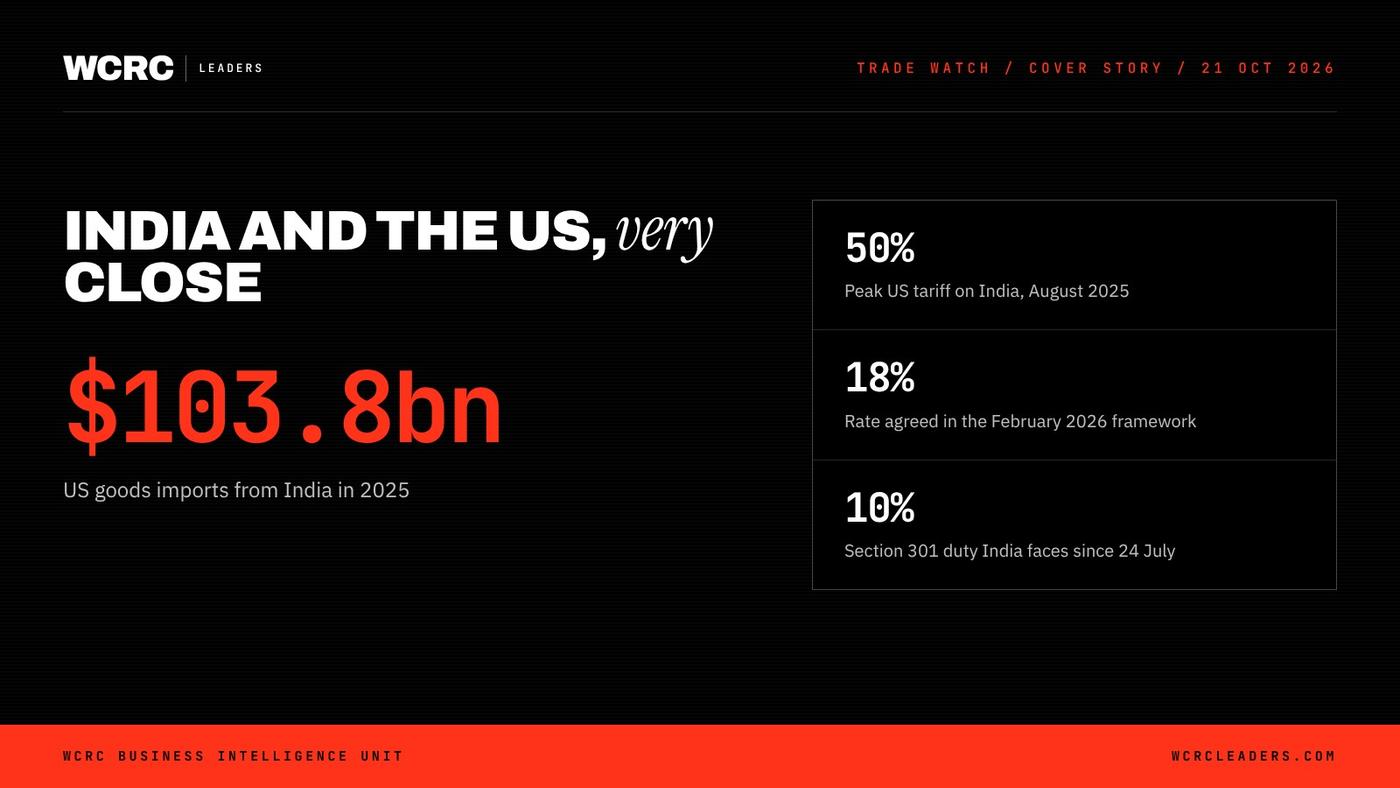
At a glance: WCRC Leaders' assessment: Rubio's Mumbai stop signals that Washington now treats India as an energy and refining partner as much as a trade partner, and exporters should plan for a signed first-stage deal within weeks but price contracts on today's tariffs. On 20 October 2026 Marco Rubio met External Affairs Minister S. Jaishankar in Mumbai and joined a trilateral meeting with the UAE's Sheikh Abdullah bin Zayed. He told reporters the trade agreement was "very, very close". His itinerary included Reliance's Jamnagar refinery on 21 October.
What happened in Mumbai?
Rubio was in Mumbai on 20 October on what the US State Department called his second official visit to India this year. The department's travel notice of 13 October listed two Indian stops after Samarkand in Uzbekistan, Mumbai and Jamnagar, with meetings on the strategic partnership, energy cooperation and commercial investment.
Rubio held talks with S. Jaishankar and joined a trilateral meeting with Sheikh Abdullah bin Zayed Al Nahyan, the UAE's Deputy Prime Minister and Foreign Minister. The UAE Ministry of Foreign Affairs said the 20 October trilateral covered the economy, trade, investment, technology and artificial intelligence, along with economic integration and regional security.
On 19 and 20 October Sheikh Abdullah and Jaishankar also met bilaterally on trade, investment, finance and energy under the UAE-India Comprehensive Economic Partnership Agreement (CEPA). The UAE ministry noted that the UAE is India's third-largest trading partner, after the United States and China.
How close is the India-US trade deal?
Close, says Rubio. Speaking to reporters at the Taj Mahal Palace hotel on 20 October, in remarks published by the State Department, he said: "We're very, very close." He added that "there's a small number of items to wrap up, so I think that will happen shortly".
In a separate interview transcript released by the department the same day, Rubio said: "I'm not personally negotiating it because it's done through our Trade Representative." He said the deal is "something we anticipate seeing in a matter of weeks, not months."
India's side of the record points the same way, without a date. When Commerce and Industry Minister Piyush Goyal travelled to the United States for the G20 trade ministers' meeting from 29 September to 5 October, his ministry said he would work to finalise an interim deal "in line with the Joint Statement of 7 February 2026." No deal text has been published, and neither government has set out final terms.
Why do tariffs on Indian goods keep changing?
Because their legal basis has shifted three times in a year.
- August 2025: up to 50%. India faced a 25% reciprocal tariff, and on 6 August 2025 President Trump ordered a further 25% duty on Indian goods over purchases of Russian oil, effective 27 August. Together that took many goods to 50%.
- February 2026: a framework at 18%. An executive order dated 6 February removed the Russia-related 25% duty from 7 February, tied to India's commitment to stop importing Russian oil directly or indirectly. The White House fact sheet of 9 February said the reciprocal rate would fall from 25% to 18%, and that India would buy more than $500 billion of US energy, technology, coal and other products.
- 20 February 2026: the legal base changed. A further executive order ended the tariffs imposed under emergency economic powers, including the reciprocal tariffs, and a proclamation the same day applied a temporary 10% import surcharge for 150 days from 24 February under Section 122 of the Trade Act of 1974.
- 24 July 2026: Section 301. As the surcharge expired, the US Trade Representative imposed duties on 60 economies over forced-labour import rules. India was placed in the lowest tier, a flat 10%, which USTR said reflected India's adoption of a forced-labour import prohibition after its June proposal. Some products are exempt, and separate Section 232 duties on goods such as metals still apply.
The headline rate on most Indian goods is now below the 18% agreed in February. A first-stage deal is therefore less about cutting a punitive tariff and more about locking in a stable rate and preferential access before the next legal change.
What does it mean for Indian exporters?
US Census Bureau data show the United States imported $103.8 billion of goods from India in 2025 and exported $45.4 billion, a US deficit of $58.4 billion. In the first eight months of 2026 US imports from India reached $68.0 billion.
WCRC analysis: Three groups have most at risk. Labour-heavy sectors such as textiles, apparel, gems and jewellery, leather and marine products compete on margins of a few points, so the gap between a 10% Section 301 duty and any rate a deal fixes is the difference between keeping or losing an order. Engineering and auto-component makers need to check whether their products fall under Section 232 duties, which a bilateral deal may not touch.
There is also a condition attached. The February order says the US Commerce Secretary will monitor whether India resumes importing Russian oil, and the duty can be reconsidered if it does. For refiners, that is a live risk.
Why go to Jamnagar, and where does the Gulf fit?
Choosing a refinery over the capital was the trip's clearest message. Reliance Industries describes Jamnagar as the world's largest single-site refinery complex, with 1.4 million barrels a day of crude capacity and a complexity index of 21.1.
On 20 October Rubio said India is "a refining superpower" and that Reliance has "the capability to refine heavy crude". He linked this to Venezuela: "as more and more Venezuelan oil comes online, it's something they can do," while noting "a few impediments" around sanctions. In his interview he added: "They've invested in increasing the refining capacity within the United States."
The Gulf remains the base of India's energy security, which is why the UAE sat at the table. Rubio said shipping through the Strait of Hormuz has recovered: "most nights it's at least 70 or 80 percent" of pre-conflict levels. India depends on imported crude, and a large share of Gulf supply passes through that strait.
WCRC analysis: The trilateral format puts the UAE inside the India-US relationship rather than beside it. For India, a supply mix that adds American and Venezuelan barrels to Gulf crude reduces exposure to any single chokepoint. For the UAE, it confirms Abu Dhabi as a bridge between the two.
Reliance has been selected by the Business Intelligence Unit of WCRC for India's Most Loved 250 Workplaces 2026. WCRC has also examined the group's chairman in Ambani versus Musk on Starlink and India's digital sovereignty.
How does this fit the wider trade picture?
Washington is closing deals across Asia. It has signed reciprocal trade agreements with Bangladesh, Indonesia and Taiwan this year, and extended its trade truce with Beijing, as WCRC reported in the US-China truce extension. India's rivals in apparel and electronics already have terms. Gulf states are integrating faster too, as the UAE-Saudi rail and grid pact shows. WCRC has also examined why tariffs have not cut the US trade deficit.
The WCRC View
The WCRC Business Intelligence Unit's call: a first-stage India-US agreement is likely to be signed before the end of 2026, and its main value will be certainty rather than a dramatic tariff cut. Today's 10% Section 301 rate already sits below the February framework's 18%.
Who gains: refiners and energy traders with heavy-crude capability, led by Reliance; Indian exporters in labour-heavy sectors if the deal fixes a rate and shields them from the next legal shift; and the UAE, which has made itself the third party in India-US economic talks.
Who loses: exporters that priced on the February 18% assumption without checking Section 232 exposure, and any Indian business that assumes the Russian-oil condition has gone away.
What leaders should do now: map every US-bound product line against the Section 301 annexes and Section 232 lists; write tariff-change clauses into US contracts; and for energy-intensive firms, stress-test costs against a Hormuz disruption and a tighter Russian-oil regime at the same time.
What WCRC will watch: publication of the deal text and USTR's annexes; any Reliance announcement after the Jamnagar visit; the next India-UAE-US meeting and whether it adds a formal energy or connectivity track; and monthly US import data for India through December.
Quick answers
Q: Did Rubio say the India-US trade deal is done? A: No. On 20 October he said the sides are "very, very close" and expect a deal "in a matter of weeks, not months". The US Trade Representative leads the talks.
Q: What tariff do Indian goods face in the US now? A: Since 24 July 2026 most Indian goods face a 10% Section 301 duty, with some exemptions. Section 232 duties on products such as metals apply separately.
Q: What happened to the 50% tariff? A: The Russia-related 25% was removed from 7 February 2026, and the emergency-powers reciprocal tariffs were ended on 20 February 2026, replaced first by a 10% temporary surcharge and then by Section 301 duties.
Q: What was discussed at the India-UAE-US meeting? A: The UAE foreign ministry said the 20 October trilateral in Mumbai covered the economy, trade, investment, technology, artificial intelligence, economic integration and regional security.
Filed under