Business
Jio Platforms' ₹30,213 crore IPO: why no one is selling
India's largest public offer is built entirely of new shares. No existing investor is cashing out, and that choice tells boards more about Reliance's plans for Jio than the price band does.
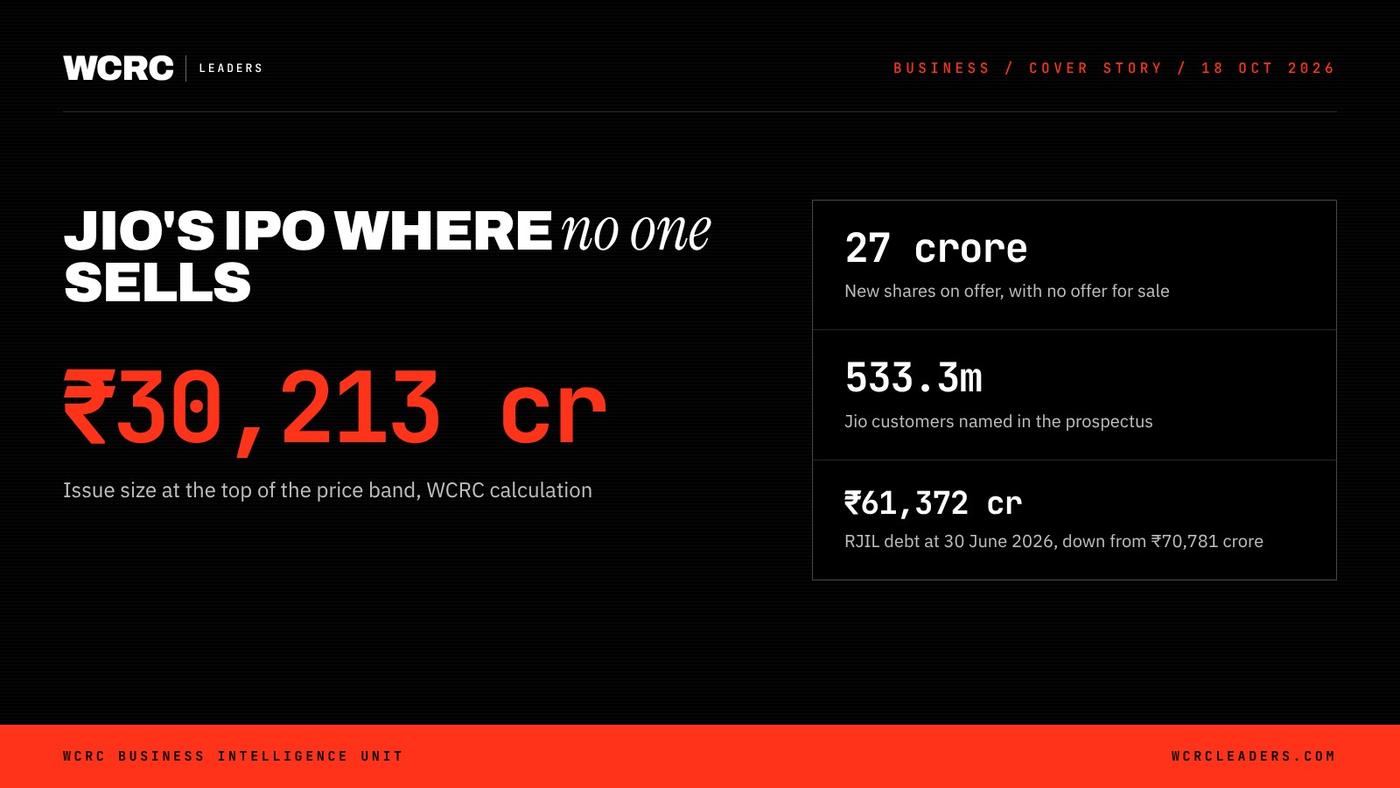
At a glance: WCRC Leaders' assessment: Jio Platforms has written a prospectus that asks the market to fund a stronger balance sheet rather than buy out early investors, and Monday's anchor book will show whether long-term money accepts that bargain. The issue offers up to 27 crore new shares at ₹1,065 to ₹1,119, worth about ₹30,213 crore at the top of the band by WCRC's calculation. Anchors bid on 19 October; the issue is open from 21 to 23 October on BSE and NSE.
What exactly is Jio Platforms selling?
The red herring prospectus (RHP), dated 14 October 2026, describes a fresh issue of up to 270,000,000 equity shares of face value ₹10 each. There is no offer for sale. Every rupee raised goes to the company, not to Reliance Industries (RIL) or to the global investors who bought into Jio in 2020.
That is the headline structural fact, and it sets this issue apart from the deal it overtakes. Hyundai Motor India's ₹27,870 crore listing in October 2024, until now the country's largest, was an offer for sale by its parent. Jio has chosen the opposite route.
RIL told the exchanges on 14 October that Jio's IPO committee had approved a price band of ₹1,065 to ₹1,119 a share. The minimum bid is 12 shares, or ₹13,428 at the cap, and eligible employees bidding in their reserved portion receive a ₹54 discount per share. At the top of the band, 27 crore shares raise about ₹30,213 crore. That figure is WCRC's arithmetic: the company has not filed a rupee issue size.
The issue is made under Regulation 6(1) of SEBI's capital-issue rules, which caps the qualified institutional buyer (QIB) portion at 50% and sets floors of 15% for non-institutional investors and 35% for retail investors. The issue also carries reserved portions for eligible employees and for eligible RIL shareholders, sized at up to ₹500 crore and up to ₹2,500 crore respectively. Nineteen banks are running the book, from Kotak Mahindra Capital and Morgan Stanley to SBI Capital Markets and 360 ONE WAM. NSE is the designated stock exchange.
Where will the money go?
The RHP lists two objects: prepayment, in full or in part, of certain borrowings of Reliance Jio Infocomm Limited (RJIL), the operating telecom subsidiary, and general corporate purposes. The rupee split is left blank until pricing.
The debt is real. Jio Platforms reported total borrowings of ₹61,372 crore at 30 June 2026, down from ₹70,781 crore at 31 March 2026. A full-size issue would equal roughly half of the June figure, by WCRC's calculation, although not all of it will go to repayment.
The business underneath is profitable and growing. Restated figures in the RHP show:
| Period | Revenue from operations | Profit after tax |
|---|---|---|
| FY2024 | ₹1,09,558 crore | ₹21,423 crore |
| FY2025 | ₹1,28,218 crore | ₹26,109 crore |
| FY2026 | ₹1,46,885 crore | ₹30,049 crore |
| Q1 FY2027 (to 30 June) | ₹39,173 crore | ₹7,764 crore |
Revenue rose about 14.6% in FY2026 and profit about 15.1%, with a net margin near 20%. RJIL served 533.3 million customers at 30 June 2026 and contributed 87.74% of consolidated revenue in FY2026. Average revenue per user was ₹215.6 a month in the June quarter, up from ₹214.0 across FY2026.
WCRC analysis: a company earning ₹30,000 crore a year does not need an IPO to survive. It is using one to cut interest costs, widen its shareholder base and give itself a listed currency, while the cash flow of a mature telecom operator carries the story.
What should boards and investors read in the anchor book?
Anchor investors are QIBs who commit a day before the issue opens. Under SEBI rules they can take up to 60% of the QIB portion, one-third of that is held for domestic mutual funds, and half of each anchor's shares are locked in for 30 days and the rest for 90 days. (A separate WCRC explainer today covers the mechanics in full.)
The anchor book closes on Monday 19 October. Indian markets are shut on Tuesday 20 October for Dussehra, under NSE's 2026 holiday list, so the anchor allocation will sit in public view for a full non-trading day before retail bidding starts on Wednesday. Five things are worth reading in it:
- Price. Anchors allotted at the cap signal that institutions see room above ₹1,119. Allotment at the floor would be a warning.
- Mix. The balance between global long-only funds, sovereign wealth funds and Indian mutual funds shows whose conviction is holding the book.
- Concentration. A handful of very large tickets suggests strategic support; a long list of mid-sized ones suggests broad demand.
- Insurers and pension money. Their presence speaks to Jio as a long-duration, dividend-capable asset rather than a listing trade.
- What is left for QIBs. Whatever anchors do not take falls to the main QIB book from 21 October, and the subscription multiple there is the clearest test of price.
Why does a fresh issue matter for Reliance?
RIL held 5,937,841,645 Jio shares, or 66.43% of pre-issue capital, according to the RHP. Meta's affiliate Jaadhu Holdings held 9.98% and Google International 7.73%, with the Public Investment Fund of Saudi Arabia among holders at 2.31%. None of them is selling.
Because the shares are new, RIL is diluted rather than paid. By WCRC's calculation from the RHP's share capital, about 894 crore shares are in issue before the IPO; adding 27 crore new shares would leave RIL at roughly 64.5% if the issue is fully taken up. Control does not move.
WCRC analysis: three things follow for Reliance. First, a listed Jio gets a daily market price, which ends the long debate about what the digital business is worth inside the group. Second, a deleveraged RJIL lowers the group's consolidated interest bill without RIL writing a cheque. Third, the ₹2,500 crore shareholder quota rewards RIL's own retail base, which keeps the parent's investors close to the subsidiary. The trade-off is that RIL gives up the option to monetise part of its stake in this deal; any future sale will have to come later, in the market's view.
What does it mean for India's capital markets?
A ₹30,000 crore primary raise tests the depth of India's domestic institutional money at a delicate moment. WCRC has noted the Reserve Bank's first rate hike since 2023 and wholesale inflation of 11.39% in September. Higher rates make the debt-reduction story more valuable to Jio, but they also raise the bar for equity buyers.
Two other effects matter. A fresh issue of this size adds new paper to the market without taking cash out of it, which differs from the large offer-for-sale exits that have dominated recent years. And the presence of Gulf sovereign money on the register, alongside two American technology groups, makes Jio a reference point for how Asia's largest consumer platforms reach public markets. Jio's challenge on satellite broadband, covered in our analysis of the Starlink contest, and the group's work in consumer finance give investors a longer runway to price than the core mobile business alone.
What should leaders in India, the Gulf and Asia take from it?
For Indian promoters planning listings, Jio sets a template: list the operating platform, raise primary capital, and keep strategic shareholders in place. Boards that had assumed an IPO must double as an exit for early backers now have a large counter-example.
For Gulf sovereign funds and family offices, the issue is a chance to add to or establish an Indian digital-infrastructure position at a disclosed price, and the anchor book is where that intent will appear first.
For Asian telecom and platform boards, the RHP is a benchmark document: 533 million customers, ARPU above ₹215 and a 20% net margin will be quoted in every comparable deal for years.
Parent company Reliance Industries has been selected by the Business Intelligence Unit of WCRC among India's Most Loved 250 Workplaces 2026.
The WCRC View
The WCRC Business Intelligence Unit reads this as a balance-sheet IPO dressed as a landmark. That is a compliment. A fresh issue with no seller tells investors that insiders see more value ahead than today's price captures.
The winners are RJIL's lenders, who will be repaid early, RIL shareholders, who get a reserved route into the subsidiary, and India's market infrastructure, which gains a heavyweight listing without an exit overhang. The losers, if any, are rivals whose cost of capital now sits against a deleveraged Jio.
Boards should not read the price band as the story. The anchor allocation on 19 October is the first independent view of value, and the QIB subscription on 23 October is the second. Companies with their own listings in the pipeline should watch both before fixing their timetables.
The risk is concentration. Prepaid connectivity distributed through Reliance Retail made up 77.08% of consolidated revenue in FY2026, per the RHP. Related-party distribution of that scale is a governance point that independent directors should expect to answer for after listing.
WCRC will watch the anchor list and pricing on Monday, the category-wise subscription by Friday, the final split of proceeds between debt and corporate purposes, and the first post-listing disclosure of borrowings.
Quick answers
Q: How big is the Jio Platforms IPO? A: Up to 27 crore new shares at ₹1,065 to ₹1,119. At the cap that is about ₹30,213 crore, by WCRC's calculation.
Q: Is any shareholder selling in the IPO? A: No. The RHP describes a fresh issue only, with no offer for sale. RIL, Meta's affiliate and Google keep their shares.
Q: What are the key dates? A: Anchor bidding on Monday 19 October, a market holiday on 20 October for Dussehra, and the issue open from 21 to 23 October.
Q: What will the money be used for? A: Prepaying part or all of certain borrowings of Reliance Jio Infocomm, plus general corporate purposes. The rupee split will be set at pricing.
Filed under