WCRC Intelligence
Singapore's core inflation cools to 2.0% as India and Japan heat up
Singapore's core inflation slipped to 2.0% in September even with Brent at $114 a barrel. India's retail inflation jumped to 5.54% and Japan's underlying prices sped up. For companies working across Asia, one regional inflation assumption no longer holds.
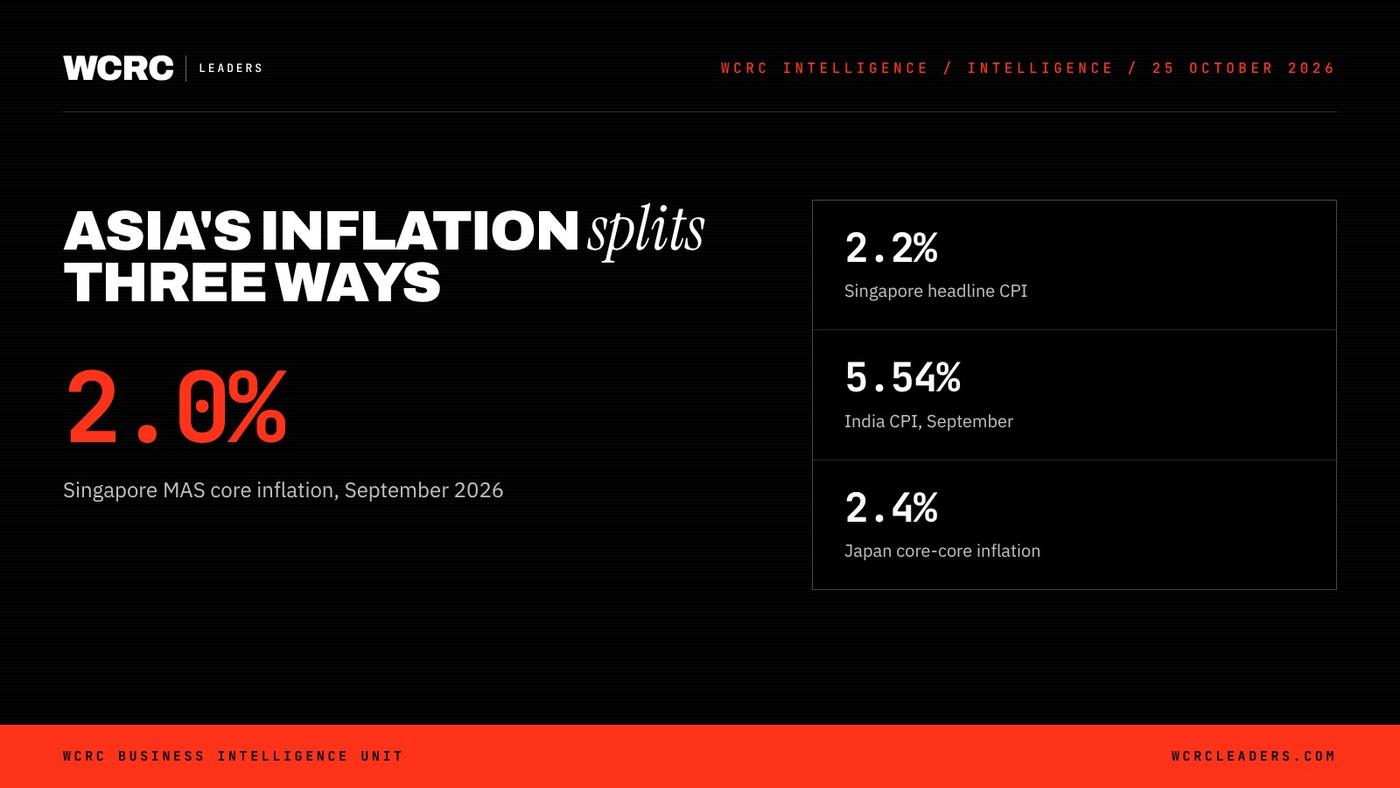
At a glance: WCRC Leaders' assessment: Asia now has three inflation regimes, and CEOs who set prices, pay and funding on one regional average will misprice at least two of them. On 23 October the Monetary Authority of Singapore (MAS) reported that core inflation eased to 2.0% in September, from 2.2% in August. Headline inflation slipped to 2.2%. India's CPI rose to 5.54% and Japan's core-core index reached 2.4%. Brent averaged $114 a barrel in September.
What did Singapore report for September?
MAS and the Ministry of Energy, Trade and Industry said MAS Core Inflation eased to 2.0% year on year in September, from 2.2% in August. CPI-All Items inflation, the headline measure, edged down to 2.2% from 2.3%.
Most of the slowdown came from services and goods. Services inflation fell to 1.7% from 2.0% because point-to-point transport costs rose less and telecommunication prices fell further. Retail and other goods inflation eased to 1.2% from 1.8%, as furniture prices fell and clothing prices rose more slowly. Private transport inflation eased to 7.1% from 7.5% because car prices rose more gradually.
Two components went the other way. Food inflation rose to 2.4% from 2.3% on higher prices for non-cooked food and food services. Accommodation inflation edged up to 0.9% from 0.8% as rents rose faster. Electricity and gas inflation held at 8.7%. The release says the third-quarter rise in the regulated electricity tariff reflects the spike in global energy prices between April and mid-June 2026.
The forecasts did not change. MAS expects core inflation to average 1.5% to 2.0% in 2026 and 1.5% to 2.5% in 2027. It sees headline inflation at around 2.0% in 2026 and 1.5% to 2.5% in 2027. It still warns that "the risks to inflation remain tilted to the upside", with a sharp, sustained rise in global energy or food prices as the main danger.
Why is Singapore cooling during an oil shock?
This year's oil shock is severe. The US Energy Information Administration's October Short-Term Energy Outlook, published on 6 October, said Brent averaged $114 a barrel in September after more attacks on oil infrastructure and tankers around the Middle East. It estimated that Middle East crude production shut-ins averaged 4.8 million barrels a day in September. The EIA expects Brent to average $105 in the fourth quarter and to fall to $84 in 2027.
Singapore feels that shock mainly through its electricity bills. The rest of the shock is being held back by its exchange rate and by subdued domestic costs. MAS steers monetary policy through the Singapore dollar nominal effective exchange rate (S$NEER), not an interest rate. MAS's record of policy decisions shows it raised the slope of the S$NEER band slightly in April 2026 and very slightly in July. That let the currency appreciate faster against Singapore's trading partners, which damps imported inflation. On 14 October MAS left the slope, width and centre of the band unchanged.
The September release says domestic price pressures should stay subdued. Productivity gains should keep unit labour costs in services contained, and government subsidies for healthcare and education will hold down services inflation. MAS still expects imported cost pressures to "remain firm" in the near term. Energy prices have risen again, and food costs face costlier inputs and bad weather.
How do India and Japan compare?
India. Data released on 12 October by the Ministry of Statistics and Programme Implementation (MOSPI), on the new 2024 base, put all-India CPI inflation at 5.54% in September, up from 4.83% in August. Food is the biggest driver: consumer food price inflation jumped to 7.74% from 5.97%, and onion prices more than doubled, up 108.09% on a year earlier. Fuel shows up through transport. Transport services for goods rose 14.73% and the operation of personal transport equipment 7.46%. Electricity, gas and other fuels rose only 3.24%.
Oil cuts deepest further up the supply chain. Wholesale inflation reached 11.39% in September, from 9.92% in August. Mineral oils rose 40.02% and fuel and power 25.85%. The Reserve Bank of India (RBI) raised the repo rate by 25 basis points to 5.50% at its 5 to 7 October meeting and changed its stance to "calibrated tightening". Its minutes, published on 21 October, project CPI inflation of 5.2% for 2026-27, with 6.0% in the October to December quarter. WCRC covered the RBI's first rate hike since 2023 and the bond market response, as India's 10-year yield reached 7.46%.
Japan. The Statistics Bureau reported on 23 October that national CPI rose 2.1% in September, from 1.9% in August. CPI excluding fresh food also rose 2.1%, up from 1.7%. The measure excluding fresh food and energy rose 2.4%, from 1.9%. Japan's consumer energy index actually fell 0.6% from a year earlier. The Bureau estimates that abolishing the provisional gasoline tax and other policy measures took about 0.82 percentage points off headline inflation. Food excluding fresh food rose 2.9%. Japan's oil exposure shows up more in its trade accounts, as WCRC reported when oil nearly doubled Japan's trade deficit.
The pattern is clear. In Singapore, oil reaches consumers mainly through utility tariffs, and policy is absorbing the rest. In India, oil is pushing up wholesale prices and freight while food lifts retail inflation. In Japan, tax measures are keeping energy out of the consumer basket, while underlying inflation rises.
What does this mean for pricing and wages?
Analysis. In India, the gap between 11.39% wholesale inflation and 5.54% retail inflation is a margin problem. Businesses are absorbing fuel and freight costs that they have not yet passed on. The RBI expects retail inflation to peak at 6.0% this quarter, so companies selling to Indian consumers face a choice. They can reprice now, while food inflation already has households expecting higher prices, or wait and absorb another quarter of input costs. Pay settlements for 2027 will be negotiated against retail inflation of 5% to 6%, not the 4% to 5% many budgets assumed.
In Singapore, MAS's forecast of 1.5% to 2.5% core inflation for 2027 points to modest pay rises. Companies with regional headquarters there can hold service prices steady. Pass-through of energy costs should be limited to electricity-heavy operations, where tariffs follow gas prices with a lag of about a quarter.
In Japan, core-core inflation at 2.4% matters more than the headline figure. Underlying prices are rising even with energy held down by policy. If those measures lapse, the energy effect reverses. Employers in Japan should budget for wage demands set by underlying inflation, not by the subdued headline.
What does it mean for funding and the Gulf?
Analysis. Funding costs are moving apart as well. Indian borrowers face a tightening cycle and wider bond yields. Singapore's currency-based policy is on hold after two slope increases. Gulf exporters earn high oil prices but face output shut-ins and pay more for imported food and goods. A Gulf group buying from Singapore pays more for a firmer currency but little extra for inflation. A Gulf group with Indian operations is funding them as rupee yields rise. In Korea, the Bank of Korea held at 3.00% and kept more hikes on the table.
The WCRC View
The WCRC Business Intelligence Unit reads September's data as the end of a single Asian inflation story. Singapore has largely contained the oil shock. India is still absorbing it, and Japan is deferring it through tax policy.
Who gains: Singapore-based treasury and regional service centres, whose costs are now more predictable than their neighbours'.
Who is exposed: Indian consumer, logistics and manufacturing companies that sit between 40% mineral oil inflation and price-sensitive consumers. Japanese companies are also exposed if energy measures end before underlying inflation cools.
What leaders should do now: set India price reviews for this quarter rather than next, and plan wage settlements around 5% to 6% retail inflation. Lock in rupee funding before the RBI's 2 to 4 December meeting. Set Singapore budgets on MAS's 1.5% to 2.5% core range for 2027. In Japan, plan wages around the 2.4% core-core rate.
What WCRC will watch: India's October CPI on 12 November and wholesale prices on 16 November, the RBI decision on 4 December, and the EIA's November outlook for Brent. In Singapore, the next test is October CPI data and whether imported energy costs feed into core inflation.
Quick answers
Q: What was Singapore's core inflation in September 2026? A: MAS Core Inflation was 2.0% year on year, down from 2.2% in August. Headline CPI-All Items inflation was 2.2%, from 2.3%.
Q: What did MAS decide in October 2026? A: On 14 October MAS left the slope, width and centre of the S$NEER policy band unchanged, after raising the slope slightly in April and very slightly in July.
Q: How does India's September inflation compare? A: India's all-India CPI inflation was 5.54% in September, up from 4.83% in August. Food inflation was 7.74%, and wholesale inflation was 11.39%.
Q: What was Japan's September inflation? A: National CPI rose 2.1%, CPI excluding fresh food 2.1%, and CPI excluding fresh food and energy 2.4%. Energy prices fell 0.6% from a year earlier.
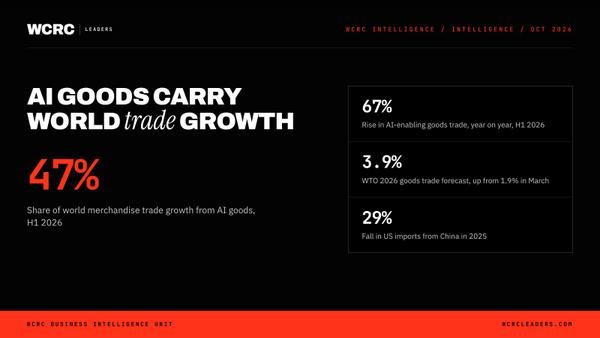
The AI trade economy: chips and servers now carry almost half of world trade growth
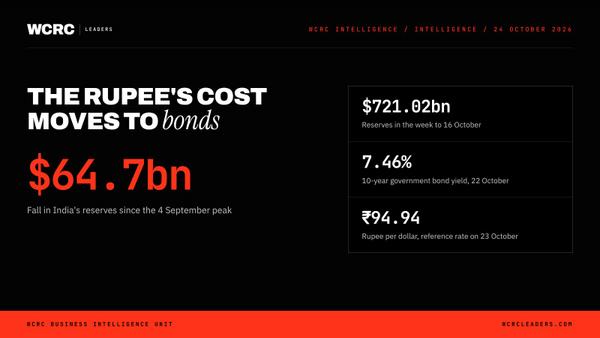
India's 10-year yield hits 7.46% as reserves fall $64.7bn from peak
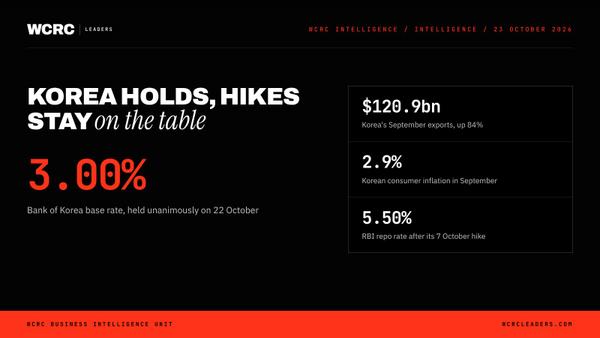
Bank of Korea holds at 3.00% and keeps more hikes on the table

The AI adoption gap: what the World Bank's new numbers say about emerging markets
Jio's IPO, China's GDP: the leaders' week ahead, 19 to 25 October
India's core sector grows 7.9% in September despite the oil shock
Filed under