Business
Hindustan Zinc's $671m quarter: silver, a weak rupee and rare earths
Hindustan Zinc has reported the most profitable quarter in its history in Amarendu Prakash's first full quarter as chief executive. The harder question for the Vedanta subsidiary is what it does with the cash, and whether a new rare earth block in Karnataka can become a second business.
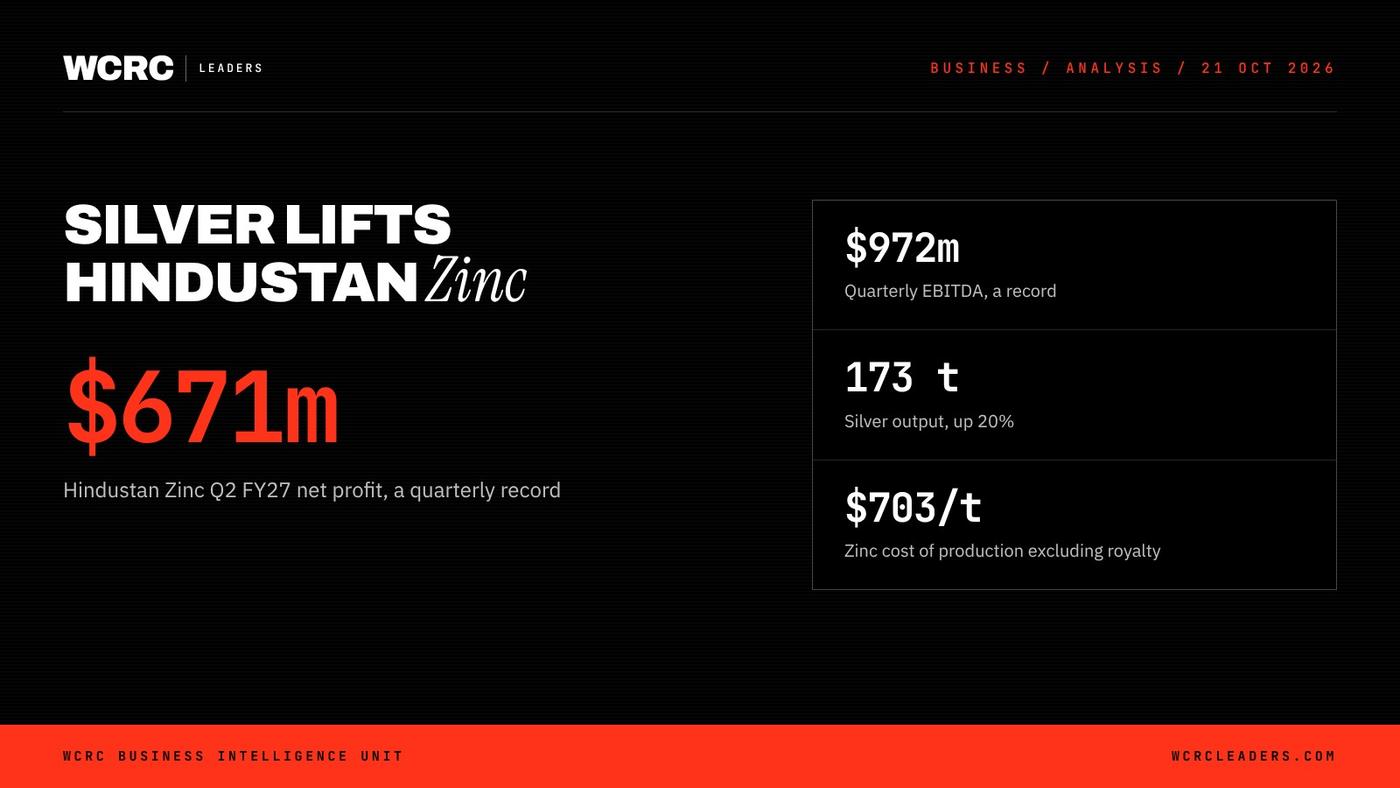
At a glance: WCRC Leaders' assessment: Hindustan Zinc's record quarter owes more to cost, silver and a weaker rupee than to volume, which makes capital allocation, not production, the real test of its new chief executive. On 19 October 2026 the Udaipur-based miner reported Q2 FY27 net profit of $671m, revenue of $1,579m and EBITDA of $972m, all quarterly records. It also confirmed a Letter of Intent for the Gundlupet rare earth and yttrium block, its latest step into critical minerals.
What did Hindustan Zinc actually report?
In the quarter to 30 September 2026, Hindustan Zinc's release puts revenue from operations at $1,579m, up 77% year on year, and EBITDA at $972m, up 108%, the highest it has recorded for any quarter. Net profit was $671m, up 142% and a quarterly record. Free cash flow before growth capital expenditure was $668m, almost exactly matching profit.
Production also set records. Mined metal reached 271,000 tonnes and refined metal 264,000 tonnes, both the best second quarters the company has had. Silver output rose 20% to 173 tonnes. Zinc cost of production, excluding royalty, was $703 a tonne, which the company describes as lower.
For the half year to 30 September, the company reported EBITDA of $1,816m and net profit of $1,243m, both records, with what it calls an "industry-leading EBITDA margin of 60%".
Why is this quarter a windfall rather than a volume story?
Set the records against the base. A year earlier, in Q2 FY26, the company's release reported mined metal of 258,000 tonnes and net profit of $303m. Mined metal is up about 5%. Profit has more than doubled.
WCRC analysis: Three forces did most of the work. The first is cost. A zinc producer whose cost per tonne falls while selling prices hold keeps almost all of the difference as margin. The second is silver. The company's own Q2 FY26 release said silver drove roughly 40% of profitability, and silver output has since grown 20%. It describes itself as among the world's top 10 silver producers.
The third is currency. The headline growth rates match the company's rupee accounts: the board-approved Q2 FY26 results showed net profit of ₹2,649 crore and revenue of ₹8,549 crore. The release converts at ₹95.57 to the dollar this quarter, against ₹87.31 a year ago. On WCRC's calculation from the two releases' dollar figures, net profit rose about 121% in dollar terms, revenue about 61% and EBITDA about 90%. Those are still exceptional numbers. But a share of the reported surge reflects a rupee that has lost roughly 9% against the dollar, which lifts the rupee value of metal priced in dollars.
Who is Amarendu Prakash, and what changed at the top?
Hindustan Zinc's board approved Prakash's appointment as chief executive and whole-time director on 24 July 2026, effective 1 August, subject to shareholder approval, according to its filing to the exchanges. He spent more than three decades in steel and was chairman and managing director of the state-owned Steel Authority of India (SAIL). He joined SAIL in 1991 and earlier ran its Burnpur and Bokaro plants.
His predecessor, Arun Misra, did not leave the group. Vedanta's own filing of 30 July shows Misra's tenure as Hindustan Zinc's chief executive ended on 31 July 2026, and Vedanta's board designated him its chief executive. The same filing shows Prakash joined Hindustan Zinc in June as chief executive designate and named him senior management personnel of Vedanta until 31 July 2029.
In the release, Prakash said the record output figures "demonstrate the strength of our operations, assets and people". He said the company remained focused on "disciplined growth, AI-led innovation and advancing our critical minerals portfolio to support the energy transition, while delivering long-term stakeholder value."
WCRC analysis: The handover is unusual in two ways. A private group has recruited a public-sector steel chief to run its most valuable asset, and the outgoing leader has moved up to the parent rather than out. Vedanta held 60.71% of Hindustan Zinc and the Government of India 27.92% at 31 March 2026, according to Hindustan Zinc's investor presentation. A leader who knows how the state thinks about strategic metals suits a company whose second-largest shareholder is the government.
What is the Gundlupet block, and why does it matter?
The Government of Karnataka issued Hindustan Zinc a Letter of Intent on 3 September 2026 as preferred bidder for the Gundlupet REE and Yttrium Block, under the Mineral Auction Rules 2015, the company's filing shows. The block covers 314.21 hectares at Mallayanapur village in Gundlupet taluka, Chamarajanagar district, and the letter refers to the grant of a mining lease. The Ministry of Mines listed Gundlupet as a mining lease block in Tranche VI of the national critical mineral auctions, in a written answer to Parliament in December 2025.
It is not the company's first such block. Its May 2026 investor presentation lists a tungsten block at Balepalyam in Andhra Pradesh, where exploration began in Q4 FY26, a potash block at Jhandawali-Satipura in Rajasthan and a rare earth block at Nawatola-Laband in Uttar Pradesh. The presentation dates mining at those blocks to 2030.
The policy tailwind is clear. The Union Cabinet approved the National Critical Mineral Mission on 29 January 2025, with government spending of ₹16,300 crore and a further ₹18,000 crore expected from public sector undertakings and others, a total of ₹34,300 crore over seven years. On 26 November 2025, it approved a ₹7,280 crore scheme to build 6,000 tonnes a year of rare earth permanent magnet manufacturing in India.
WCRC analysis: A Letter of Intent is a start, not a mine. Rare earth projects take years to move from lease to concentrate, and value sits mostly in separation and magnet-making, not digging. Gundlupet's significance is strategic: it gives Hindustan Zinc a foothold in a supply chain India wants to build at home.
Where will the cash go?
Hindustan Zinc's May 2026 presentation sets out a "2x Growth" plan toward about 2 million tonnes a year of metal. Its first phase, a board-approved 250,000-tonne integrated expansion, is due by the second quarter of FY29 at a cost of about ₹12,000 crore. Silver refining capacity is planned to rise from 800 to 1,500 tonnes a year. FY27 silver guidance is 680 tonnes, plus or minus 10.
A company generating $668m of pre-growth free cash flow in one quarter can fund that. The tension is between dividends, which flow largely to Vedanta and the government, and long-dated projects like Gundlupet.
What should boards in India, the Gulf and Asia take from this?
Indian boards should note how much of a boom can come from cost and currency rather than volume, and plan for the reverse. Gulf investors building critical mineral strategies face a cash-rich Indian incumbent with state backing in domestic rare earth auctions. Asian magnet and specialty metal buyers should track India's auction pipeline as a future source of supply diversity.
For context on how India's largest companies are handling leadership succession, see WCRC's analysis of HDFC Bank hiring its next chief executive from its biggest rival. On the cost pressures facing Indian industry, see India's 11.39% wholesale inflation and the margin squeeze.
The WCRC View
The call: This is a windfall quarter built on genuine cost discipline. Hindustan Zinc is executing well, but the record should not be read as a new normal. Silver, the rupee and metal prices can turn faster than mines can adjust.
Who gains: Vedanta, whose largest earnings stream has just got larger. The Government of India, as a 27.92% shareholder and as the sponsor of a critical minerals push that now has a well-funded private bidder. Karnataka, if Gundlupet moves to a lease.
What leaders should do now: Boards in commodity businesses should split reported growth into volume, price, cost and currency before setting pay or payout policy. Boards appointing outside chief executives should note the model here: a sector veteran from a state enterprise, with the predecessor kept inside the group.
The test for Prakash: Whether he converts cash into the 250,000-tonne expansion on time, and whether rare earths become a business plan with dates rather than a list of blocks.
What WCRC will watch: the Q3 FY27 results in January 2027; any interim dividend and its size; the formal grant of the Gundlupet mining lease; and progress against the FY29 expansion deadline.
Quick answers
Q: What did Hindustan Zinc earn in Q2 FY27? A: Net profit of $671m, up 142% year on year, on revenue of $1,579m. EBITDA was $972m. All three were quarterly records, per the company's 19 October release.
Q: Who runs Hindustan Zinc now? A: Amarendu Prakash, former chairman and managing director of SAIL, became chief executive and whole-time director on 1 August 2026. His predecessor, Arun Misra, became Vedanta's chief executive.
Q: What is the Gundlupet block? A: A 314.21-hectare rare earth and yttrium block in Chamarajanagar district, Karnataka. The state government issued Hindustan Zinc a Letter of Intent on 3 September 2026 for a mining lease.
Q: How much silver does Hindustan Zinc produce? A: 173 tonnes in Q2 FY27, up 20% year on year. Its FY27 guidance is 680 tonnes, plus or minus 10.
Filed under